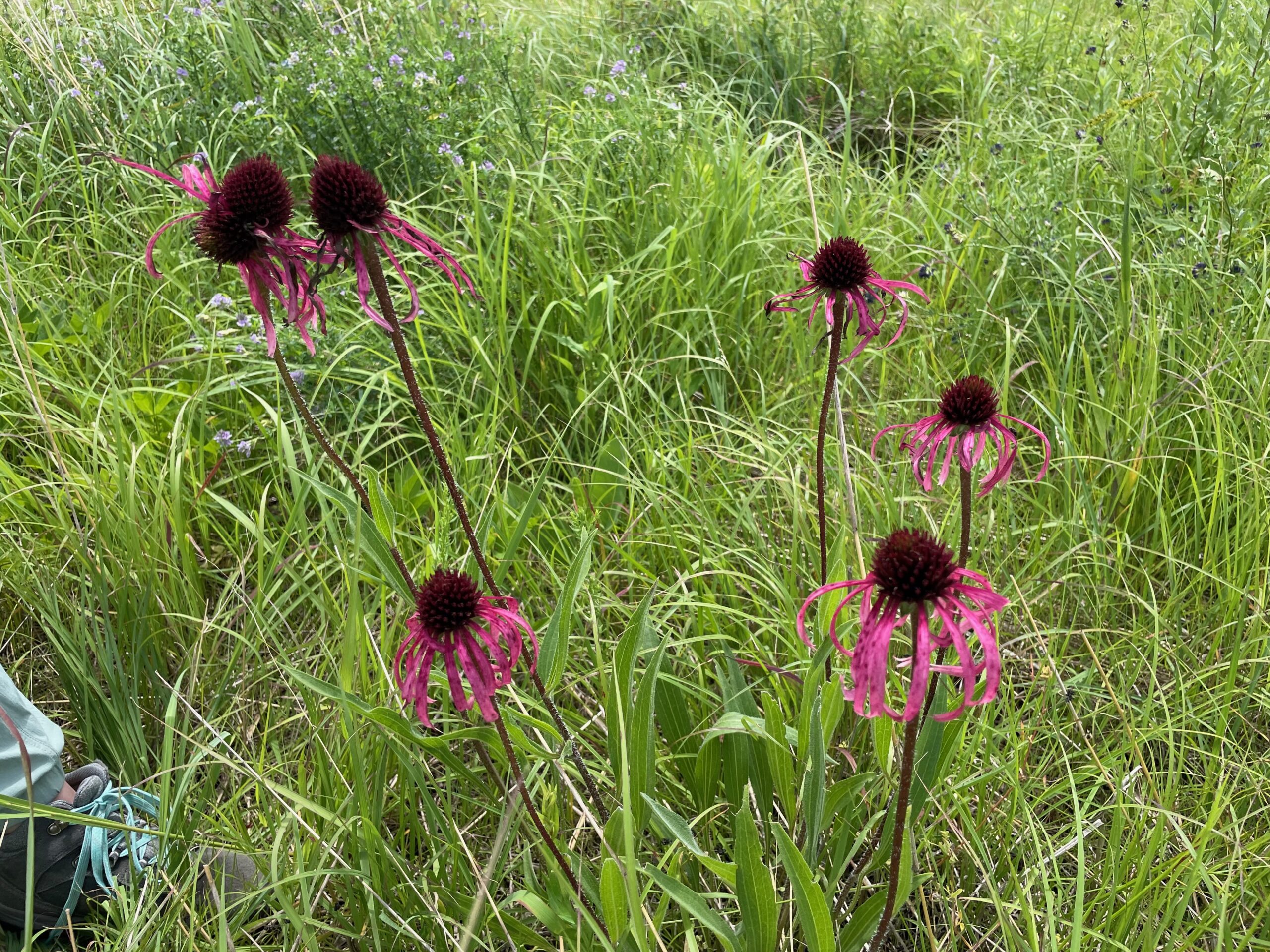
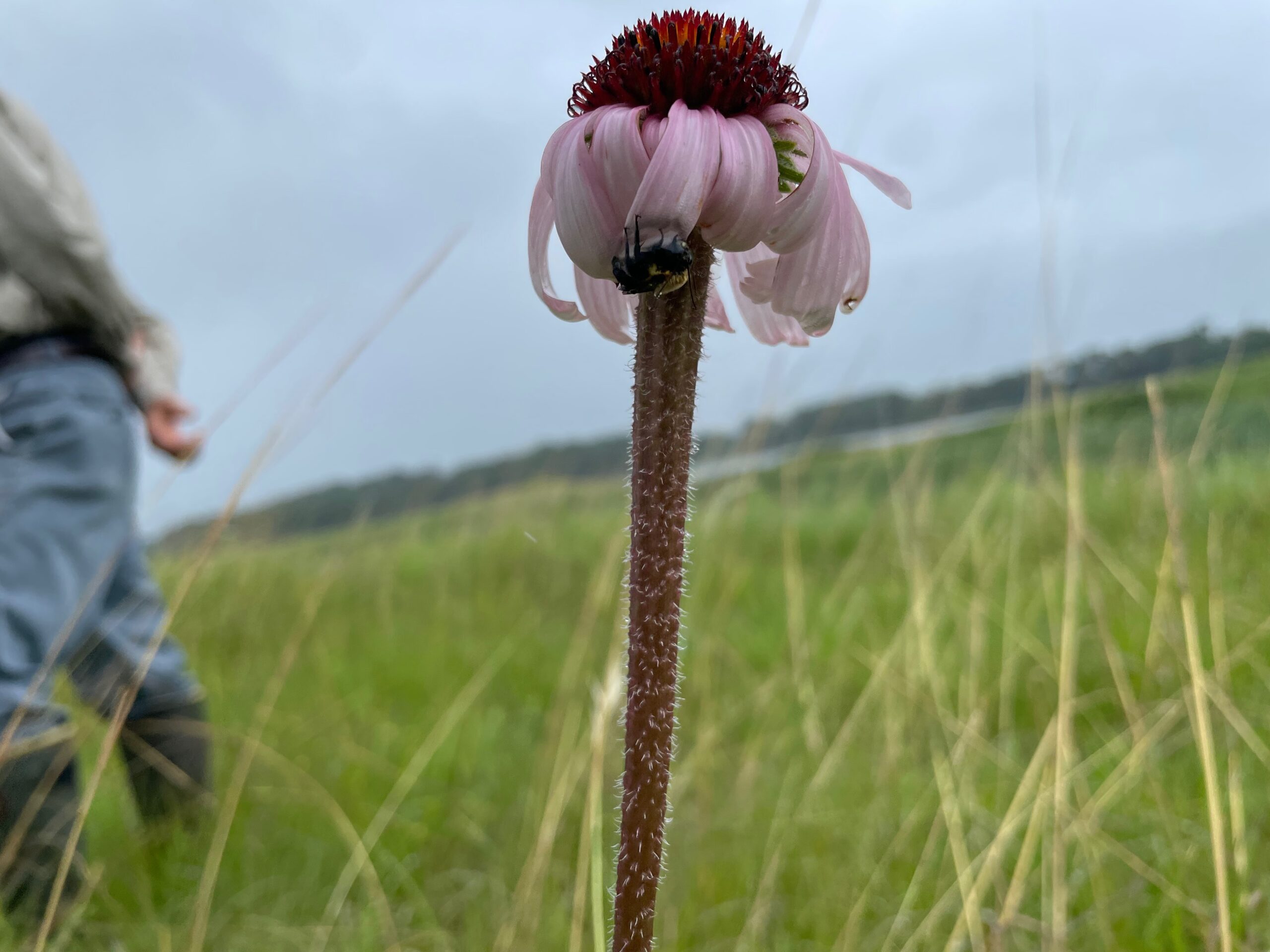
Echinacea pallida, a non-native relative to Echinacea angustifolia, is also a study species of the Echinacea Project. This year, we measured and managed E. pallida and E. pallida x E. angustifolia hybrids in experimental plots 6, 7, and 9. We also collected demographic data on E. pallida planted in the Hegg Lake WMA restoration, before removing all flowering heads.
exPt06
Only one flowering plant, a hybrid, was present in exPt06 this year. We took measurements on this plant and removed the head from the site. The plant had 1 head (83 cm tall), 1 flowering rosette, and 0 basal rosettes. The head had a blue twist tie, and its row/position was not recorded.
Samples collected: One Echinacea head (in an h-bag in Hjelm)
exPt07
Experimental plot 7 contains E. angustifolia x. E. pallida conspecific crosses and reciprocal hybrids. This year, we found a total of 37 flowering plants (29% of searched positions) in exPt07. We measured all plants in this plot and left twist-ties to identify individual heads.
Later, on 13-Jul-2026, we returned to the plot and removed all heads with the potential to produce achenes. The heads were left on the ground near where they were removed. A second look on 20-Aug-2026 revealed that we had missed one head, which was subsequently removed.
Experimental plot 9 contains a mixture of E. angustifolia plants, E. pallida plants, and E. angustifolia x. E. pallida hybrids. This year, we found 106 flowering plants (44% of searched positions) in exPt09. We measured all plants in this plot but did not leave twist-ties.
Later, on 13-Jul-2026, we returned to the plot and removed all heads with the potential to produce achenes. The heads were left on the ground near where they were removed. When we returned to the plot on 20-Aug-2026 we noted, to our surprise, that 4 heads had not been removed. Upon closer inspection, new heads had, in fact, resprouted from the peduncles below the site of decapitation. Needless to say, these heads were also removed.
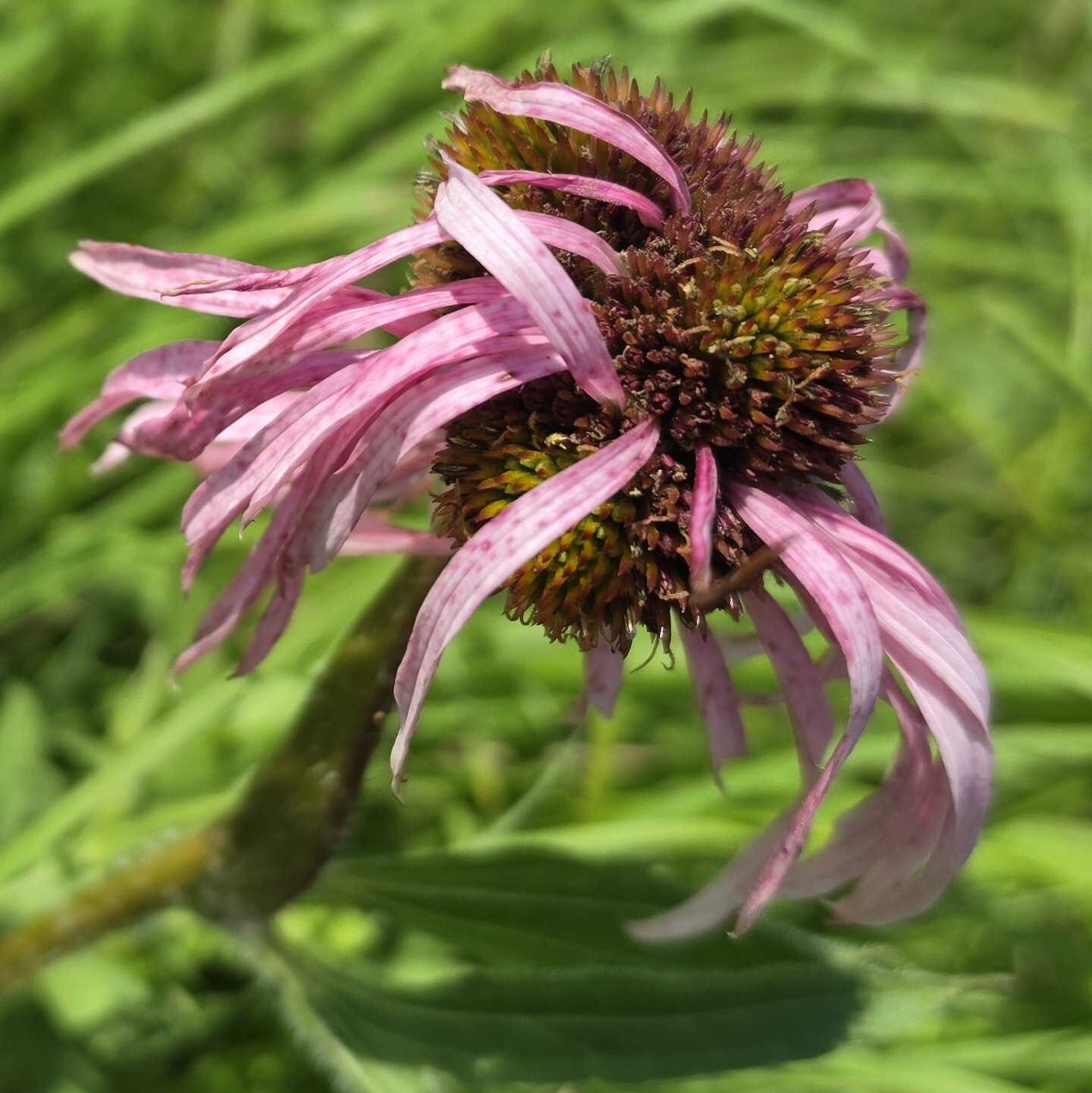
A robust Echinacea pallida at Hegg Lake WMA, blissfully ignorant of its impending decapitation
Pallida Restoration
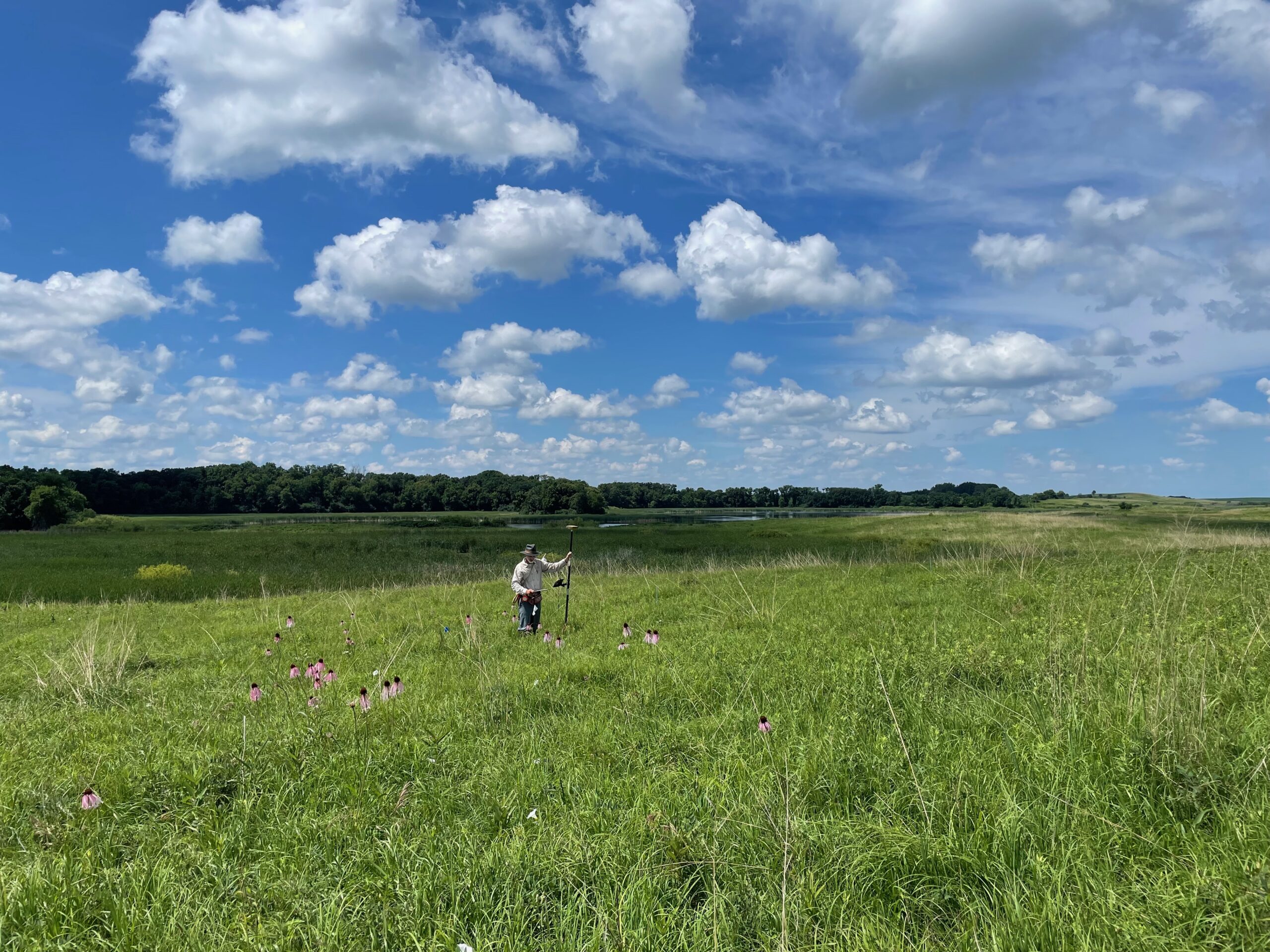
An area of restored prairie at Hegg Lake WMA contains hundreds of mature E. pallida individuals. On 8-Jul-2026, we collected demographic records for all 217 flowering pallida plants in the restoration. We then surveyed the plants and decapitated them, leaving the heads on the ground near where we cut them.
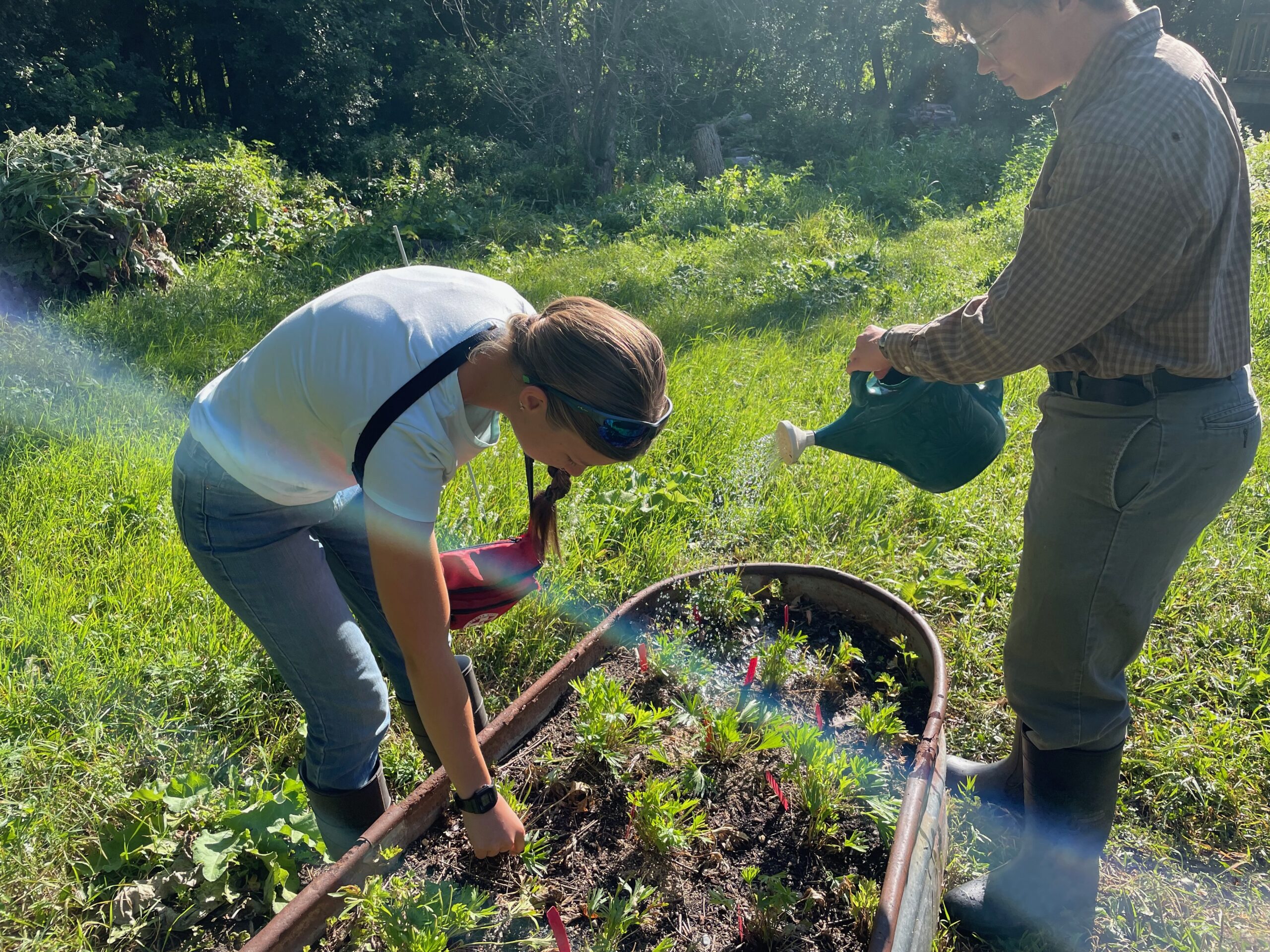
Last year, a number of Comandra umbellata individuals were transplanted into a tub outside the Hjelm house. Comandra umbellata (bastard toadflax) is a semi-parasitic plant found throughout the state of Minnesota. The goal of this experiment is to test different transplantation techniques (with vs. without field host) and, ultimately, to facilitate pollination studies.
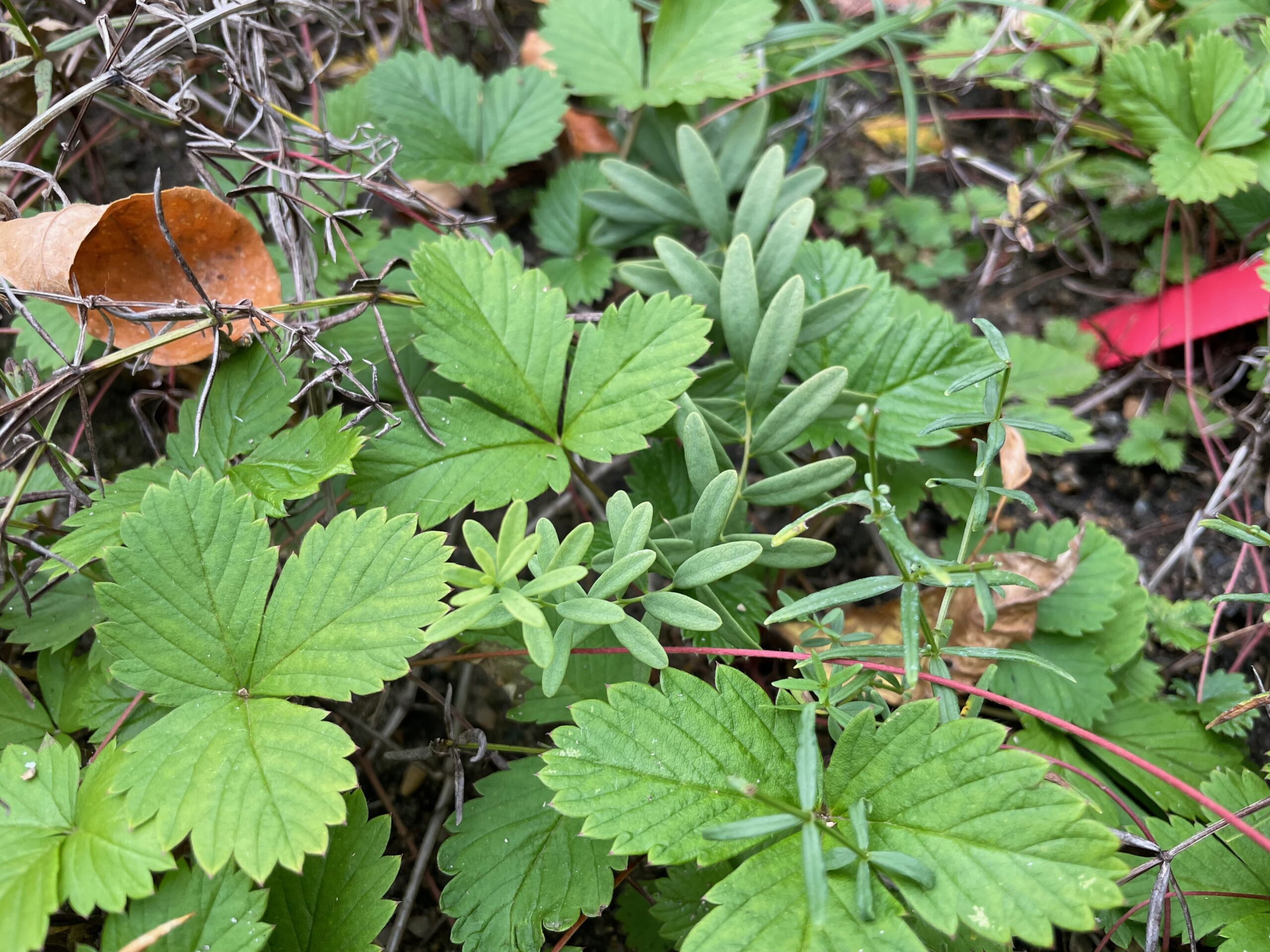
The Comandra tub contains an array of prairie species. C. umbellatais, of course, present, with at least seven surviving individuals as of the last day of the 2026 field season (2-Oct-2026). Galium boreale (northern bedstraw), which was planted as a potential host plant for the Comandra, is widespread in the tub. Fragaria vesca(woodland strawberry) has taken over much of the tub, and a few Viola pedatifida(prairie violet) individuals are also present.
Comandra umbellata (center), accompanied by Fragaria vesca and Galium boreale
Although we did not collect any data on the Comandra this summer, we watered the tub daily. We also collected seed from the Galium growing in the tub, ultimately filling a small envelope.
In addition to collecting data in the experimental plots, we also manage vegetation in order to maintain consistent experimental conditions. This summer, Team Echinacea used the herbicide triclopyr to push back encroaching sumac (Rhus glabra) in experimental plots 1, 2, and 8. We also trimmed Sorghastrum nutans in exPt08 and harvested a lone hybrid head in exPt06, and are planning a controlled burn in exPt08.
Herbicide Treatment
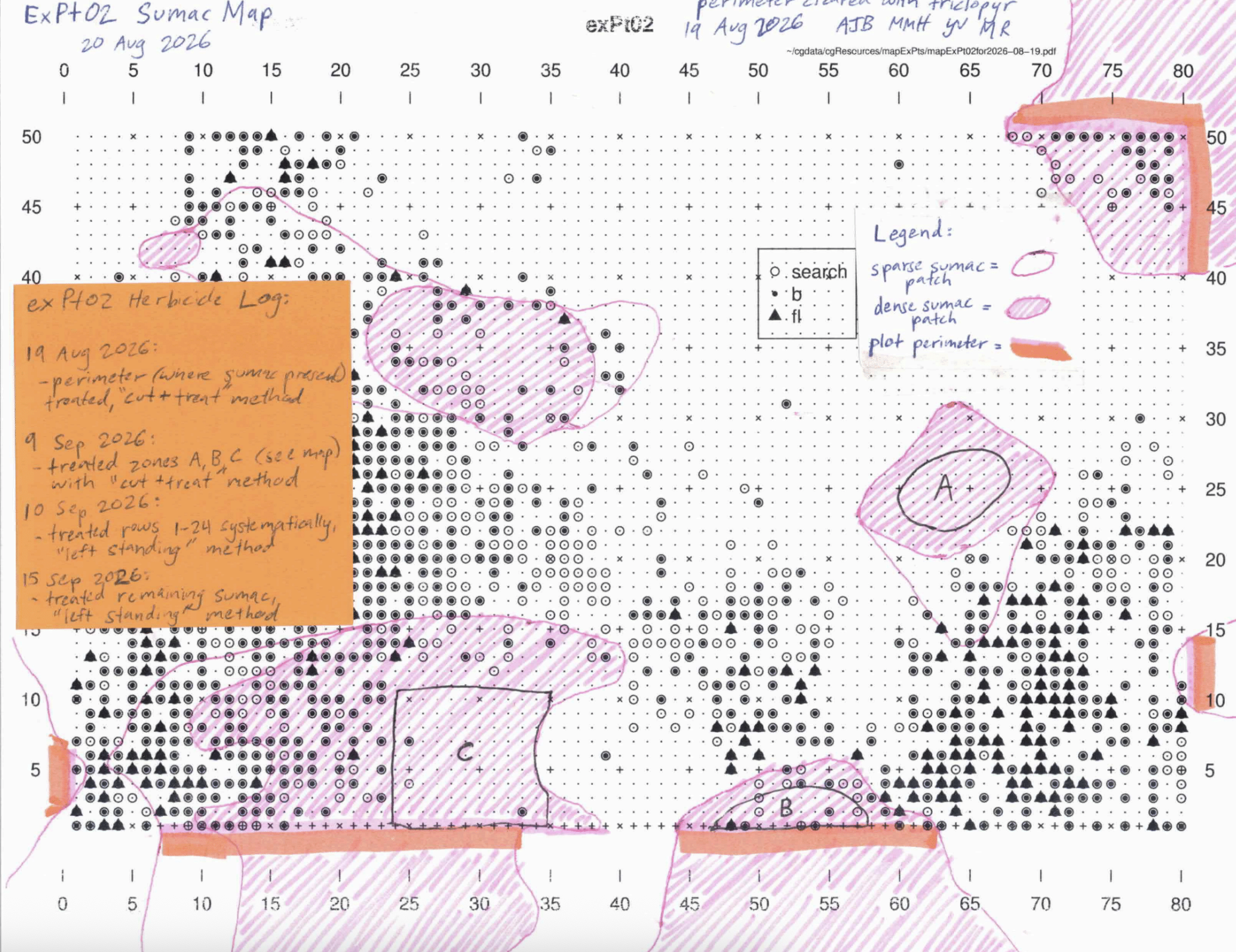
Two different methods of triclopyr application were used. The first, which we call the “cut + treat” method, involves severing the main stem of the sumac plant with loppers and treating the cut surface (and ~10cm of stem below the cut surface) with triclopyr. This method was primarily used for denser patches of sumac. The second method, which we call the “left standing” method, involves treating ~10cm of the still-standing stem of the sumac plant with triclopyr. This method was primarily used for sparser or shorter patches of sumac.
For a glimpse into our herbicide application process, see this flog post.
Our map of sumac extent in exPt02. For more maps, see the Dropbox location below
We used a cotton glove, worn over a protective nitrile glove, to apply the triclopyr. After dipping a few fingers of the absorbent glove in triclopyr, we could easily “paint” the herbicide onto sumac stems. In both treatment methods, triclopyr application typically occurred just below the lowest branches on the main sumac stem. We were careful to limit our herbicide application to the target species, Rhus glabra. If a sumac plant was so close to an Echinacea plant that accidental cross-contamination might occur, we did not treat it.
Details of herbicide application in individual experimental plots can be found below:
exPt01 (excluding 99s)
A dense patch of sumac runs along the entire east side of exPt01, and has been encroaching into the plot for years. This year, we established a perimeter of ~2 m around the entire plot and treated all sumac within the plot. We also treated a patch of sumac on the western edge of the plot, around position 955.
99 south
While the 99s garden itself was relatively free of sumac, it was surrounded by sumac on all sides. Sumac on the south side was especially dense and tall, reaching heights of over 2 m. We chose to treat all sumac within and surrounding the plot, up until the boundary created by a mowed path roughly 2-5 m from the plot’s edge.
While treating sumac on 1-Sep-2026, we found an inhabited bird nest (species unknown) constructed in a sumac plant to the northeast of the plot. We left a 1 m perimeter around the nest and treated this perimeter on 15-Sep-2026, once the nest had been abandoned
exPt02
When we first visited exPt02, dense patches of sumac could be found along the southern border of exPt02, as well as around the northeast corner and within the plot itself. Shorter, sparser sumac was also present throughout the plot, as well as a handful of 2-3 meter tall trees (ash or boxelder). We started by clearing a 2 m perimeter around the plot and removing the trees, then treated the remaining sumac within the plot over the following weeks.
exPt08
Of the four experimental plots where we conducted herbicide treatment, exPt08 had the least amount of sumac, with only a couple of sparse patches along the plot perimeter. However, small trees (primarily ash) are scattered throughout the northern part of the plot. These trees will probably require more extensive management in the coming years.
Sorghastrum nutans Management
While we appreciate the presence of native prairie grasses in the experimental plots, they can form a dense leaf litter which makes it more difficult to locate Echinacea plants. Sorghastrum nutans, a native warm-season grass, is already omnipresent in exPt01, but it has not yet taken over exPt08. In order to slow its spread in the plot, we used pruners and hedge-trimmers to remove the every S. nutans inflorescence before (we hope) the grass was able to set seed.
In 2011, 66 hybrid Echinacea seedlings were planted in exPt06, a small plot west of exPt08. We are no longer measuring in exPt06, but we did notice that one of the hybrid plants was flowering. In order to prevent propagation of hybrid achenes, we harvested this head (though not before pollination occurred). We also took some measurements: the plant had 1 head (83 cm tall), 1 flowering rosette, and 0 basal rosettes. The head had a blue twist tie, and its row/position was not recorded.
Another regular method of experimental plot management is prescribed burning, which naturally favors native prairie species over woody invaders. None of the experimental plots were burned prior to the 2026 field season. We are planning to conduct a prescribed burn in exPt08 (and maybe exPt01/99s) during fall 2026 or spring 2027. Before a burn in exPt08, all flags placed south of the plot (between exPt08 and Highway 27) should be removed. There is also the question of the viola experiment, which may be affected by a prescribed burn.
Location: exPt08 (Wagenius property)
Treatment date: Fall 2026 or Spring 2027 (depending on conditions)
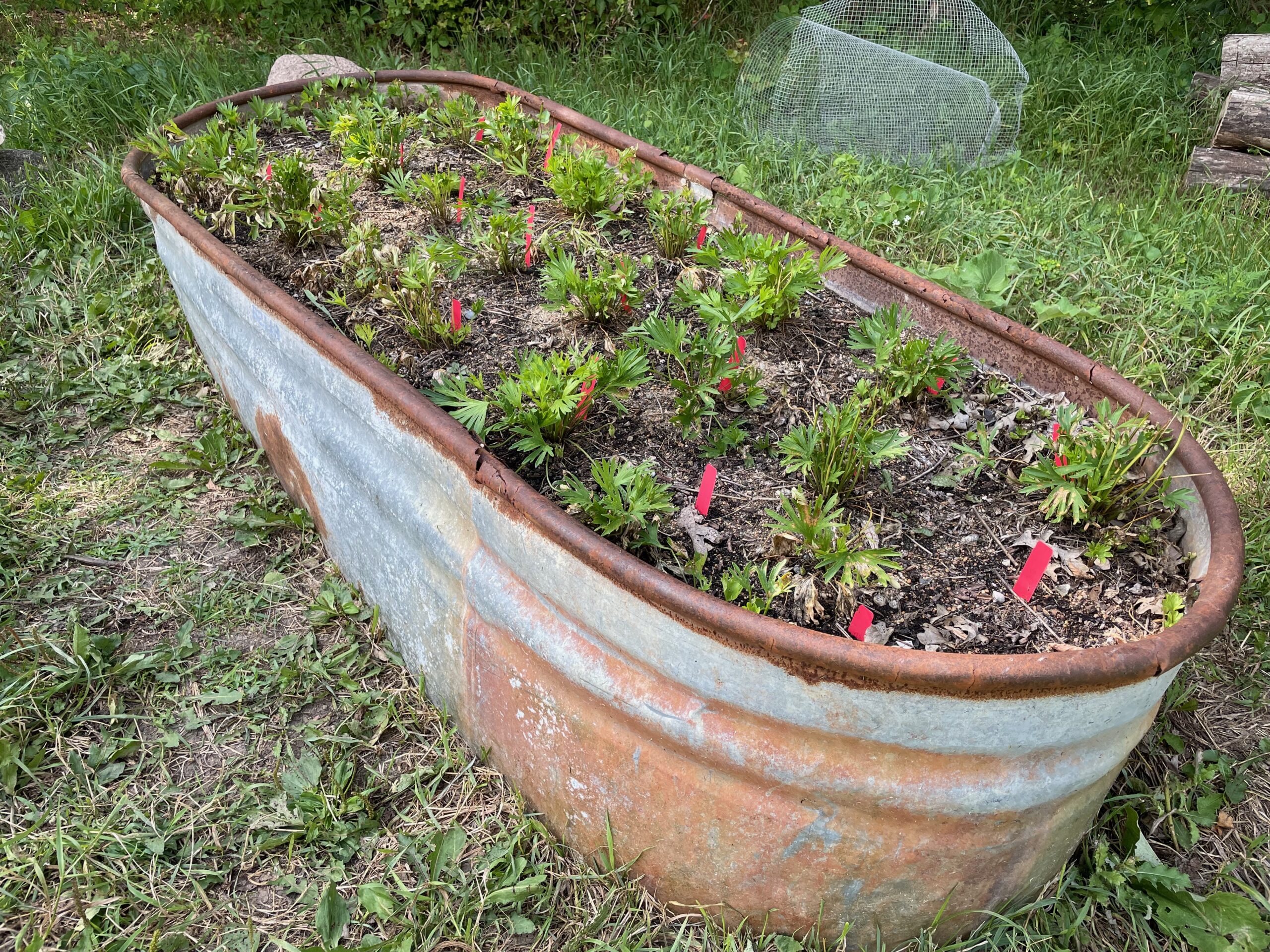
This year, Team Echinacea designed a new experiment to look at Viola pedatifida seedling establishment. V. pedatifida (prairie violet) is a species native to our study area which is a desirable addition to prairie restoration projects. In 2024, Team Echinacea installed a Viola propagation tub at the Hjelm house to produce seed for future restoration and research projects. Two years later, our Viola tub is producing enough seed for us to conduct our first experiment.
Our Viola tub, photographed on 4-Aug-2026
The goal of this experiment is to test the effects of seed age and planting date on V. pedatifida seedling establishment. Between August 3rd and September 22nd, we planted roughly 15,000 Viola seeds in exPt08, spread out across 76 two-meter segments. Each segment is marked by one or more neon flags. The planted seeds range in age (time since harvest) from 1 to 10 weeks. We will revisit these segments in the spring of 2027 to measure seedling establishment.
For more information about the design of this experiment, see this flog post.
None yet. But stay tuned for more Viola excitement!
As I write this on the final day of the field season (2-Oct-2026), the Viola tub is still producing seeds! In fact, the rate of Viola pod production has remained relatively constant since the start of August. The final Viola harvest will be this afternoon.
We have not observed any seedlings in the Viola tub, despite the many seeds which have surely dispersed there, which leads us to believe that germination will occur in the spring. There are plans in the works to conduct a controlled burn of exPt08 at some point this fall or in the coming spring. Whether this will affect Viola pedatifida seedling emergence is yet to be determined.
Team Echinacea is excited to report on this new experiment! We hope to have some results to analyze in spring of 2027.
It’s raining today. All day. After a long, dry summer, autumn has finally arrived, and it has brought with it some much-needed precipitation. I love the rain, but it does make it somewhat difficult (and very muddy) to conduct fieldwork. Instead of braving the elements, we have been using rainy days to work on our “inside activities.” For me, this mostly means cleaning achenes.
When I say cleaning, I don’t mean that the achenes themselves are dirty. Rather, they are mixed in with chaff left over from the head cleaning process. When we clean achenes, we are simply removing this chaff, which includes receptacular bracts, involucral bracts, corolla tubes, and ray florets. Once we have isolated the achenes, they are ready to be scanned and counted.
Cleaning achenes is a simple, almost meditative process. It requires only a glass tray and a good pair of tweezers. To do it, pour a mix of achenes and chaff from a coin envelope onto the tray. Use the tweezers to carefully extract each achene from the pile of chaff (be careful not to overlook small or misshapen achenes). Scoop the achenes into a labeled envelope and the chaff into another. Repeat. Another achene cleaner will inspect the chaff to confirm that no achenes were missed.
There’s still a lot to be done before the field season is over. We need to finish harvest, revisit “can’t finds” and some total demo records, and finish “DeMopUp.” The next two weeks will probably be a scramble to complete all these tasks and tie up any loose ends we discover along the way. But for now, it’s just me, the achenes, some good music (played just loudly enough to be audible but not distracting) and the occasional snap of a popping viola pod. I’m happy!
From our experimental plots, we get information about Echinacea survival and reproductive fitness. Survival/health info comes from measurements of living plants, as does some information about reproductive success (# of flowering rosettes and # of heads). But achene (fruit) count, one of the most powerful measures of Echinacea reproductive success, requires the collection of heads. This is why, for the past few weeks, we have been harvesting flowering heads in experimental plots 1, 2, and 8.
Harvest requires careful timing. Harvest a head too early, and the achenes may not be fully developed. Harvest too late, and the head may have begun to lose achenes, throwing off our counts. To give ourselves the best chance of harvesting heads at the perfect moment, we check each head in our experimental plots every 6 days.
This is, as you might imagine, a complex operation. Even though there are few flowering plants in the experimental plots this year, relative to previous years, we still have 200+ heads to monitor and harvest across three experimental plots. Fortunately, there is a system in place. For a detailed description of this system, continue to the next paragraph. For a brief summary, feel free to skip to the final paragraph.
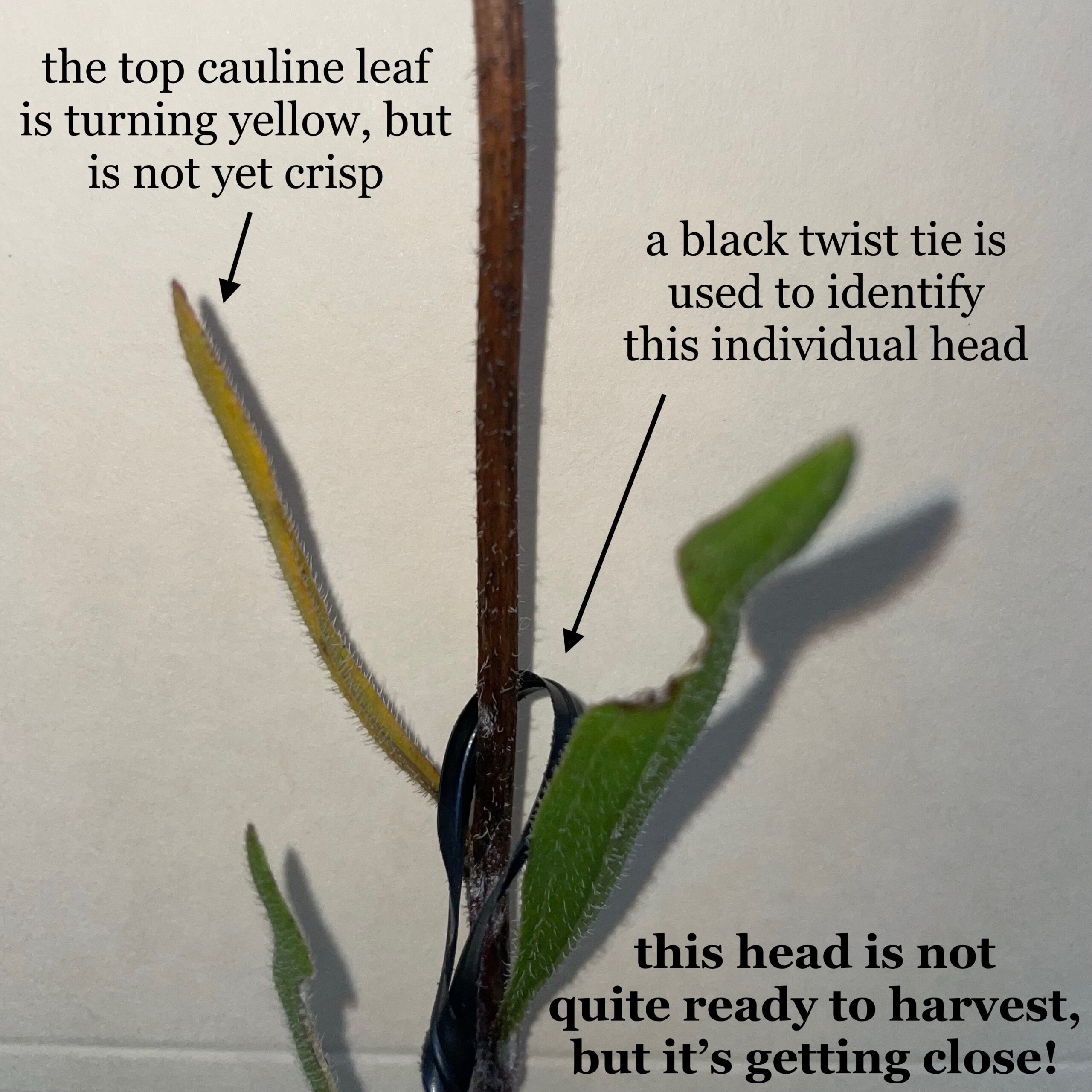
DETAILED DESCRIPTION: First, we create a list of all harvestable heads from our measure data. These are heads which were developing normally when measured, and might reasonably be expected to produce achenes this season. Heads in ExPt02 are identified by individual plant row and position, while heads in ExPt01 and ExPt08 are identified by both individual plant location and twist tie color (we added unique twist ties to each head while measuring).
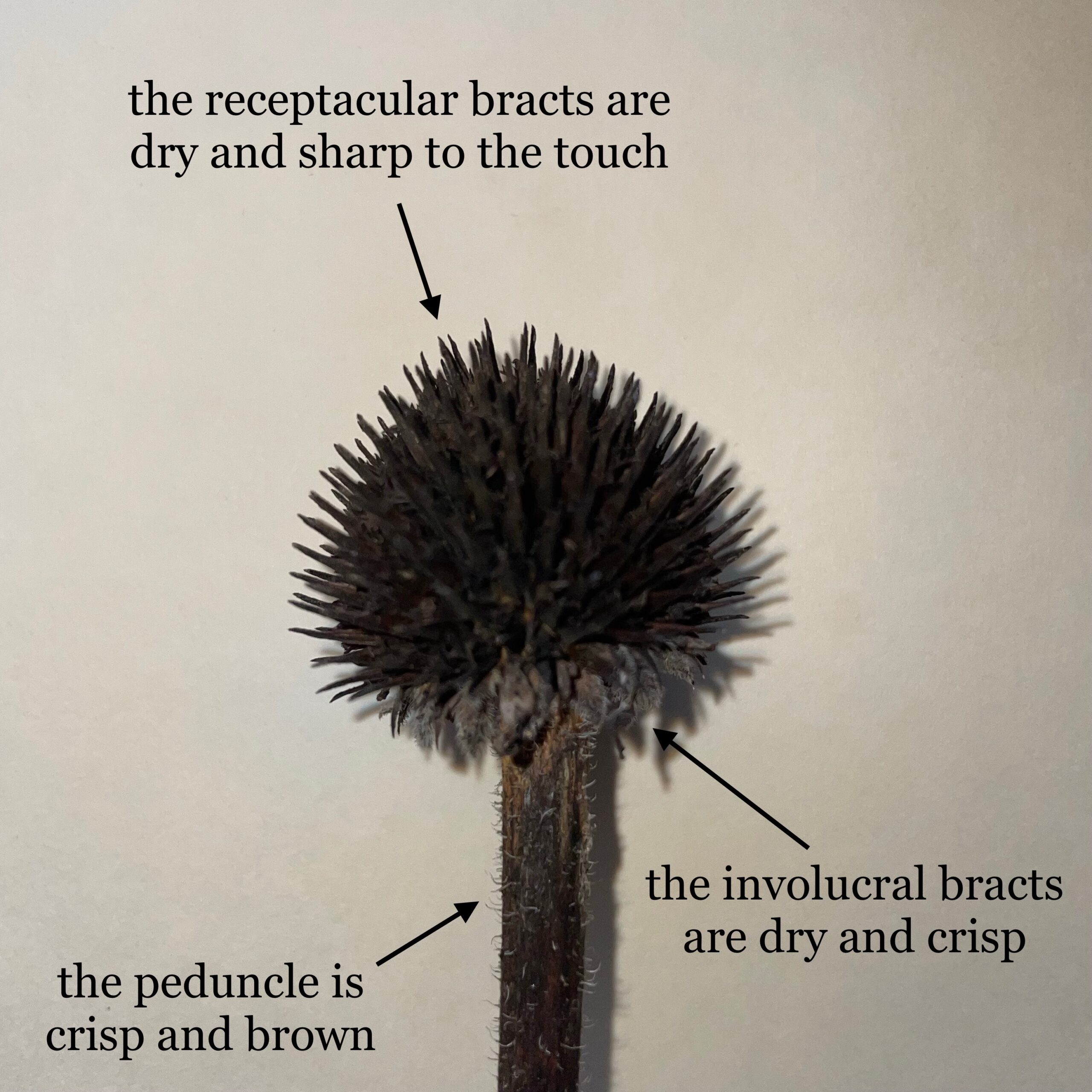
On harvest days, we visit every head that has not yet been harvested. Working in pairs, we independently assess whether each head is ready for harvest, then compare our assessments and discuss. For an Echinacea head to be ready for harvest, it must have 1) dry/sharp receptacular bracts, 2) crisp involucral bracts, 3) a dry/brown peduncle, and 4) a crisp top cauline leaf. If any achenes are missing or appear loose, the head is harvested no matter what, to minimize the loss of achenes.
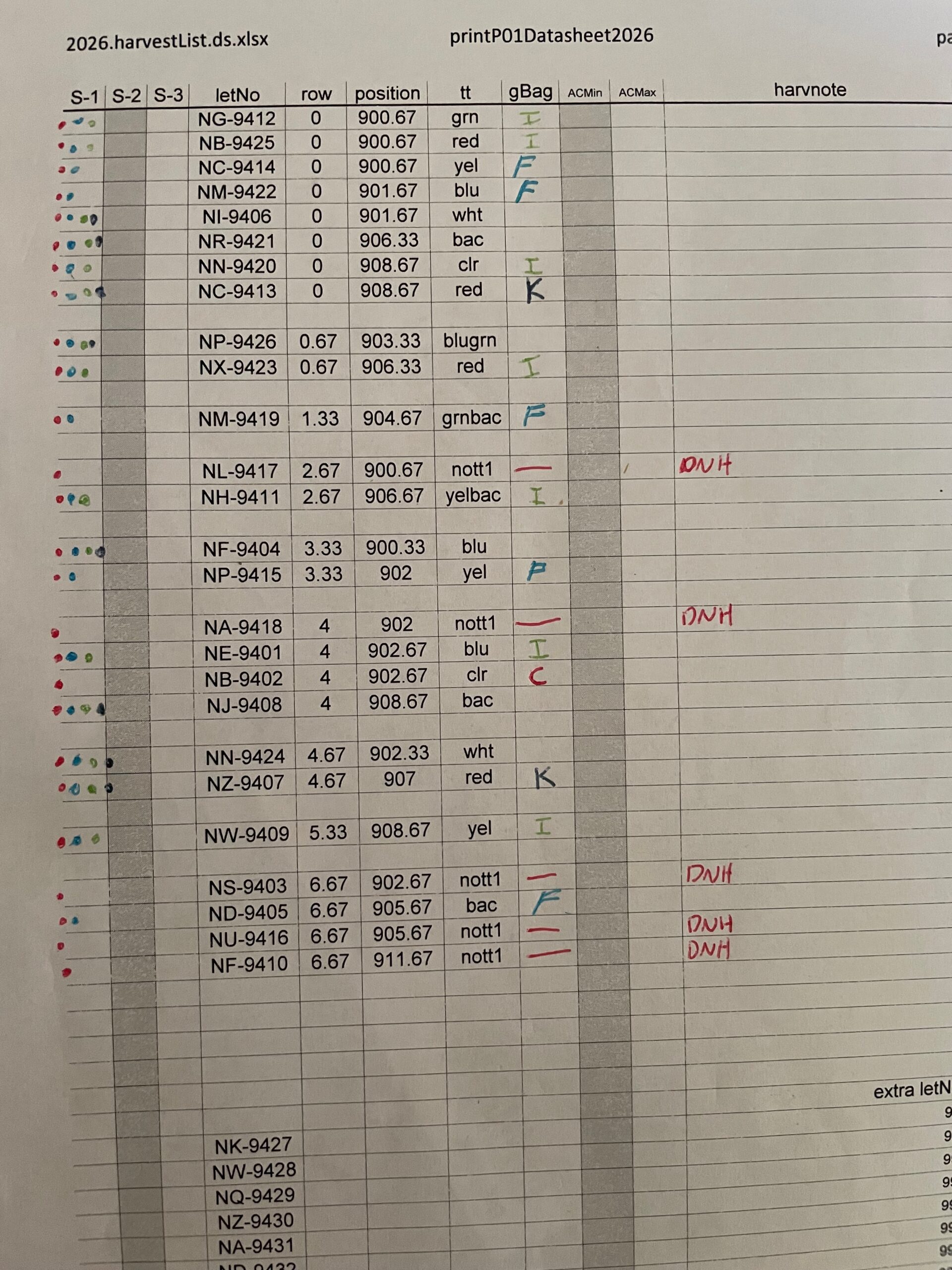
We use our harvest datasheets to keep track of this process. Each time we visit a head, we make a mark in a new color of pen to record our visit. If we deem the head ready to harvest, we carefully remove it with a hand pruner and place it in an “h-bag” (head bag). We label the h-bag with the LetNo (a unique 6-character identifier) assigned on the harvest datasheet. If harvesting all heads on one plant together (as is protocol in ExPt02), we may choose to use more than one h-bag, or an “l-bag” (lunch bag). The labeled bag(s) are then placed into a “g-bag” (grocery bag), which is given an identifying letter unique to that harvest session. The identity of the g-bag is also marked on the harvest datasheet. As you can see, a wide assortment of bags is crucial to a successful head harvesting operation.
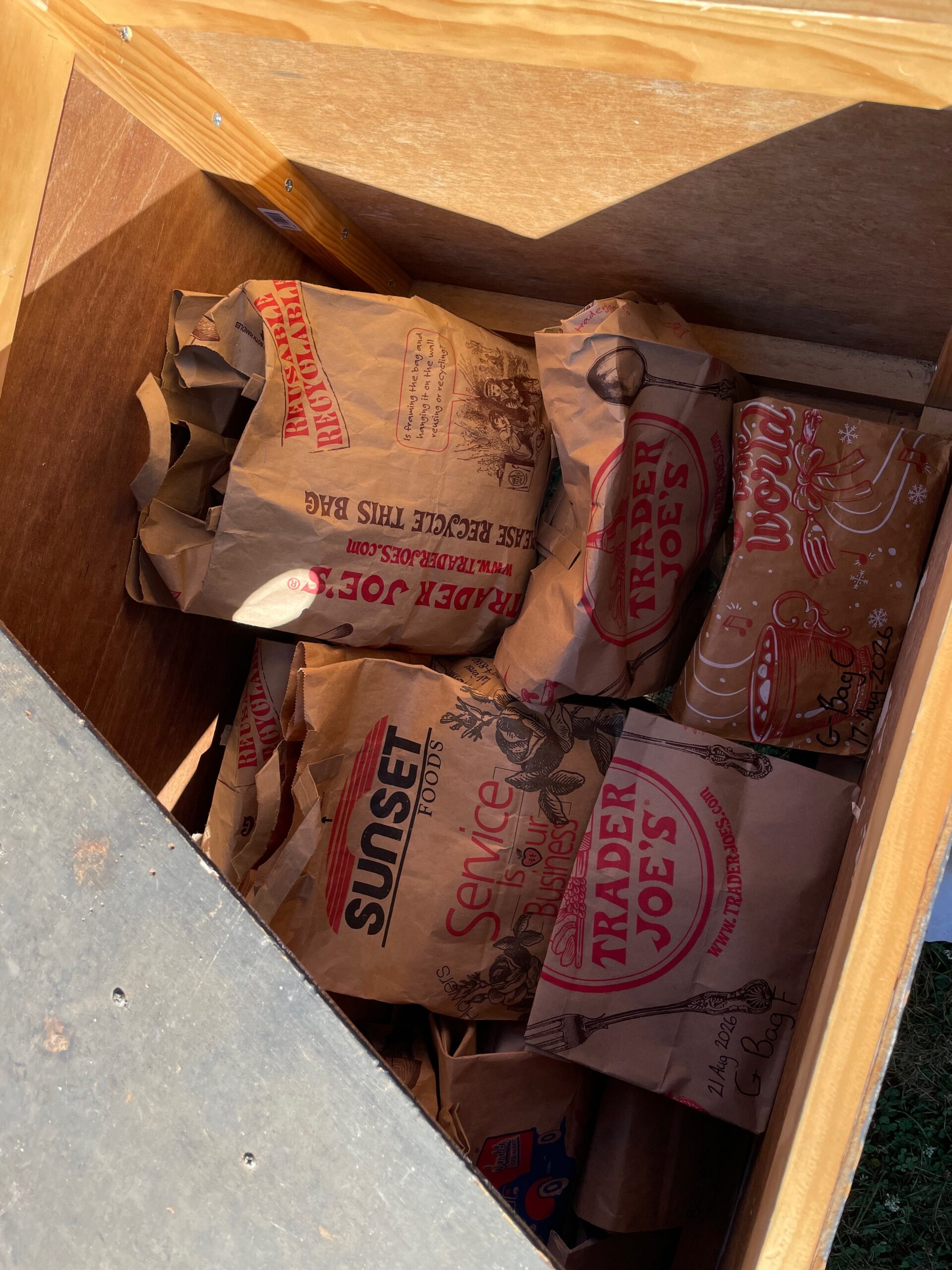
A harvest datasheet for ExPt01Assorted g-bags in the head dryer
When we are finished with a harvest session, we close up our g-bag and add it to the seed dryer (a wooden box painted black which uses the power of the sun to dry Echinacea heads and other seeds). This way, when it’s time to process these heads and count achenes, they will be well-labeled and completely dry. As we continue to harvest this year’s crop of heads, we have also been working to process the heads and achenes harvested last year. Stay tuned for a flog post on head cleaning and scanning!
Our harvest is progressing well! Harvest at ExPt02 and ExPt08 is complete, and fewer than 10 heads remain to be harvested in ExPt01. Other than an unfortunate incident of seed predation in ExPt02, where 49 heads were eaten by some sort of monstrous creature or creatures (deer? ground squirrels? bears?), we have managed to harvest almost every head without losing achenes. If all goes well, next year’s team will have no problem sorting through and collecting data on the heads that we have harvested.
Many of the variables that affect harvest are out of our hands. We can’t control how quickly Echinacea heads mature, nor can we prevent animals from eating or achenes from loosening. This harvest system, developed by Team Echinacea over the years, allows us to obtain high-quality data from a highly unpredictable system. In the end, the natural unpredictability of our study system is what makes this research so exciting!
QUICK SUMMARY: A wide assortment of bags is crucial to a successful head harvesting operation.
One of my favorite daily rituals has been the cultivation of the viola tub. Every morning since the beginning of Week 2 of our field season (6-Jul-2026), we have watered a tub of Viola pedatifida (prairie violet) outside the Hjelm house. Before we water, we also collect all ripe viola pods. Viola pods, as we call them, are the fruit of the prairie violet, and turn from pale green to white when ready to harvest. Interestingly, all the fruit we collect come from cleistogamous flowers, meaning that the flowers self-pollinated without ever opening. Prairie violet also produces chasmogamous (more traditionally pollinated, petaled) flowers, but our violets had stopped producing these flowers by the time we arrived in late June.
Yavonne and Aaron tending to the violetsCan you spot the viola pod?
I think that I enjoy the collection of viola pods because it satisfies my innate human urge to gather fruit. However, like everything else that we do here on Team Echinacea, it also has a greater purpose: the Advancement of Science! Last Monday, we designed an experiment to quantify the effect of seed freshness on V. pedatifida seedling establishment. This was our first time designing an experiment as a group, and it took us all afternoon, but it was a fun exercise in planning and group decision-making. Our experimental design is as follows:
Each morning, we collect all ripe viola pods in envelopes, where they explosively release their seeds. At the start of each week, we compile all Viola seeds collected in the previous week and weigh them out into 0.26 gram envelopes (roughly 200 seeds). Half of these will be planted later that day, while the other half are set aside for future planting. An additional five envelopes of “old” seeds, collected in the month before we designed the experiment, are planted at the same time.
We plant the Viola seeds in experimental plot 08, which is located just south of the Hjelm house. This plot is the site of an ongoing experiment (see Aaron’s recent post for details), and contains many Echinacea plants, as well as a variety of other prairie forbs and grasses, making it a good analog for a natural prairie habitat. Each envelope is planted in a unique, randomly determined 2-meter line segment within the plot, and given a single watering can’s worth of water. And then we wait!
What, you may be be asking, are we hoping to discover with this experiment? Our primary goal is to determine whether the age of Viola seeds (measured from the date of pod collection to the date of planting) affects seedling establishment. By planting “fresh” seeds (collected in the previous week) and “old” seeds (collected 2+ weeks ago) at the same time, we can directly compare their success. Previous research suggests that fresher seeds fare better, but whether this holds true in a natural setting has yet to be determined. Since our planting period spans from early August into September, we will also be testing whether time of year affects germination success. And lastly, since this is our first time conducting this sort of experiment, we will see whether our planting method yields results at all. At the very least, we should learn something about how to conduct future Viola experiments.
So there you have it! In September, myself and maybe Wyatt will return to exPt08 to count new V. pedatifida seedlings. I’m excited to see what we find out! I’m less excited to look for thousands of tiny seedlings in a sea of knee-high grass… but I’m sure I’ll enjoy it nonetheless. Stay tuned for updates!
Echinacea angustifolia, the titular study species of the Echinacea Project, is the only species of purple coneflower native to Minnesota. But these days, it’s not alone. Multiple other species of Echinacea, including Echinacea pallida, have been introduced to Minnesota, whether as ornamental plants in horticultural settings or as E. angustifolia substitutes in prairie restorations (pallida seed is significantly cheaper than angustifolia seed). One such restoration is located within Hegg Lake Wildlife Management Area, a key study site for the Echinacea Project.
These two species of Echinacea are visibly different, with E. pallida typically having taller flowering heads and longer, skinnier rays than E. angustifolia. E. pallida also has white pollen, while E. angustifolia has yellow pollen. E. angustifolia is found throughout the western half of Minnesota, while E. pallida is native to Iowa, Illinois, and other more southern states. But why does this matter? Non-native plants like E. pallida can be aesthetically pleasing, and may even provide some of the same ecological benefits as their native counterparts. However, non-native plants can also outcompete native plants, and if hybridization occurs, may dilute locally adapted native gene pools. Experimental plots 7 and 9 (ExPt07 and ExPt09) were designed to determine if E. pallida can produce viable hybrid offspring with E. angustifolia, and to monitor the fitness of these hybrids.
One of our jobs this year was to measure all of the surviving plants in ExPt07 and ExPt09. We used different protocols for the two plots, but both went by mostly without a hitch. Compared to ExPt01, these plots had far more flowering plants: 37 flowering individuals were found in ExPt07 (29% of searched positions) and 106 were found in ExPt09 (44% of searched positions). The plants that were flowering also seemed to have, on average, more flowering heads (one plant had 18!). E. pallida generally produces more flowering heads, so seeing this pattern in its hybrid offspring made sense.
The legendary “tri-butt”Stuart, marking the boundaries of ExPt07
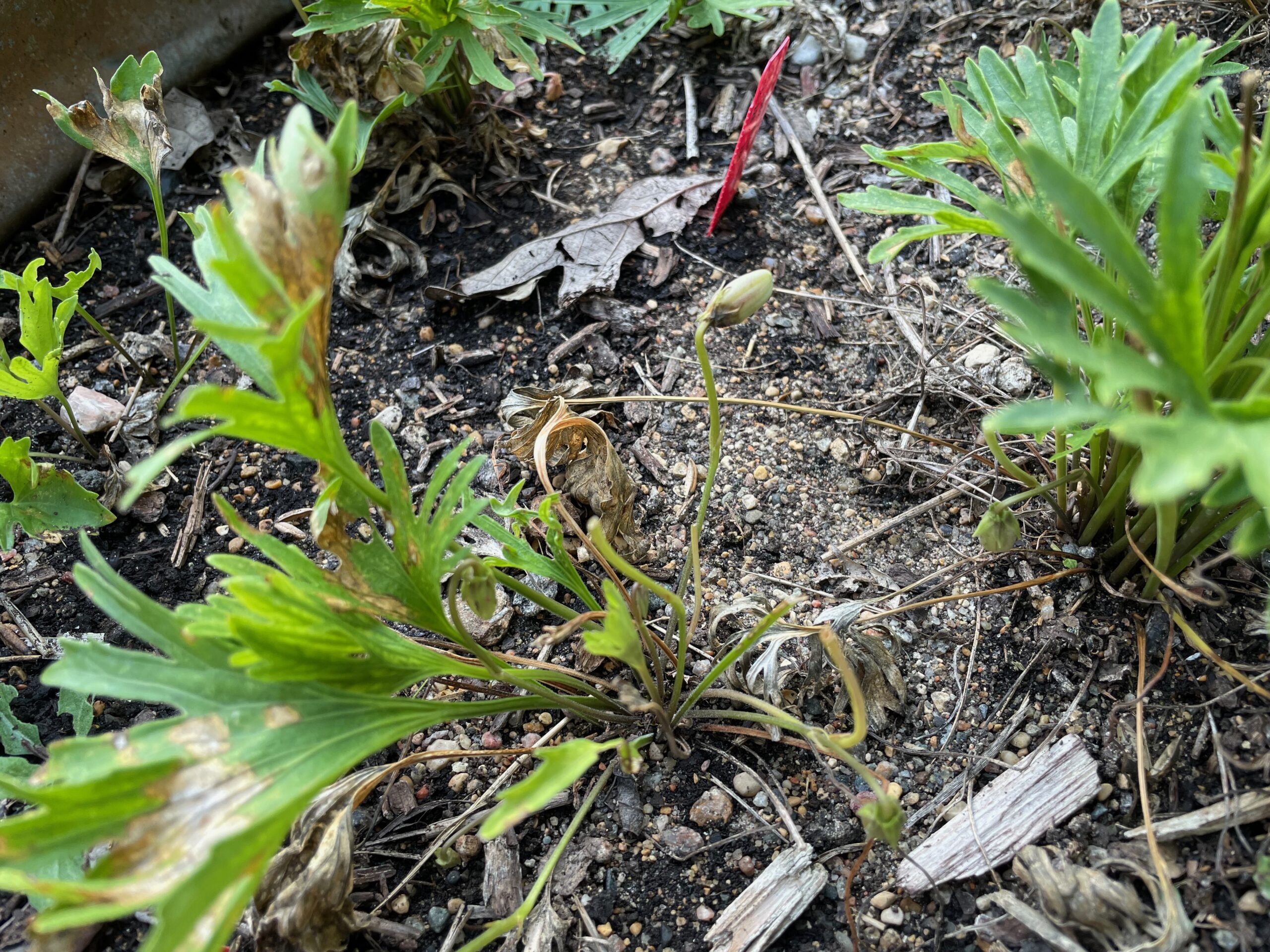
While we observed many healthy flowering heads, we also noticed lots of failed attempts at flowering (i.e. vertical developments), unsuccessful buds, and even “mutant” flowers (see the “tri-butt”, above). Whether this is an effect of hybridization or simply a result of the larger sample size of flower heads is unclear. If hybridization does increase the rate of unsuccessful flowering attempts, reducing fitness, it presents an immediate threat to populations of E. angustifolia within pollination distance of E. pallida restorations. Which brings us back to the restoration at Hegg Lake WMA…
After counting heads and identifying unique tag numbers for all of the flowering E. pallida plants in the Hegg Lake restoration, we took matters into our own hands. To prevent genetic swamping of nearby wild E. angustifolia, we beheaded every E. pallida plant in the restoration. Guillotined them. Total decapitation. If it sounds violent, that’s because it was. Robespierre would have been proud of us.
Say what you will about our methods, but Echinacea pallida won’t be showing it’s face at Hegg Lake WMA for a long, long time.
Our 2026 field season kicked off on Monday, June 29th! Stuart, Aaron, Maria, Yavonne, and I (Max) met at the Hjelm house in the morning for a brief but comprehensive introduction to the project before heading out in Stuart’s truck to see some of the study sites.
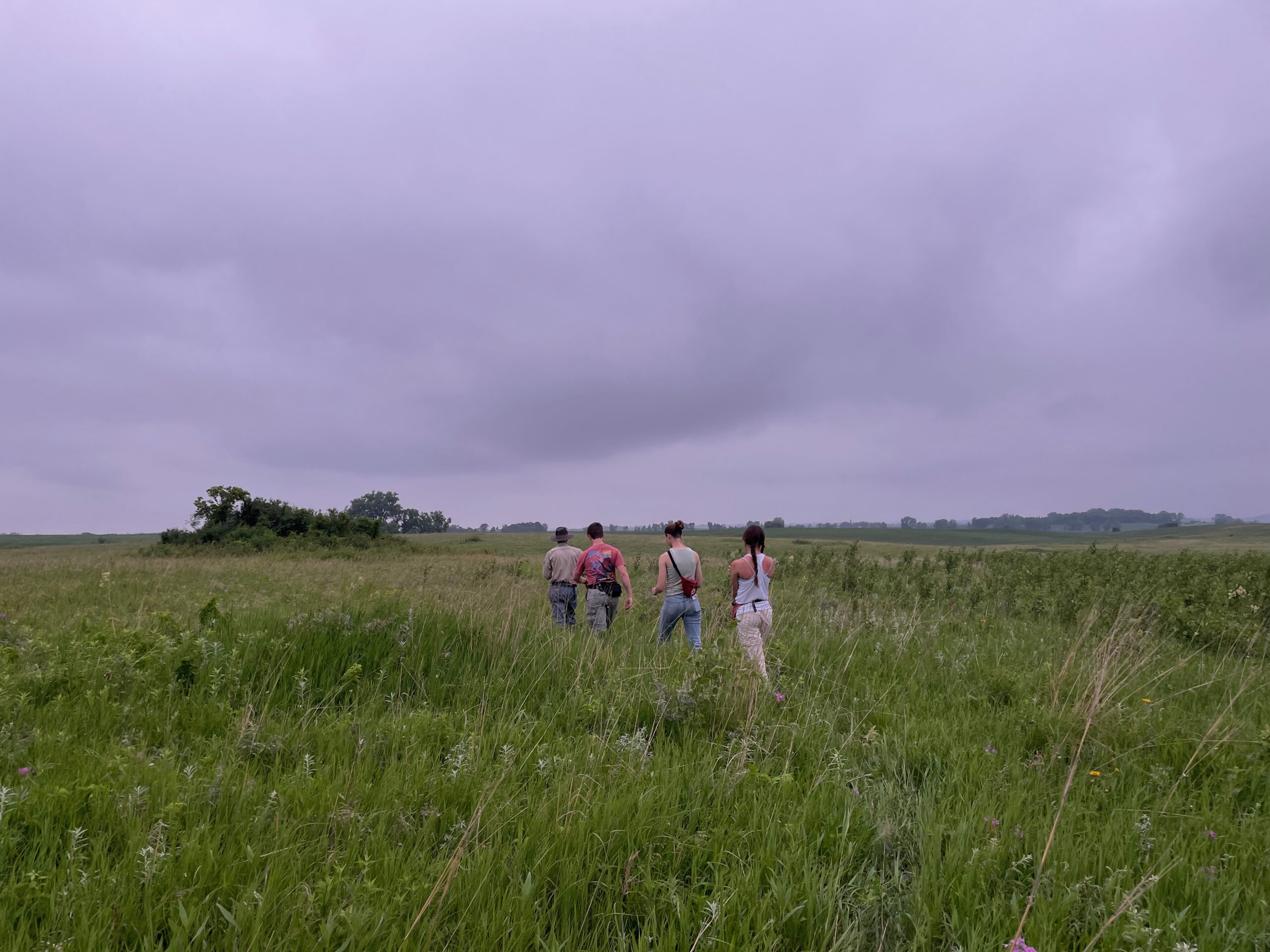
We started at Staffanson Prairie, where Stuart gave us the lay of the land and introduced us to some prairie plants while a swarm of ravenous mosquitos introduced us to some prairie insects. Then an unexpected storm cloud rolled through to introduce us to some prairie weather and we hopped back into Stuart’s truck. The rest of the tour was given through the truck windows, except for a brief stop at Hegg Lake (where I promptly lost my sunglasses).
Stuart, Aaron, Yavonne, and Maria at StaffansonA bee hiding out from the sudden downpour under an Echinacea head
Tuesday was our introduction to experimental plot #1 (exPt01). After a quick demonstration of Visor data entry, we were set free to measure inbreeding experiment 1 (INB1). We would be recording plant status (Basal/Flowering/Can’t Find), counting basal and flowering rosettes, and counting basal leaves. For flowering plants, we would also be twist-tying and recording flowering head information. This task was daunting at first, but we quickly figured out how to identify individual rosettes and sort through a thick layer of duff to count leaves. It helped that we had Aaron, who had already worked with the Echinacea Project for a full summer last year, to answer our questions.
By the end of the day on Thursday, we had finished our measurements in INB1 and INB2. Between the two experiments, we searched 381 positions for plants. We were unable to find 66 plants (we’ll return to these later in the summer to search again), and recorded 310 plants. These numbers are roughly on par with what was expected, given last year’s plant count (329) and a year’s worth of mortality. What surprised us was the frequency of flowering plants: while last year’s team found 92 flowering plants between the two experiments, we encountered only four!
Why this discrepancy? It probably has to do with fire. ExPt01 was burned last year, and we know from the past three decades of research that fire enhances Echinacea angustifolia flower and seed production. Maybe the Echinacea plants in INB1 and INB2 are still rebounding from last year’s flowering event? Maybe the somewhat cool start to the summer delayed flowering phenology? Maybe we made an outrageous counting mistake and missed 80+ flowering plants? All of these explanations are plausible. Only time and future flog posts will reveal the truth. Stay tuned!
I am a field research technician beginning my career in ecology with the Echinacea Project! I recently graduated from the University of California, Los Angeles, where I studied environmental science with a focus on conservation biology.
Pronouns: he/him
Research Interests
I’m interested in restoration ecology and plant conservation, particularly in highly human-disturbed areas such as the agricultural lands of Douglas County, Minnesota where the Echinacea Project does its work. I plan to pursue a PhD in the near future, and am hoping to learn more about the research process this summer.
Statement
I grew up near Los Angeles, California, spending much of my childhood exploring the nearby Santa Monica Mountains. I like backpacking, surfing, doodling, dinosaurs, and native plants. Although I have often visited my family in the Midwest, I’ve never lived here, and I am excited to experience everything that West Central Minnesota has to offer!
Myself (Max), thrilled to be surrounded by vegetation