|
|
Stuart recommends the below books as a good place to start thinking about time management. If you aim to manage time to better reflect your values, these books can help you develop strategies. The locations refer to NU libraries.
Mindset : the new psychology of success / Carol S. Dweck.
Dweck, Carol S., 1946-
New York : Random House, ©2006, 1st ed..
Checked out from Main Library Stacks (153.8 D989m )
Thinking, fast and slow / Daniel Kahneman.
Kahneman, Daniel, 1934-
New York : Farrar, Straus and Giroux, 2011, 1st ed..
Available at Qatar Library Stacks (BF441 .K238 2011 ) and other locations
Getting things done : the art of stress-free productivity / David Allen.
Allen, David, 1945 December 28-
New York : Viking, 2001
Available at Main Library Stacks (646.7 A425g ) and other locations
Succeed : how we can reach our goals / Heidi Grant Halvorson ; foreword by Carol S. Dweck.
Halvorson, Heidi Grant-, 1973-
New York : Hudson Street Press, ©2010
Available at Main Library Stacks (153.8 G762s )
Power of habit : why we do what we do in life and business / Charles Duhigg.
Duhigg, Charles, author.
New York : Random House Trade Paperbacks, 2014, Random House Trade Paperback edition..
Checked out from Main Library Lending Resource Sharing Requests (BF335 .D78 2014 )
Willpower : the rediscovery of humans’ greatest strength / Roy F. Baumeister and John Tierney.
Baumeister, Roy F.
New York : Penguin Press, 2011
Checked out from Main Library Stacks (153.8 B347w )
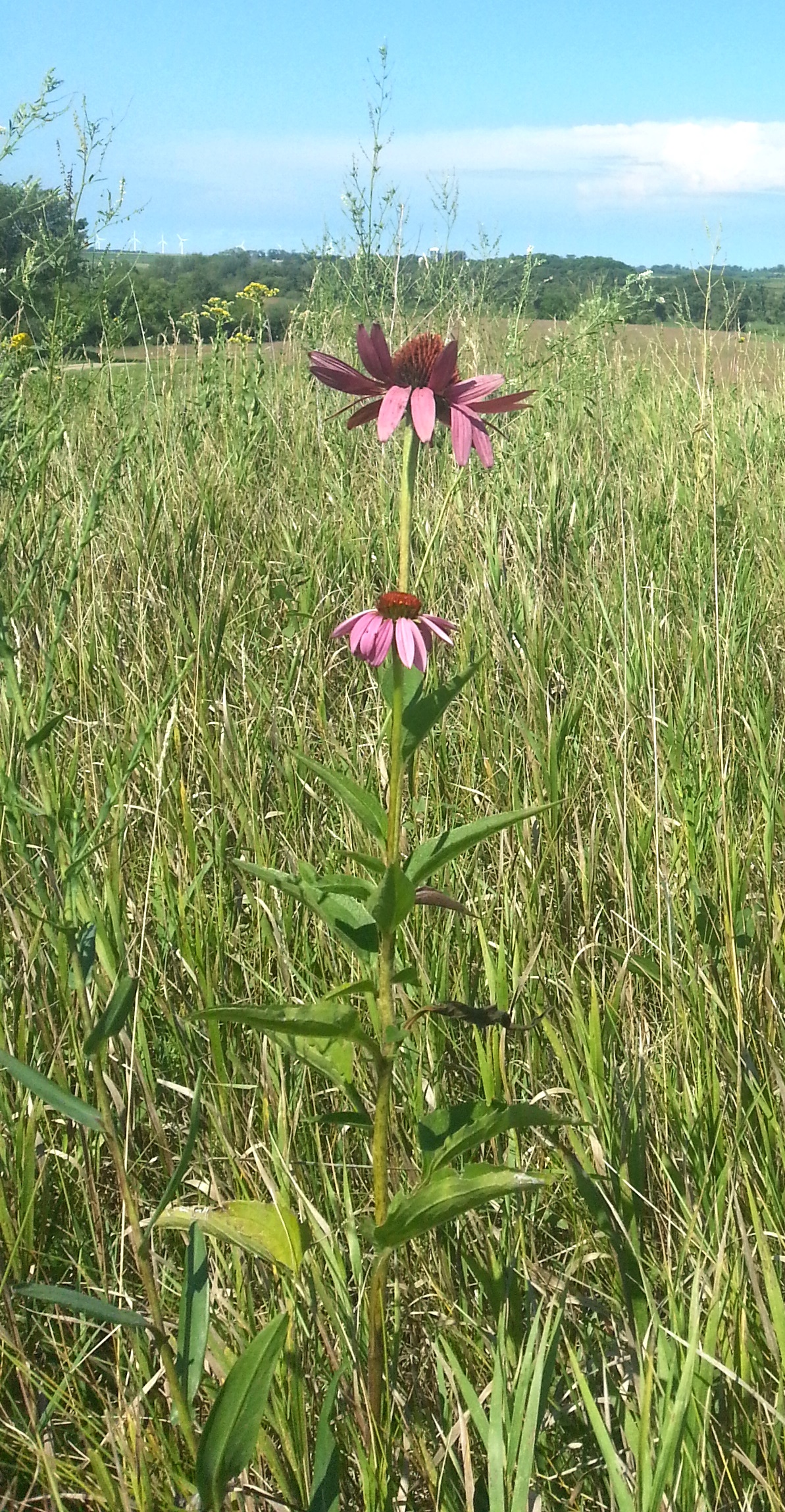
 Echinacea purpurea at Yellow Orchid Hill Non-native and invasive species are present in many of our study sites and may compete with native species for resources, such as light, space, or pollinators. Some invasive species, such as brome (Bromus inermis) and sweet clover (Melitotus officinalis), are already so widespread and abundant that we don’t keep track of where they are. However, this summer we noticed new appearances of several other non-native species, Echinacea purpurea and Rudbeckia hirta*, that could become more dominant in years to come. We documented their presence by taking photos and shooting GPS points. Most of the places where we saw these species were nearby or part of a restoration where the non-native species was introduced as part of the seed mix. Going forward, we will return to the locations where these species were found in 2016 and monitor the expansion of their populations.
Year: 2016
Location: RRX (Rudbeckia hirta), north of WAA (Rudbeckia hirta), RLR (Rudbeckia hirta and Echinacea purpurea), YOHW (Echinacea purpurea), and the corner of Tower Rd and 27 (Rudbeckia hirta)
Data collected: The photos we took are stored in Dropbox (summer2016pics/invasives)
GPS points shot: We shot GPS points at: RRX (1 pt), RLR (approximately 10 pts), YOH (1 pt). The restoration near WAA had too many plants to shoot individually, so we just took pictures. We couldn’t find the Rudbeckia at the corner of Tower Rd because the area where it had been was disturbed by electrical work. These points are stored in the job ‘ECHPURP_RUDBHIRT_20160914_SULU.tsj’.
*You might be thinking, “Isn’t Rudbeckia native?” and the answer is yes, in other parts of Minnesota. However it is not present in any of the high-quality remnant prairies in our study area and so we consider it to be non-native to our sites.
Hello Flog,
Long time, no flog. Guess where I am?!?
“Chicago”
good guess.
Yes, I ventured to Chicago for an extended weekend of fun and work in the Chicago Botanic Garden lab for the next step of my project about intra-specific pollen diversity (see proposal posted many moons ago).
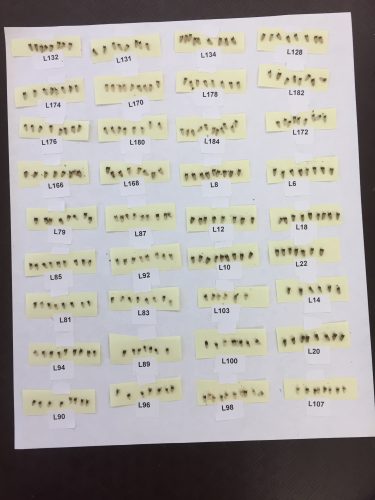
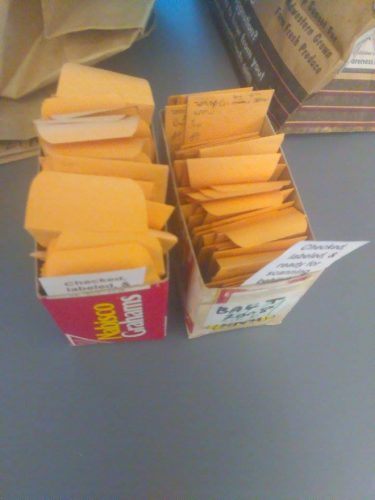
I was greeted on Thursday night by Lea, Amy, and Scott with pizza! It was awesome and tasty, though I am more of a thin crust person myself. On Friday, I went to the lab with Amy and Lea and began dissecting the heads that I crossed this summer. Amy developed an ingenious system for separating my achenes and getting them x-ray ready that involved the sticky side of a post-it note.
 Achenes prepped for x-raying. Later, Stuart, Gretel, Lea, Amy and I explored some of the gardens on the way to lunch in the café. After a few more hours of dissection, we went home and upon Stuart’s orders, painted the town red, so to speak. After giving Lea’s dogs lots of love and attention, Amy, Lea, and I explored downtown Evanston and stumbled into a pie shop where we ate four different types of pie. Much like an ice cream shop, this pie shop begrudgingly gave us samples of their pie, so we all made very informed decision as there were a lot of choices. We all shared a expresso cream, pear fig, “Fat Elvis” (chocolate, peanut butter banana), and a curry lamb pie. Decadent, I know! Consensus: pie is delicious. Then we returned to the abode and watch Portlandia and went to sleep at promptly 9:30.
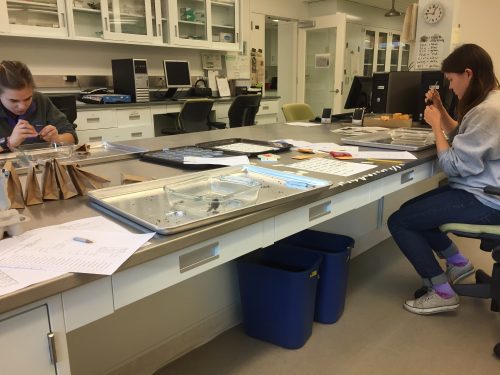
 Amy and Betsy workin’ hard. This morning, Amy, Betsy (Amy’s visiting friend, feat. in photo and also shoutout for the help in lab), and I went to the gardens while Lea hit the lib hard. With their help, I finally dissected all my heads and got them ready for pre-germination treatment.
Shortly, we will be off to Lou Malnati’s Pizza to eat more pie (the central theme of my trip).
Toodaloo,
Laura
Hey Flog!
My name is Sam Hamilton, and I am a Northwestern senior doing research in the Echinacea Project lab this quarter. My project specifically seeks to understand the relationship between prairie fires and reproductive success of flowering plants using our model organism A. Echinacea. This is an important relationship to understand because, while historically fires were an integral part of the prairie life cycle, today’s isolated prairie remnants are often never burned. This could have a large impact on the success of shorter plants that rely on the extra sunlight and nutrients that a burn year supplies to flower and germinate. This quarter, I will be collecting the data from seed heads collected this year and analyzing it along with data collected in previous years to draw my conclusions.
I am also looking at the reproductive success of Echinacea flowers collected from the bottom, middle, and top of each head. In Echinacea, flowers mature first at the bottom and slowly develop towards the top over time. This allows us us to deduce when a plant was pollinated best during the season. I’ve been hard at work the past month cleaning seed heads and separating their achenes into top, middle, and bottom sections for later analysis. It’s been a lot of work, but the great company has kept it fun!
Until next time!
-Sam

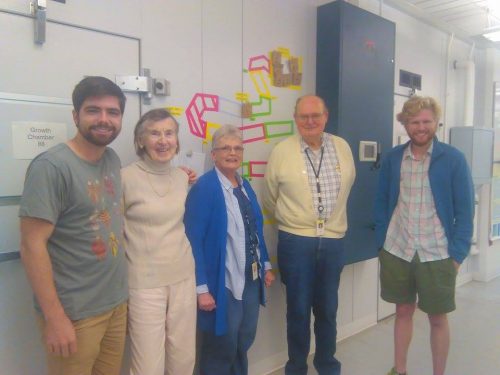
Myself with Susie, Char, Aldo, and Scott. (Left to Right)

One month of cleaned and organized achenes.
|
|