
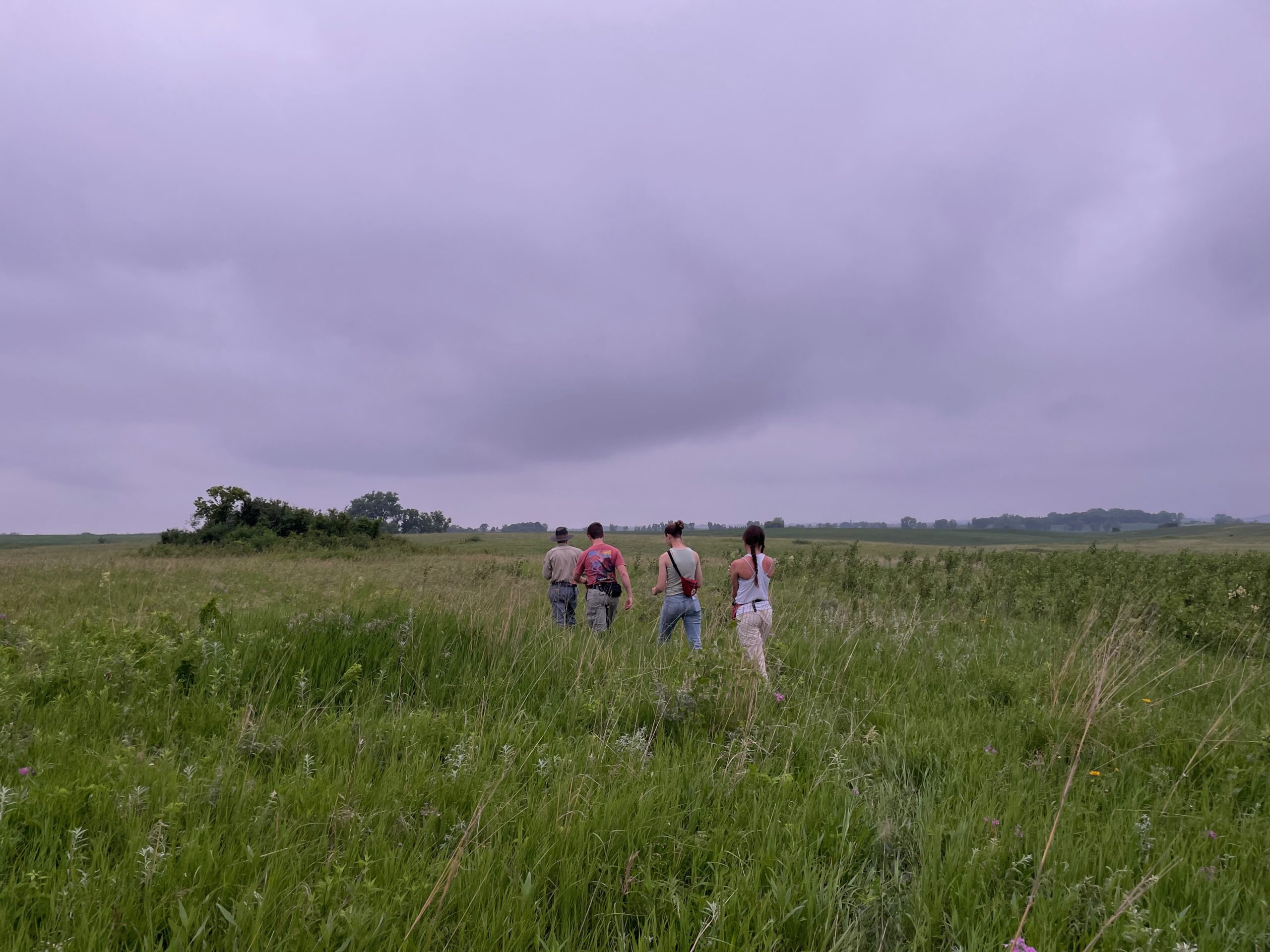
Our 2026 field season kicked off on Monday, June 29th! Stuart, Aaron, Maria, Yavonne, and I (Max) met at the Hjelm house in the morning for a brief but comprehensive introduction to the project before heading out in Stuart’s truck to see some of the study sites.
We started at Staffanson Prairie, where Stuart gave us the lay of the land and introduced us to some prairie plants while a swarm of ravenous mosquitos introduced us to some prairie insects. Then an unexpected storm cloud rolled through to introduce us to some prairie weather and we hopped back into Stuart’s truck. The rest of the tour was given through the truck windows, except for a brief stop at Hegg Lake (where I promptly lost my sunglasses).
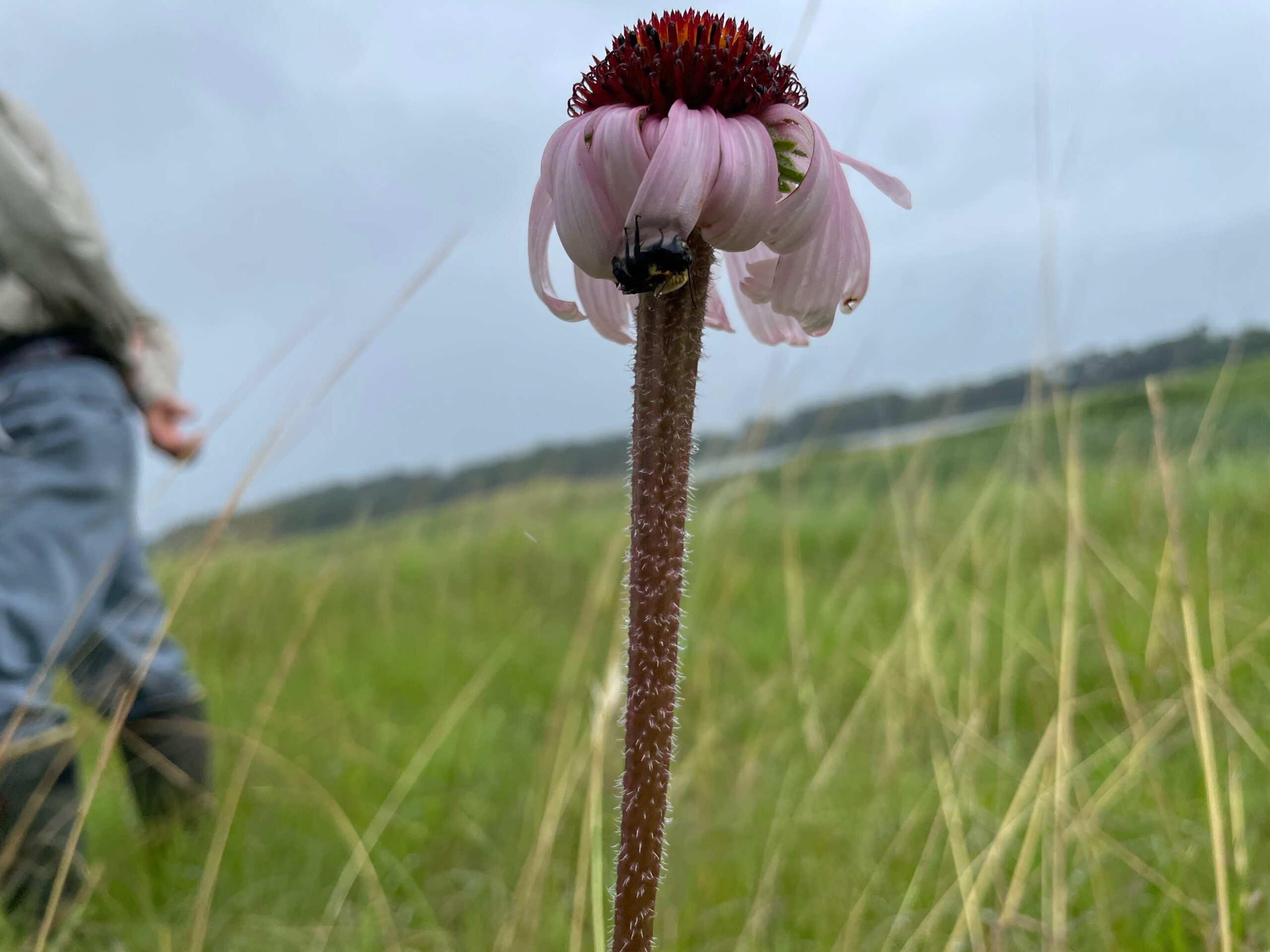
Tuesday was our introduction to experimental plot #1 (exPt01). After a quick demonstration of Visor data entry, we were set free to measure inbreeding experiment 1 (INB1). We would be recording plant status (Basal/Flowering/Can’t Find), counting basal and flowering rosettes, and counting basal leaves. For flowering plants, we would also be twist-tying and recording flowering head information. This task was daunting at first, but we quickly figured out how to identify individual rosettes and sort through a thick layer of duff to count leaves. It helped that we had Aaron, who had already worked with the Echinacea Project for a full summer last year, to answer our questions.
By the end of the day on Thursday, we had finished our measurements in INB1 and INB2. Between the two experiments, we searched 381 positions for plants. We were unable to find 66 plants (we’ll return to these later in the summer to search again), and recorded 310 plants. These numbers are roughly on par with what was expected, given last year’s plant count (329) and a year’s worth of mortality. What surprised us was the frequency of flowering plants: while last year’s team found 92 flowering plants between the two experiments, we encountered only four!
Why this discrepancy? It probably has to do with fire. ExPt01 was burned last year, and we know from the past three decades of research that fire enhances Echinacea angustifolia flower and seed production. Maybe the Echinacea plants in INB1 and INB2 are still rebounding from last year’s flowering event? Maybe the somewhat cool start to the summer delayed flowering phenology? Maybe we made an outrageous counting mistake and missed 80+ flowering plants? All of these explanations are plausible. Only time and future flog posts will reveal the truth. Stay tuned!
Thanks for Echin Project update. Much appreciated. Keep up the good work.