
In addition to collecting data in the experimental plots, we also manage vegetation in order to maintain consistent experimental conditions. This summer, Team Echinacea used the herbicide triclopyr to push back encroaching sumac (Rhus glabra) in experimental plots 1, 2, and 8. We also trimmed Sorghastrum nutans in exPt08 and harvested a lone hybrid head in exPt06, and are planning a controlled burn in exPt08.
Herbicide Treatment
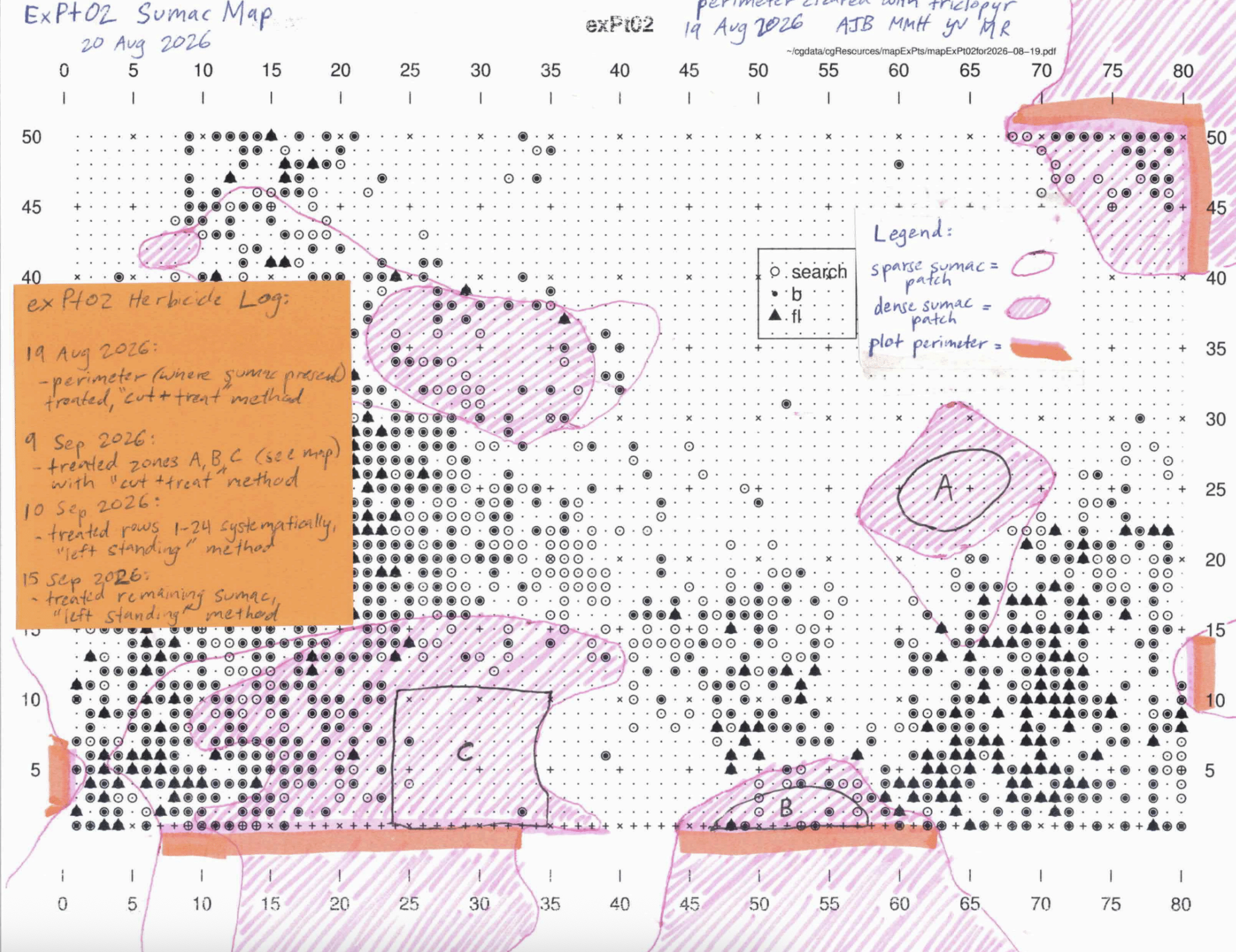
Two different methods of triclopyr application were used. The first, which we call the “cut + treat” method, involves severing the main stem of the sumac plant with loppers and treating the cut surface (and ~10cm of stem below the cut surface) with triclopyr. This method was primarily used for denser patches of sumac. The second method, which we call the “left standing” method, involves treating ~10cm of the still-standing stem of the sumac plant with triclopyr. This method was primarily used for sparser or shorter patches of sumac.
For a glimpse into our herbicide application process, see this flog post.
We used a cotton glove, worn over a protective nitrile glove, to apply the triclopyr. After dipping a few fingers of the absorbent glove in triclopyr, we could easily “paint” the herbicide onto sumac stems. In both treatment methods, triclopyr application typically occurred just below the lowest branches on the main sumac stem. We were careful to limit our herbicide application to the target species, Rhus glabra. If a sumac plant was so close to an Echinacea plant that accidental cross-contamination might occur, we did not treat it.
- Location: exPt01, 99s, exPt08 (Wagenius property); exPt02 (Hegg Lake WMA, DNR)
- Treatment dates:
- exPt01 (excluding 99s): 14-Aug-2026, 31-Aug-2026, 4-Sep-2026
- 99s: 26-Aug-2026, 1-Sep-2026, 15-Sep-2026
- exPt02: 19-Aug-2026, 9-Sep-2026, 10-Sep-2026, 15-Sep-2026
- exPt08: 4-Sep-2026
- Overlaps with:
- common garden experiments (exPt01, exPt02, exPt08)
- Maps:
- Experimental plot herbicide maps: dropbox/teamEchinacea2026/zz.scanned/herbicideMaps2026.pdf
Details of herbicide application in individual experimental plots can be found below:
exPt01 (excluding 99s)
A dense patch of sumac runs along the entire east side of exPt01, and has been encroaching into the plot for years. This year, we established a perimeter of ~2 m around the entire plot and treated all sumac within the plot. We also treated a patch of sumac on the western edge of the plot, around position 955.
99 south
While the 99s garden itself was relatively free of sumac, it was surrounded by sumac on all sides. Sumac on the south side was especially dense and tall, reaching heights of over 2 m. We chose to treat all sumac within and surrounding the plot, up until the boundary created by a mowed path roughly 2-5 m from the plot’s edge.
While treating sumac on 1-Sep-2026, we found an inhabited bird nest (species unknown) constructed in a sumac plant to the northeast of the plot. We left a 1 m perimeter around the nest and treated this perimeter on 15-Sep-2026, once the nest had been abandoned
exPt02
When we first visited exPt02, dense patches of sumac could be found along the southern border of exPt02, as well as around the northeast corner and within the plot itself. Shorter, sparser sumac was also present throughout the plot, as well as a handful of 2-3 meter tall trees (ash or boxelder). We started by clearing a 2 m perimeter around the plot and removing the trees, then treated the remaining sumac within the plot over the following weeks.
exPt08
Of the four experimental plots where we conducted herbicide treatment, exPt08 had the least amount of sumac, with only a couple of sparse patches along the plot perimeter. However, small trees (primarily ash) are scattered throughout the northern part of the plot. These trees will probably require more extensive management in the coming years.
Sorghastrum nutans Management
While we appreciate the presence of native prairie grasses in the experimental plots, they can form a dense leaf litter which makes it more difficult to locate Echinacea plants. Sorghastrum nutans, a native warm-season grass, is already omnipresent in exPt01, but it has not yet taken over exPt08. In order to slow its spread in the plot, we used pruners and hedge-trimmers to remove the every S. nutans inflorescence before (we hope) the grass was able to set seed.
- Location: exPt08 (Wagenius property)
- Treatment date: 31-Aug-2026
- Overlaps with:
- common garden experiments (exPt08)
exPt06 Head Removal
In 2011, 66 hybrid Echinacea seedlings were planted in exPt06, a small plot west of exPt08. We are no longer measuring in exPt06, but we did notice that one of the hybrid plants was flowering. In order to prevent propagation of hybrid achenes, we harvested this head (though not before pollination occurred). We also took some measurements: the plant had 1 head (83 cm tall), 1 flowering rosette, and 0 basal rosettes. The head had a blue twist tie, and its row/position was not recorded.
- Location: exPt06 (Wagenius property)
- Overlaps with:
- Samples collected:
- One Echinacea head (in an h-bag in Hjelm)
exPt08 Prescribed Burn
Another regular method of experimental plot management is prescribed burning, which naturally favors native prairie species over woody invaders. None of the experimental plots were burned prior to the 2026 field season. We are planning to conduct a prescribed burn in exPt08 (and maybe exPt01/99s) during fall 2026 or spring 2027. Before a burn in exPt08, all flags placed south of the plot (between exPt08 and Highway 27) should be removed. There is also the question of the viola experiment, which may be affected by a prescribed burn.
- Location: exPt08 (Wagenius property)
- Treatment date: Fall 2026 or Spring 2027 (depending on conditions)
- Overlaps with:
Leave a Reply