|
|
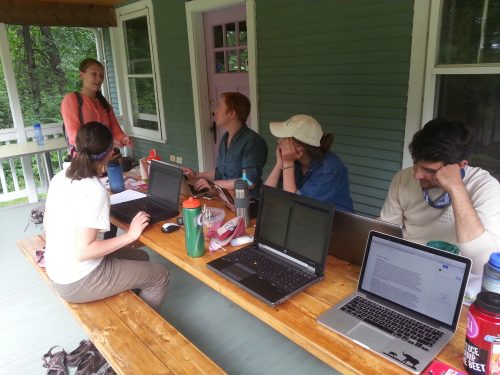
Today we all divided up to complete phenology at all sites but were interrupted by thunder. We all hurried back to the Hjelm house to wait it out. After seeing the closest lightning strike most of us have ever experienced we decided it would be best to wait until 4 to go back out. Some of the taller members of the team were concerned for their safety still & suggested short members go out first because they’re “farther away from a lightning strike”. Ruth visited today to help with phenology and also made tags during our lightning break. During lunch Lea updated us on her independent project. She wants to look at how burn years affect co-flowering species of Echinacea and settled on other composites. Because they aren’t clonal it’s easy to track individual flowers and Lea feels comfortable recognizing when composites are flowering. She’s going to track when composites along a transect in Staffanson begin and end flowering and compare the burned unit to the non-burned unit. Jennifer helped clarify the difference between Andrena and Melissodes to other Lea and me. Although she described their different appearances she told us the biggest difference is their foraging behavior atop Echinacea. Eventually we finished phenology for the day and headed home to eat Amy and Laura’s wild rice soup.
 Female Melissodes Highlights of the day:
Jennifer brought her munchkin, Zachary, to work. It’s never too early to join Team Echinacea.
Ruth brought an amazing rhubarb bundt cake and Amy, Lea and Laura fought over the last piece (James took the second to last all for himself).
Playing “was that thunder or a truck?”
Today team echinacea celebrated independence day with a picnic at the Elk Lake beach, The gathering started with the annual reading of the Declaration of Independence, and remembering why we celebrate on the Fourth of July. After the reading was complete the team had a potluck which included baked beans, lots of fruits and veggies and some really good iced tea! After eating and of course waiting 30 minutes some of the team swam and canoed. All in all a great picnic and the team is looking forward to having the day off tomorrow!
Stuart starts off the reading of the Declaration! The Feast!
Today we recorded first flowering dates for the early-flowering Echinacea plants in our remnant populations. For short, we call this activity “phenology.” Now we want to estimate how many total plants will flower this year at each site.
At four remnants (eri, sap, yohe, and lfw), we also recorded as many plants as we could find in bud. The ratio of currently flowering plants (flPla), to all plants in bud (allPla) at these sites ranged from 9 – 27%.
The below table shows the estimates (guesses) of how many plants will flower at each site this summer based on the assumption that 10% (guessHigh) and 25% (guessLow) of plants at each site are already flowering.
> aa[order(aa$guessLow), ]
    site proFl allPla flPla guessLow guessHigh
12  nwlf  0.00      2     0        0         0
16 rrxdc  0.00      2     0        0         0
20 tower  0.00      1     0        0         0
23 woody  0.00      1     0        0         0
5     gc  0.50      2     1        4        10
17   sgc  1.00      1     1        4        10
10   lcw  1.00      2     2        8        20
11  nrrx  1.00      2     2        8        20
22 tplot  0.50      4     2        8        20
25  yohw  0.67      3     2        8        20
3    eri  0.09     33     3       12        30
6     kj  1.00      3     3       12        30
15   rrx  0.43      7     3       12        30
21    th  0.75      4     3       12        30
24  yohe  0.22     18     4       16        40
1     aa  0.56      9     5       20        50
19   sap  0.19     26     5       20        50
4   eelr  0.54     13     7       28        70
18  sppe  0.57     14     8       32        80
2    alf  0.50     20    10       40       100
13  on27  0.60     25    15       60       150
8    lfw  0.27     74    20       80       200
7    lfe  0.39     62    24       96       240
14    ri  0.44     54    24       96       240
9    lce  0.74     34    25      100       250
>
These estimates will help us decide which populations to choose for our planned systematic observations of bees this summer.
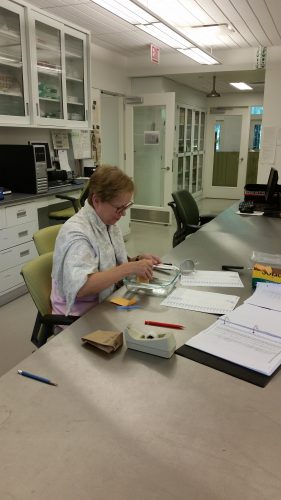
This week the crew pushed on cleaning and re-checking seeds and counting achenes. I spent a good amount of time prepping seeds to be frozen for long term storage. These seeds are from several different experiments in 2013 and 2014 and have not been X-rayed. They must be placed in the dryer for two weeks, which removes enough internal moisture to avoid the seed rupturing when frozen at -20 degrees Celsius. These E. angustifolia seeds join the Dixon National Tallgrass Prairie Seed Bank here at the Chicago Botanic Garden. This collection has aimed to bank at least one representative sample of every species found in the tallgrass prairie ecosystem. Multiple populations have also been sampled for more than 500 species that are deemed critical to prairie restoration, so our seeds are in good company!
 Seeds from multiple experiments in 2013 going in the dryer.
Today was another great day on Team Echinacea. This morning we continued our work on Q2, and we continued to make significant progress. We measured many plants and found at least five new plants in the experimental site. After a hearty lunch and a short time marveling at ice formations in a water bottle, Amy Dykstra gave a presentation on her research, which included her study of local adaptation of Echinacea. The afternoon was filled with preparations for IS projects (for the Wooster folks) and independent projects for the rest of us. Leah and Laura quickly became adept at catching pollinators, but were not so successful at transferring the collected pollen to fuchsin jelly. The rest of us hunkered down on our computers, read some literature, prepared project proposals and thought about how hard it would be to use NMR and IR to analyze pollen.
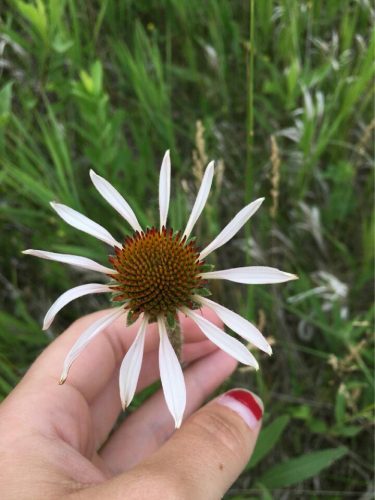
 Leah regales us with stories of captured pollinators and attempts at melting fuchsin jelly on a car dashboard. The exciting news of the day is that we found our first flowering Echinacea in P1 and at Elk Lake Road East! Tomorrow we will find out how many more Echinacea are flowering.
 The second flowering Echinacea (found at Elk Lake Road East)!
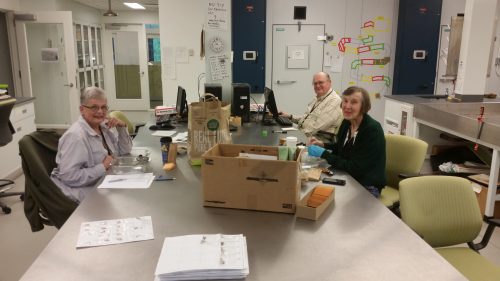
It’s been steady work back here at the Chicago Botanic Garden. The heads from exPt2 collected in 2015 have begun to be re-checked for any remaining achenes. We’re also about halfway done cleaning the heads from the 4th of 12 bags for exPt2. Overall, this is a BIG job as 1,215 heads were collected last year in this plot, an amount nearly five times the amount of heads seen in 2014. Only time will tell how this year will compare! Everyone in the lab and in the field keep up the great work!

Char, Aldo, and Susie cleaning heads from exPt2.

Leslie making sure the heads are cleaned of all achenes.
This weekend is “Runestone Days” in Kensington. Last night, we got the chance to scope out the scene and talk to a few people in town. This morning, the Lions Club of Kensington gave us way too much food at the Pancake Breakfast. It was so much fun to have time to eat, chat, and be able to learn more about each other. Then, we walked around town, checking out the garage sales. We headed back to Town Hall once it began to rain and spent the rest of the afternoon relaxing.
 Leah, Lea, Laura, Alex, James, and I experiencing the atmosphere at Runestone Days Alex shows off his new hat and honey that he bought from the garage sale
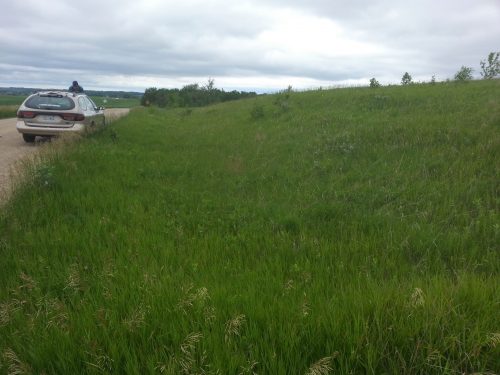
All the first year researchers were assigned a study site to visit and observe. East Elk Lake Road, located in the northwest corner of the study area, is a small reserve that has not been actively maintained. The site lies just off a gravel road and consists of plants by the roadside, with a ditch and hillock that run for around 200 meters alongside the road. A wetland surrounded by trees lies at the western edge of the study site, and the trees are encroaching on the prairie fragment. The study site is across the road from a larger prairie fragment contributing to a larger gene pool. The site south of the road had similar plant diversity suggesting more active management.
This study site was characterized by three different sets of plants. The edge of the gravel road is disturbed and the flora consists of a high abundance of brome as well as dandelion and Poa. Just beyond the disturbed road edge is a shallow ditch and sloping hillside. This area contained the highest diversity of forbs, grasses and legumes, many of which are native. Grasses included big bluestem and needle and thread grass. There were many native forbs, including Canada anemone, goldenrod and bedstraw. This was the only area in which Echinacea (a clump of four individuals) was found. We also found asparagus plants, some of which looked ready to eat! While many legumes are found in most study sites, this site had a surprising few native and nonnative legumes. Leadplant also grew along the hillside. The top of the hillock was densely covered in nonnative brome, along with some relatively dense dogbane and prairie rose, but this area showed lower diversity than the hillside. This summit also featured tree saplings, no higher than five feet tall.
The size of woody trees and shrubs in the area and the large amount of duff on the hilltop suggests the site had not been burned for many years. Plant cover on the hilltop as well as an overgrown access road (we call this an approach) to the hilltop suggested the area had been used for grazing or farm fields.
View West from approach with brome along the gravel road shown on the left
Echinacea Project 2016
Hi everyone! My name is Rachel Rausch, and I’m so excited to be a part of Team Echinacea this summer. I graduated from Morris Area High School a few weeks ago, and will be attending the University of Minnesota Twin Cities this fall, studying Psychology.
Research Interests
Because UMN is a research institution, I’m looking forward to getting research experience this summer. This will be my first hands on experience with conservation biology and I’m excited to learn about the research process.
Statement
I’m from Morris, MN which is about 30 miles from Kensington. I In my free time, I love to read, rollerblade, and enjoy Minnesota’s 10,000 lakes. I love learning new things, and in my 18 years on earth have attempted to knit, play piano, weld, unicycle, and make an ice sculpture.
My name is Chris Woolridge and I’m very excited to begin as a Seasonal Researcher with the Echinacea Project this summer! I’ll be helping Danny and the citizen scientists in the lab while the rest of the team is in Minnesota conducting field work. I’m currently a graduate student in the Plant Biology and Conservation Program at the Chicago Botanic Garden and Northwestern University. My research is focused on better informing seed sourcing for restorations. Some researchers and managers have proposed sourcing seed from more southern latitudes to foster populations that are pre-adapted to climate change. In order to test this strategy’s feasibility, I’m conducting a common garden experiment in Grayslake, IL, investigating relative fitness of plants sourced across a latitudinal gradient in five savanna/prairie species used in restorations. With that being said, I’m very interested in the questions the Echinacea Project is asking and I’m thrilled to be joining the team!

|
|