|
|
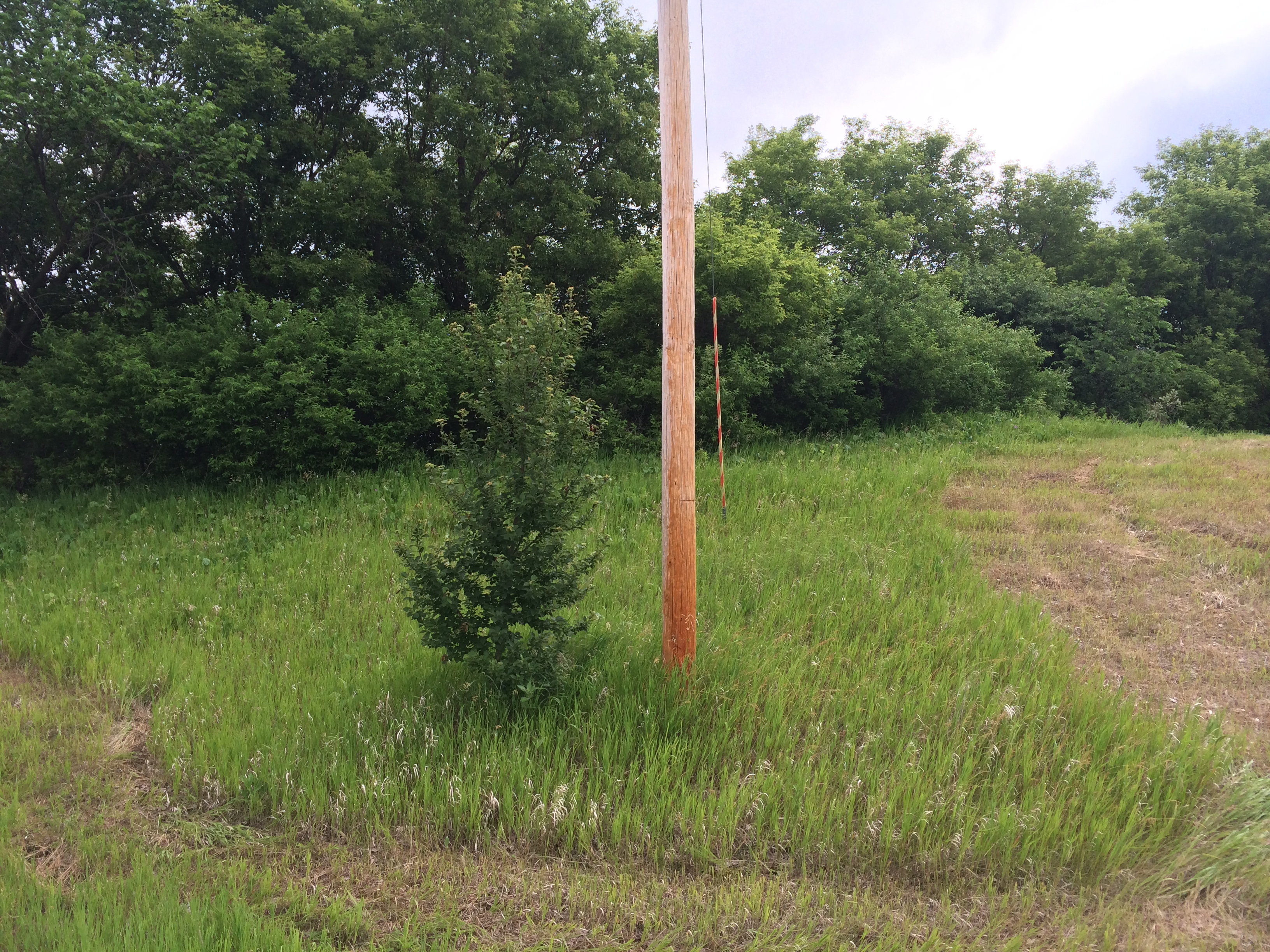
Turning right onto Unity Drive from Highway 27 you’ll quickly come upon a small patch of remnant prairie just off the right side of the road. The patch is squeezed in between a tree line and the heavily mowed roadside, and at first glance looks to be primarily invasive grasses. Brome, poa, and Indian grass–all non-native–clearly dominate. And creeping down from the tree line is a fair amount of poison ivy that actually seems to overtake the grasses up closer to the trees. We saw no evidence of the pale and narrow leaves of the Echinacea angustifolia poking up in between the grasses. Slightly disappointed with the apparent lack of diversity and absence of native species in this unassuming roadside patch, we were about to walk away when we spotted the soft metallic green of some leadplants crowning the top of the incline by the tree line. These native legumes are a sign of a healthy prairie, and finding them was without a doubt the redeeming highlight of our encounter with this otherwise sad patch of prairie.
Upon returning to the research base just down the road and showing the picture we took of the site to Stuart, we found out that much of the remnant had very recently been mowed and the patch we were examining was smaller than it had been even since Stuart’s last visit–a disappointing fact added to our investigation. We hope that this ever-shrinking prairie remnant sees better days soon.
 Snapshot of “South of Golf Course” prairie remnant off of Unity Drive and Highway 27.
My, oh my how time flies! It seems hard for me to believe that today is already my last day. Working with Stuart, Gretel, the Echinacea Project volunteers, and the rest of Team Echinacea over the past year has been a wonderful experience. I have learned a tremendous amount and I feel very fortunate that I had the opportunity to spend time working on such a great project with such a terrific group of people!
Keep of the good work and good luck Team Echinacea 2015!
– Jared
We are in the process of reviewing many excellent applications for research internships. Thanks to references who sent in letters of recommendation! Thanks to all applicants–we will contact you soon.
Meanwhile, Jared has returned for a field trip to California, Stuart finished grading final papers, we are preparing for the SER meeting, and our citizen scientists continue clean heads, count achenes, and take random samples for x-raying. Yay team!
We are starting to review applications for summer research internships for undergraduates (REU). Get your application in! We’ll accept applications until positions are filled.
Apply!
https://echinaceaproject.org/summer-reu-internship-2015-ech/

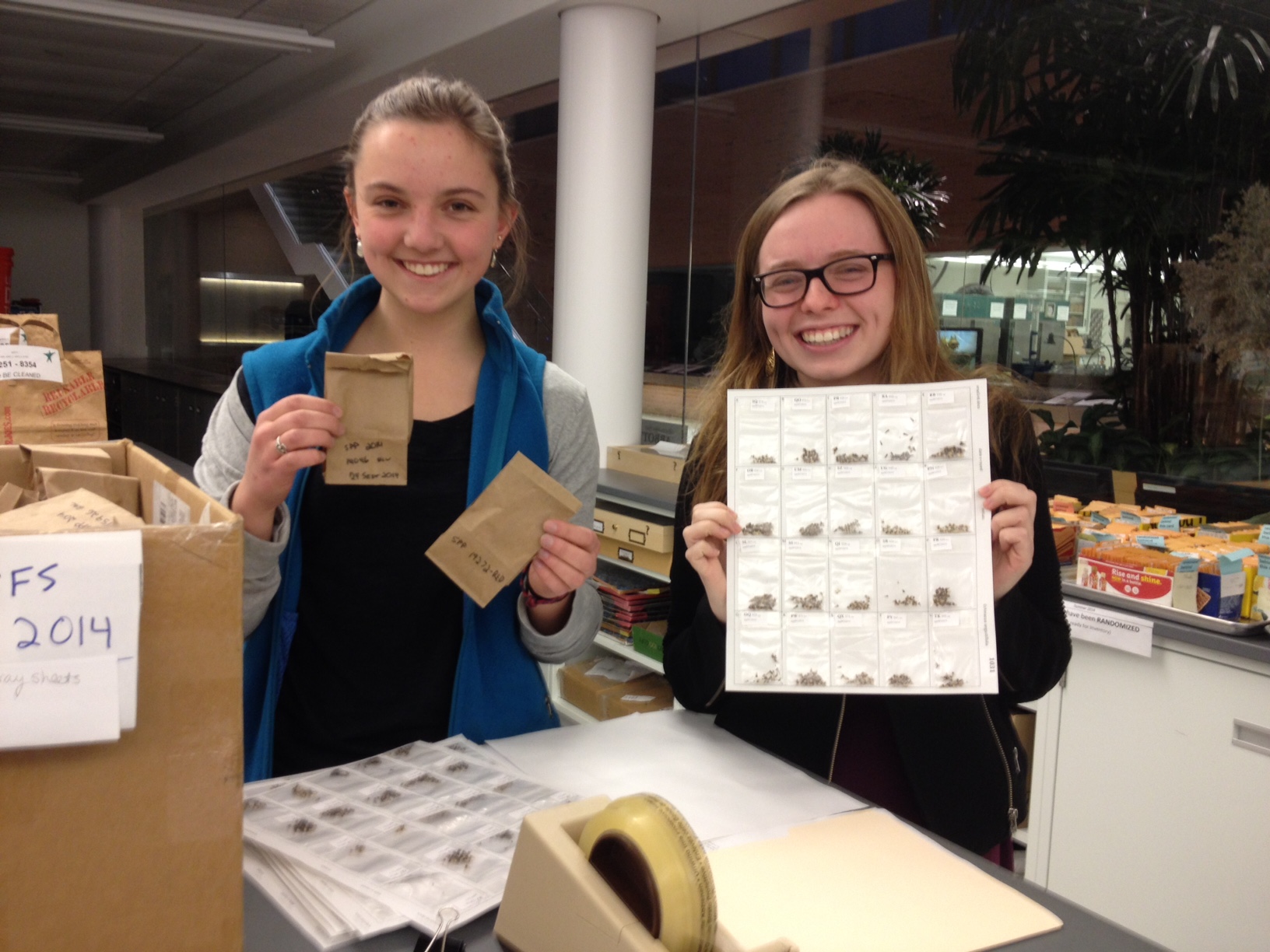
We arrived at the Botanic Garden on Monday and had a tour of the labs and a discussion with Stuart to introduce us to the Echinacea Project. We began our work by cleaning 82 Echinacea angustifolia heads, separating the top 30 achenes and the bottom 30 achenes. The rest of the achenes were labeled as mid or unknown (if we did not know the location the achenes came from). Once the top and bottom achenes were separated out, we affixed them to sheets in preparation to x-ray.
Graduate students and post docs shared information on their research and advice on graduate school options. Lynnaun introduced us to his graduate research involving fungus on orchid roots. Evelyn discussed her path to working at the Chicago Botanic Garden as a post doc researcher, including her PhD research on ferns and what type of work is available after getting a PhD. Rob shared his graduate research on the effect of buckthorn invasion in oak savannas on the ectomycorrhizal community. One evening after our work at the gardens, we attended a journal club for the graduate students who work in the labs at the Botanic Garden and attend Northwestern University. Jessa discussed with us her time spent after under-grad working in an arboretum and how that led to her involvement in graduate research here at the Botanic Garden.
Looking forward to next week!
– Emma and Jocelyn
Just as the children in the the classic film “The Sound of Music” said their goodbyes, I must also say mine. Unfortunately, my time with the Echinacea Project has been abruptly cut short, but such is life. I cannot think of anything that could have made this summer any better. We laughed, we cried, and we laughed some more. Everyday was a new adventure with a different challenge to overcome, but not even the toughest obstacle could bring down our team. We truly were a team. But even more than that, we were a family, in every sense of the word. We grew together, cared for each other, and challenged each other to reach our highest potential. I will never forget this experience, nor the friends I made along the way. As this summer comes to a close for the rest of the team, I hope everyone will view this ending with a positive outlook rather than with negativity. Yes, this is the finish of a wonderfully awesome situation, but with every ending comes a new beginning. And with every beginning comes opportunities for novel experiences and self-growth. So as I say my last farewell, let me leave you with this famous quote by Dr. Seuss: “Don’t cry because it’s over, smile because it happened.”
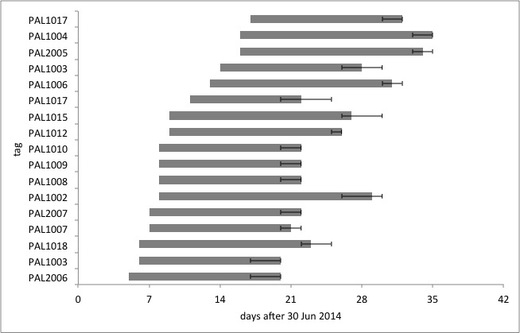
One of my projects this summer was monitoring the flowering phenology of Echinacea pallida in the restoration east and southeast of the parking lot at Hegg Lake Wildlife Management Area. When compared with Echinacea angustifolia flowering phenology, this will help us assess the temporal extent of the opportunity for hybridization between these species.
There were 19 flowering heads on 16 plants. The figure below illustrates the flowering periods of the 17 heads for which I could assess start and end dates (two heads finished flowering before I started monitoring). I define flowering period as the period from the first day of male florets to the last day of female florets. I estimated the last day of female florets based on patterns of flowering and style persistence. Error bars indicate the range of possible end dates (last day florets observed to first day no florets observed).

This morning Team Echinacea was joined by special guest Steve Ellis, a commercial beekeeper based in Barrett, MN. Steve is also a national advocate for curbing the usage of neonicotinoid pesticides and has filed a lawsuit against the US EPA for sanctioning the widespread use of these chemicals in agriculture. While sipping on wild forage sumac-ade and devouring some delectable scones, the team was captivated by Steve’s description of the US pesticide regulatory system and the consequences of neonicotinoid usage. Neonicotinoids are a relatively new class of neuro-active insecticides used in agriculture throughout the US. Mounting evidence suggests these long-lived chemicals are at least partly responsible for the precipitous decline of commercial honeybee populations over the past 20 years. However, less is known about how neonicotinoids affect native pollinators, the birds and mammals that feed on pesticide-ridden insects, and the aquatic systems where neonicotinoids accumulate.

In other news, we finished measuring P1 before returning to the Hjelm House to celebrate Keaton’s birthday with cake and “exercises in estimation.”
This week I was able to share my work with my parents and my brother. My parents came out in the field on Thursday to learn about how we document phenology in the remnants. My mother expressed her surprise that the remnants are much smaller than she had expected. Stuart was in the field with us and gave my parents a detailed explanation of what we are doing this summer and answered all of my parents’ questions. Yesterday my brother drove up to visit me. I showed him Staffenson prairie reserve which has blooming blazing star, sunflowers, lead plant, Echinacea, wild onion, bergamot and more! It was fun to show my older brother around and finally get a chance to teach him a think or two.
Although Echinacea flowering is tapering off for summer 2014, the team is busy wrapping up phenology, collecting fitness data plants in the long-term experiments, and working on individual research projects. In addition to the projects well under way, the team has two more sizable projects on tap for August: conducting seedling searches and collecting demographic information on remnant populations.
On Wednesday, we were joined by Ruth, Amy, and Katherine to begin seedling searches at East Elk Lake Road. In what can only be described as a mentally demanding exercise, seedling searches involve locating and identifying seedlings from previous years using maps and distance matrices. Patience is of utmost importance when trying to solve Echinacea puzzles that may have 1 or many possible solutions…
|
|