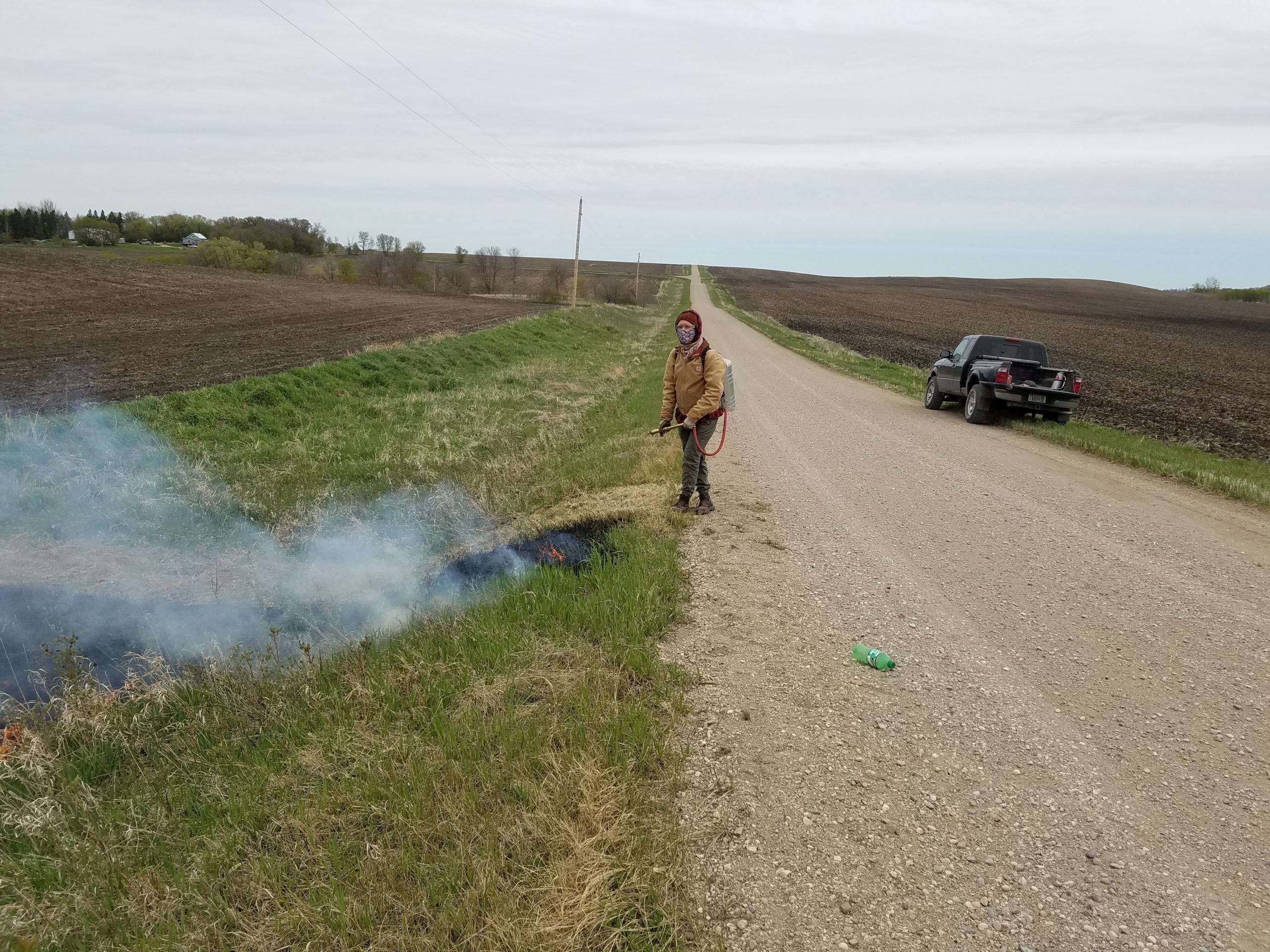
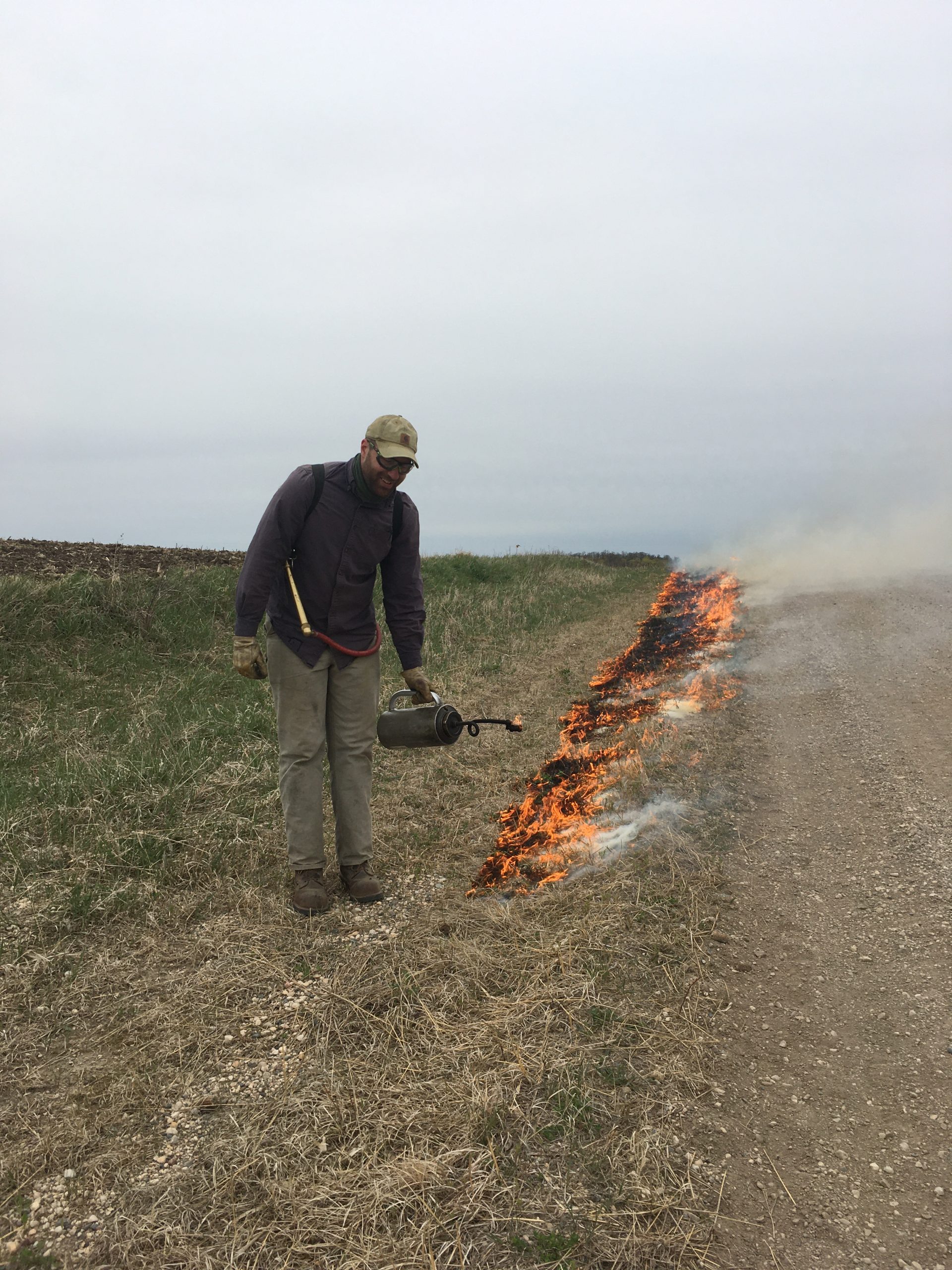
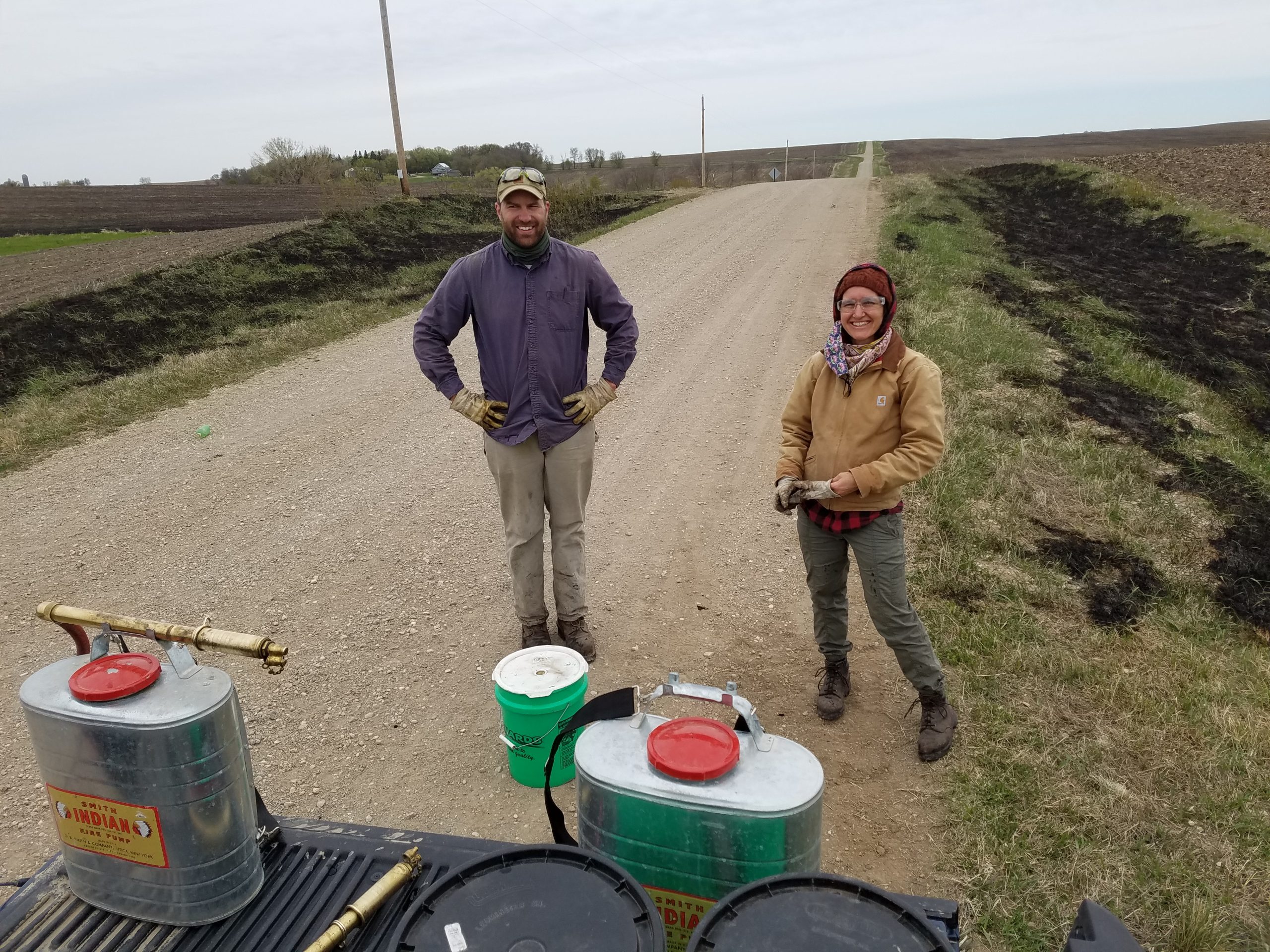
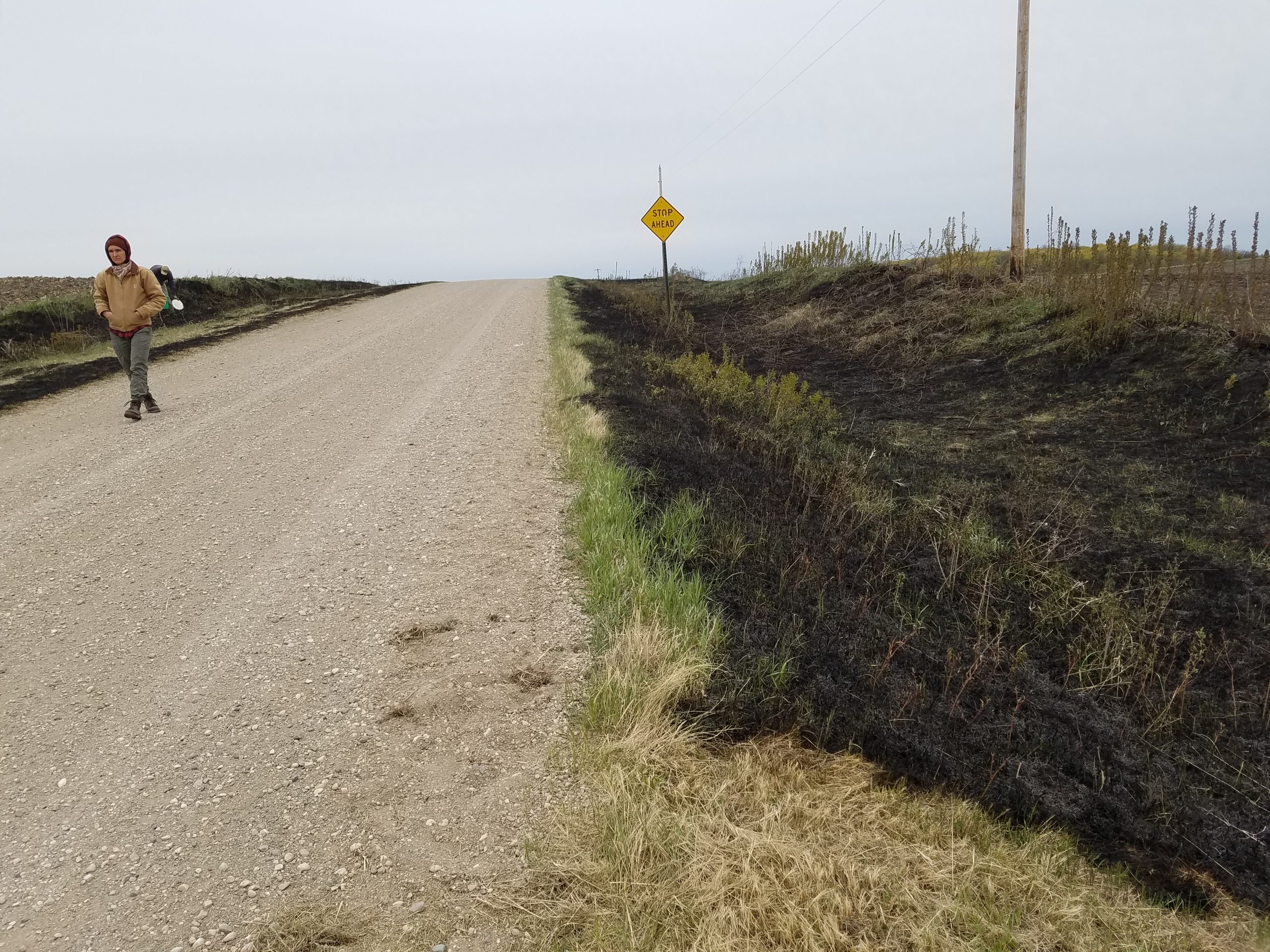
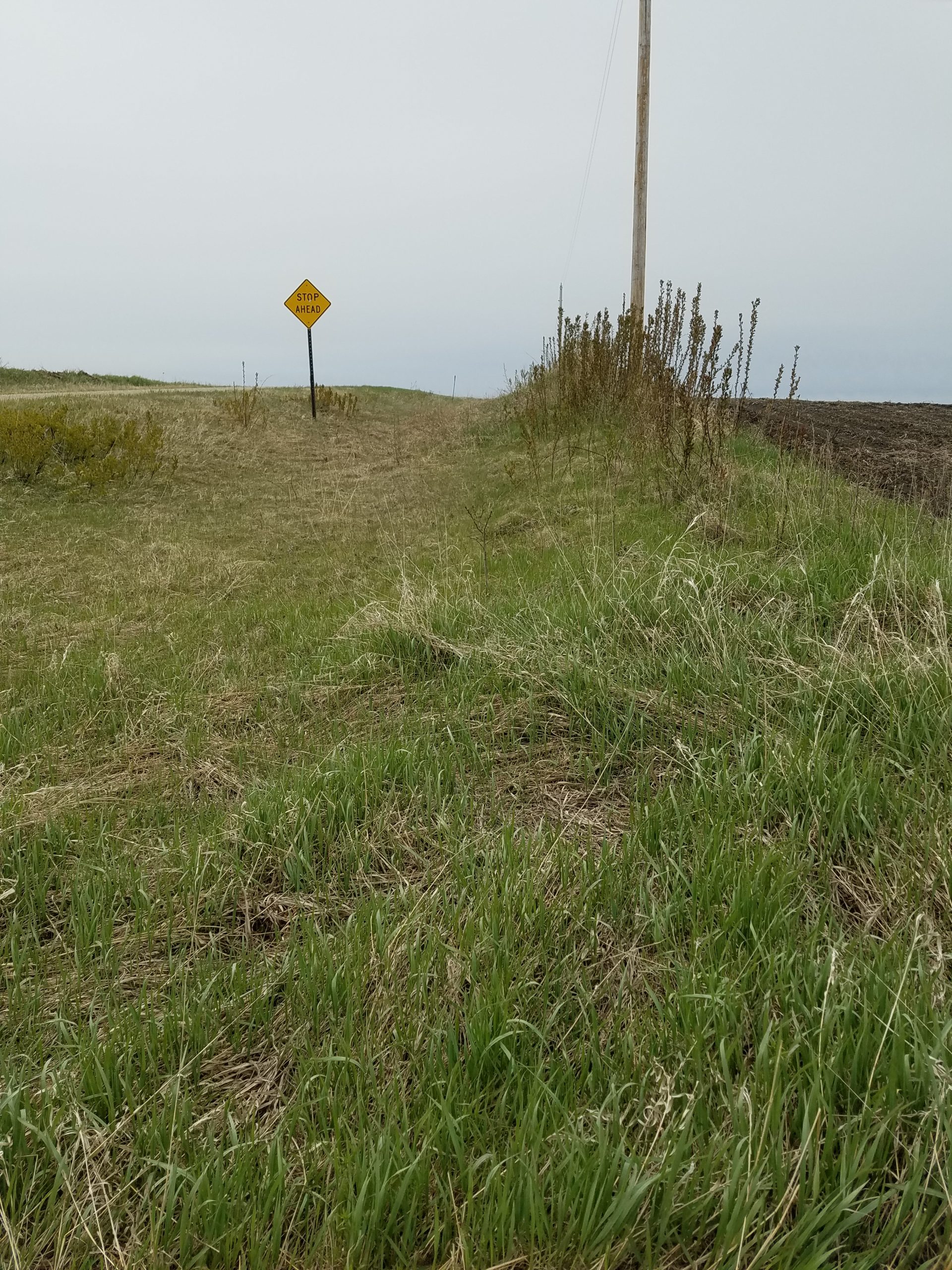
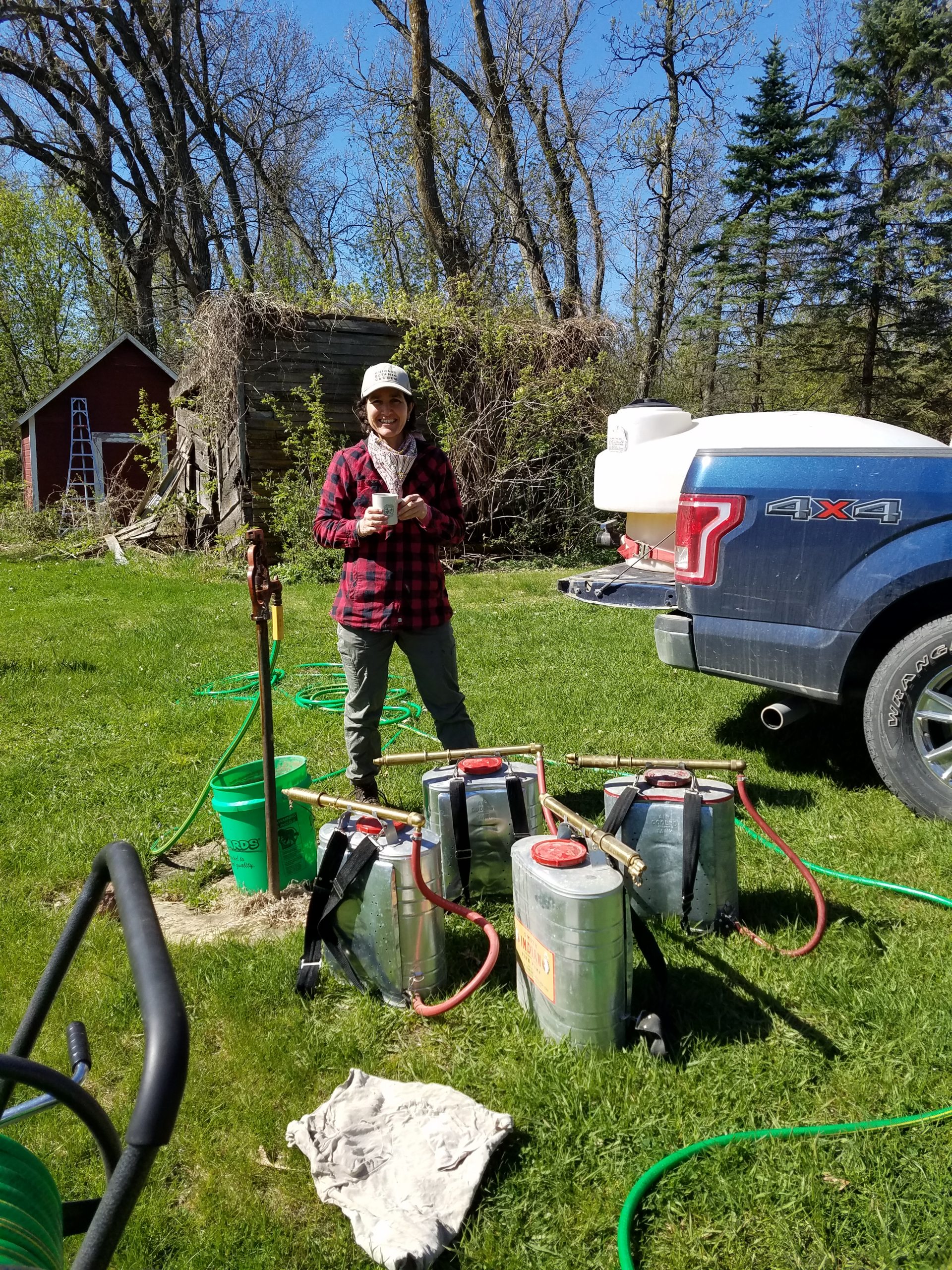
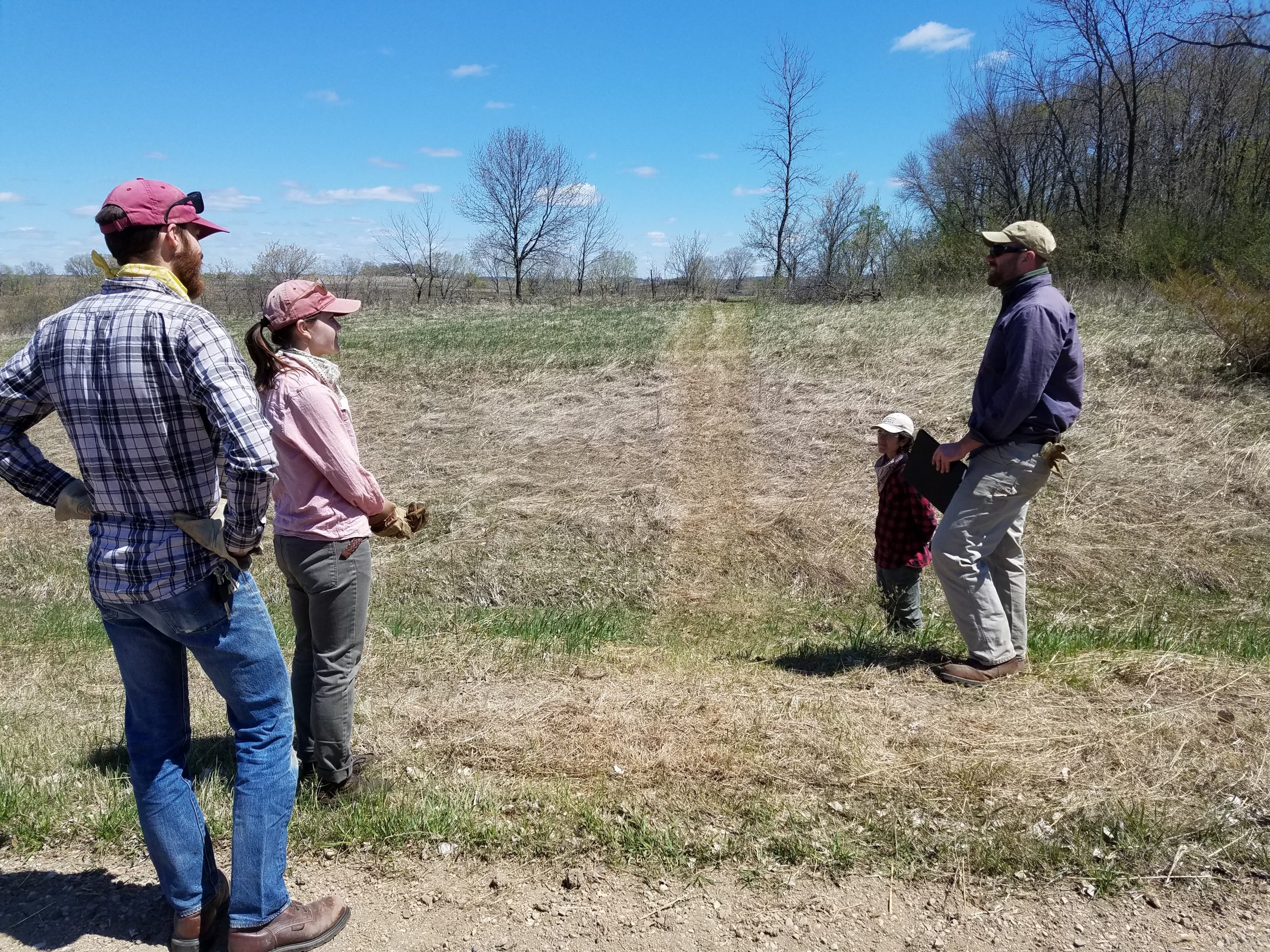
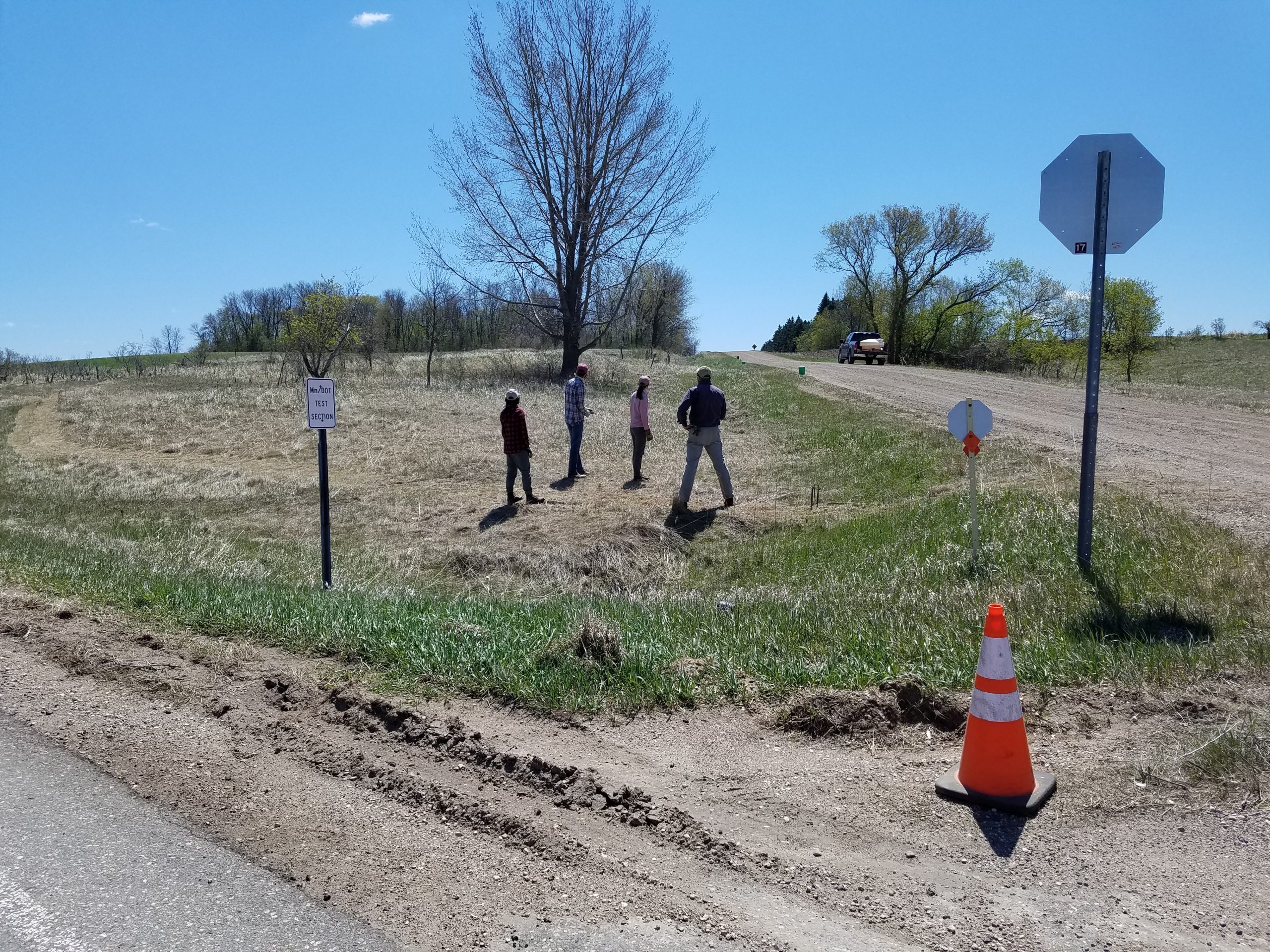
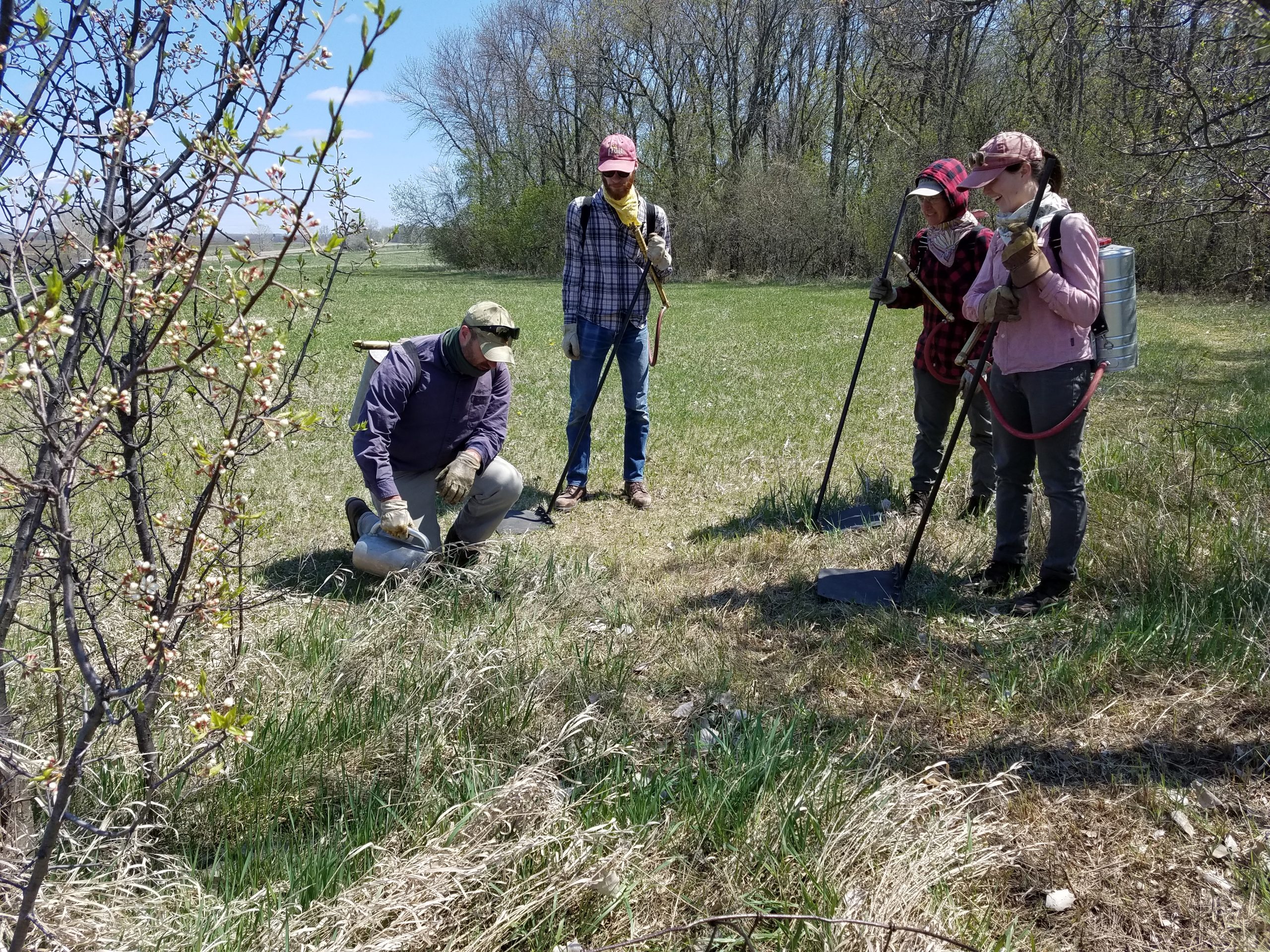
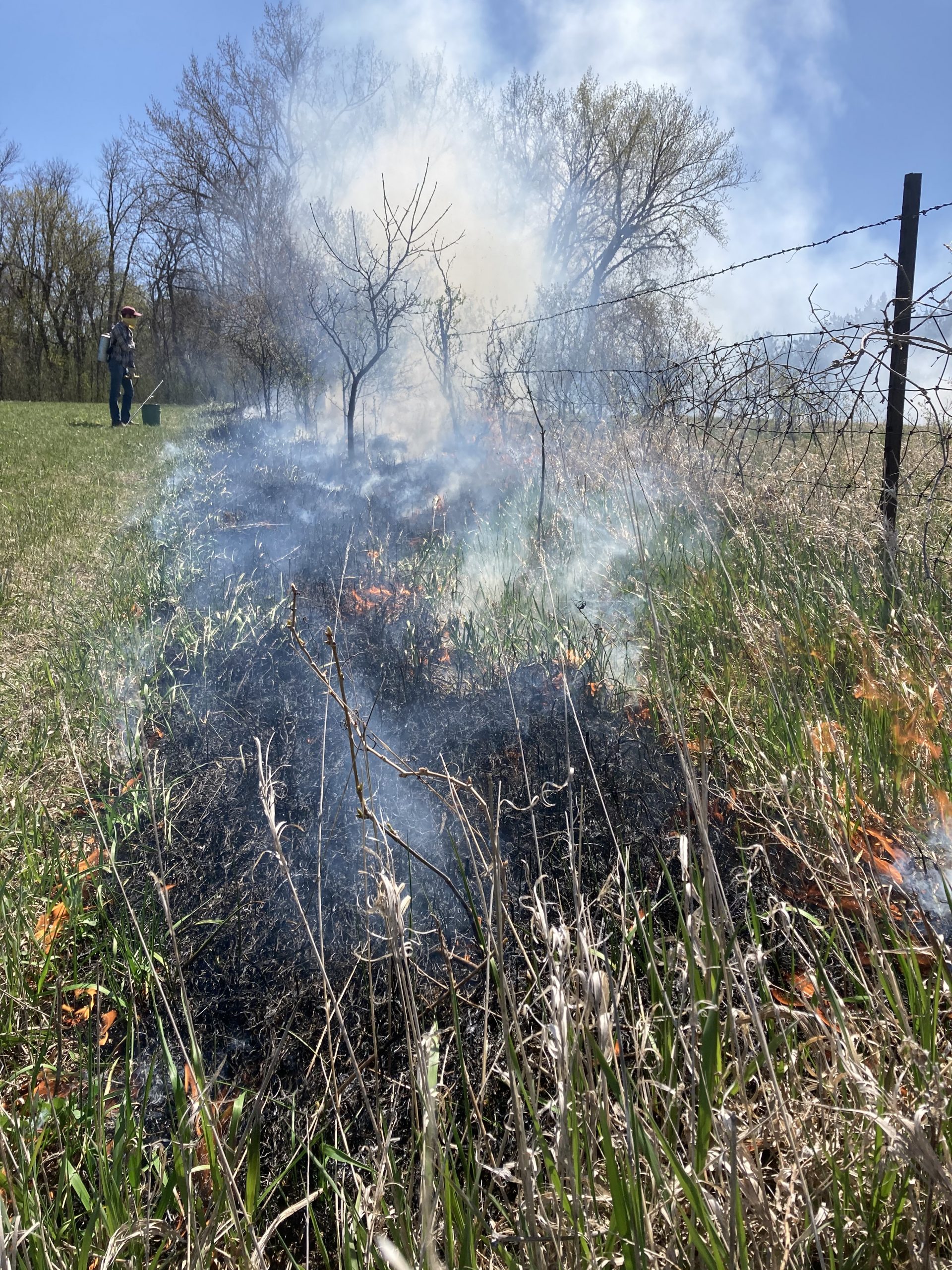
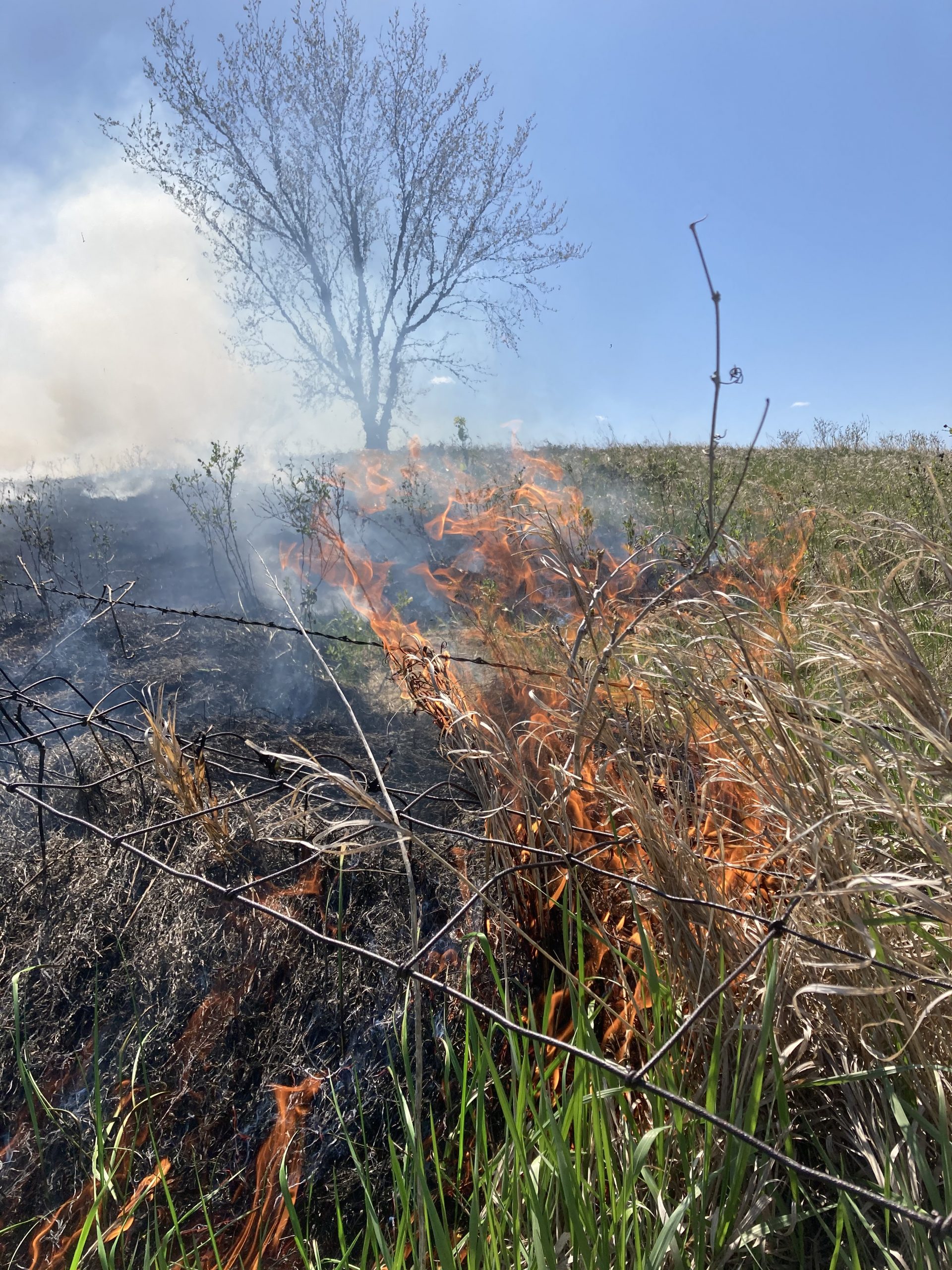
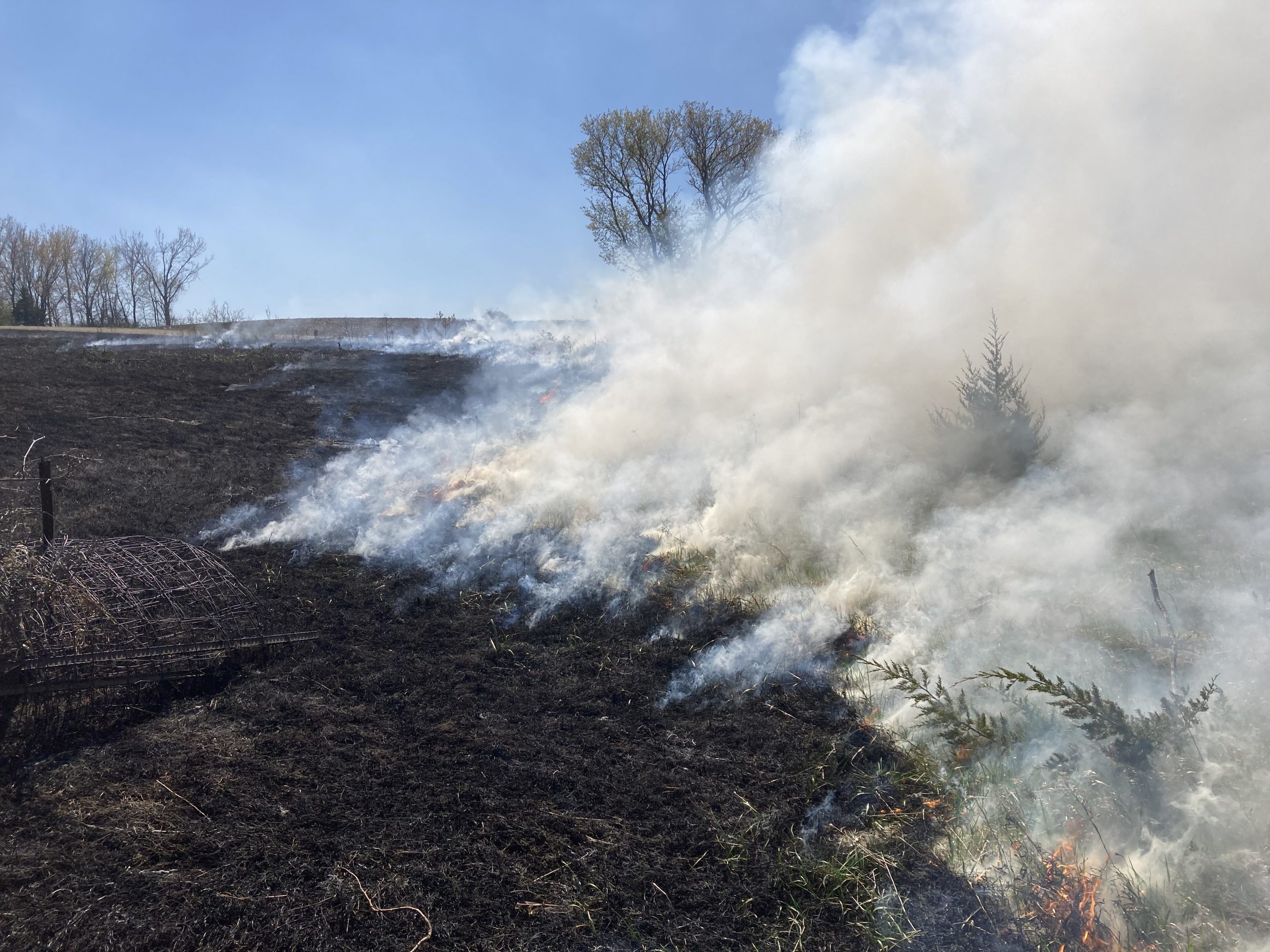
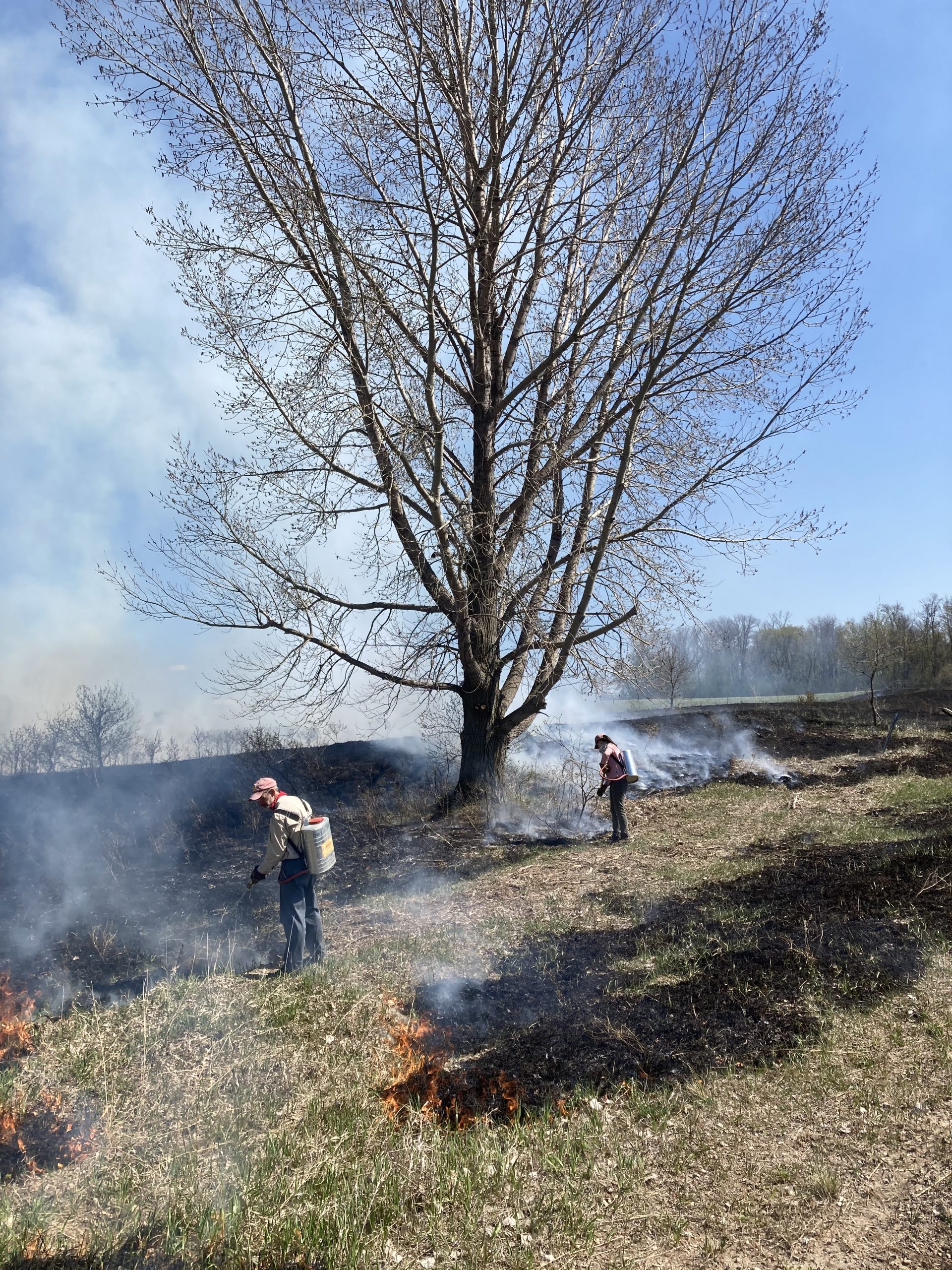
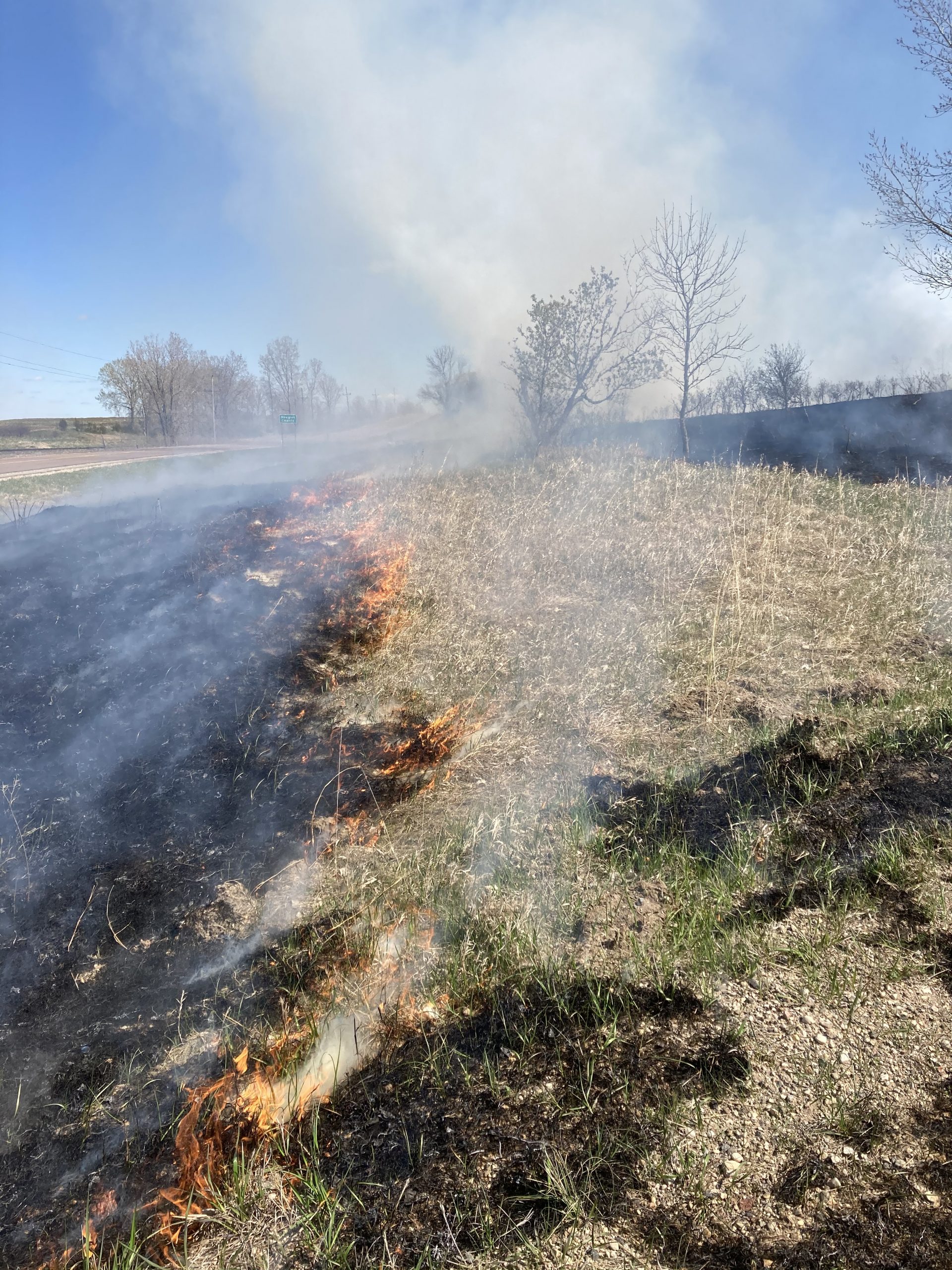
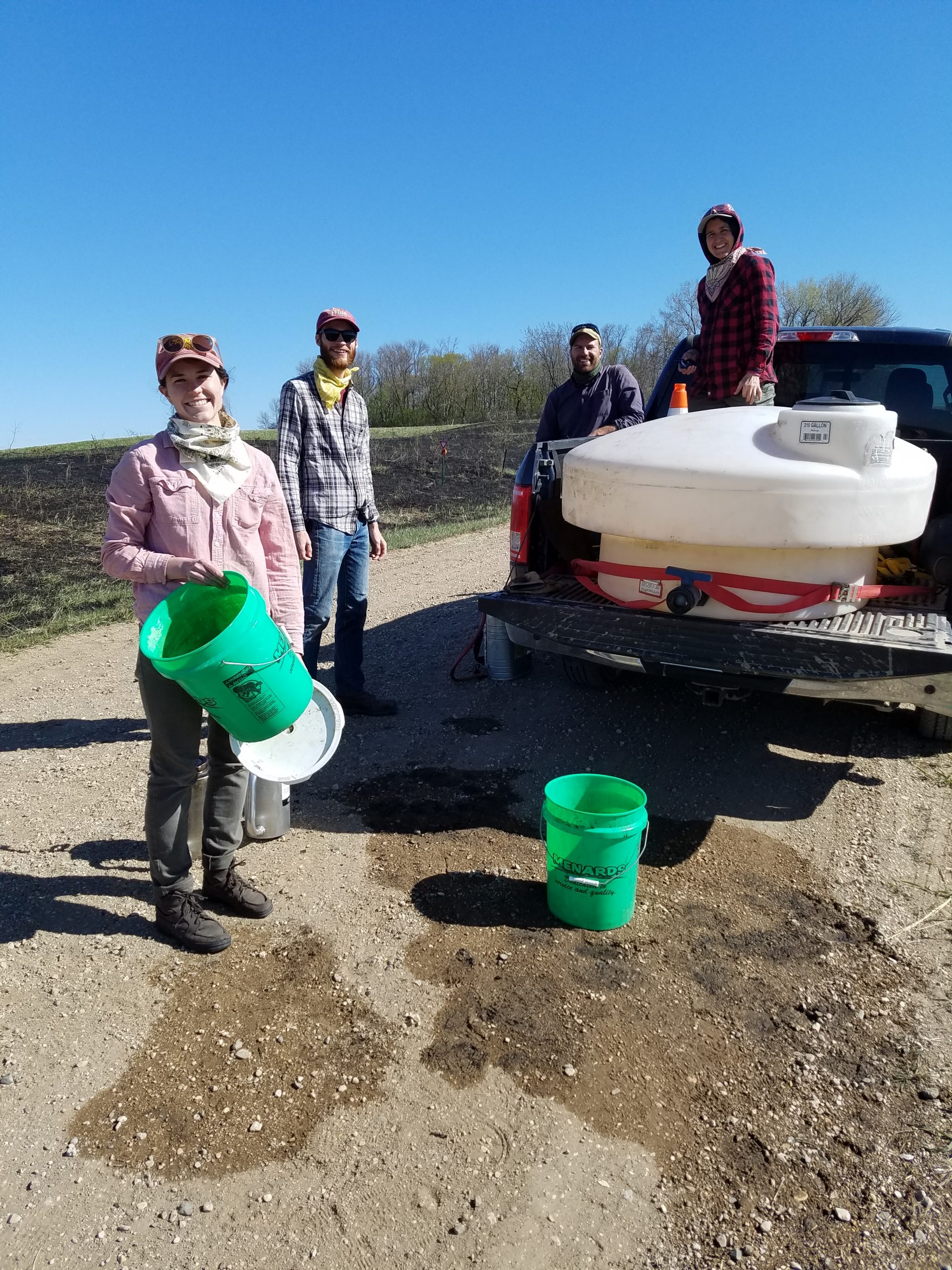
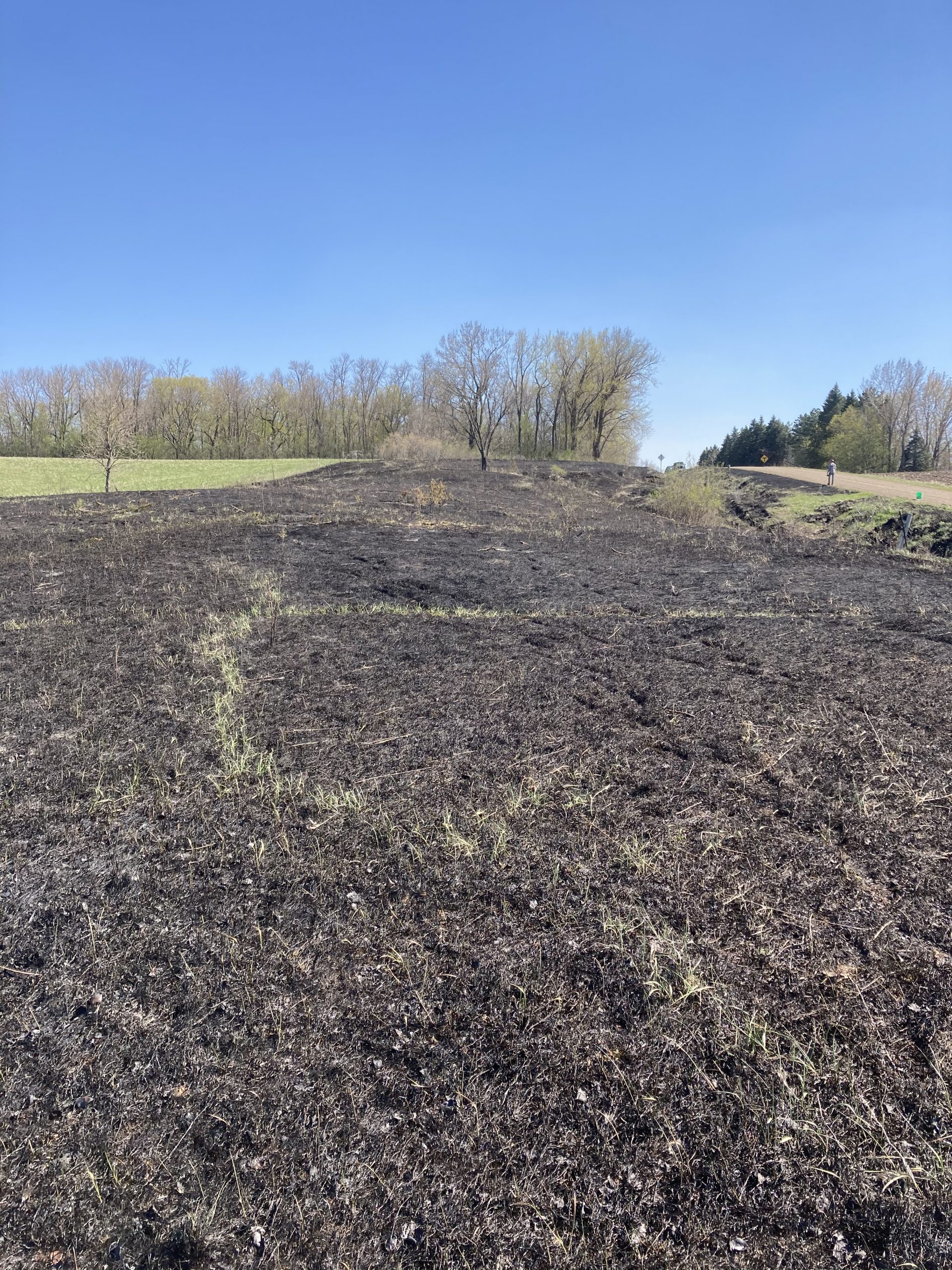
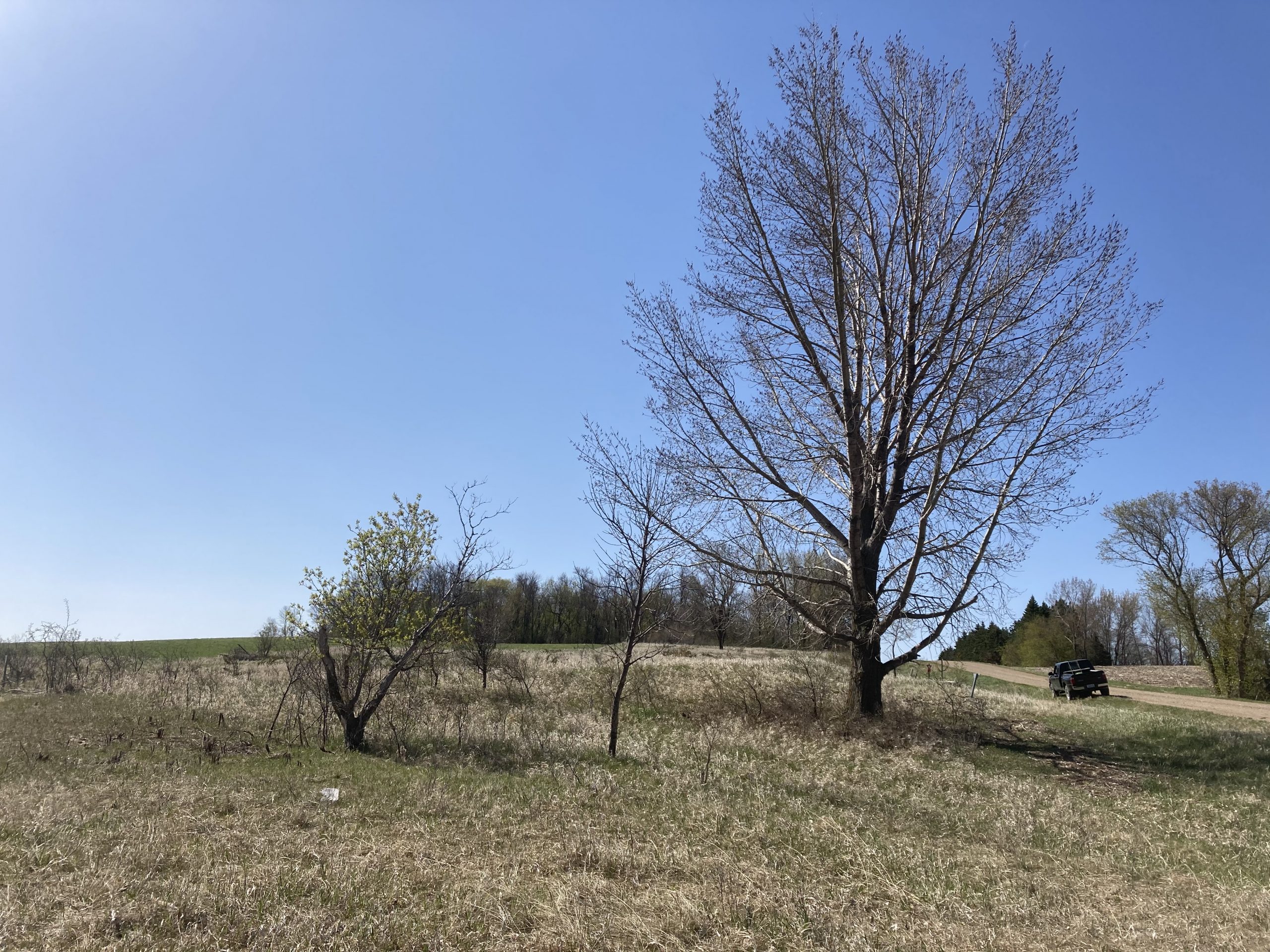
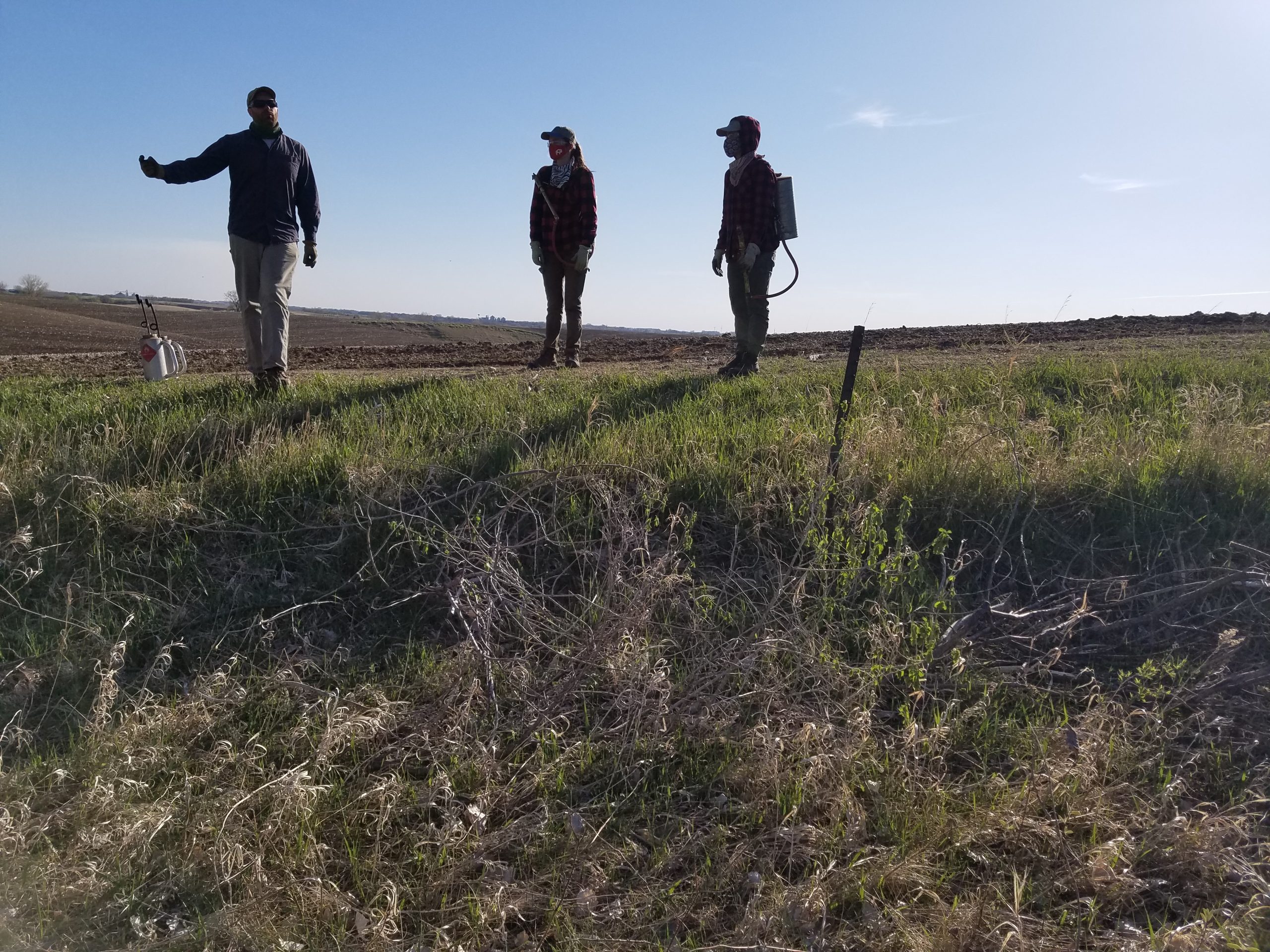
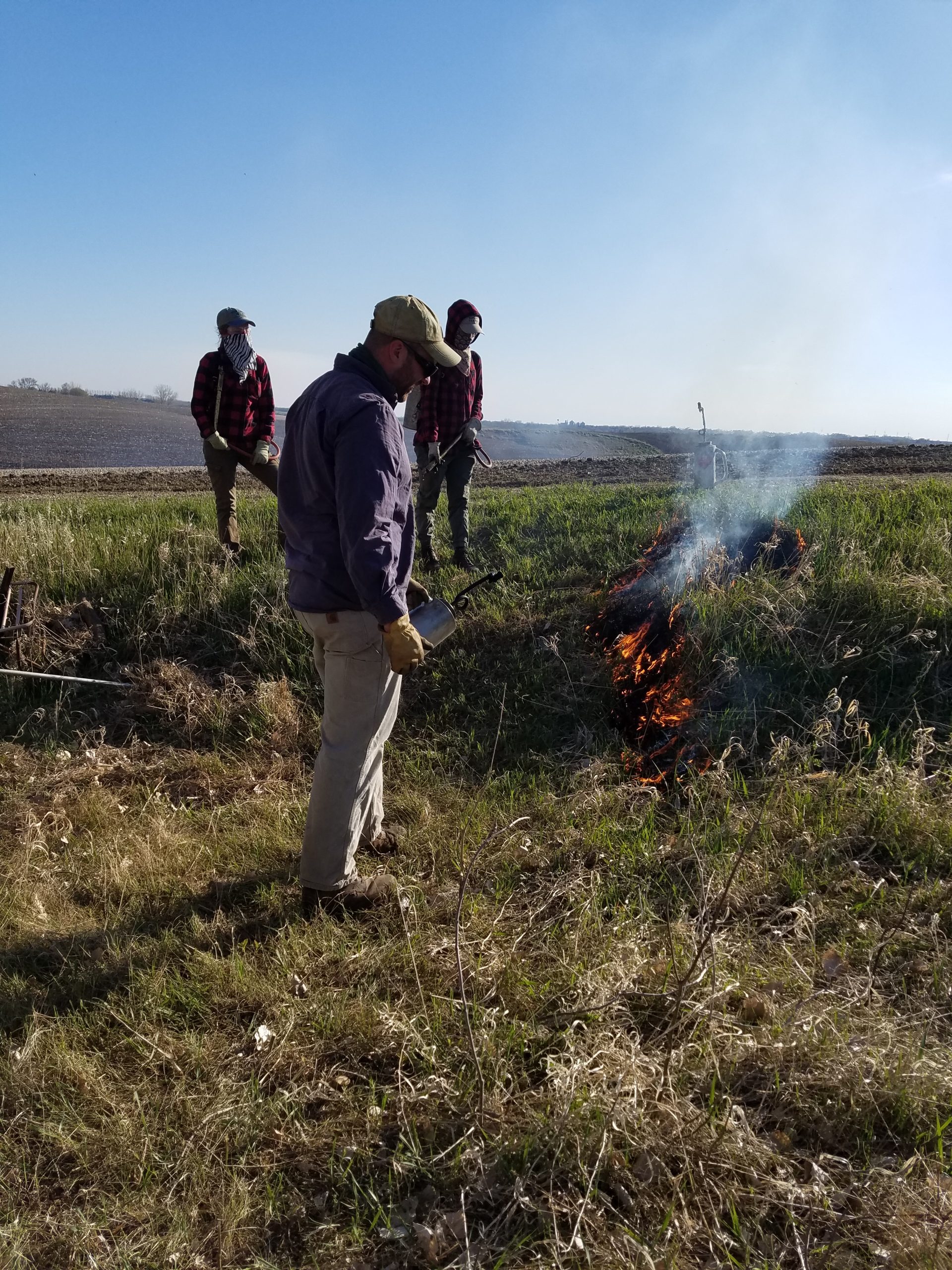
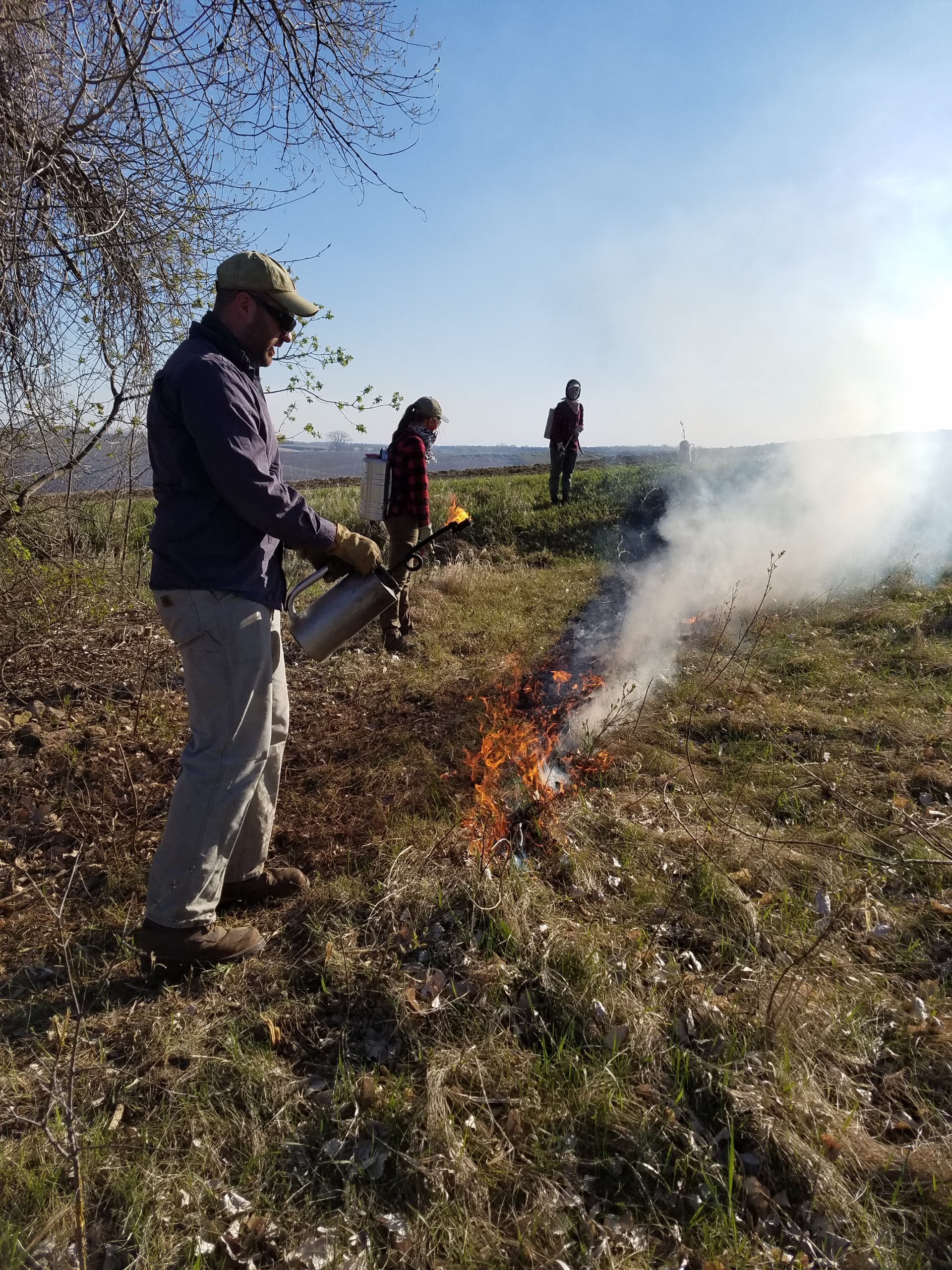
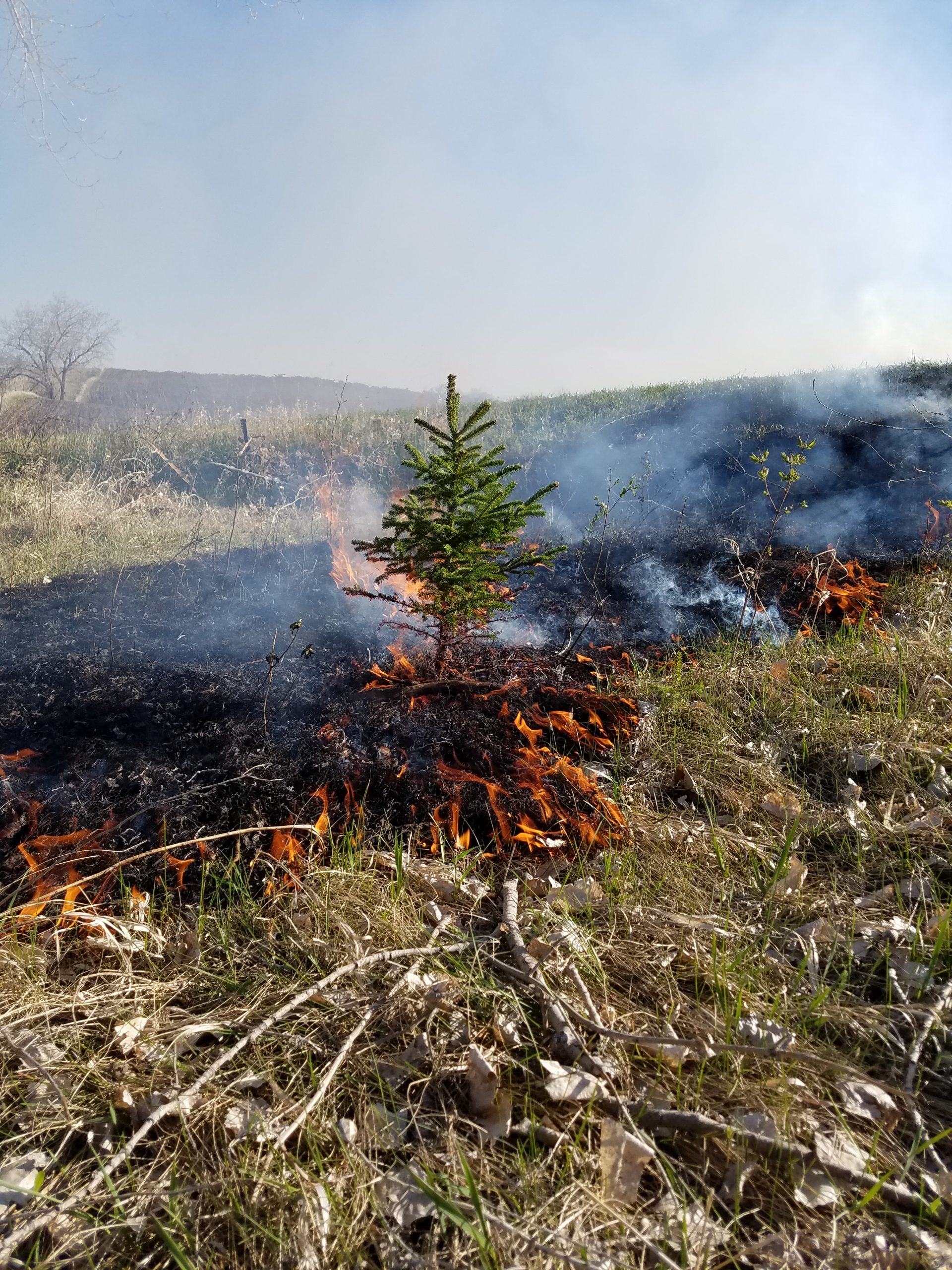
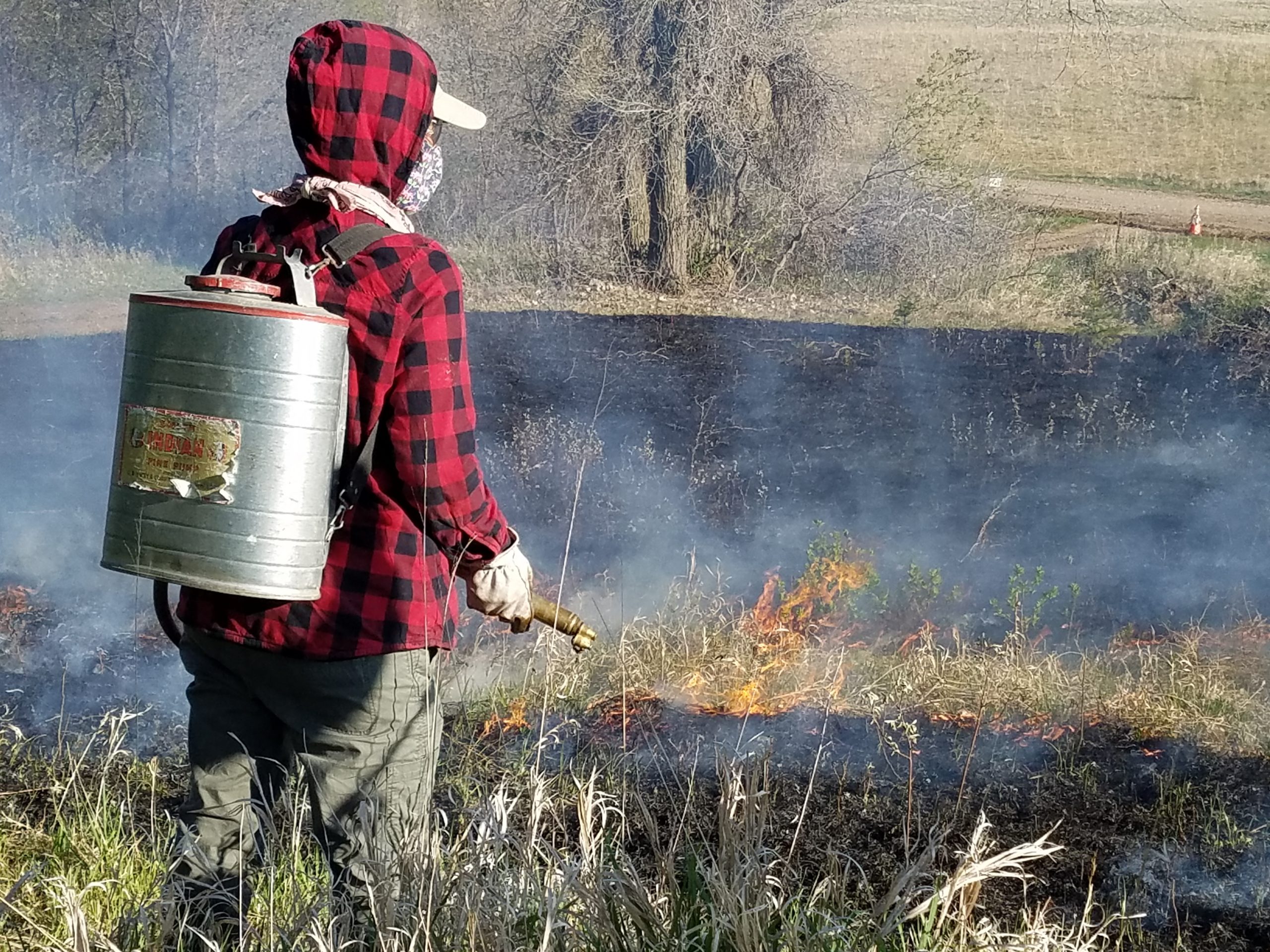
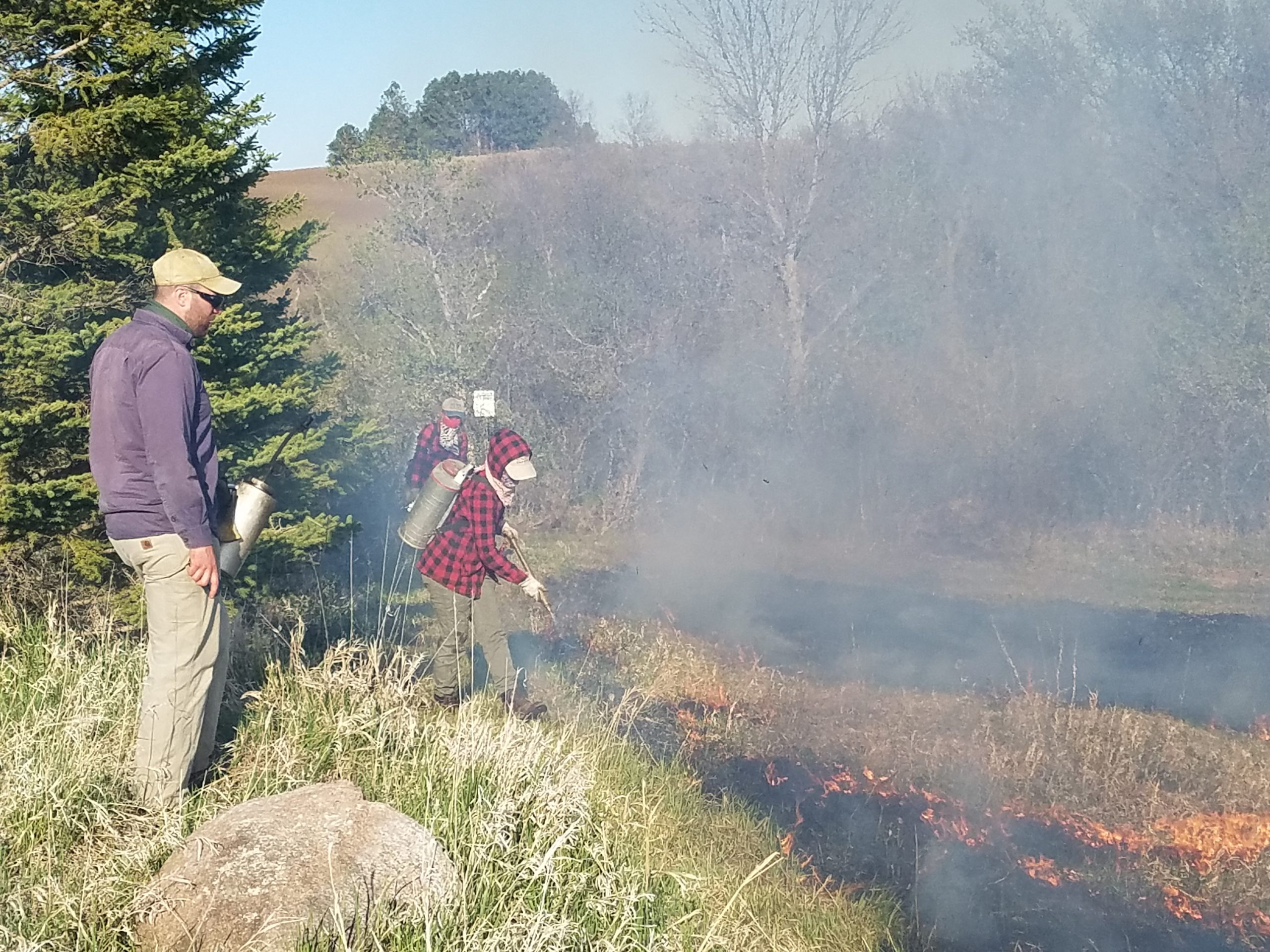
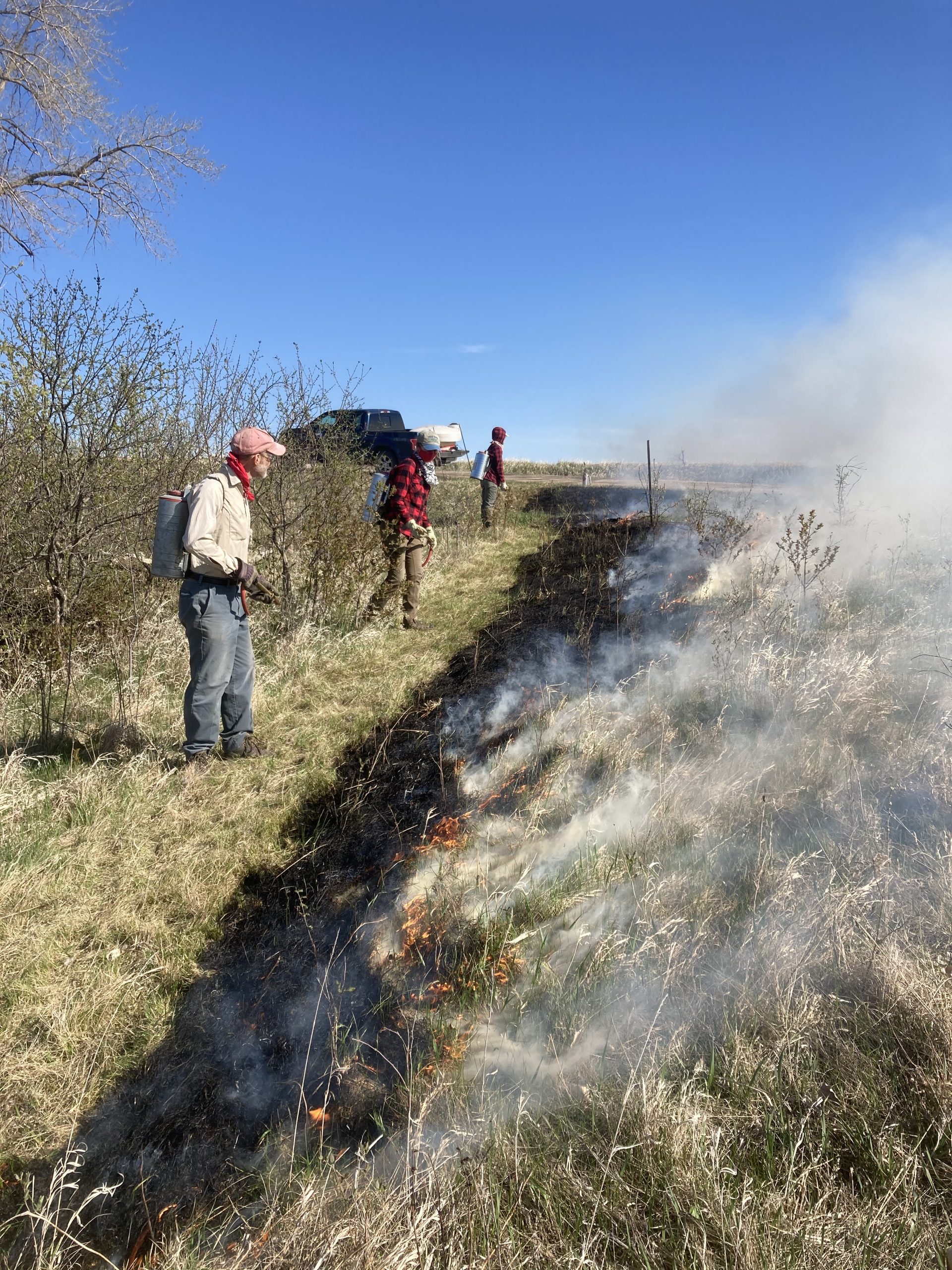
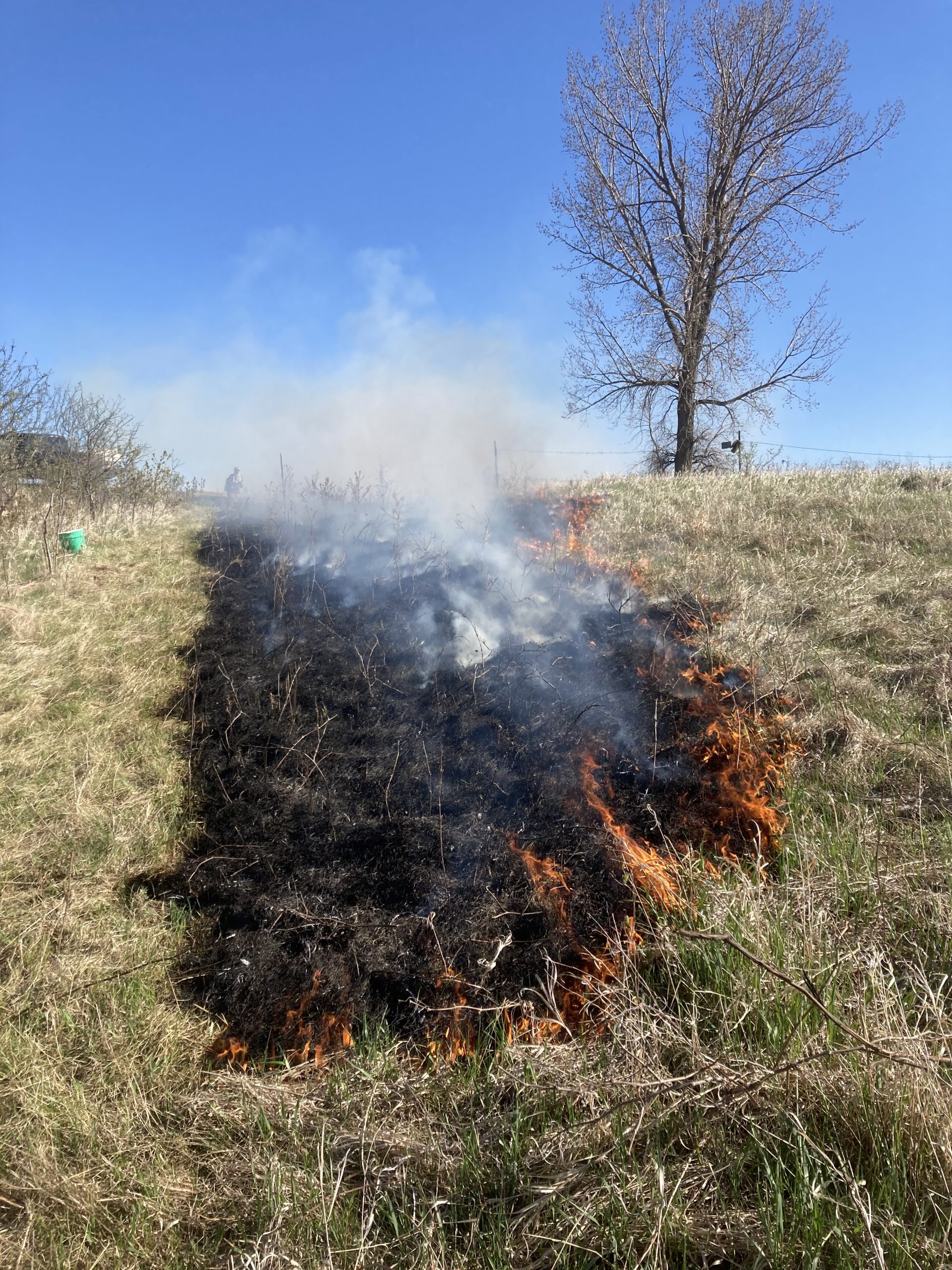
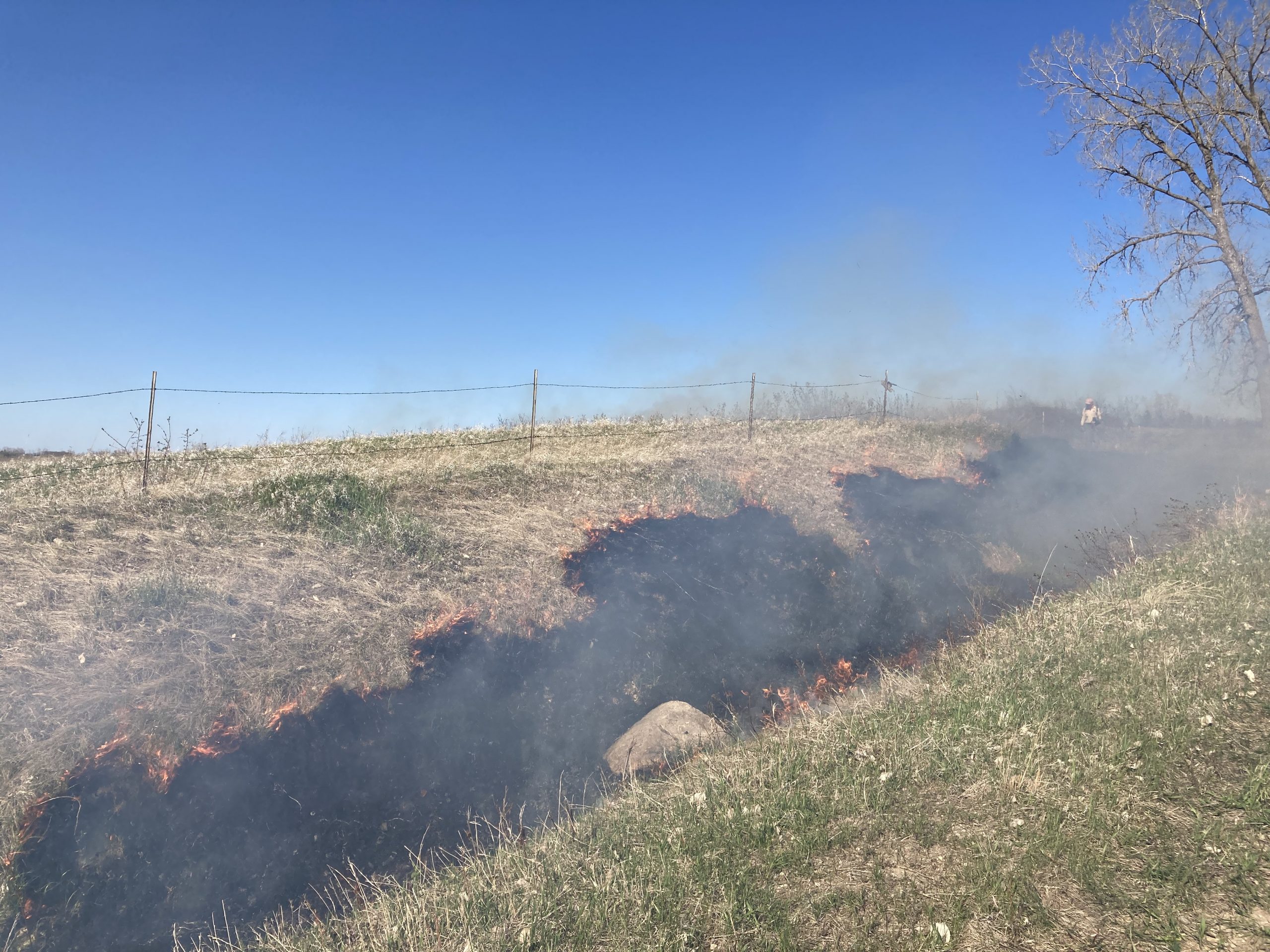
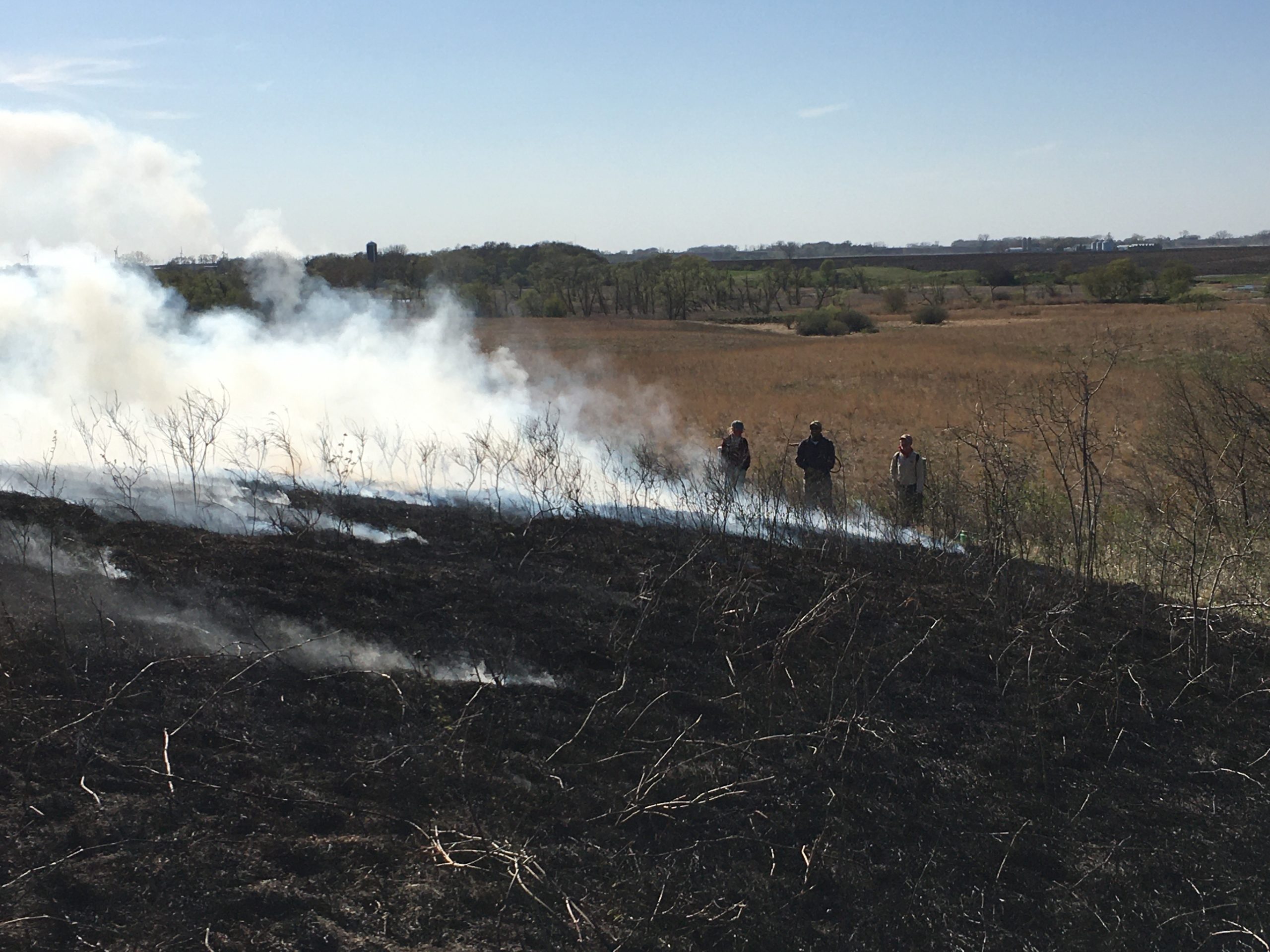
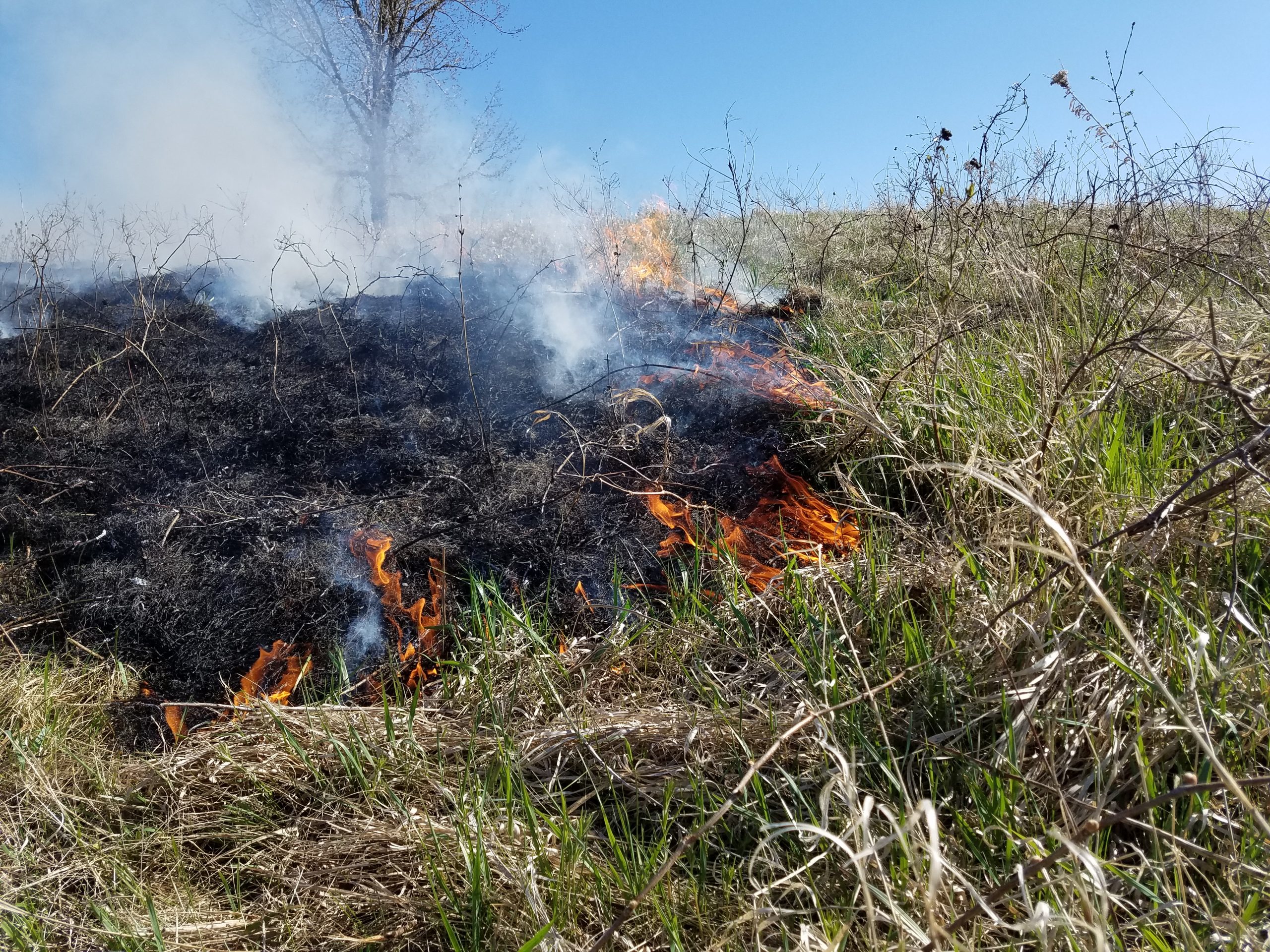
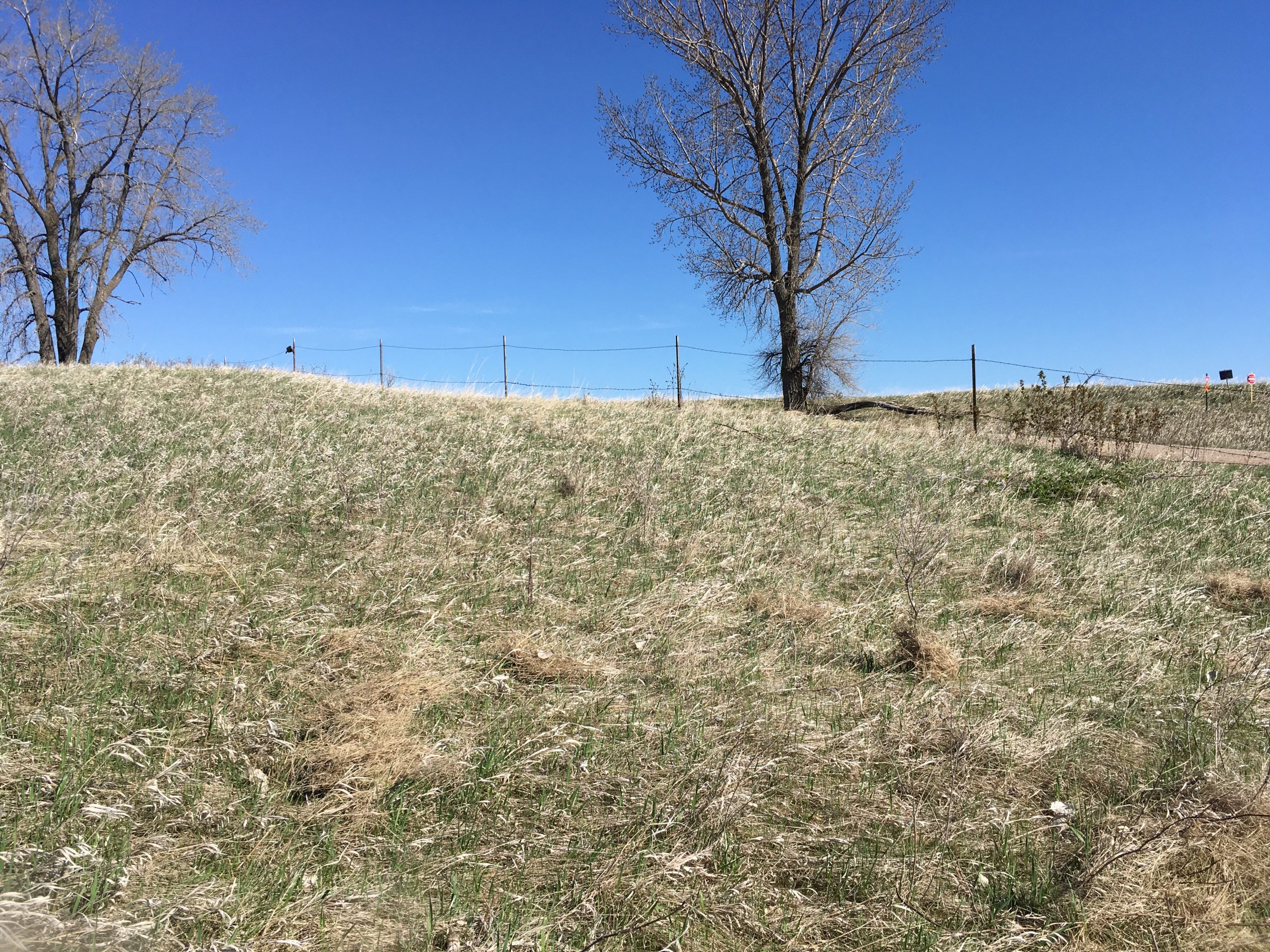
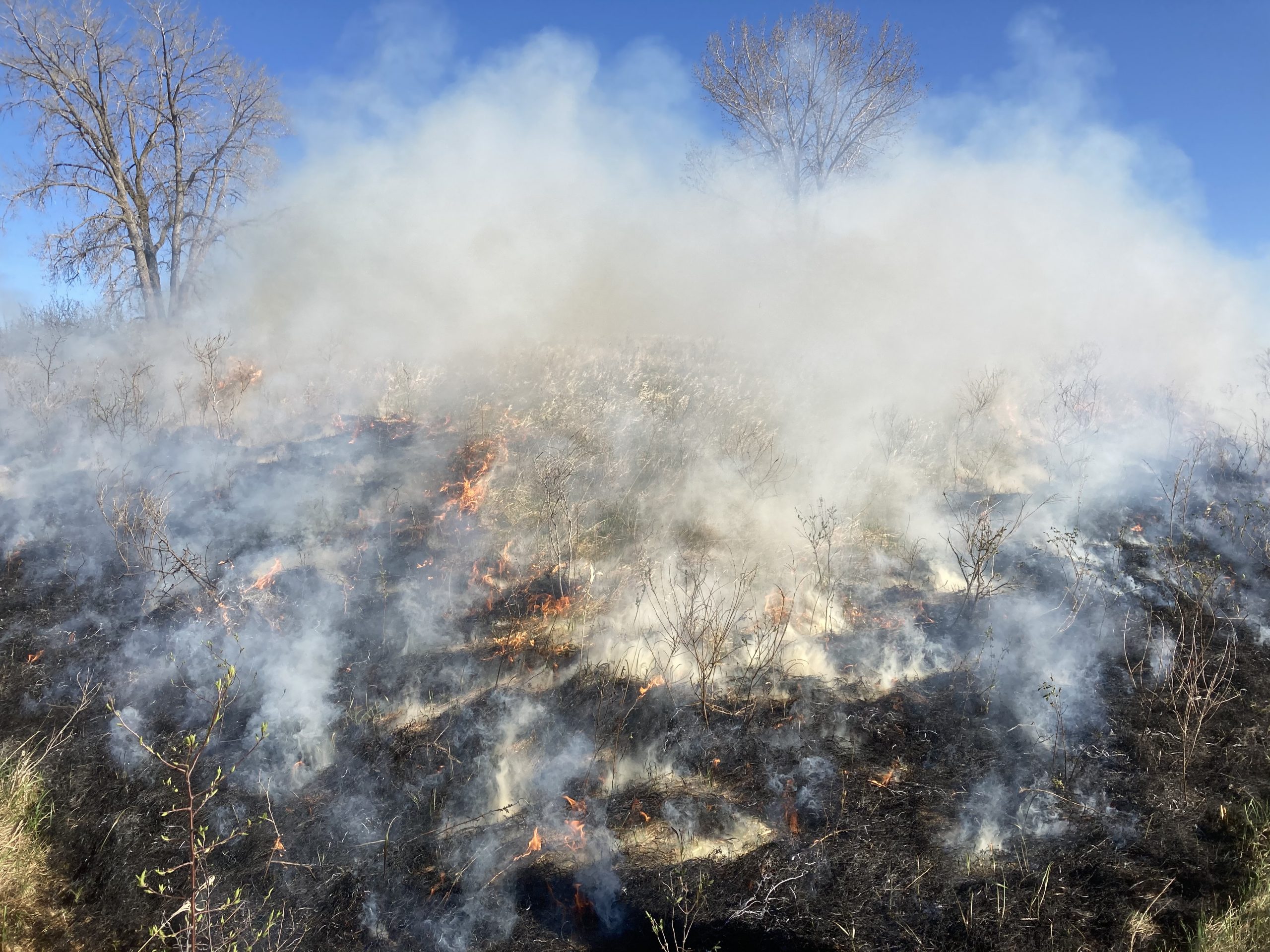
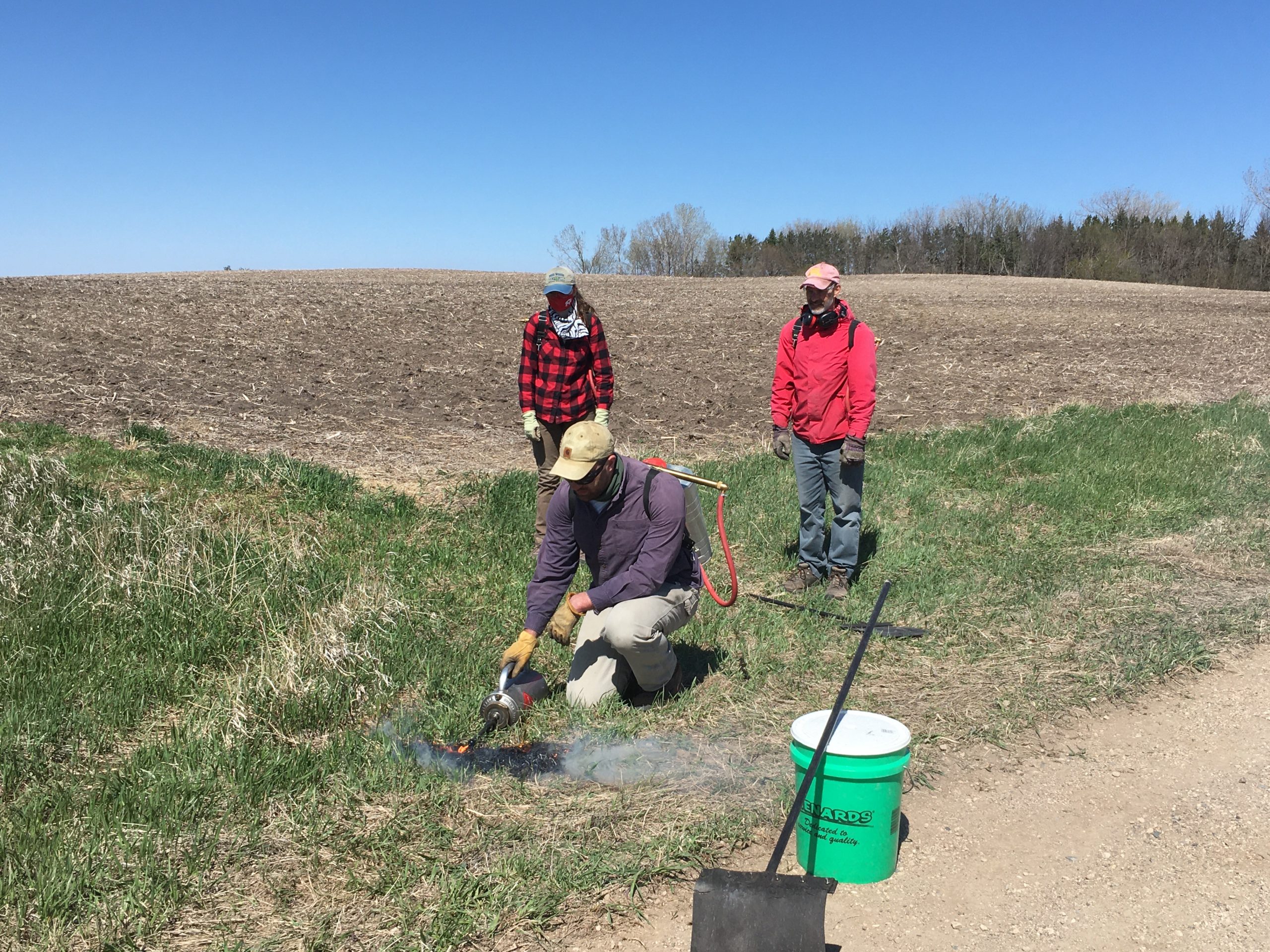
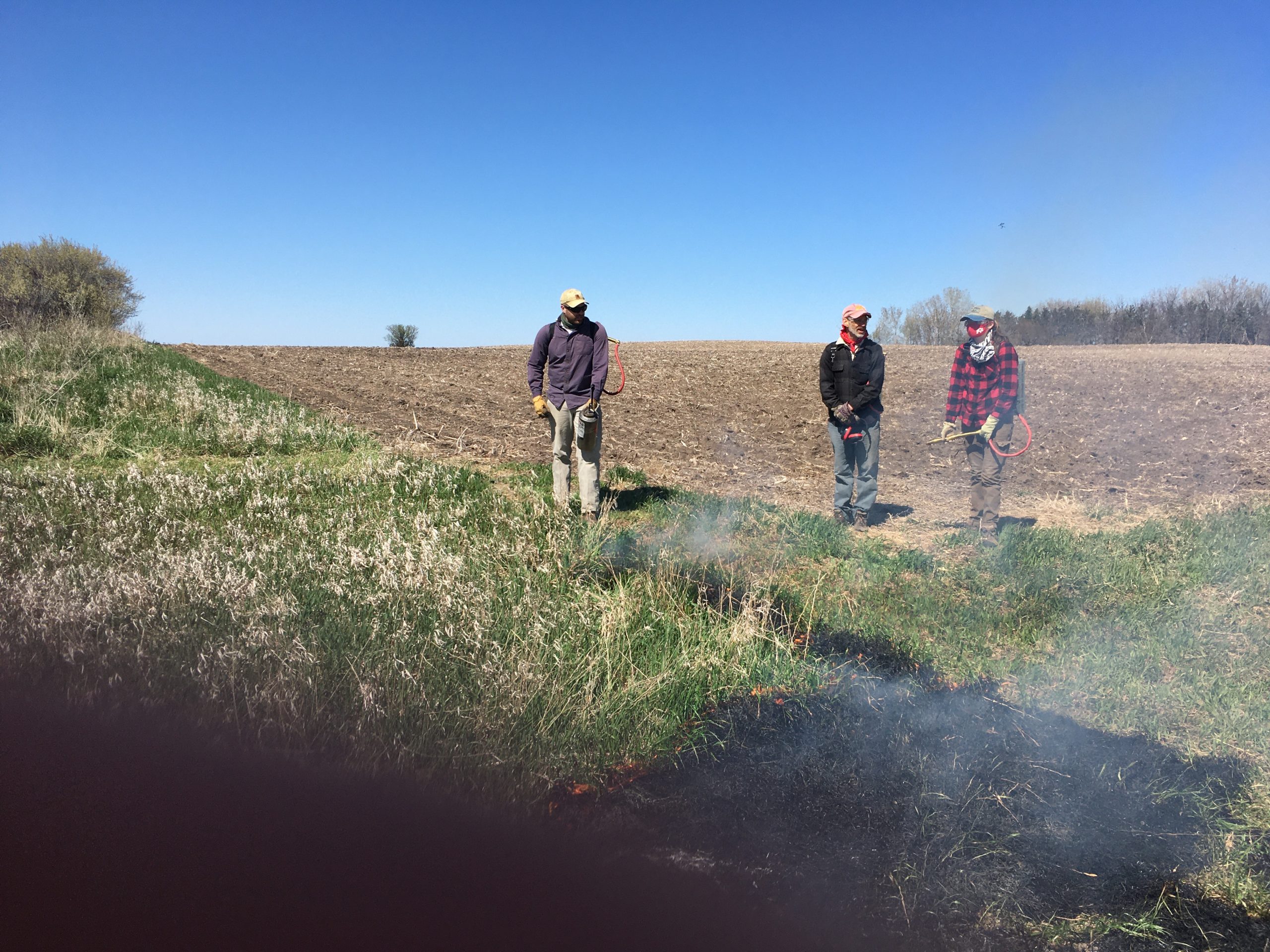
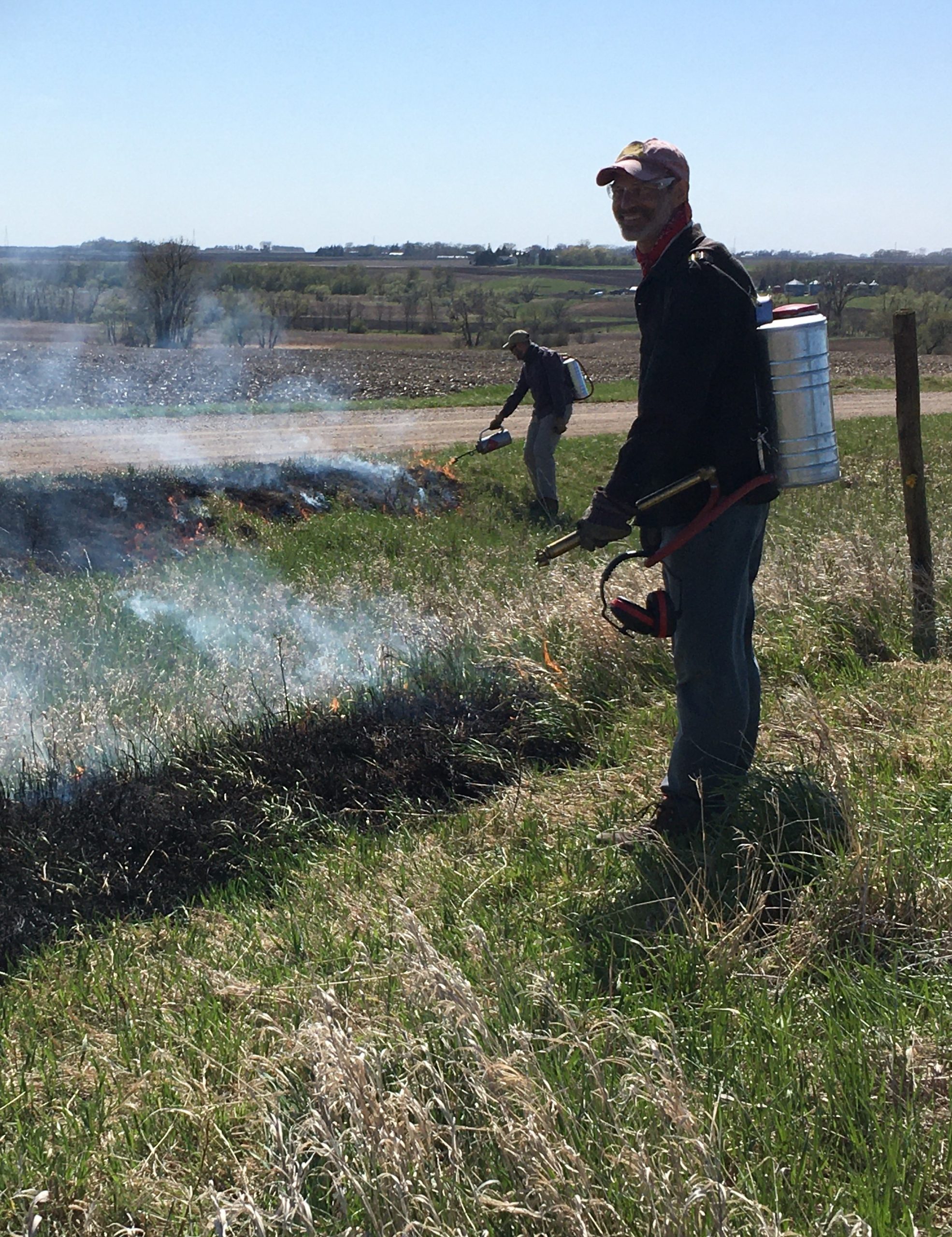
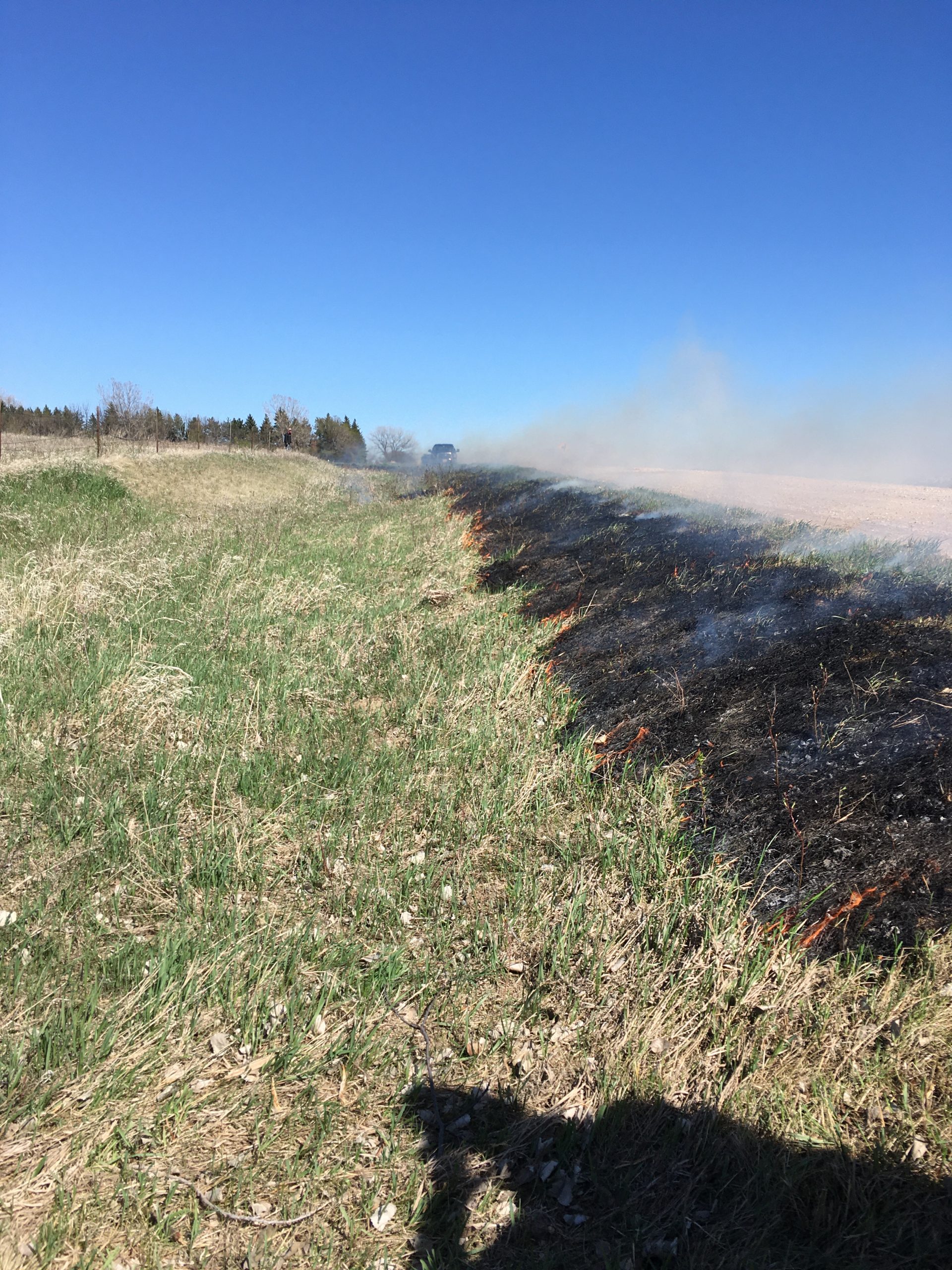
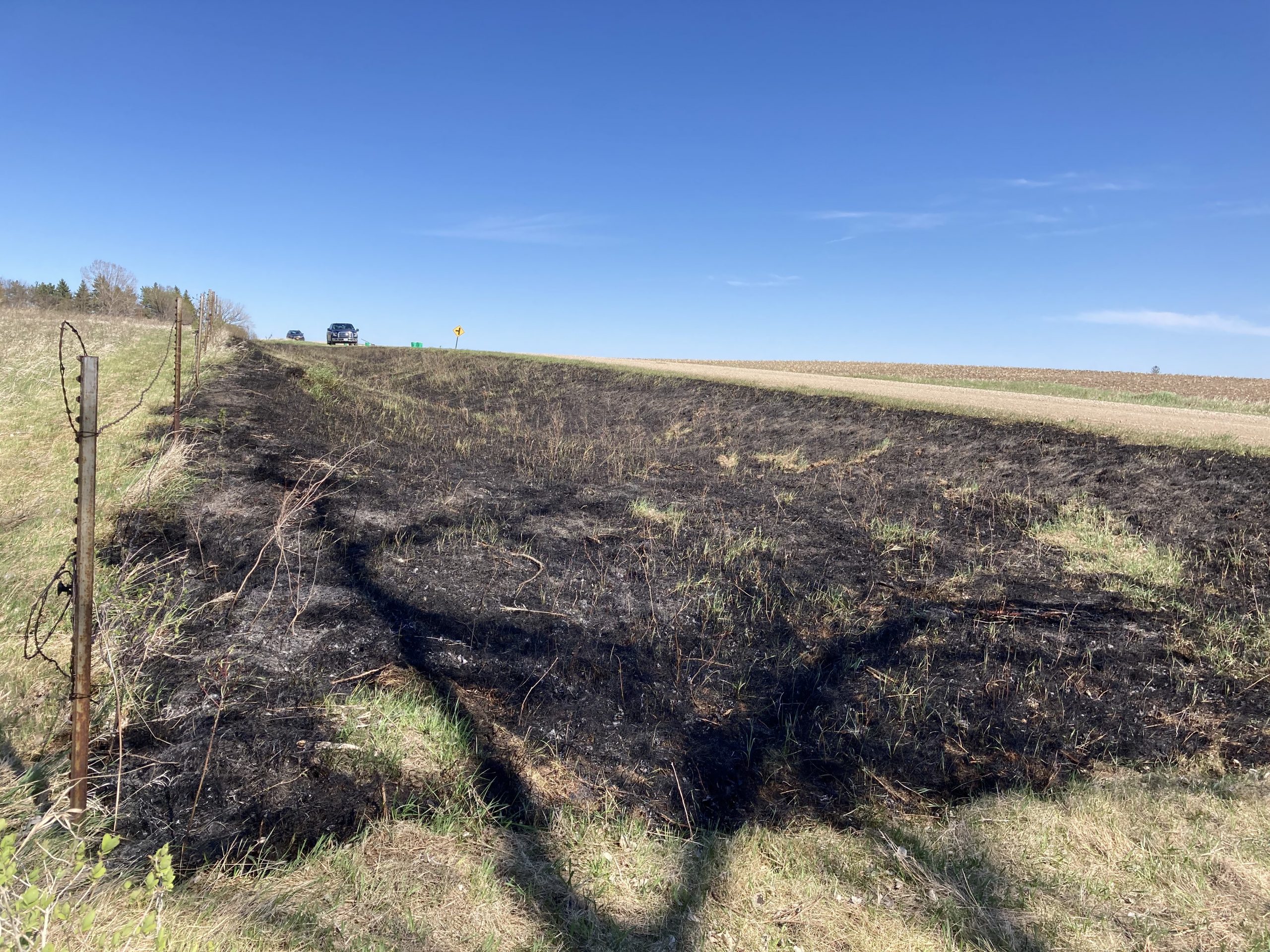
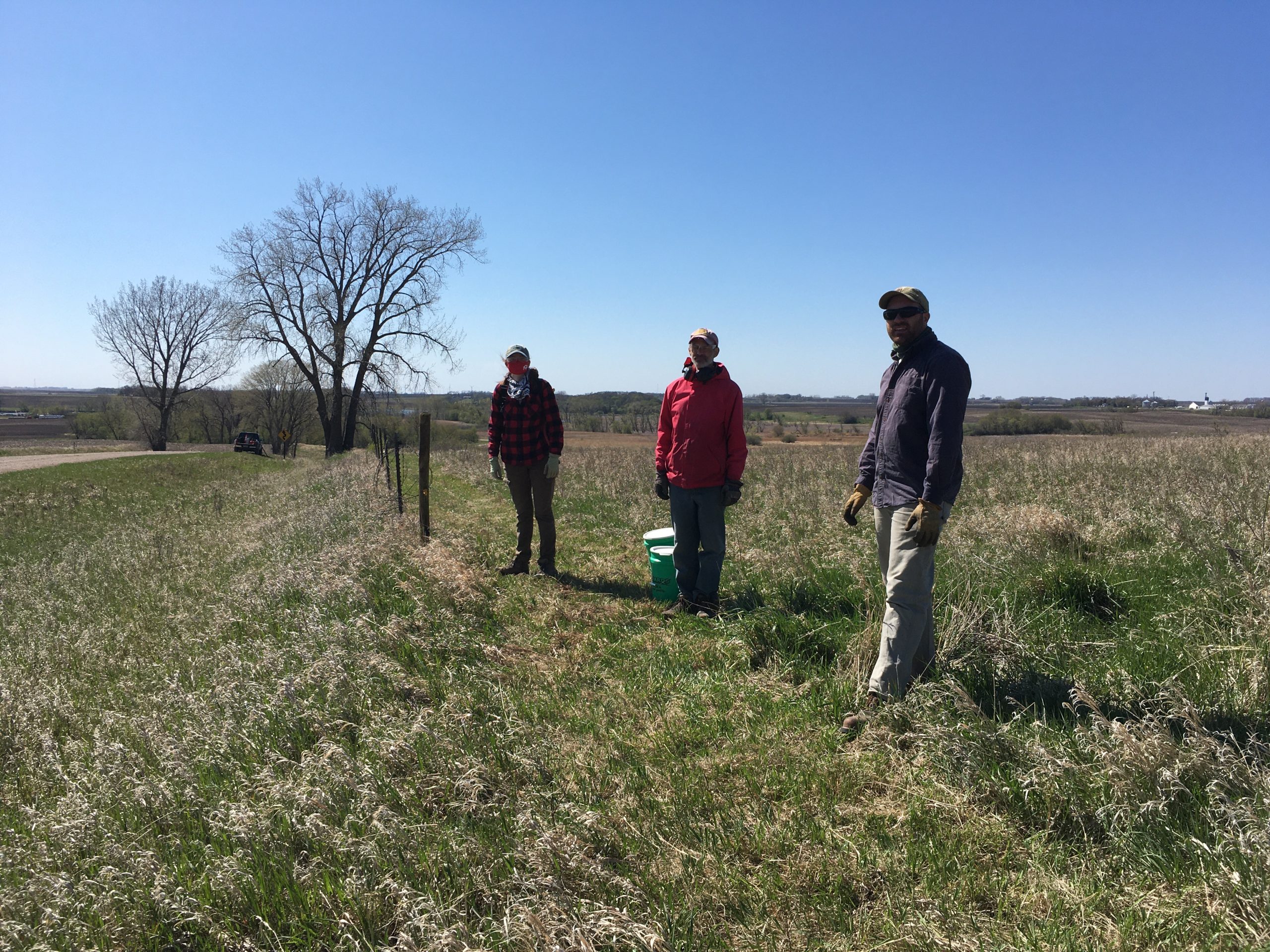
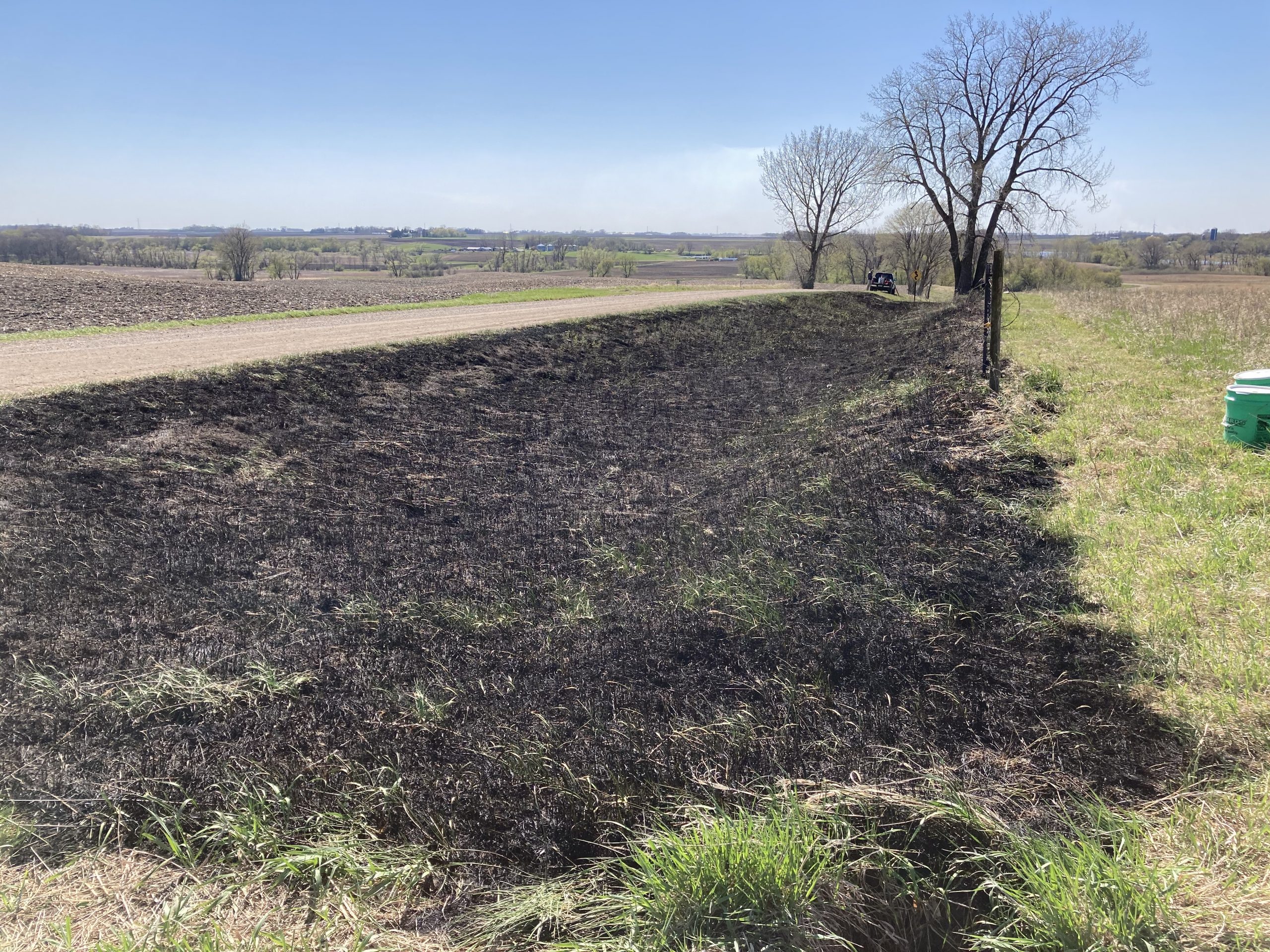
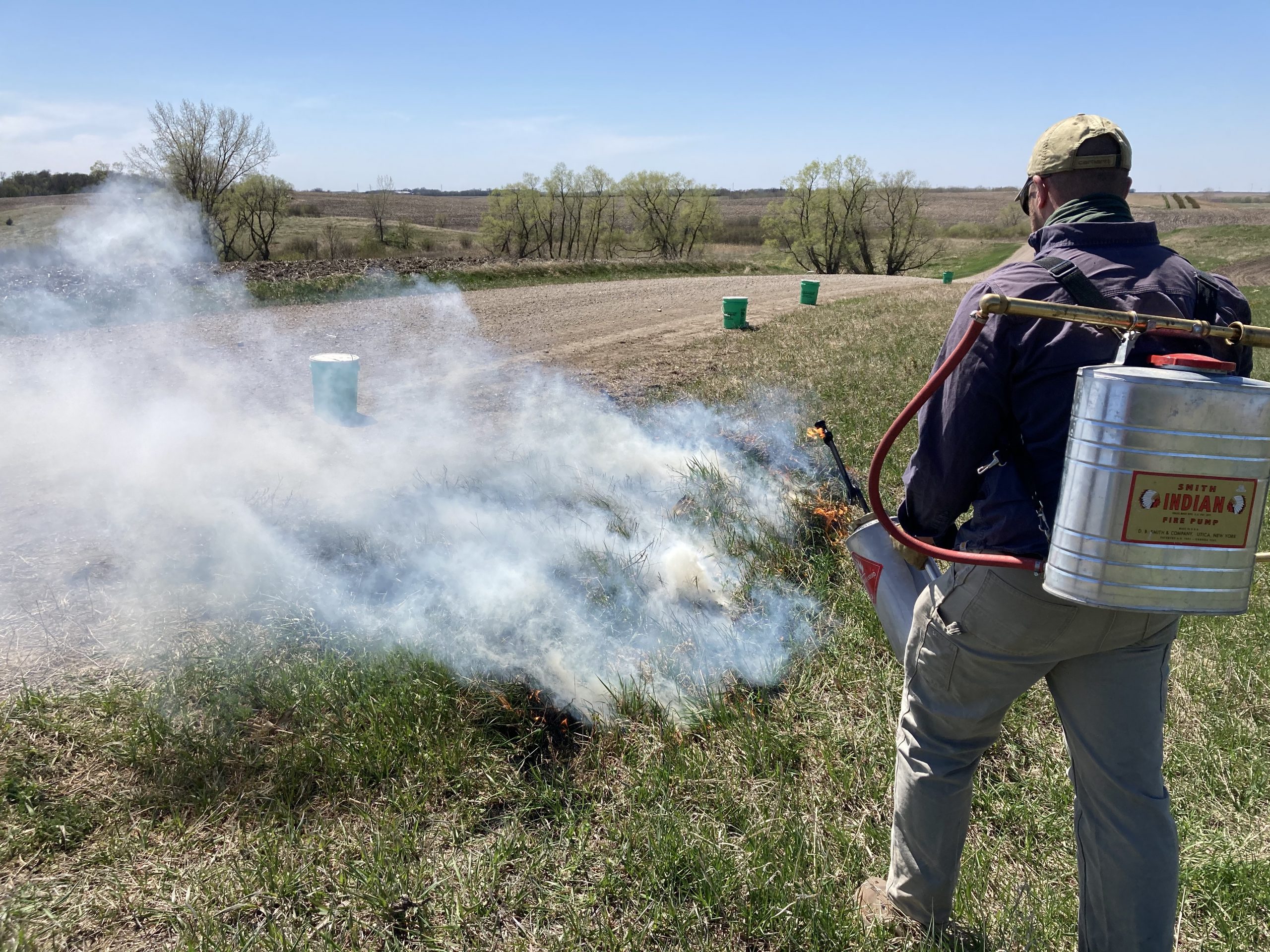
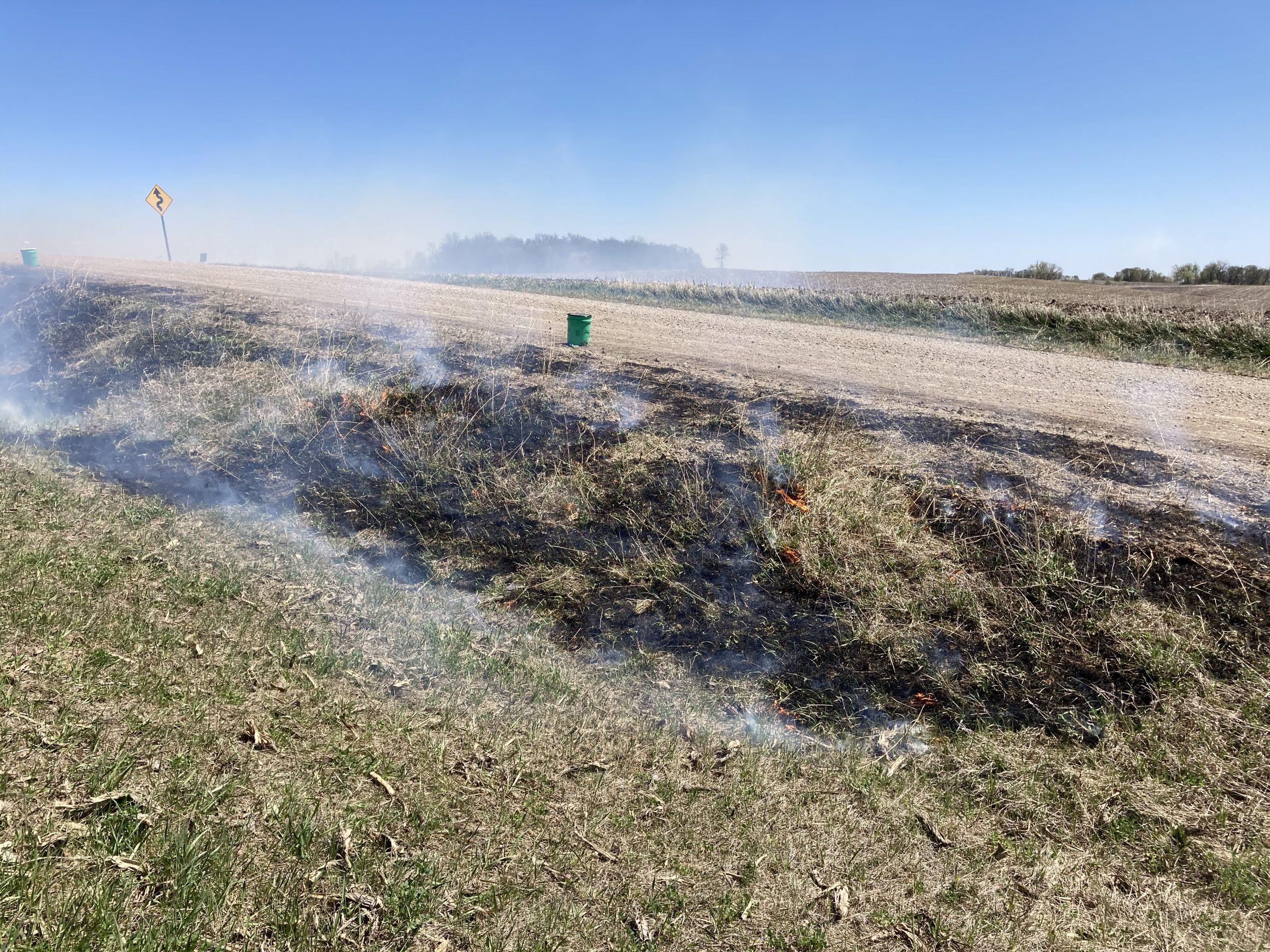
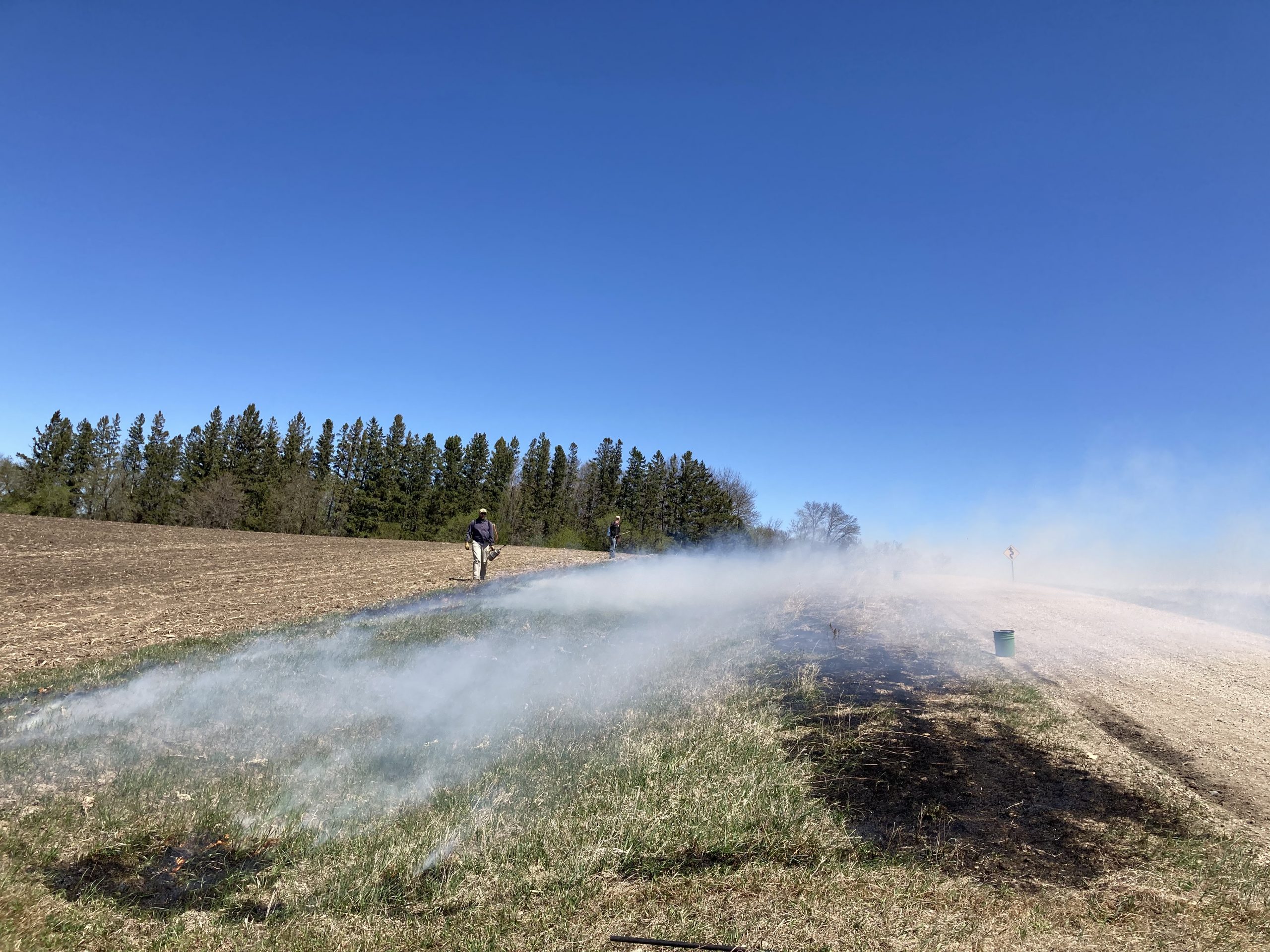
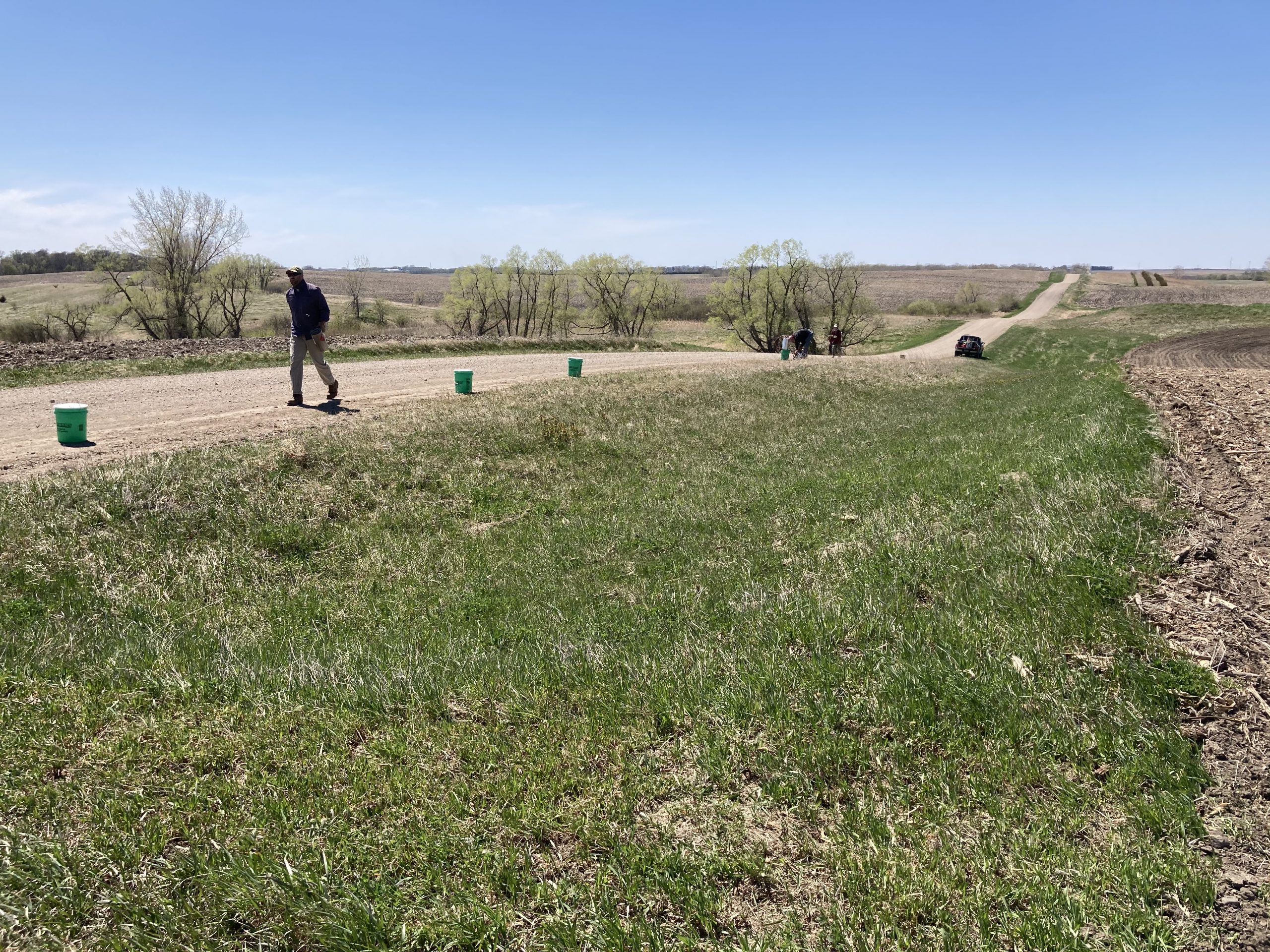
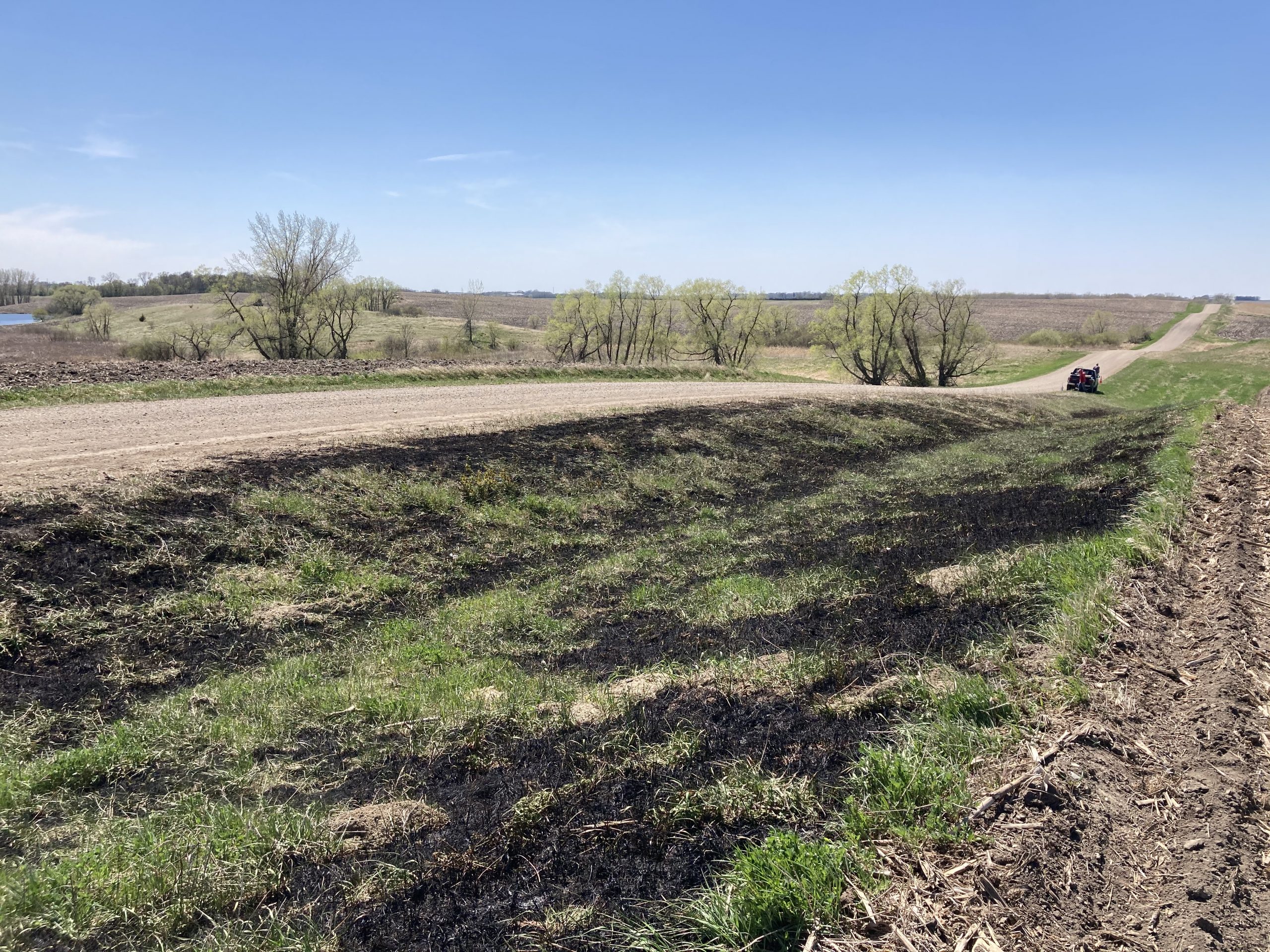
Saturday (May 8) brought overcast skies and east-southeast winds. Conditions were not ideal for burning but the winds, cloud cover, and relative humidity stabilized by mid-morning. Gretel, Stuart, and I thought we might be able to get a couple burns in. We decided to try Steven’s approach where I had mowed burn breaks Thursday. We loaded up backpack pumps, drip torches, water buckets, flappers, and other equipment and drove a short way east to the pair of burn units.
Starting with the west unit, we ignited a test fire in the northwest corner, secured the north burn break, and proceeded to ignited the western edge the unit. We ignited cautiously around two telephone poles but made quick work of igniting along the field edge. Towards the end of burning the west unit, winds became squirrelly shifting from southeast to east and back again (Stuart and I swear it was northeast for a minute or two). Nevertheless, the fire backed well across the western side of Wolley Lake Rd. Fire on the approach was a bit patchy but Jared was committed to emptying a drip torch. So Jared “painted” the approach with a drip torch producing an aesthetically pleasing mosaic of burned grasses and bare gravel.
Once the south end of the western unit had been secured by Stuart, Gretel and Jared scurried across the road and began igniting the east unit while Stuart kept vigilant watch of the western unit. Jared ignited a fire in the southeast corner of the east unit (as winds were more or less straight east at this moment). Once Gretel and Jared secured the southern edge of the unit, Jared ignited along Wolley Lake Rd moving north. Winds shifted back to the southeast so Jared quickly ignited the entire length of the unit. Gretel and Jared secured the northern end of the east unit while Stuart kept watch over the southern end. We proceeded mop up the units and extinguish any remaining woody debris that was still smoking. With unreliable winds, we decided to call it a day and returned to Echinacea Project home base for lunch.
Temperature – 52 F Relative humidity – 27 % Wind speed (max gusts) – 12 (18) mph wind direction – ESE Burn crew: Jared, Gretel, Stuart sap.w ignition time: 11:06 PM sap.w end time: 11:58 PM sap.e ignition time: 11:40 PM sap.e end time: 12:18 PM
Weather conditions Friday (May 7) presented nearly ideal conditions for burning the east side of Loeffler’s corner. Because this patch of prairie is located immediately south of Hwy 55, our burn prescription calls for a stiff north wind to keep smoke off the highway. The weather forecast called for a high temperature in the mid 50s, an relative humidity to bottom out in the upper 20s, and north winds 10-15 mph. We couldn’t have asked for a better forecast. Amy W. and Matthew G. drove up from the Twin Cities to join Stuart, Gretel, and myself on our Friday burn crew.
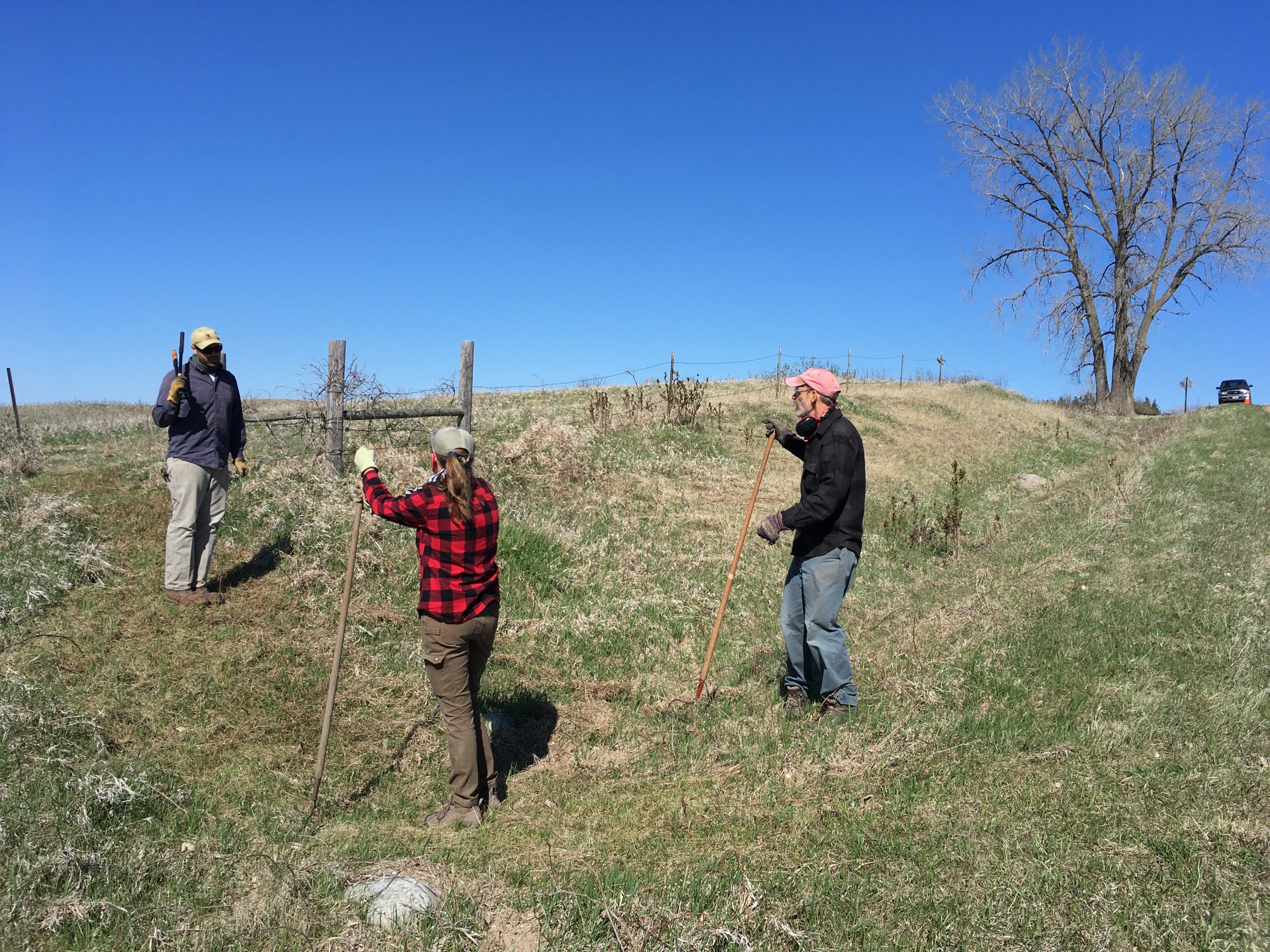
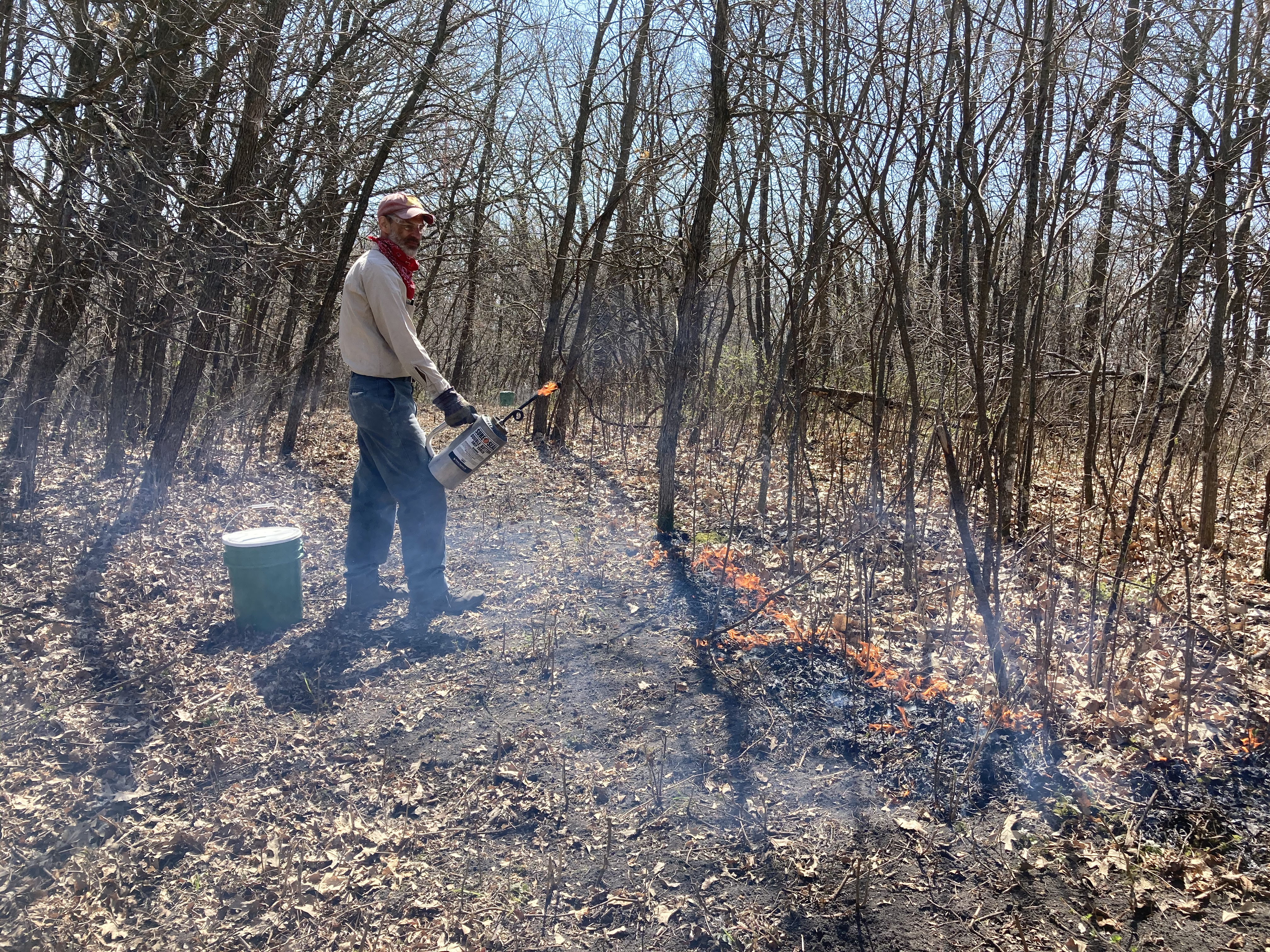
Photos depicting preparations for the days burn at Loeffler’s corner east.
During the morning, we prepared equipment for the burn. We loaded equipment after lunch and drove south to the burn unit. Along the drive, we spotted a very large plume of smoke from a USFWS burn to the southwest and once at the site, another USFWS burn 10 miles. Stuart, Gretel, and I staged vehicles and water buckets. We placed orange traffic cones along the highway and Sandy Hill Rd to alert passing traffic. The whole burn crew walked the entire burn break while reviewing the burn plan and discussing hazards. The east edge of the burn unit (along Sandy Hill Rd) presented few challenges including a mass of woody debris, wooden fence posts with barbed wire, and a pile of wood chips.
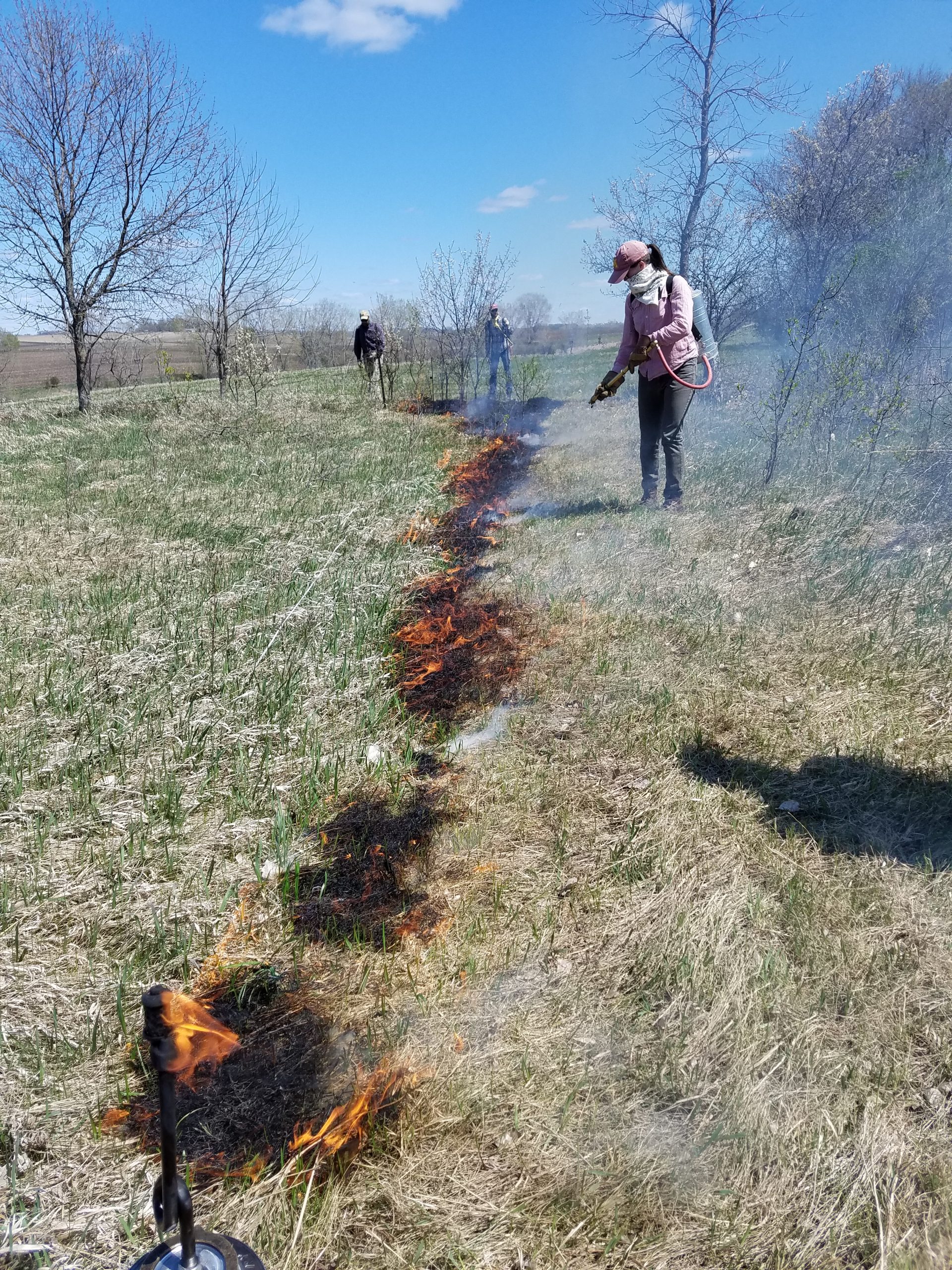
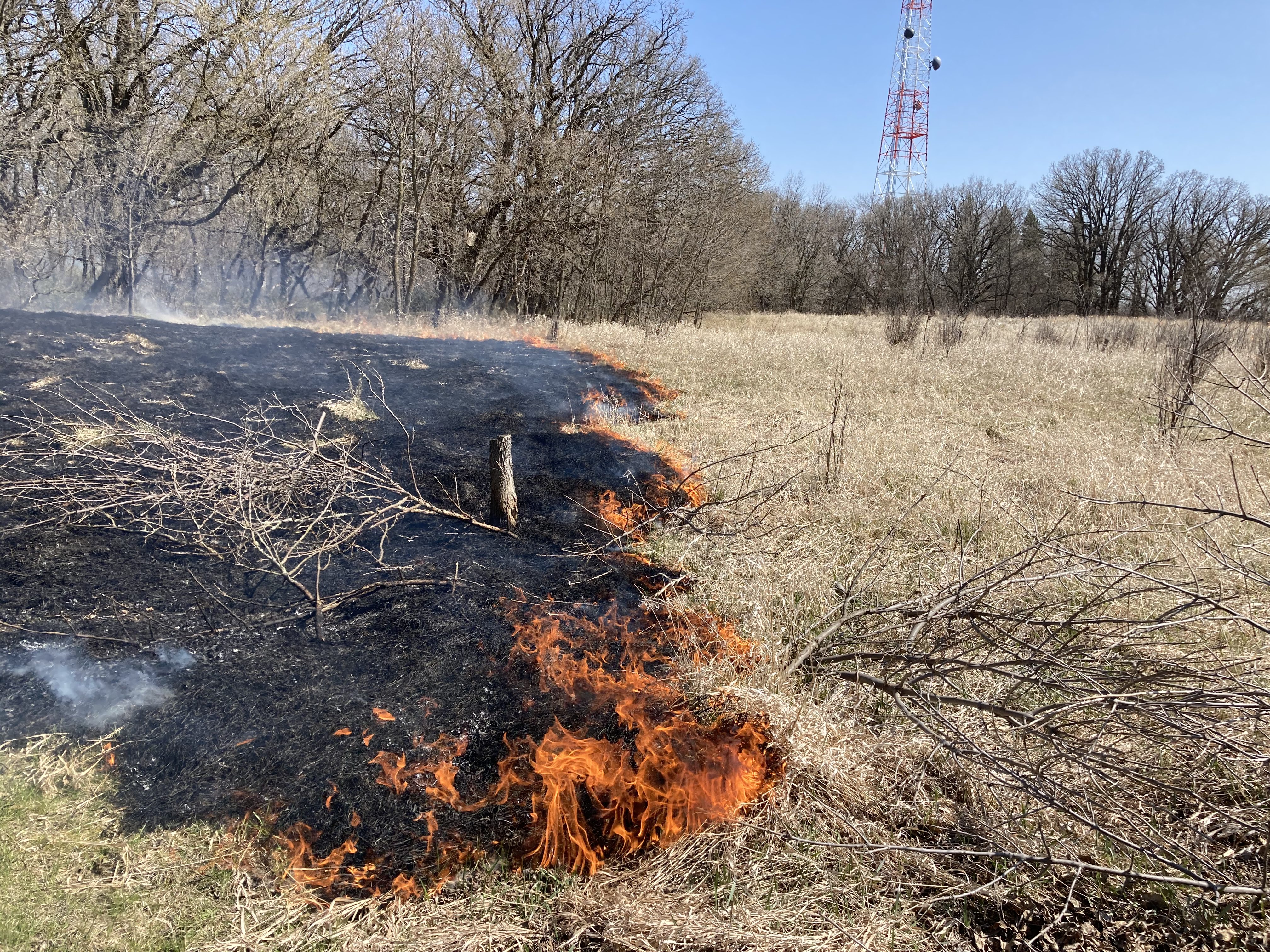
Sequence of photos illustrating test fire and the crew securing the southern burn break.
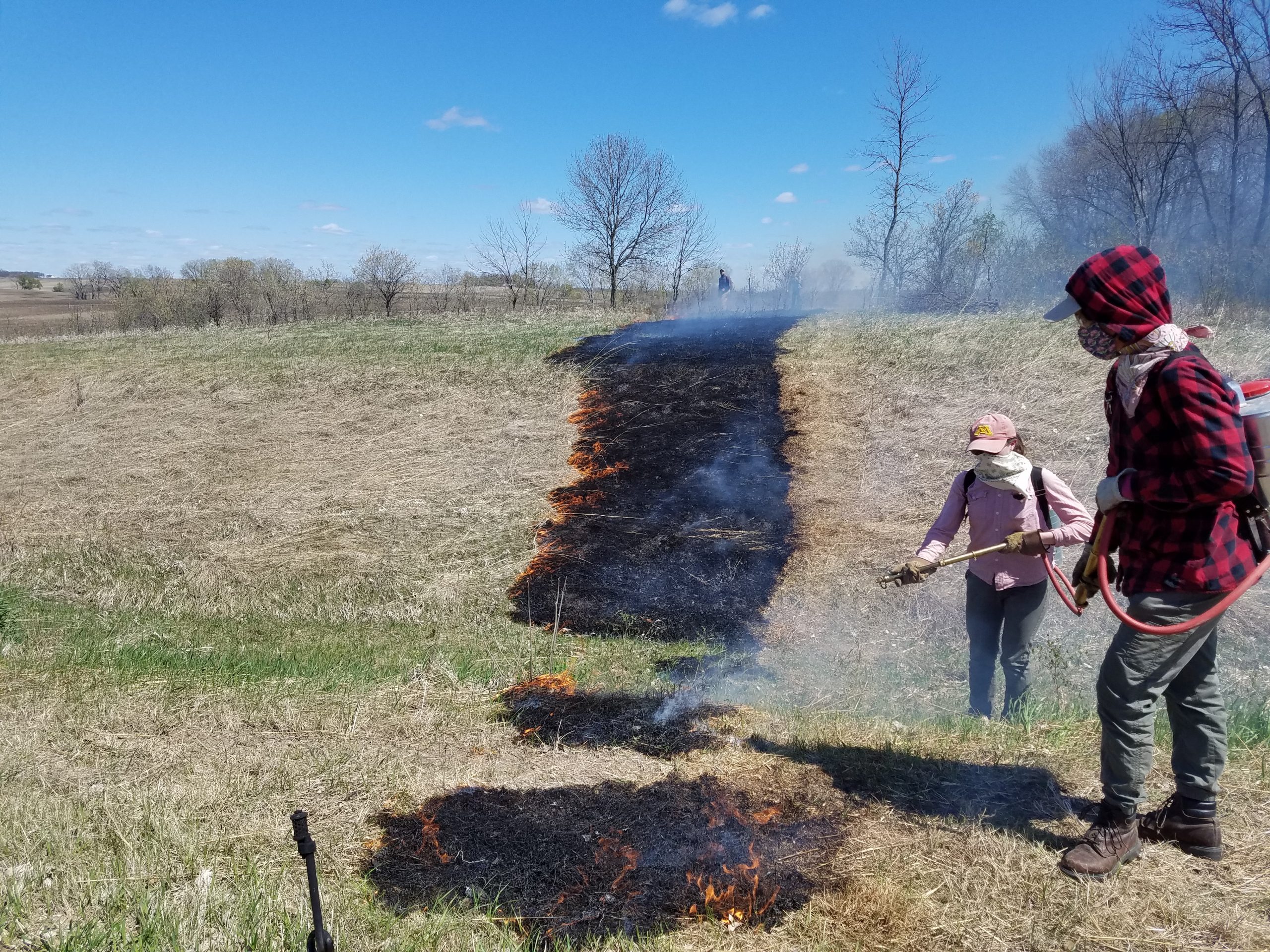
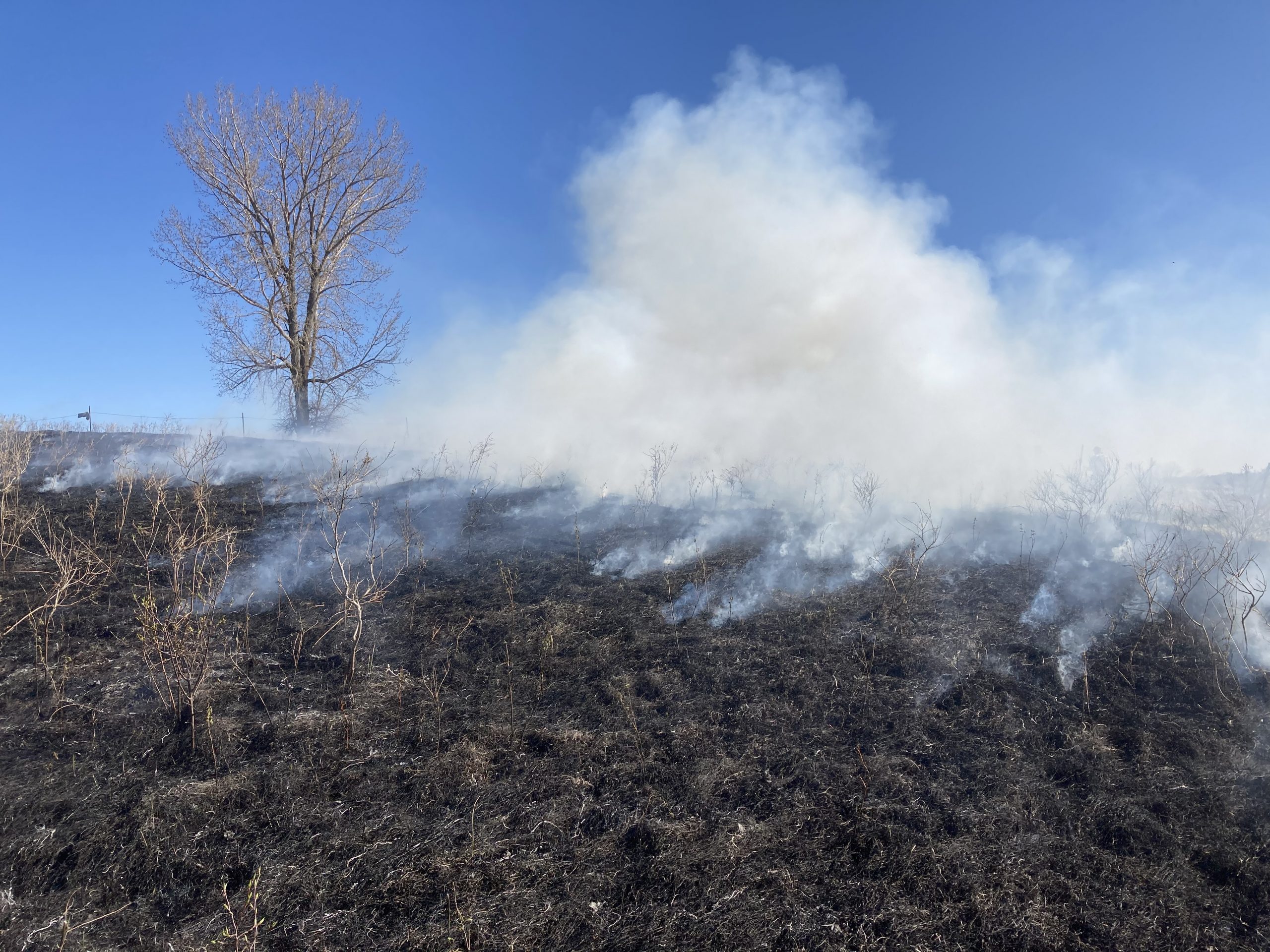
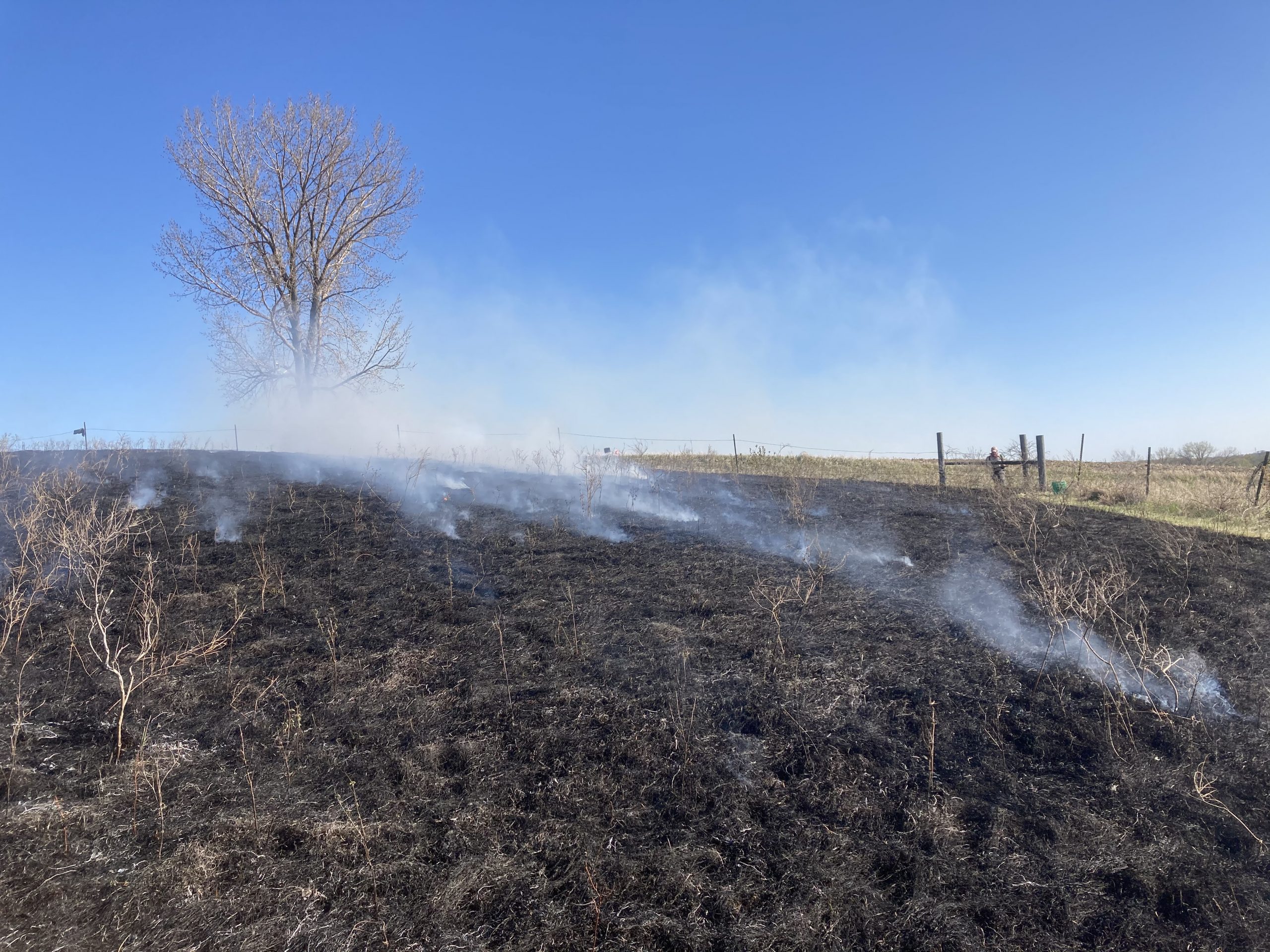
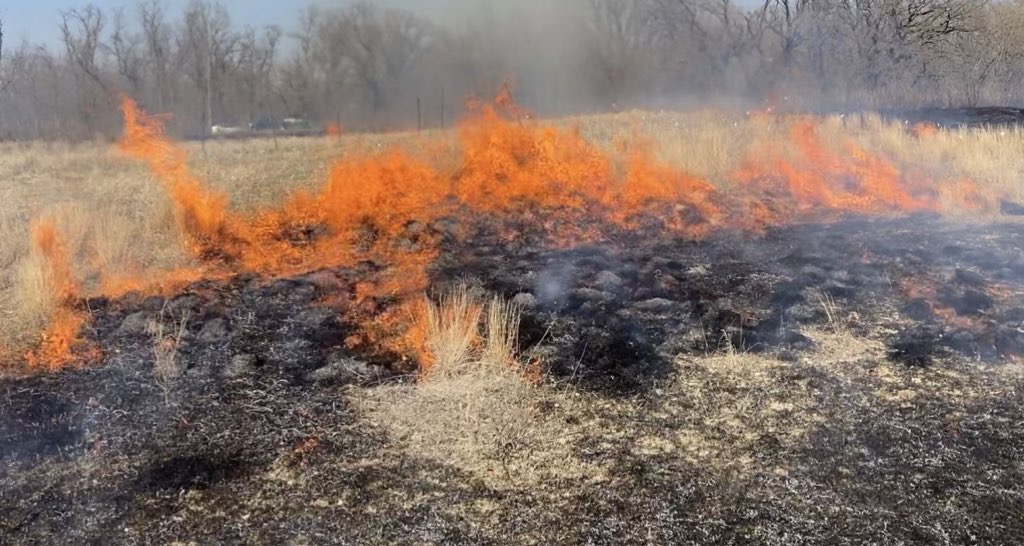
We ignited a test fire in the southeast corner of the burn unit. Once we secured the southern edge of the burn unit, Stuart and I ignited in parallel directions moving north. Matthew and I patrolled the eastern edge while Stuart, Gretel, and Amy did most of the hard work along the troublesome western edge. The eastern edge of the burn unit (along agricultural field) was very civilized. Matthew and I ignited along the fence line. The fire essentially put itself out. The western edge of the unit required more effort. Stuart ignited carefully around a brush pile, around fence posts, and around the large cottonwood while Gretel and Amy diligently kept watch to ensure none of the hazards caught fire. Realized winds 30 minutes into the burn were lighter and more variable than forecast, argggh… We started with steady N winds but wind direction wobbled with NW, N, and NE gusts alongside a couple short-lived E and W gusts. With topography and the dominant wind in our favor, Stuart and I kept in contact with radios. We adjusted our pacing to accommodate the fickle winds and complete the burn safely. While Amy and Stuart tended to wood chips around the cottonwood, I lit the head fire with help from Matthew and Gretel to hold the northern burn break. The head fire was not terribly exciting. We ended up igniting more slowly than anticipated and back burning ~90 percent of the burn unit. Though slower, this contributed to a consistently blackened unit. The wood chips were a hassle. Tiny plumes of smoke occasionally popped up demanding our attention. With the fire contained, we returned to the research base for dinner. Stuart, Gretel, and I then returned to the site after dinner to check on and extinguish any remaining logs/woodchips that were smoking.
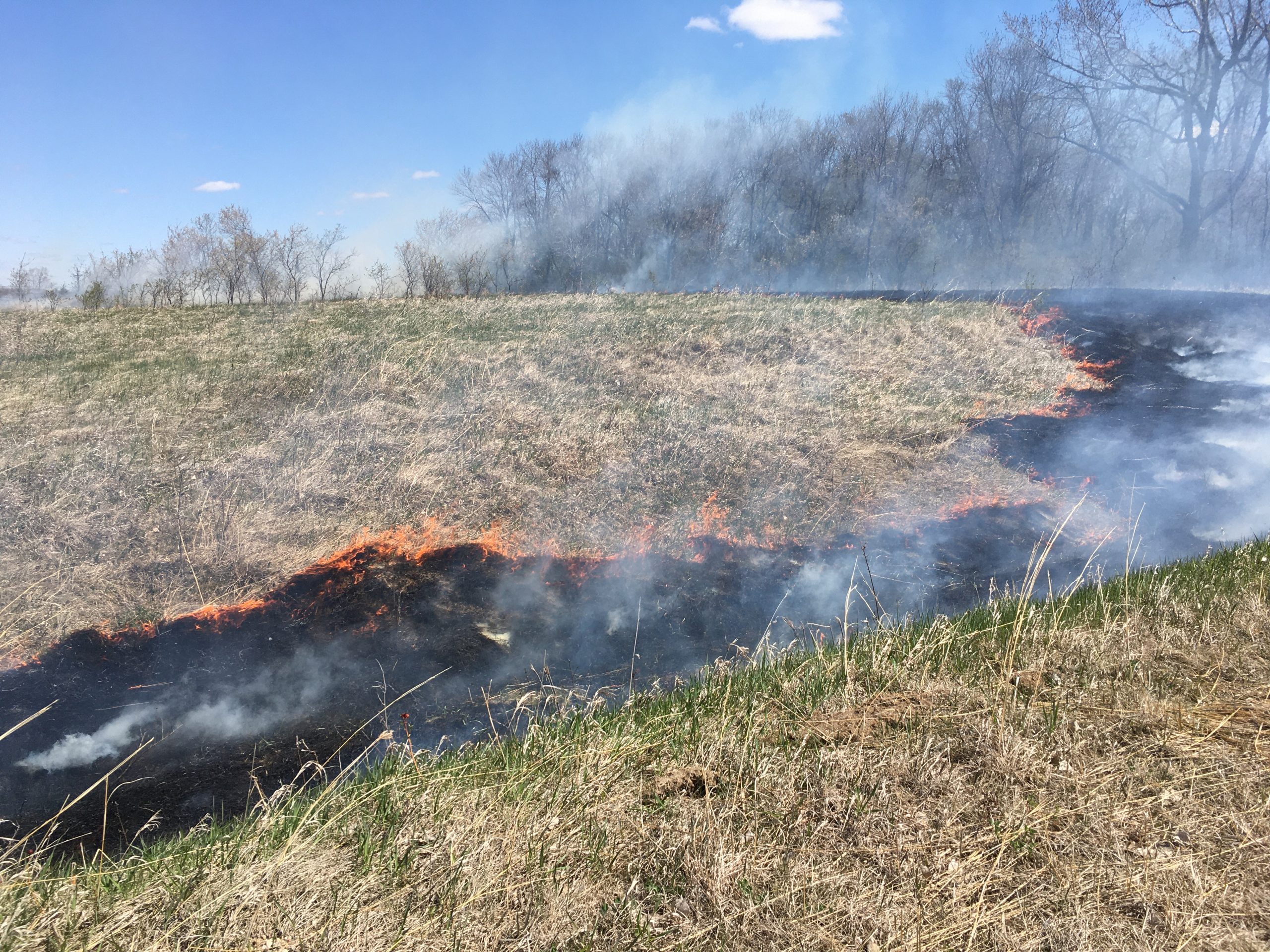
Photos from the burn.
Temperature – 52 F Relative humidity – 32% Wind speed (max gusts) – 10 (22) mph wind direction – N Ignition time: 2:06 PM End time: 3:44 PM Burn crew: Jared, Gretel, Stuart, Amy W., Matthew G.
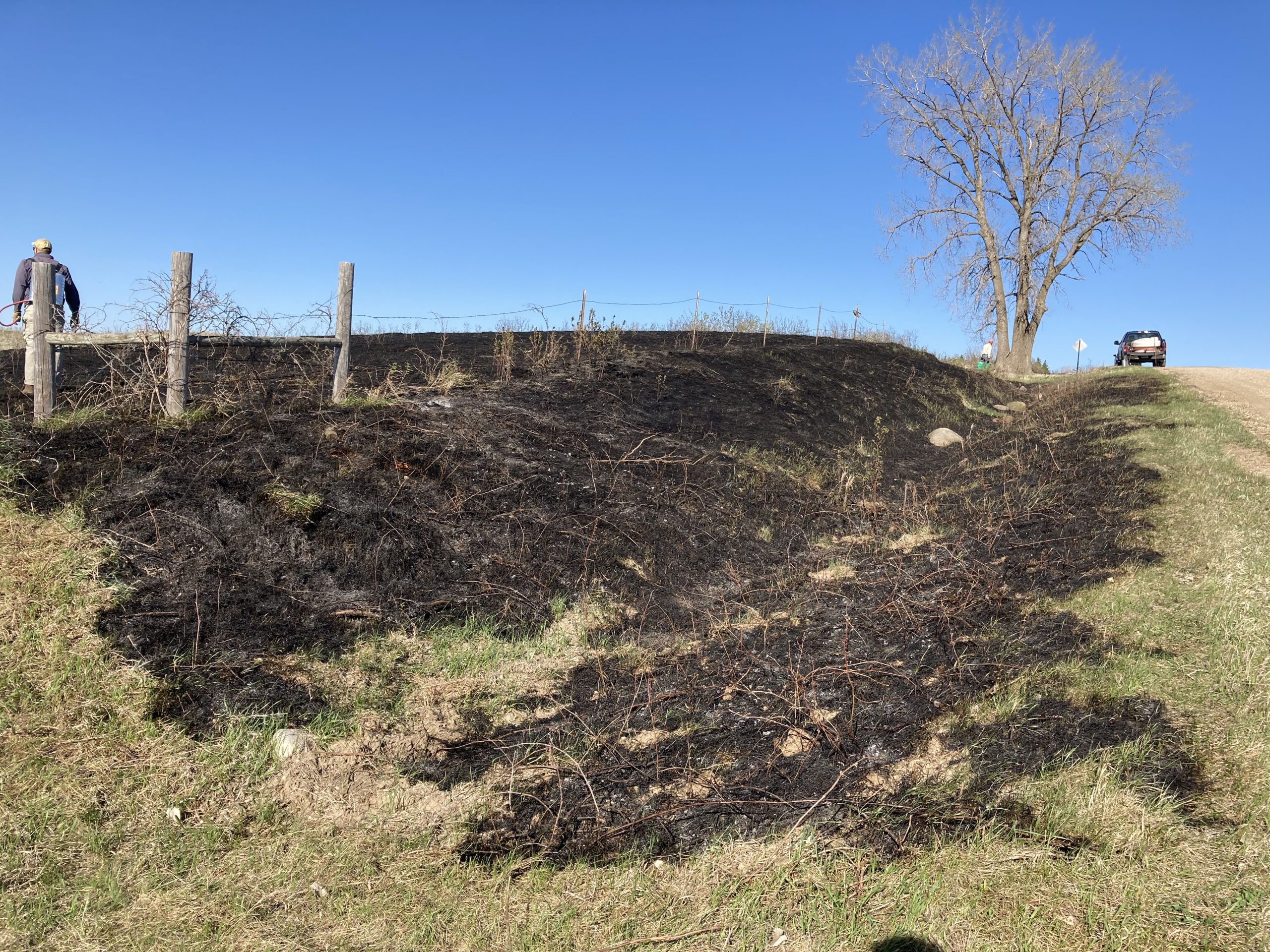
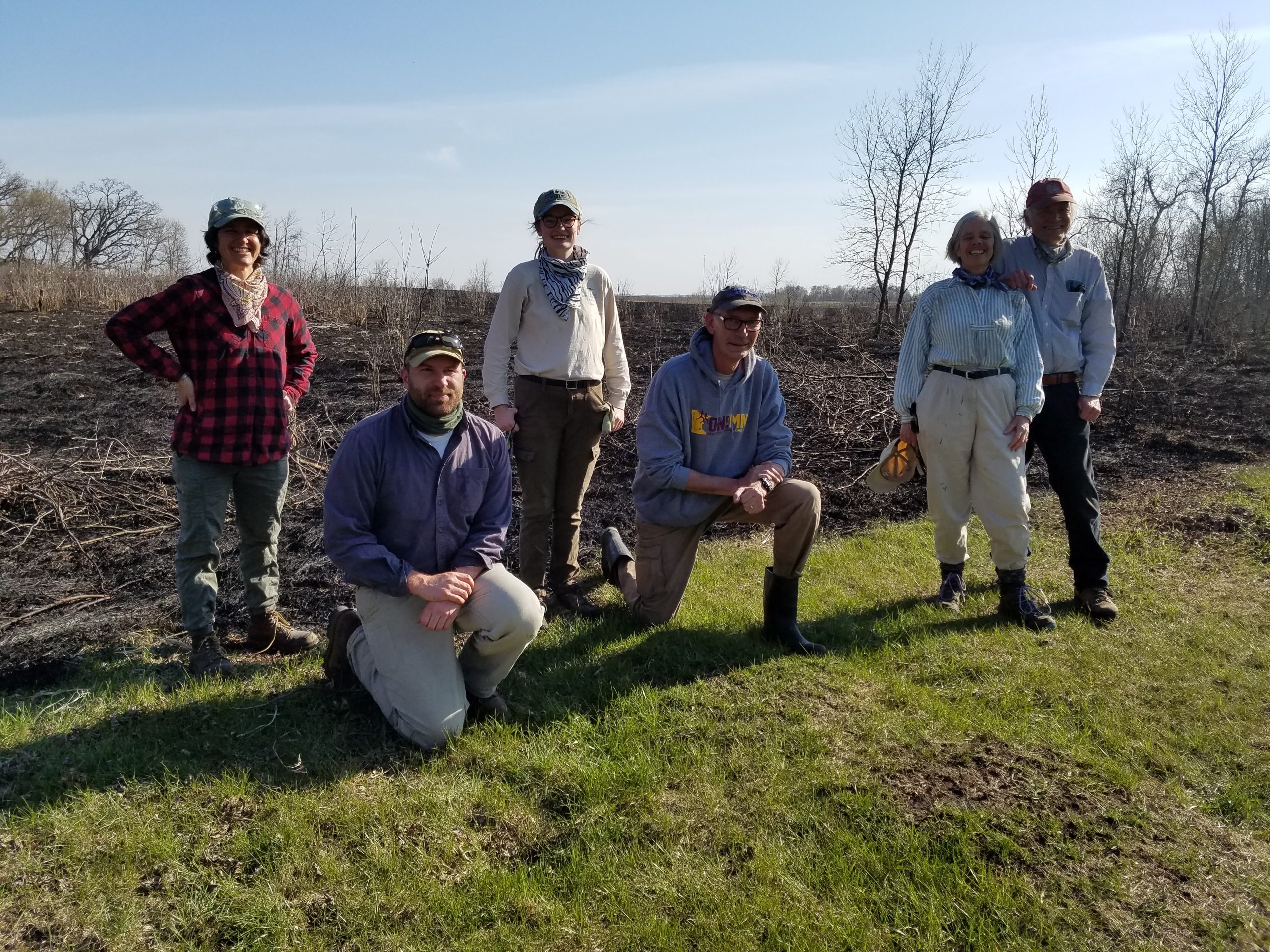
Before and after photos from our prescribed burn at Loeffler’s corner east.
The oldest plants in our experimental plots are turning 25 years old this year. Happy almost birthday to them! I set off on a mission to determine how many of these plants are still alive so we know how much cake we need to celebrate. These plants are in the oldest portion of our oldest experimental plot (exPt01), they were planted in 1996 and every year since we have visited each plant and recorded various traits.
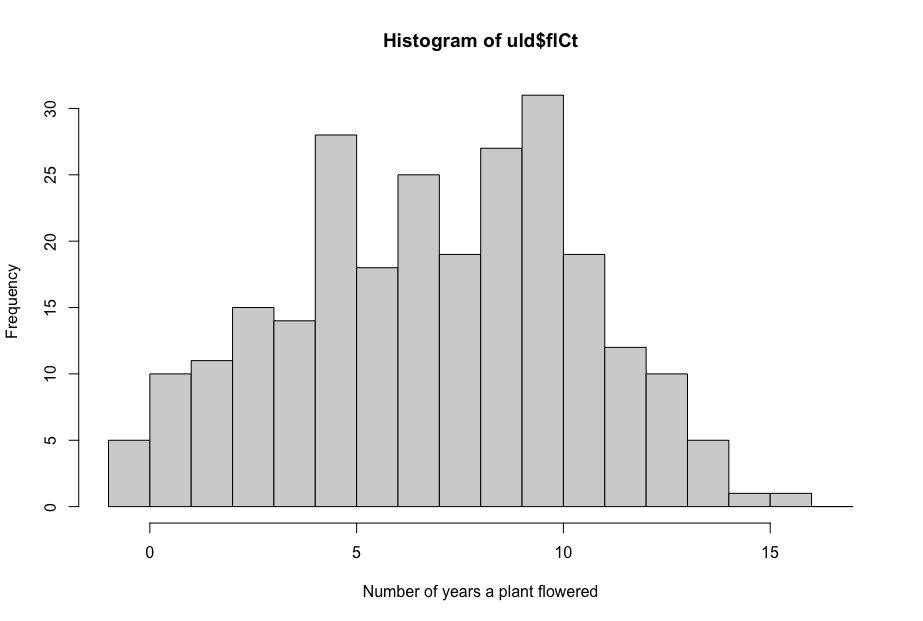
The first year that these plants flowered was in 1999, a total of 10 plants flowered in this first year. If we look at survival as of 2019 only 251 of the original 646 plants are still alive. Of these 251 surviving plants five of these plants have never flowered! They have been alive for 26 years and never flowered, they have only been producing basal rosettes (just leaves nothing else), all these years. On the other end of the flowering frequency spectrum, one plant has flowered during 16 of the 26 years that it has been alive, that is a 62% flowering rate. To show the high variation in flowering frequency I made the following histogram, the majority of plants have flowered a total of nine or four times.
As I continue to work through the 2020 data from our experimental plots I will be posting more “Random Fun Facts” with Mia so stay tuned to learn more about what is going on in the experimental plots!
It’s Emma Greenlee, reporting from Northfield, MN on my presentation at the Winchell Undergraduate Research Symposium! This is a research symposium for students in STEM at Minnesota colleges to present their research, and I presented my work from my independent project with the Echinacea Project last summer (see this flog post for more info!). The symposium was on zoom, naturally this year, and students presented in small groups for 10 minutes each. So pretty low stakes but a really good opportunity to practice presenting to an audience and it held me accountable to finish a few data analysis and visualization things I had been needing to do for my project. This e-conference made me think I could handle and enjoy the real thing, which is cool!
That’s all for me for now, just a month left at Carleton before I’ll be heading to Nevada on a Conservation and Land Management internship doing native seed collection with the Forest Service.
Peace out for now FLOG but I don’t think you’ve heard the last of me yet!
For our fourth and final burn of the afternoon on May 4, 2021, we ventured back into Douglas County for a burn at kjs. Earlier in the day, Mia and I prepared burn breaks by cutting woody plants and mowing burn breaks. Despite increasing humidity and less consistent winds, the prescribed burn at kjs proceeded quickly and produced a beautifully consistent burn. We ignited a mowed a line in the southeast corner along our mowed burn break. Once the line was secure and we had 5-10 feet of black (burned area downwind), the crew split with one line lighting along Elk Lake Rd and the other along the dirt access road. Realized winds midway through the burn were lighter and more variable than anticipated. A couple ENE/NE wind gusts turned our backing fire into 5 second headfires (not part of the plan!) so we made a quick decision to ignite around the remaining perimeter and finish up the burn while avoiding any further unexpected wind shifts. We extinguished a couple remaining hotspots, packed up our equipment, and returned to the Echinacea Project research base for dinner after a successful day of burning.
While the prescribed burn at kjs was completed in just over 15 minutes, this and other burns are the culmination of weeks if not months of planning and preparation. Safety is our #1 priority when conducting prescribed burns. We developed written burn plans for each unit outlining the conditions (e.g. temperature, humidity, wind speed and direction, fuel conditions, etc.) when fire should behave predictibly and a burn can be conducted safely. This is the prescribed part of prescribed burns. Our burn plan also includes a step-by-step plan for igniting a fire and keeping it contained within the burn unit.
Stay tuned for more prescribed burns and our research investigating the effects of fire on plant reproduction and population dynamics in fragmented prairies!
Temperature – 53 F Relative humidity – 26% Wind speed (max gusts) – 8 (16) mph wind direction – NNW Ignition time – 6:11 PM End time – 6:27 PM Burn crew: Jared, Stuart, Gretel, Mia
Upon completion of the prescribed burn at yellow orchid hill east we moved equipment and staged vehicles just a short stroll down Wennersborg Rd at yellow orchid hill west. Gretel finished mowing and the entire crew walked the mowed burn break. We discussed the plan for ignition, raked around several wooden fence posts, and wet down the wooden posts with a backpack pump.
We ignited a test fire in the southeastern corner of the burn unit. The test fire behaved as predicted so we slowly extended the ignition line along the downwind side of the unit (up the steep south-facing side of the ditch and back down the more gentle north slope across the fence line). Once the downwind fire break of the burn unit had been secured, Gretel and Mia set about igniting along the base of the ditch while Jared and Stuart slowly rounded northeast corner of the burn unit. Jared and Stuart held their position at the northeast corner until Gretel and Mia reached the wooden fence posts in the southwest corner of the burn unit. At this point, Jared and Gretel ignited the north and west edges of the burn unit respectively while Stuart and Mia expertly kept fire from creeping across our mowed breaks. The whole crew met in the northwest corner and paused to watch the headfire dash uphill to complete another successful prescribed burn.
Temperature – 54 F Relative humidity – 28% Wind speed (max gusts) – 15 (19) mph wind direction – NNW Ignition time – 5:01 PM End time – 5:27 PM Burn crew: Jared, Stuart, Gretel, Mia
Before and after photos illustrating the burn at yoh.w.
After wrapping up our first remnant burn of the season at east riley, the crew ventured into the wild western prairies of Grant County. Earlier in the day, Mia mowed burn breaks at yellow orchid hill east. This roadside patch had considerably more fuel than east riley and NW winds remained stiff when we arrived. Once water buckets had been staged and the crew briefed, we ignited a test fire in the southeast corner. This fire backed beautifully against the wind, moving steadily and burning fuel completely. One of my takeaways from burns this spring is that prescribed burns in a little lower relative humidity (RH = 25-30) and a little higher winds (12-18 mph sustained) seem to produce great results in burn units where brome is the primary fuel.
A nice sequence of photos illustrating how the burn at yoh.e progressed. We started with a test fire and observed that small fire before proceeding to burn the entire unit. We decided to ignite the downwind edge of the burn unit and allow that fire to back against the stiff wind. Looking at the fourth and fifth photos, you can see the wind push smoke to the south as the fire backs slowly against the wind moving north.
We decided to let the fire back against the wind across the entire burn unit. Once sufficient black had been established in the southeast corner of the unit, we ignited a backing fire along the entire southern edge of the unit along Wennersborg Rd. After fire lines were secured, Gretel grabbed the push power and finished mowing burn breaks at yellow orchid hill west while Jared, Stuart, and Mia extinguished any remaining hotspots. 30 minutes after ignition, we were left with an almost entirely blackened burn unit. Beautiful, predictable prescribed burn!
Temperature – 53 F Relative humidity – 30% Wind speed (max gusts) – 18 (21) mph wind direction – NNW Ignition time – 3:44 PM End time – 4:14 PM Burn crew: Jared, Stuart, Gretel, Mia
Before and after photos looking east along Wennersborg Rd
Before and after photos looking west along Wennersborg Rd
After 5 months of preparation, we officially applied the first experimental treatments for our NSF proposal to study prescribed fire effects on prairie plant reproduction and population dynamics.
Weather conditions Tuesday afternoon were favorable for burning but wind forecasts were at the upper end of our burn prescription. Given our success burning p8 in similar conditions just a week earlier, we decided to proceed cautiously by starting with a prescribed burn on the north side of east riley. Here light and discontinuous fuel (mostly brome), a gravel road for a firebreak on the south side, and agricultural fields downwind mitigated our concerns about gusty winds. Earlier in the day, Mia mowed fire breaks along the east and west end of the burn unit. We ate lunch, loaded up our equipment, and drove down to east riley. Along the way, the crew got a great look at a western kingbird perched along Sandy Hill Road.
Once at the site, we reviewed the burn plan and staged equipment. We ignited a test fire in the southeast corner of the burn unit. Despite a slow start to the test fire and stiff NW winds that kept extinguishing the drip torch, the backing fire burned well through brome and scattered warm season grasses. With scattered poison ivy in the eastern third of east riley, we were cautious to stay upwind of smoke by lighting small strips perpendicular to the wind. Once sufficient black (burned area downwind) had been established, we proceeded to ignite the southern edge of the unit along Mellow Ln and wrap around the western end of the unit to ignite a head fire along the northern edge of the burn unit.
While somewhat patchy, we considered the burn a success. The fire behaved predictably and we felt comfortable that we could continue burning other units with more fuel. After the burn, Stuart shared the observation that the fire did not carry well in areas where fuel was covered by a film of silt/gravel. We packed up and drove a short distance into Grant County for our next set of burn units…
Temperature – 52 F Relative humidity – 34% Wind speed (max gusts) – 13 (22) mph wind direction – NNW Ignition time – 2:22 PM End time – 2:58 PM Burn crew: Jared, Stuart, Gretel, Mia
Before and after comparison looking west along Mellow Ln.
Last week Stuart, Gretel, Jared, and I headed northward from Chicago to Minnesota to perform the first prescribed burn of the season! On our drive up we hit some snow that was almost whiteout conditions very exciting, especially for April. We arrived in Douglas County late Wednesday night and quickly bundled into our sleeping bags.
Stuart examining the test fire of the Island
The next morning, we walked the unit/p8 and saw two bald eagles flying over the plot, we decided that this was a good omen for the burn. There are two areas in the unit that haven’t been burned in the past that we decided to burn this year, this was the island that is northeast of the plot and the “bee trees”. After examining the unit we set off to prep the unit and gather supplies. After a break for lunch, we ran a test of how the wooded area would burn by burning the island area. This burn went well, the fire moved slowly but we did kill a frog :(. Halfway through this burn Ruth and Frank arrived from the Cities, they were greeted with excitement and backpack sprayers.
After the success of burning through the woods in the island, we decided to burn through the bee trees. The bee trees burned very slowly Frank and I spend most of the burn focused on ensuring that no sparks from the bee’s trees got taken in the wind downhill. To the south of the bee trees, the burn brake is only mowed and still has quite a bit of brome that could be fuel. We were all shocked by the civilized behavior that the fire had around this burn break. Once we had a sufficient backfire Stuart light the head fire in the windward portion of the plot and boy it was spectacular. Our civilized fire politely ripped through the brome of p8 and even left many pin flags untouched!
The backfire heading southThe head fire heading through p8
After we were satisfied with the large p8 unit fire being out we gathered, including John VanKempen who arrived during the course of the p8 burn. We then headed down to Jean’s prairie plant garden and Jared, who was the burn boss for the final two burns, light a nice line around the perimeter of the garden, this burn only took 16 minutes. When we were waiting for the garden to burn we noticed a small adjacent patch of dried duff and we decided to burn that too! This burn went even faster than the prairie garden it was also much more powerful.
The burn crew! Left Gretel, Jared, Mia, John, Ruth, Frank (Stuart not pictured)
After the prairie garden and adjacent area were done burning, Stuart, Gretel, Jared and I made sure that everything was put out back at p8. We found a smoldering log and made some s’mores!
The next day, Jared and I inspected the remnant sites that we are planning on burning. Jared, Stuart, and I also broadcast some native prairie seeds (mostly two grasses: side-oats grama and little bluestem) that we collected in the fall in p8.
We performed this burn a week ago now, on Earth Day, performing a prescribed burn that aids in the restoration of the prairie was a wonderful way to celebrate. This was my first prescribed burn, overall it was really fun, impressive, exciting, and also boring. I am very excited to be heading back up to Minnesota to conduct more burns but also to see how the community changes after the burn.
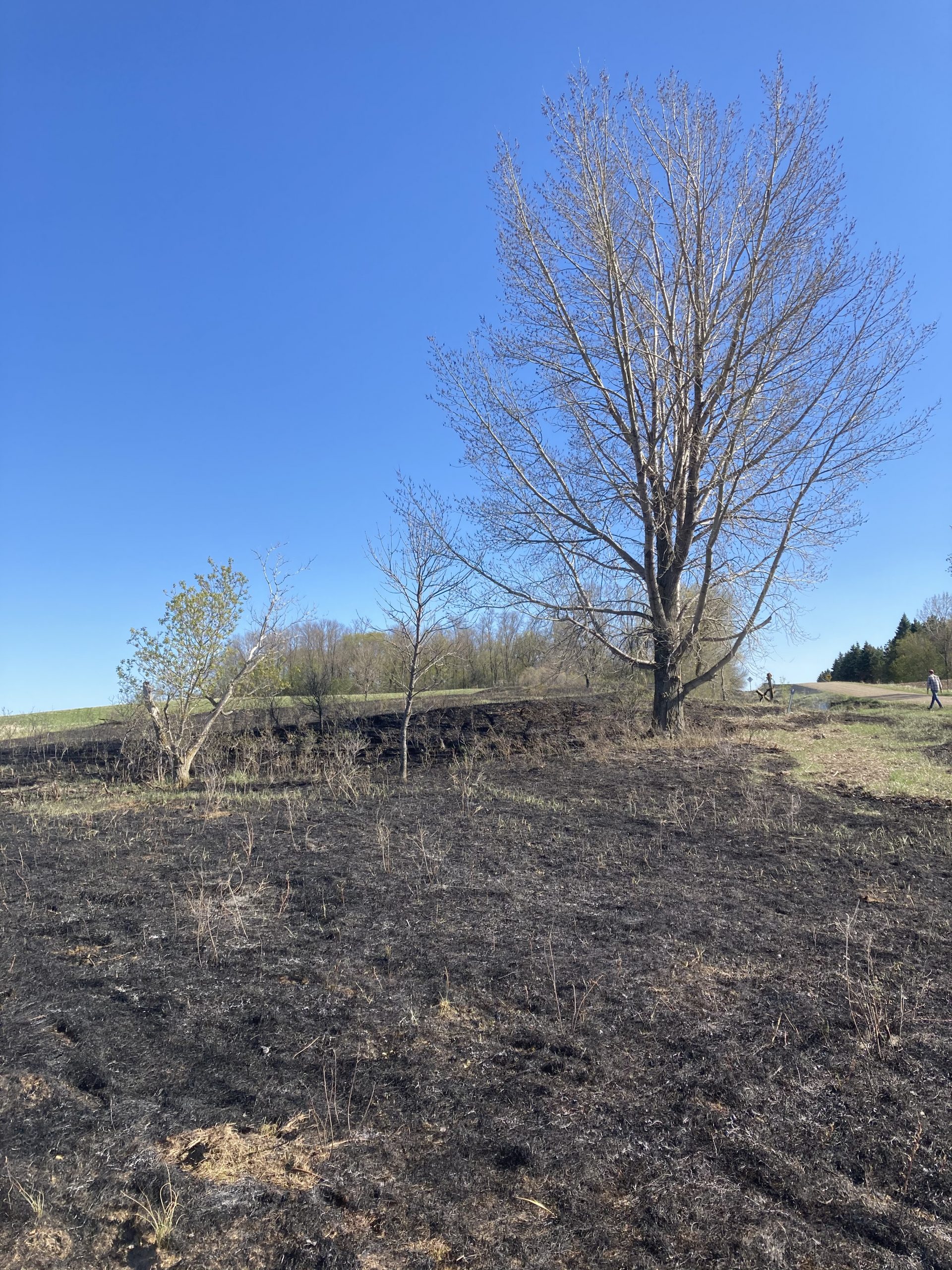
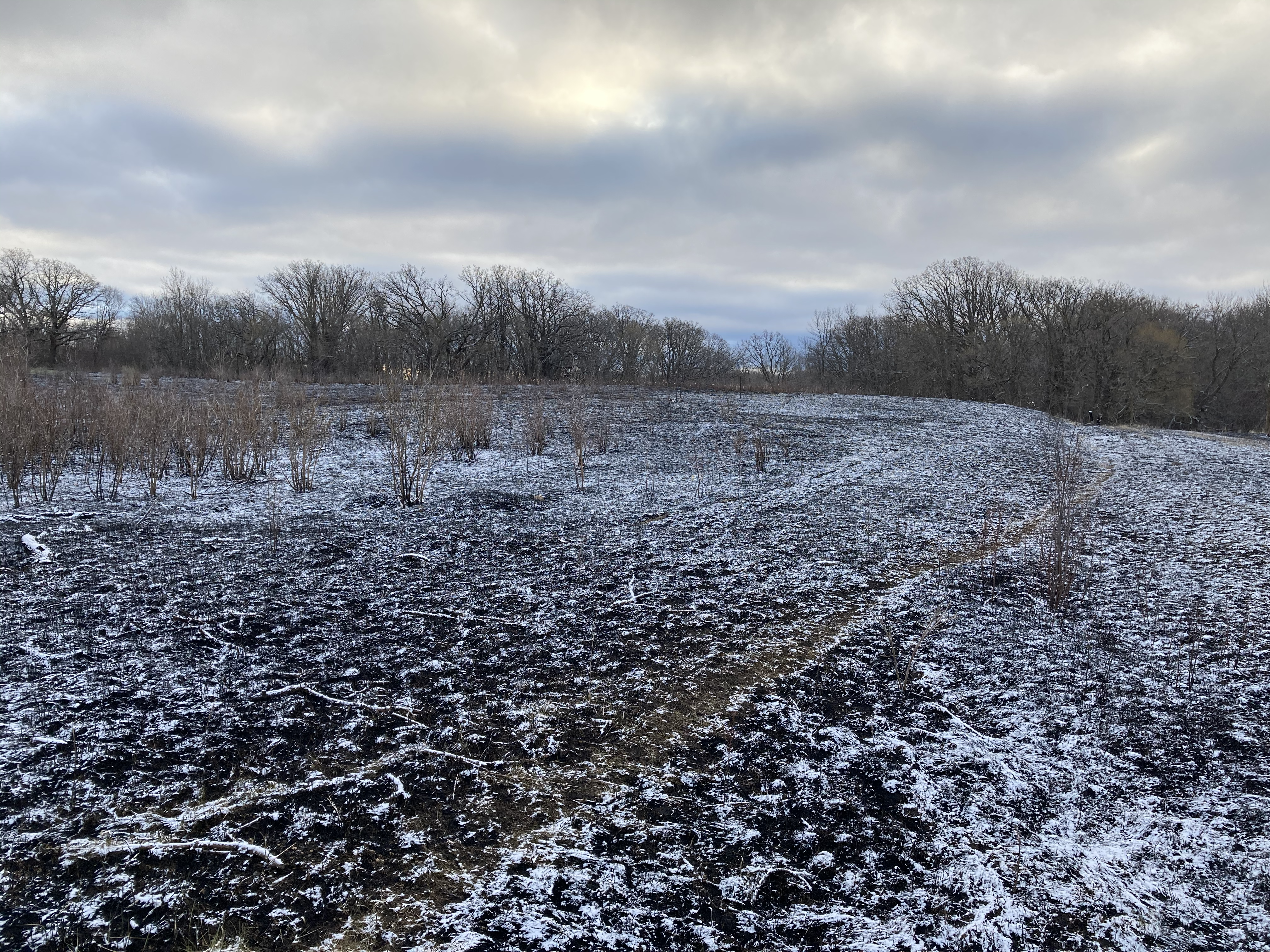
The charred and snow-sprinkled plot on Saturday morning
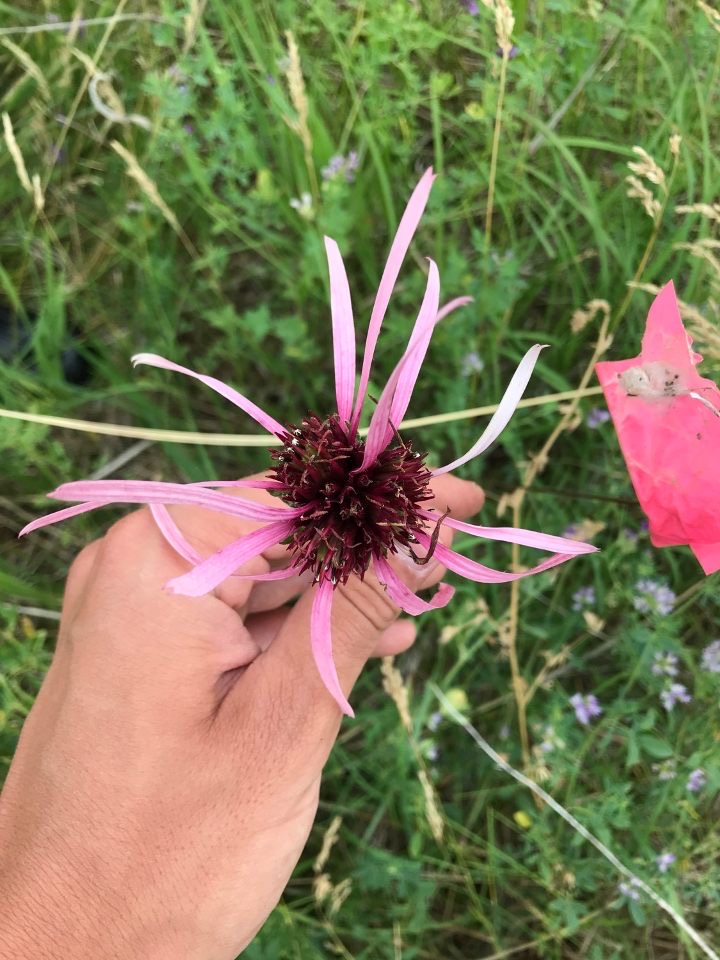
Echinacea pallida Flowering phenology:Echinacea pallida is a species of Echinacea that is not native to Minnesota. It was mistakenly introduced to our study area during a restoration of Hegg Lake WMA. Since 2011, Team Echinacea has visited the pallida restoration and taken flowering phenology and collected demography on the non-native. We have decapitated all flowering Echinacea pallida each year to avoid pollination with the local Echinacea angustifolia. Each year we record the number of heads on each plant and the number of rosettes. We also get precise gps coordinates of all plants and then chop the flowering heads off! This year we cut E. pallida heads off on June 30th. We revisited plants and shot gps pointson September 17th 2020. When shooting points, we found two E. pallida plants that had missed the big decapitation event. We harvested the heads before any fruit dispersed.
Overall, we found and shot 99 flowering E. pallida. On average, each plant produced 1.96 flowering heads, with a total of 194 beheadings. The average rosette count was 6.1, the maximum was 31 rosettes — absolutely massive!!
Location: Hegg Lake WMA Start year: 2011
exPt6: Experimental plot 6 was the first E. angustifolia x E. pallida hybrid plot planted by Team Echinacea. A total of 66 Echinacea hybrids were originally planted; all have E. angustifolia dams and E. pallida sires. In 2020, we visited 40 positions and found 22 living plants. No plants have flowered in this plot yet. Location: near exPt8 Year started: Crossing in 2011, planting in 2012
You can find more information about experimental plot 6 and previous flog posts about it on the background page for the experiment.
exPt7: Planted in 2013, experimental plot # 7 was the second E. pallida x E. angustifolia plot. It contains conspecific crosses of each species as well as reciprocal hybrids. There were 294 plants planted, of these plants only 148 plants were still alive. There were 2 flowering plants this year! One was the progeny of a E. pallida x E pallida cross and the other of these flowering plants was a hybrid of E. pallida X E. angustifolia! This is the first hybrid to bloom. Anna M. investigated the compatibility of this hybrid with E. pallida and E. angustifolia by performing a series of hand crosses.
Location: Hegg Lake WMA Start year: Crossing in 2012, planting in 2013
exPt9: Experimental plot 9 is a hybrid plot, but, unlike the other two hybrid plots, we do not have a perfect pedigree of the plants. That is because E. angustifolia and E. pallida maternal plants used to generate seedlings for exPt9 were open-pollinated. We need to do paternity analysis to find the true hybrid nature of these crosses (assuming there are any hybrids). There were originally 745 seedlings planted in exPt9. We found 391 living plants in 2020, three of which were flowering! Two of these plants were technically “flowering” because they produced buds, but they produced zero flowering heads because no flowers ever opened (no pollen or fruits). There were 105 plants that we searched for but could not find. Location: Hegg Lake WMA Start year: 2014
You can find out more information about experimental plot 9 and flog posts mentioning the experiment on the background page for the experiment.
There were a total of three flowering heads between the three plots, we collected flowering phenology data on these heads. Flowering started on June 28th and ended between July 7th and 23rd. There were two additional flowering plants that only produced duds.
Data collected for exp679: For all three plots we collected rosette number, length of all leaves, and herbivory for each plant. We used visors to collect data electronically and it is still being processed to be put into our SQL database.
Data collected for E. pallida demography and phenology: Demography data, head counts, rosette counts, gps points shot for each E. pallida. Find demo and phenology visor records in the aiisummer2020 repository. GPS coordinates can be found in demap.
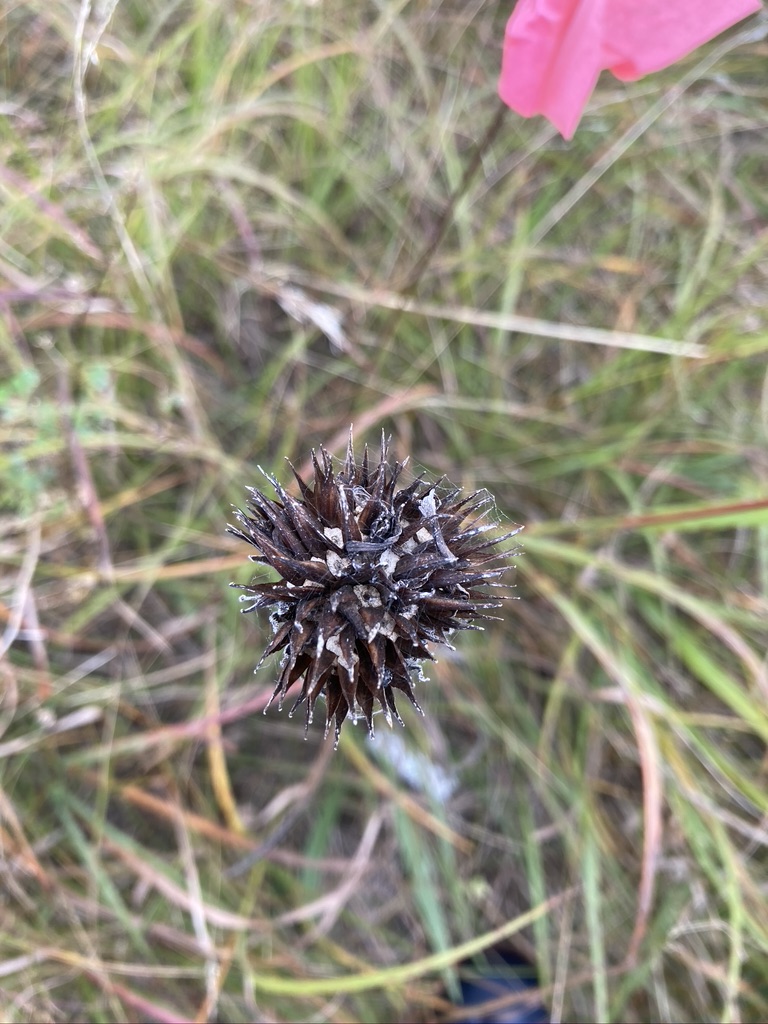
Look at this three-headed E. pallida monster we found! Shown at the beginning and end of season