|
|
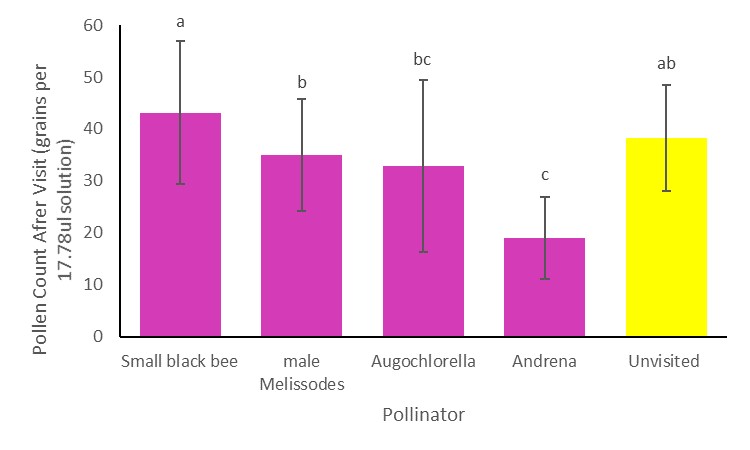
This year in experimental plot 2, we measured pollinator visitation rates, per visit pollen removal, and per visit pollen deposition across common pollinator taxa to provide insight into pollination failure in Echinacea. We collected male and female phase floret samples from 183 Echinacea head observations conducted from July 9th to the July 31st, 2018. The pollinator taxa included in analysis were Andrena (N=18), Augochlorella (N=9), male Melissodes (N=53), small black bees (N=59), and unvisited heads used as environmental controls (N=30). Using light microscopy, we then quantified the number of pollen grains in these samples to determine how much pollen an individual of each taxon removes and deposits per visit. We found that the composite specialist Andrena rudbeckiae removes more grains of pollen per visit than the other common pollinator taxa in the study area; namely, male Melissodes sp., Augochlorella sp., and ‘small black bees,’ a wide taxonomic group comprising a variety of species mostly in the Halictidae. Pollen limitation in the population could be driven by frequent male Melissodes sp. visitation late in the season; based on the per visit removal of male Melissodes sp. and number of visits observed in this study. These results combine to contribute to our understanding of pollination failure and pollen limitation in small fragmented flowering plant populations.
 Mean pollen count of male phase floret samples after visitation compared across pollinator taxa Start year: (Official Experiment) 2018
Location: Experimental plot 2 at Hegg Lake WMA
Overlaps with: ExPt2
Physical specimens: 183 Echinacea heads in egg cartons
Data collected: Contact ZZ, EJ, or JLI for access to their data
Product (to come): Zeke Zelman’s Senior Thesis at Wooster College, 2019
Team members who worked on this project include: Zeke Zelman, Evan Jackson, and Jennifer Ison (2018)
In summer 2018, we searched experimental plot 7 for Echinacea plants that are crosses between and within E. angustifolia and E. pallida. Of the 294 plants originally planted, we found 169. However, for the first time in the history of experimental plot 7, we found a flowering plant (an E. pallida x pallida cross)! The table below shows the counts of Echinacea plant in the summer of 2018. In addition to the lowest survivorship, the native E. angustifolia also has been the smallest (above-ground) over the five experimental years. Uh oh!
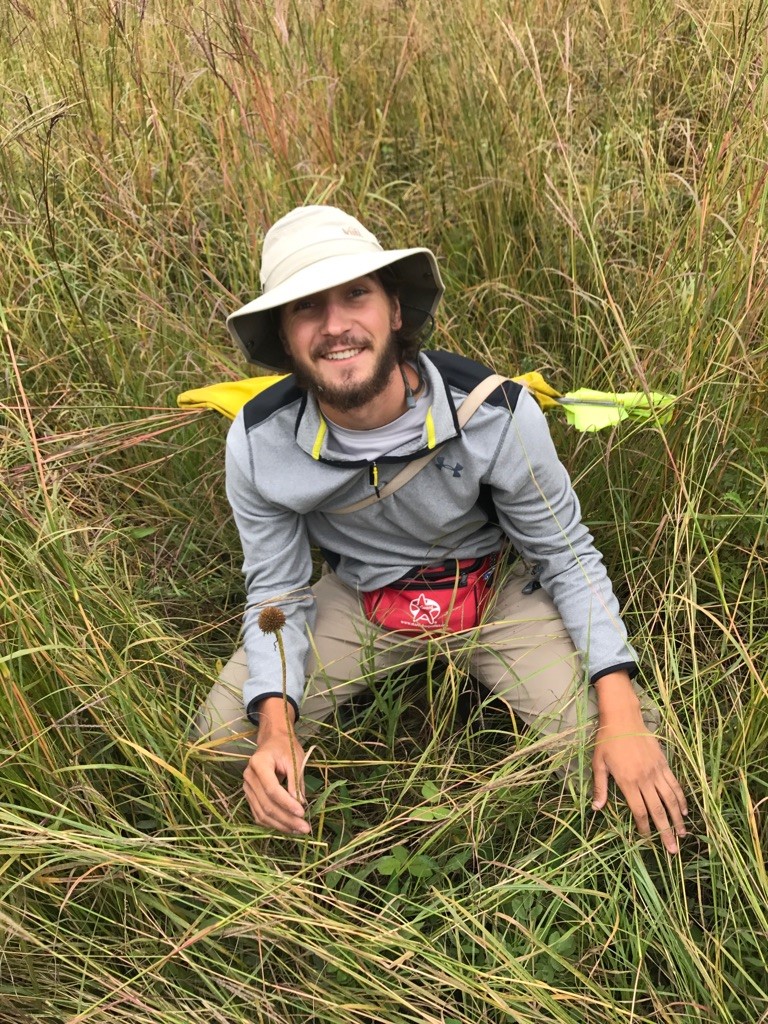
 Riley with the first ever flowering head in exPt7!
| Status 2018 |
ang x ang |
ang x pal |
pal x ang |
pal x pal |
| not found |
52 |
12 |
26 |
35 |
| found |
22 |
16 |
59 |
72 |
Start year: Crossing in 2012, Planting in 2013
Location: Hegg Lake Wildlife Management Area – Experimental Plot 7
Overlaps with: Echinacea hybrids: exPt6; Echinacea hybrids: exPt9
Data collected: Rosette number, leaf number, length of longest leaf, herbivory for each plant collected electronically and exported to CGData. Recheck information for plants not found was also collected electronically and stored in CGData. In 2018, Riley also used a Li-Cor 6400 to analyze ecophysiological traits of Echinacea in expt7. This included photosynthetic rate and water use efficiency. Riley has this data and we’ll make it available after he’s done with his thesis.
Products: Riley’s 2018-19 Biology Honors Project at Gustavus. Riley found that within-species Echinacea angustifolia crosses have lower survivorship, above-ground biomass, and ecophysiological traits than other cross types. Riley made a poster, is writing his thesis, and will defend it in May.
You can read more about rexPt7, as well as links to prior flog entries mentioning the experiment, on the background page for this experiment.
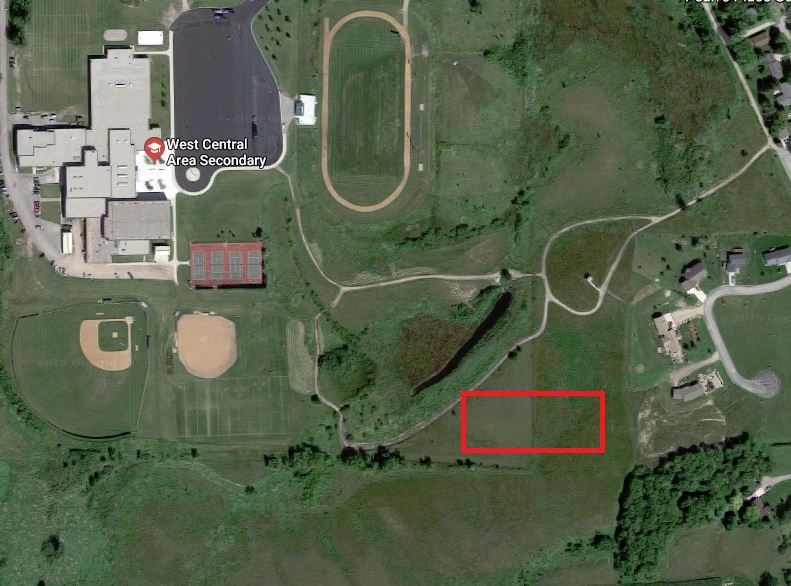
West Central Area School District and grounds are located in west central Minnesota. The high school is located in Barrett, MN which encompasses five small communities (Barrett, Hoffman, Kensington, Elbow Lake, and Wendell) that have united to make one high school. The school was built in 1994 and we are still in the process of restoring our 35 acres of land (Environmental Learning Center – ELC) into native prairie plant species. The ELC has several trails, an observation deck, and a pier that reaches into a small pond. The area has recently begun to be more and more incorporated into several classroom activities. One of the science classes used the ELC in 2018 to sample types of Bombus (bumblebee) species and populations, the agricultural instructor has been using the ELC for soil sampling and classification along with looking at soil profiles. Even the art teacher has had drawing sessions from the observation deck and the English teacher used it for writing exercises. The plan is to utilize the ELC more and more in upcoming years and we have received outstanding support from the school administration, school board, and local businesses in promoting this part of our school. Plans for 2019 are to have 12 plots that 8m x 12m in which four are burned in the spring, 4 are burned in the fall and 4 are not burned at all. As years progress, we plan to have classes engaged in monitoring the progression and health of some native species in these plots, especially Echinacea angustifolia, which will be hand planted in the plots in May of 2019.
Start year: 2019
Location: West Central Area High School
Overlaps with: Nothing… yet!
GPS points shot: 96 points delineating the future plot locations
 The location of the field site, near the high school
Hi Flog!
As I’ve said before, here at the Echinacea Project we rely pretty heavily on the work done by our volunteers. That is why I am so excited to introduce you to the newest member of Team Echinacea: Priti!
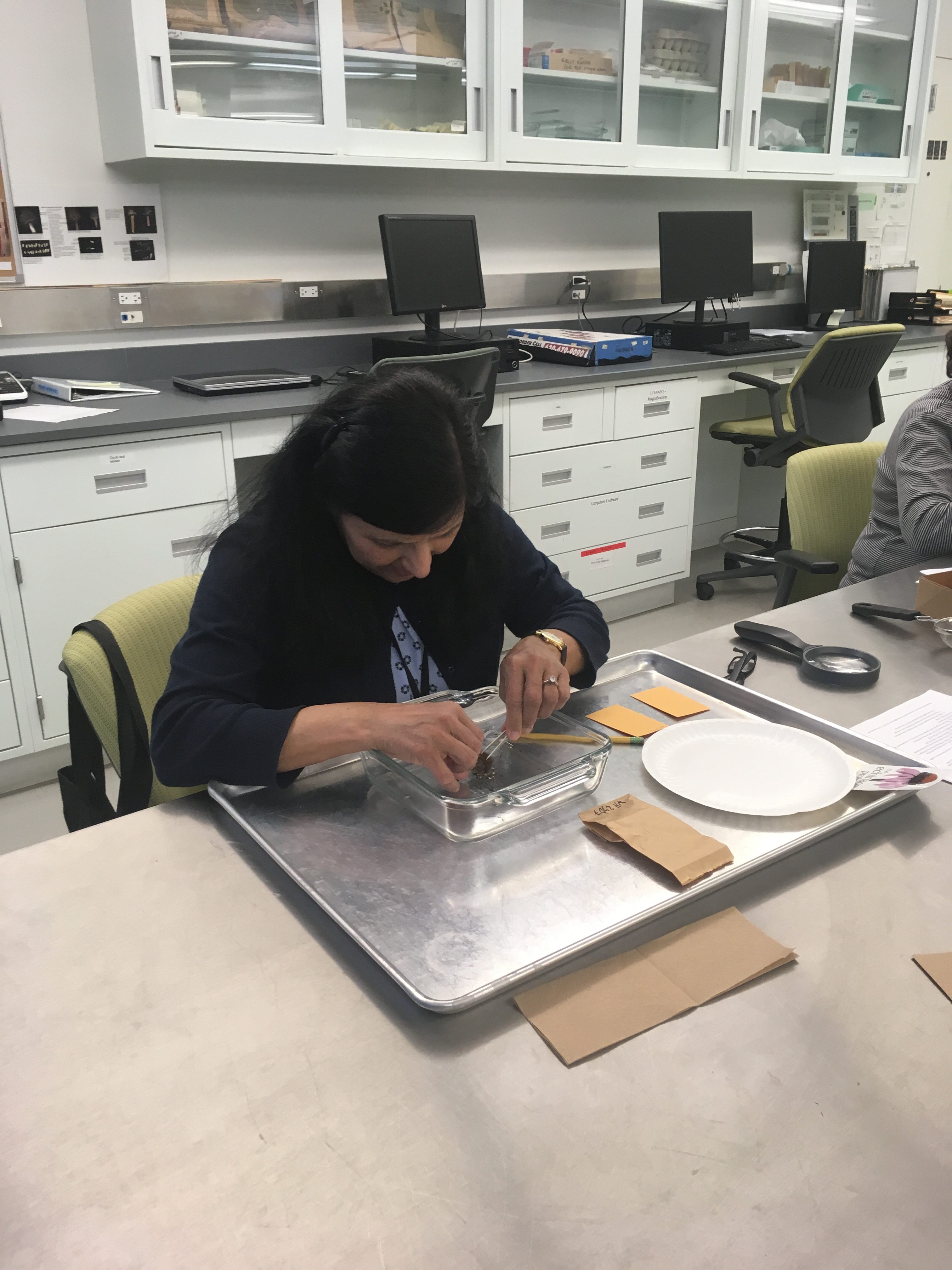
Priti has been working in the seed bank here at the Plant Conservation Science Center, but has just started working our lab today. Priti will be joining us on Fridays to clean heads — the first step to processing echinacea heads, and one of the most important.
Priti cleaning a head We’re thrilled to have Priti as part of the team!
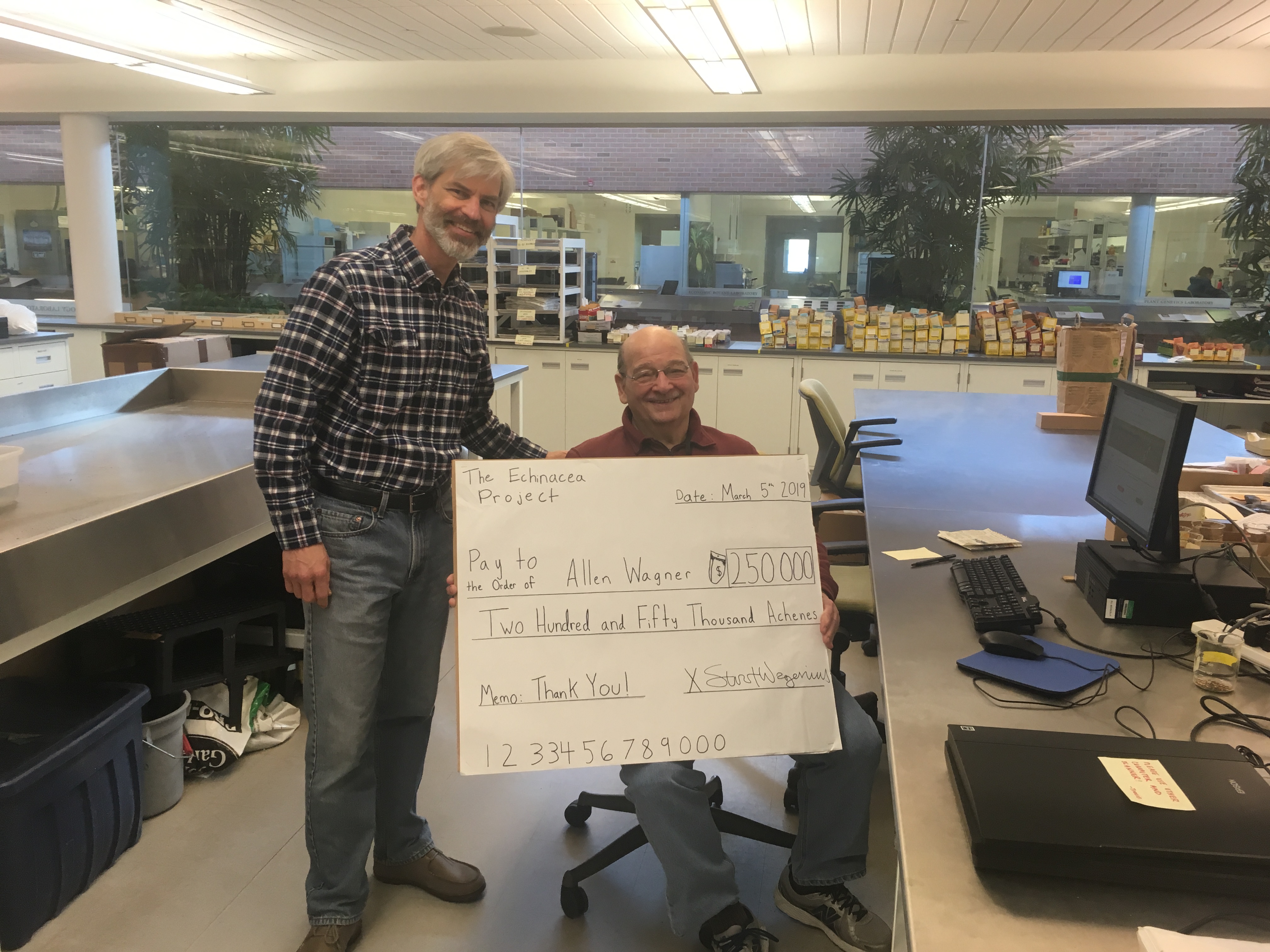
Here on the flog, we like to talk about how much of the important work around the lab is done by our volunteers. Last week Allen, one of our long-term volunteers, hit a huge milestone and showed us just how much he does for the project.
Allen has officially counted a quarter of a million achenes.
Allen reached this number faster than usual, counting up to his quarter million in just a bit over two years. We’re super thankful for all of the work Allen has done for the project. And of course, what better way to show our thanks than a big check?
 Allen, Stuart, and a big check In the future, Allen will continue to count achenes and hopefully hit many more large milestones in his counting.
Thank you Allen!
Hello once again flog!
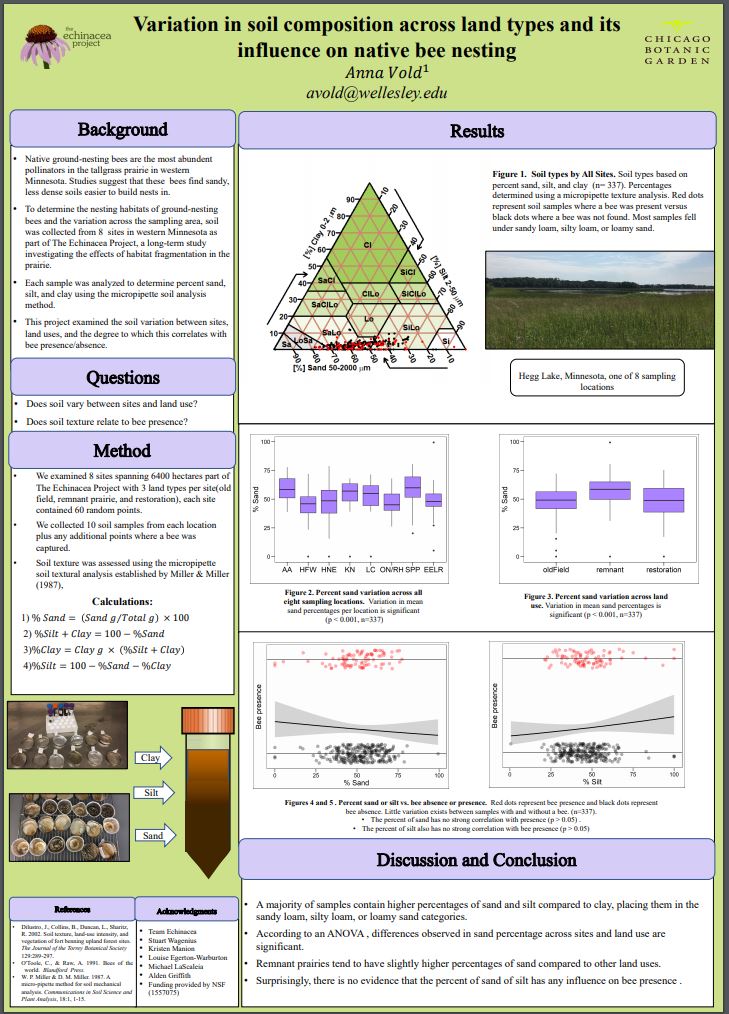
Last weekend I presented a poster (link below) at the Massachusetts Association of Conservation Commissions convention in Worcester, MA.
This was my first poster symposium and I am glad to say it went great! I was able to interact with so many people attending the conference, along with other student researchers. I received some wonderful comments and feedback, and hopefully was able to make more people aware of soil, native bees, and the Echinacea Project!
My poster focused on the soil texture data I collected over January and its correlation to native bee nesting. After a little more work in R, I found some surprising results. The percent of sand or silt did not have any influence on bee presence. However, between the eight sites and the three land uses, variation in percent sand was significant. Meaning, soil variation does exist across the Echinacea Project sampling area, it just might not be the strongest factor influencing bee nesting.
The soil is only one component of this project though. We also collected data on the slope, vegetation, percent bare ground, and soil hardness. One of these variables may be the key in understanding native bee nesting, so there’s a lot more analyzing and R to come.
I am so grateful for all the help I have received to make my first poster experience a success!
Until next time!
 Click on the link below to see a high resolution image of the poster annavoldMACCposter19Final
Hi Flog,
It’s business as usual here at CBG, and we’re hard at work trying to finish counting the achenes from heads that were harvested in 2015. It may sound like we’re a little behind on counting, but that’s only because there’s simply so many achenes to count! In 2018, volunteers at the project counted over 800,000 achenes, and we’re certainly striving to beat that in 2019.
Tuesdays are particularly fun in the lab because it is far and away the most full time. Marty and Allen count achenes while Laura classifies. Shelley is randomizing and Naomi is cleaning. All in the name of progress! Hopefully as some of our volunteers return from their winter getaways we’ll start grinding through some of the 2016 counting, and we’ll certainly start cleaning all the heads from 2018 within the month.
Our full lab! Look for more updates soon on how our counting and cleaning is going!
Michael
Hi Flog!
One of the biggest task we do here at the echinacea project is what we call demap. Demap is our shorthand for “demography map” and is also certainly in no way a testament to our ongoing support of Bill Swerski’s Superfans and how they may pronounce “the map.”
In demap, our goal is to take all of the field records from remnant populations of echinacea that we spend many weeks collecting and make them look all nice and pretty. If you ever doubt just how long that this data takes to collect, do a search of our “daily updates” category and count the percent of days that include the word “demo” or “surv.”
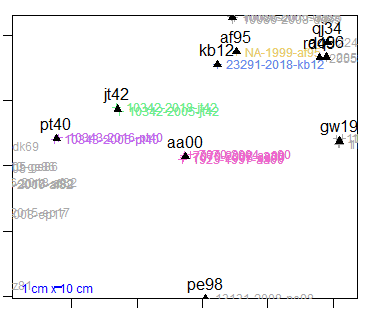
Where the true magic happens with demo, as with many things with the Echinacea Project, occurs in R. There, we are able to take all the location records and all the flowering data for every plant for every year, and create a big, beautiful map.
 A small, but still beautiful map. The big one is a little to crowded and confusing 😥 Why mention demap now in the middle of February? While we finished collecting the data back in October, just yesterday we finished making sure it was all accurate. It may have taken a while, but it’s always worth it for high quality data!
Have a great weekend!
Michael
We all know how the situation goes. You get home from a long day of work, take off your shoes, flop down on the couch, and think to yourself “There’s no way that there’s very much variation in echinacea flowering from year to year. ”
I know, we’ve all been there.
I’m here to tell you that, despite what you might think, there is HUGE variation in echinacea flowering from year to year. When these punctilious perennials decide that it’s time to flower, they really seem to go at it as a group.
And if you’re still sitting there thinking “Well a small amount of year to year change is to be expected” then let me hit you with some visual proof.
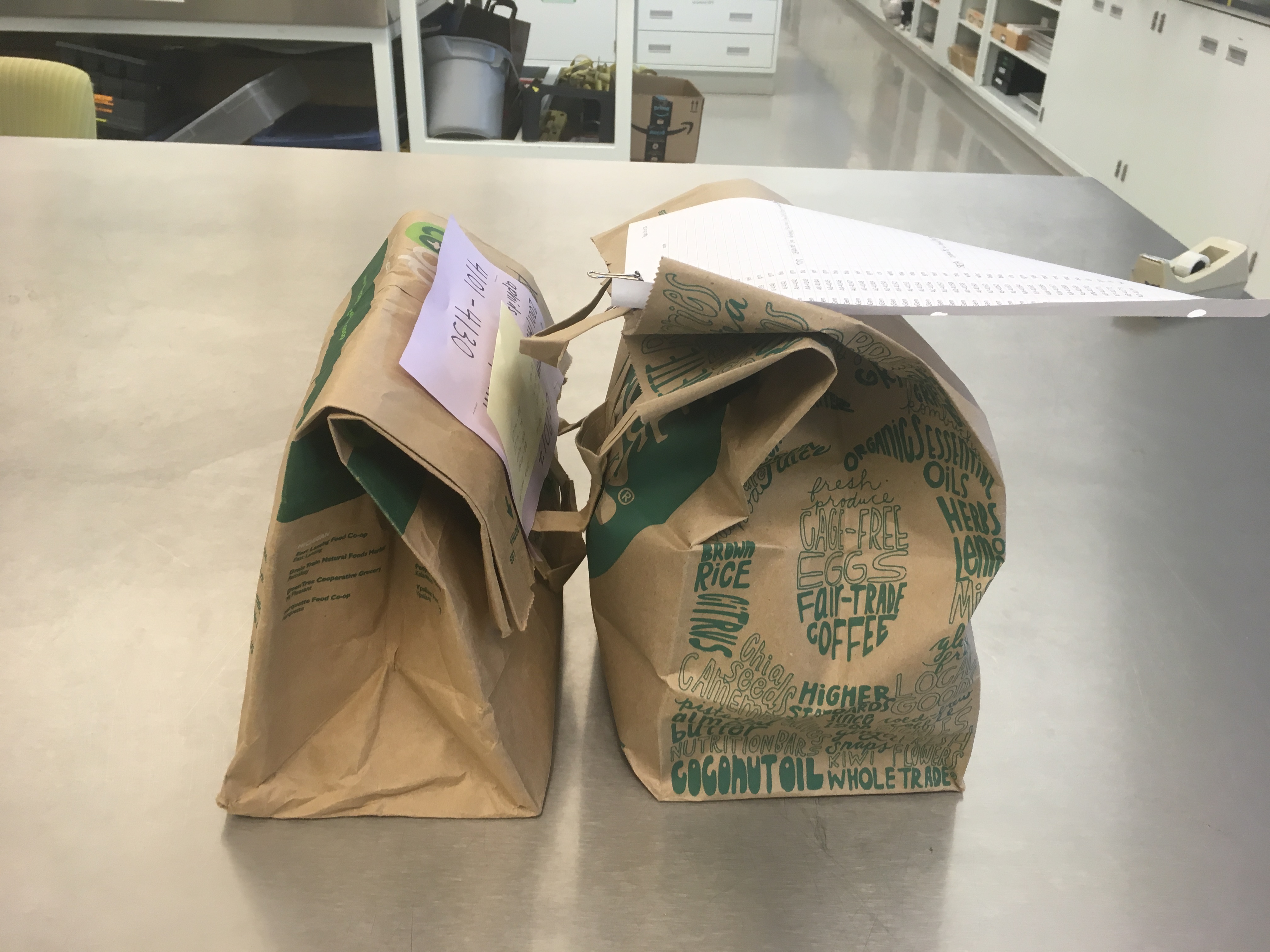
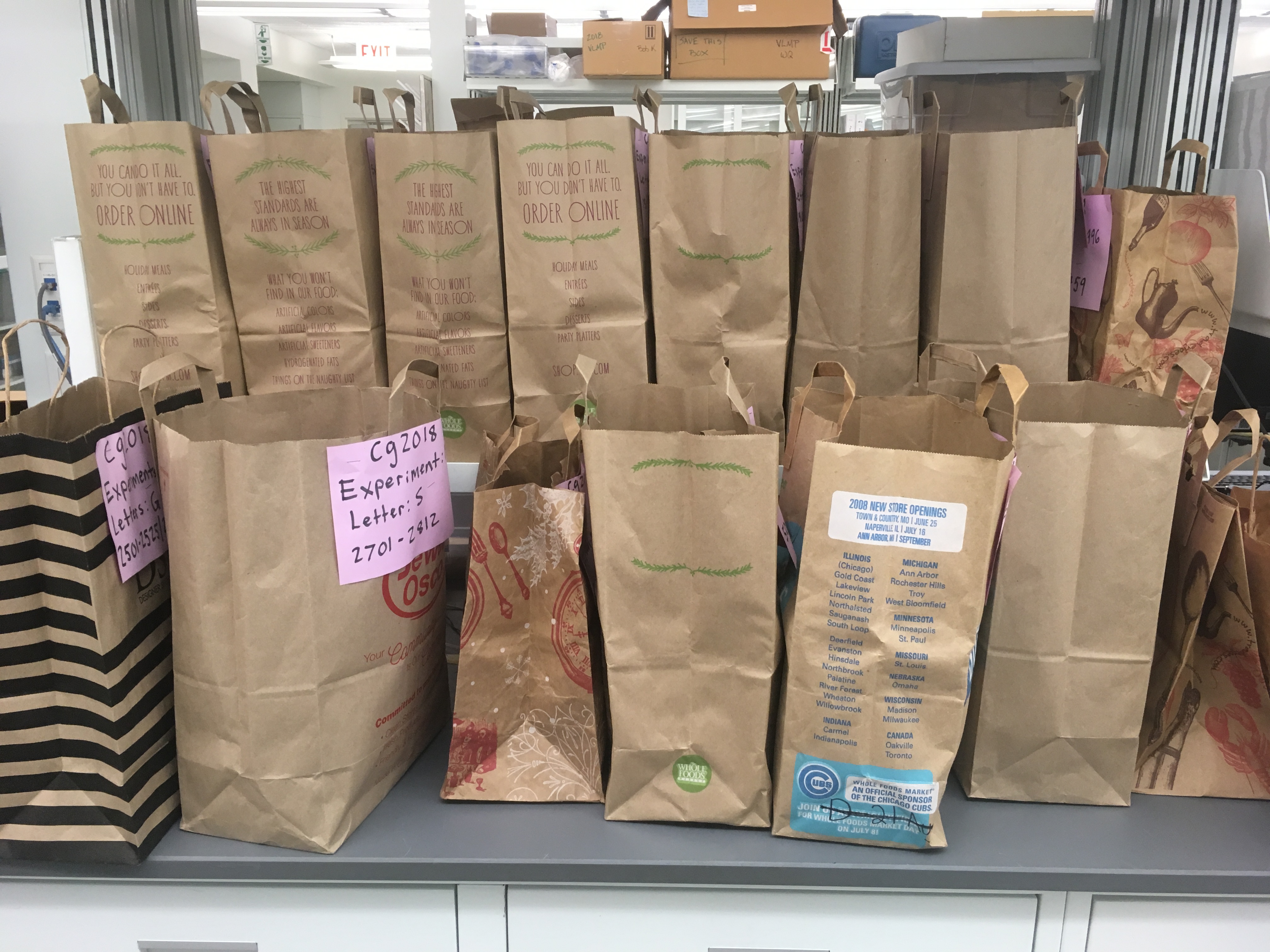
Here is a picture of ALL of the heads from Experimental Plot 1 in 2017. They fill up about 1 grocery bag total. Not a bad haul!
Our plot 1 heads from 2017 Now, let’s take a look at 2018. I spy just a few more bags than in 2017:
Our plot 1 heads from 2018 in many bags Now it’s time for the real question: why? What is it that makes echinacea flower in these large groups? They cant phone a friend and say “hey dude, you gonna flower this year?” They must respond to signals or communicate chemically or do any of a hundred other things to flower in groups like this. All I know is that we’ve got a lot of 2018 cleaning in our future.
Hello Flog!
I know you’ve all been sitting on the edge of your seats waiting for your most recent update on our push to xray our achenes. Wait no longer! I’m here to inform you that as this is being posted the last of the 2016 achenes are being assembled. 2016 is the most recent year for which we have every head cleaned and randomized, and marks the beginning of the end for our backlog. Very soon we will be seeing some 2016 seed sets. Exciting!
Implied above, this also means that 2015 is fully assembled. 2015 was the largest year of flowering ever for the project with over 3000 heads. Not to fear: they’re all cleaned, randomized, xrayed, and ready to be classified.
All of our assembled 2015 achenes Tune in next week for an update on the status of the polLim experiment xrays. expect good news!
Michael
|
|