|
|
Howdy Flog Followers,
After the scanning is completed and all of the achenes have been counted, the next process is randomizing.
Randomizing consists of taking the top, middle, and bottom sections of achenes and separating their achenes into an informative and uninformative subcategory. The goal of this step is to get a random, and therefore representative, sample of achenes from the middle.
For the informative subcategory, the goal is to place 30 achenes from the top, middle, and bottom section into clear envelopes. The top and bottom achene sections normally have 30 achenes already within their section, due to the extraction method used that aimed to get 30 achenes from the top and bottom before moving on to the middle. So, in exchange the middle section of achenes normally has a larger number of achenes. In order to narrow the large sections of achenes down to 30, randomization is necessary.
Steps for randomizing:
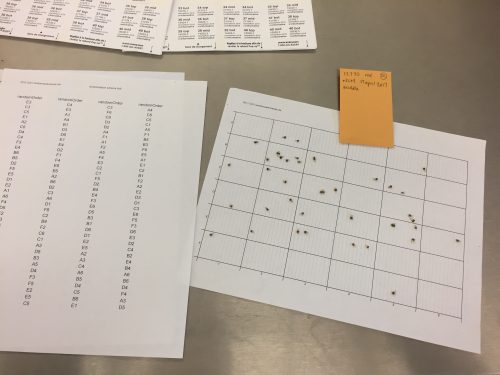
- Pour the section of achenes across a sheet with a labeled grid.
- Make sure that all of the achenes are clearly within a box of the grid. Go through and push all the achenes that landed on the lines and outside the grid space into a distinct box. This is to avoid bias.
- Follow the list of randomized letters and numbers, provided on a separate sheet of paper, until you have accumulated 30 informative achenes.
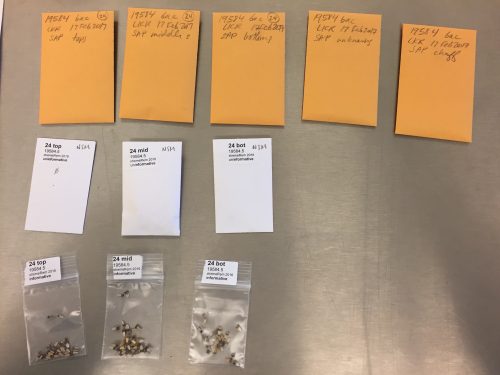
All of the remaining achenes from randomization that were not chosen are put into the uninformative subcategory. Ray achenes, achenes with holes, and achenes that have been crushed along the way are considered uninformative. These are placed in small white paper envelopes.
After the achenes are separated into their informative and uninformative subcategories, they must be labeled with their corresponding sticker. This is so that their identification, and therefore the extreme quality that the seed-head possesses, is not lost.

Seen in the image directly below is The Final Product: 11 envelopes. 3 of these envelopes are the clear bags full of the informative achenes, from the top, middle, and bottom sections, that will move on to be X-rayed. The use of clear bags is for X-ray purposes, so that a clear shot of the achenes is achieved.
‘Till next time folks,
Nicolette McManus
Howdy Flog Followers,
After cleaning a whole bunch of seed-heads, I began the process of scanning.
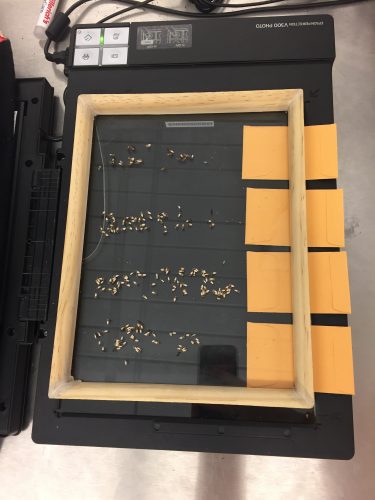
Scanning is a rather simple process. Out of the 5 achene envelopes for each seed-head, the four envelopes containing achenes (excluding the chaff) are used. Each section is poured out onto a glass ‘sheet’, that is placed onto the scanner. I loaded each section with its corresponding label from the paper envelope, for identification and to avoid confusion between the different sections. In the image below, from the bottom to the top of the glass sheet the achene sections : top, middle, bottom, other. The middle section is the most noticeable, as it normally has the largest number of achenes.
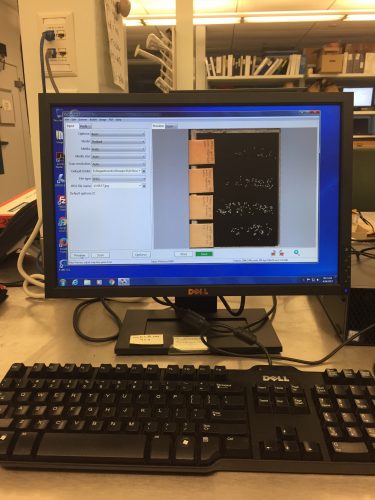
After all the achenes are placed onto the glass sheet, a cover is placed over the sheet, for the sake of darkness. Then the scanning can commence! Each resulting scan looks similar to the second image, on the computer screen.
Lastly, it is important to have a specific place to save all of the scans to. I have saved all of the extreme scans to the ‘EchinaceaCG2016’ Folder, under the I Drive. This way, everyone (including yourself) will be able to find your hard work.
 
The scanned images are then used to count all of the seeds found on that specific seed-head. Specifically, the seeds are counted in reference to their category (top, middle, bottom, or other), which can be combined for a total count value. As a result, we are able to compare the sizes of the seed-heads, based on achene count.
‘Till next time folks,
Nicolette McManus
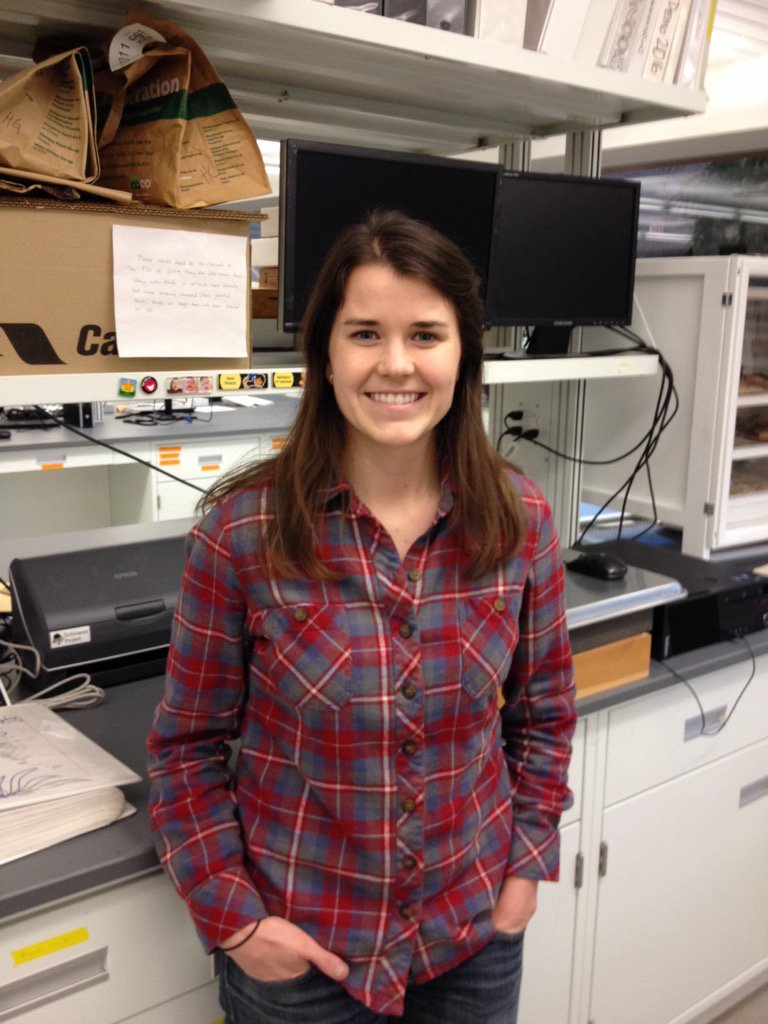
Today was Amy Waananen’s last day working at the Chicago Botanic Garden with the Echinacea Project. The last few days were a flurry of activity with our potluck, preparing for prescribed burning in Minnesota, and getting ready for the summer field season. On top of that, Amy submitted a manuscript about reproductive synchrony to The American Naturalist. It’s sad to see Amy leave but we’re happy that she will be nearby. She is working out on the prairie in western Minnesota the summer with her new lab group. It is great she is starting a PhD program at the University of Minnesota this fall. Good luck, Amy!
 Amy W at CBG
We had a great time at our annual lab potluck on Tuesday. We celebrated all the people in the lab, including all of the undergraduate interns. Scott told us about the smoke experiment. Then Amy explained the pollinator study from 2016. Lea talked about her projects on flowering phenology. We reviewed some of our many accomplishments in the lab, including: 1) cleaning and randomizing all 1233 heads from exPt2 in 2015, 2) counting 478,069 achenes from 3078 heads, 3) scanning 1710 images, 4) assembling 198 xray sheets. This year Lois, our reigning “achene queen,” counted her 800,000th achene and Sam counted his 250,000th! This summer we have ambitious plans for the field and lab. It was a lot of fun and the food was great–an incredibly diverse spread of tasty dishes.
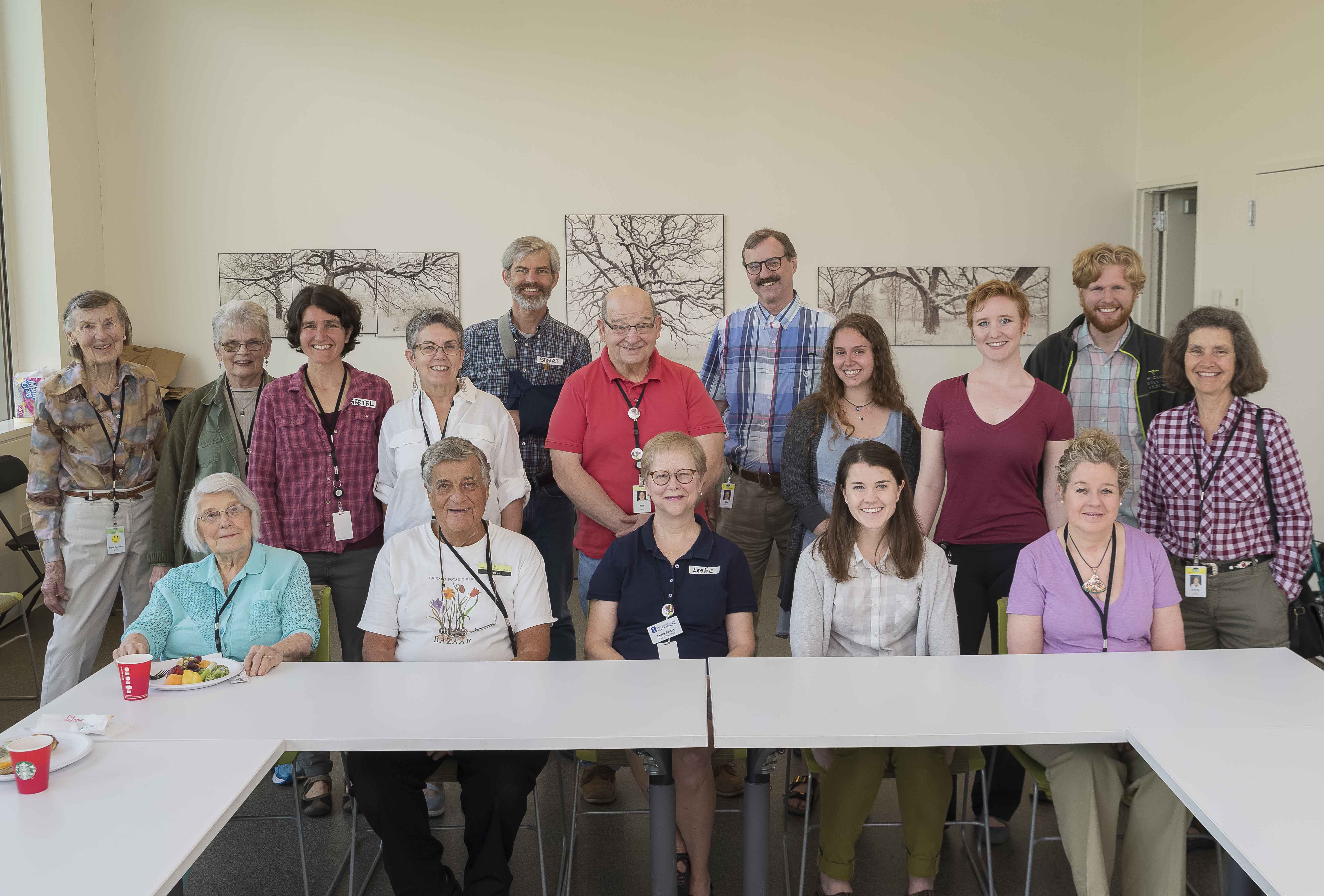
We took a group photo:
 First row (L to R): Lois, Art, Leslie, Amy, Laura; Second row: Susie, Char, Gretel, Anne, Stuart, Allen, Mike, Ivy, Lea, Scott, Shelley. Not pictured: Aldo, Susan, Michele, Marty, Naomi, Sam, Kathryn, Lou, Suzanne, Nicolette, Sarah. Thanks for a great year!
|
|