There are only two plants from Steven’s Approach left in the Common Garden that have yet to finish flowering! I have the rest of the start and end dates of all other flowering plants attached to the csv file below.
Ian
|
||||
|
There are only two plants from Steven’s Approach left in the Common Garden that have yet to finish flowering! I have the rest of the start and end dates of all other flowering plants attached to the csv file below. Ian This site explains the circumstances where burning permits are required in Minnesota: http://www.dnr.state.mn.us/forestry/fire/questions.html This graph summarizes the First and Last Day of Flowering for Echinacea plants in the common garden. It looks like peak flowering was July 8, 2010.
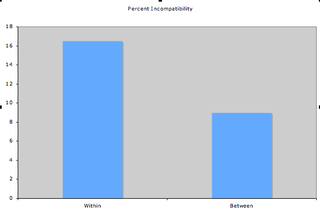
I analyzed my data and put together a couple of tables and figures. one thing that is interesting to me is that each species of bee was more sucessful in pollinating styles that had been 2 days old rather than 1 day old styles. hmmm? Maybe styles that are out for more than a day are more susceptable to shriveling..? Also, when Gretel compiles the data for CG phenology into a figure, I will use the figure to match up dates for when I did the insect visits and which species I saw most on those days. It should be interesting because it seems to be that in the beginning of flowering and towards the end of flowering, the smaller bees such as Augochlorella appear. Whereas during the peak of flowering, Melissodes dominated and I didn’t see any Augochlorella. -Katie The simplified protocol for crossing these plants (silverleaf scurfpea) is to find an uncrossed, flagged & bagged plant. Remove both bags, leaving the twist tie on the branch to be able to recognize it. Using a toothpick, transfer pollen from the donor flower on a plant to the receiver. (I have been doing a minimum of four and up to as many as possible on the branch) After the pollen is transferred, use a new toothpick to transfer pollen between the next two flowers. (Always a new toothpick) Then transfer to the “donors” of pollen on that same plant. For this pollen, use another flowering plant AT LEAST 5 meters away – to avoid them being clones. Individually transfer from donor flower to donor recipient. These sepals get painted pink and the twist tie should be red. Record the number of flowers (it can be more or less than the recipient number) and the color of paint and the twist tie. Sample data: It is tedious to get the anthers out of the sheath, but they are loaded with pollen- so touching the toothpick loads it even if you cannot see them. I checked some anthers under the microscope and there is a good deal of pollen – it is clear so it doesn’t show up as well as some asteraceae pollen. There have been some small details to fix on my data that I posted yesterday so I have attached a new and improved csv file below. I also ran the chi-square again today removing one cross that was not securely an incompatible cross. When removing this point the results for higher incompatibility within remnant crosses became more significant (X2 = 4.33, df = 1, P = 0.038). My methods for assessing whether there was compatibility between two plants was to collect pollen from a randomly selected paternal plant and then introducing that pollen on five styles of a randomly selected maternal plant. The styles on the maternal plant were marked by painting the bracts behind the styles a unique color and noting the direction the styles were facing on the head. After introducing pollen, styles were given 24 hours to experience shriveling before assessment. A shriveled style was indicative of a compatible cross while a persistent style signaled incompatibility. The plant that I removed for the second chi-square showed 3 persistent styles and 2 shriveled styles when assessed. I was unable to do the cross again given that the plant ended flowering quite early on, and given that it showed only 60% assurance of incompatibility I decided to reject the cross from the statistical analysis. My original sample size was 30 plants found in the common garden that were progeny from Steven’s Approach, East Riley and Nessman. There were no biparental inbred plants included in the sample. However, towards the end of the crosses one of the plants from Steven’s Approach died before it could receive pollen so I randomly selected a new plant in order to finish the crosses. If I remove the crosses done on the later selected plant the chi-square analysis of the compatibility for between and within remnant crosses becomes slightly less significant (X2 = 3.80, df = 1, P = 0.051). I have also attached my original data sheets from style assessment as a pdf. I have some pictures of pollinators, but more to choose from would always be helpful for putting together my poster in a couple weeks. If so.. I would like any good pictures of Melissodes, Agopostemon, Augochlorella, Ceratina, and Lasioglossum. Preferably on Echinacea. If you could go through them and put them on a USB for me, that would be greatly appreciated. And I would acknowledge you for the picture if I use one of yours. Thanks, Katie After a couple of weeks of work 278 crosses in the common garden have been completed. Attached is a csv file containing the data collected. I have yet to finish collecting dates of the end of phenology for some of the plants so once all flowering is done I will post the remaining data. I ran a chi-square on the between and within crosses for compatibility and came up with a nearly significant result (X2 = 3.62, df = 1, P = 0.057). Below is a graph representing the difference in compatibility for between and within remnant crosses. As expected, there was higher incompatibility for within remnant crosses than for between remnant crosses. I will continue to post statistical results along with project photos and methods. Please feel free to question or comment.
In case we need help 🙂 Materials: 1. Sync visor, get randomized plant (row and position) from Hillary. |
||||
|
© 2026 The Echinacea Project - All Rights Reserved - Log in Powered by WordPress & Atahualpa |
||||
-thumb-320x242-50642.jpg)