|
|
Ashely Barto, an REU student in summer 2017, developed an independent project looking at how pollination influences reproductive success in Echinacea angustifolia. She was interested in how heads that get pollinated each day differ from heads that only get visited infrequently, but receive a lot of pollen on those sporadic visits.
Over 19 days in July 2017, 1980 styles from 21 capitula were pollinated following a randomly assigned pollination schedule: pulse or steady. Capitula assigned to the pulse pollination treatment received pollen on all emergent styles at the same time, so there was a range of style ages. Steady pollination capitula received pollen daily, so all styles were pollinated on the day they emerged. Style shriveling, a proxy for pollination, was used as the response variable.
Using a generalized linear model, interactions between style age, floret position, and pollination treatment were considered to create a pollination rate model. Style age and pollination treatment did not interact or have an additive effect on pollination rates. Instead, floret position within the capitulum was the only factor essential to modeling pollination rates in Echinacea. The results suggest resource allocation plays a major role in Echinacea reproduction. Ashley will investigate seed set from the same capitula later this year to further elucidate the role of style age, floret position, and pollination treatments in Echinacea reproduction.
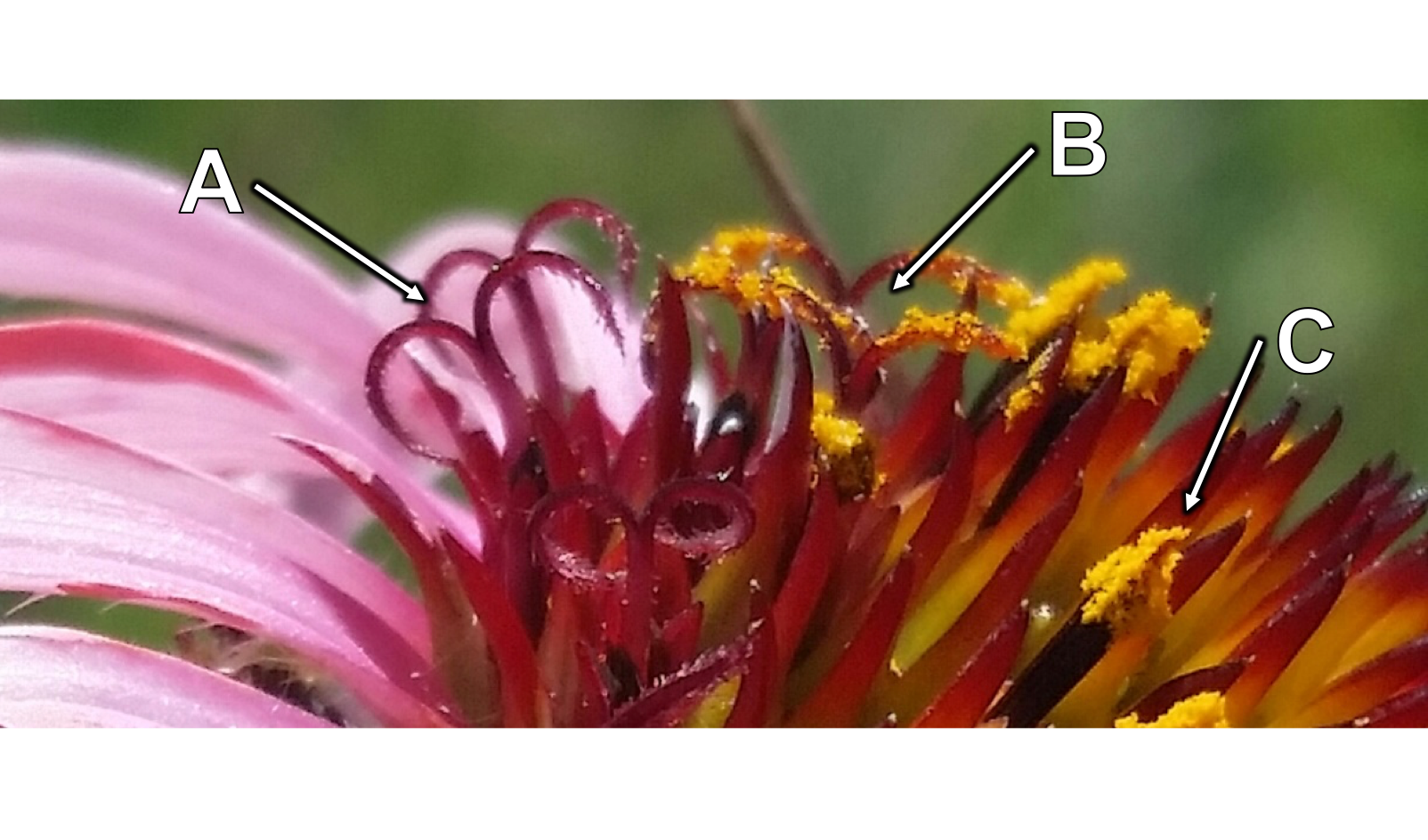
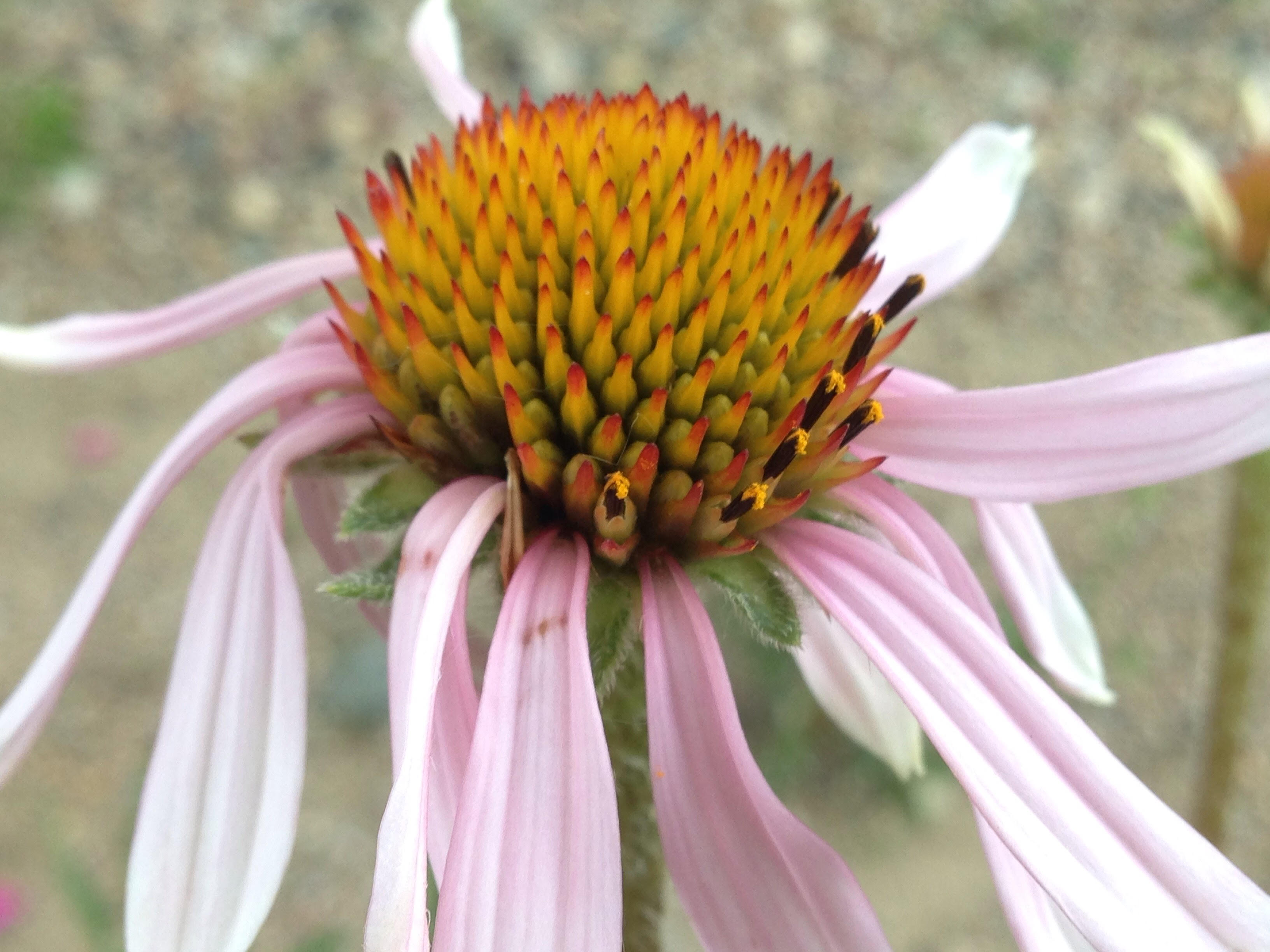
 Echinacea on its third day flowering. Within the disc florets, there are persisting styles in Row 1 (A), fresh styles in Row 2 (B), and new anthers in Row 3 (C).
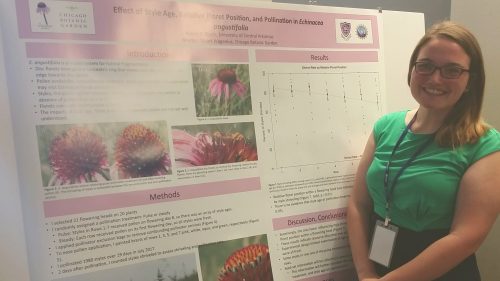
Ashley presented her work at the 2017 Arkansas INBRE Conference on October 28. Arkansas INBRE is the Arkansas Institutional Development Award’s network of biomedical research conference, and this year, it was hosted at the University of Arkansas. While this conference attracted undergraduates from many states to present on biomedical research in biology, chemistry, and physics, there were many posters like Ashley’s sharing summer research outside of the medical scope central to the conference’s theme. Ashley was able to talk about the Echinacea Project’s big picture work and how her independent REU Project fit into that larger image.
 Ashley presenting her summer REU project at the Arkansas INBRE Conference in October 2017. Start year: 2017
Location: Nice Island, prairie remnant
Physical specimens:
- 21 harvested Echinacea heads at the CBG, ready for cleaning and x-ray
Products: Here’s Ashley’s Poster of her results.
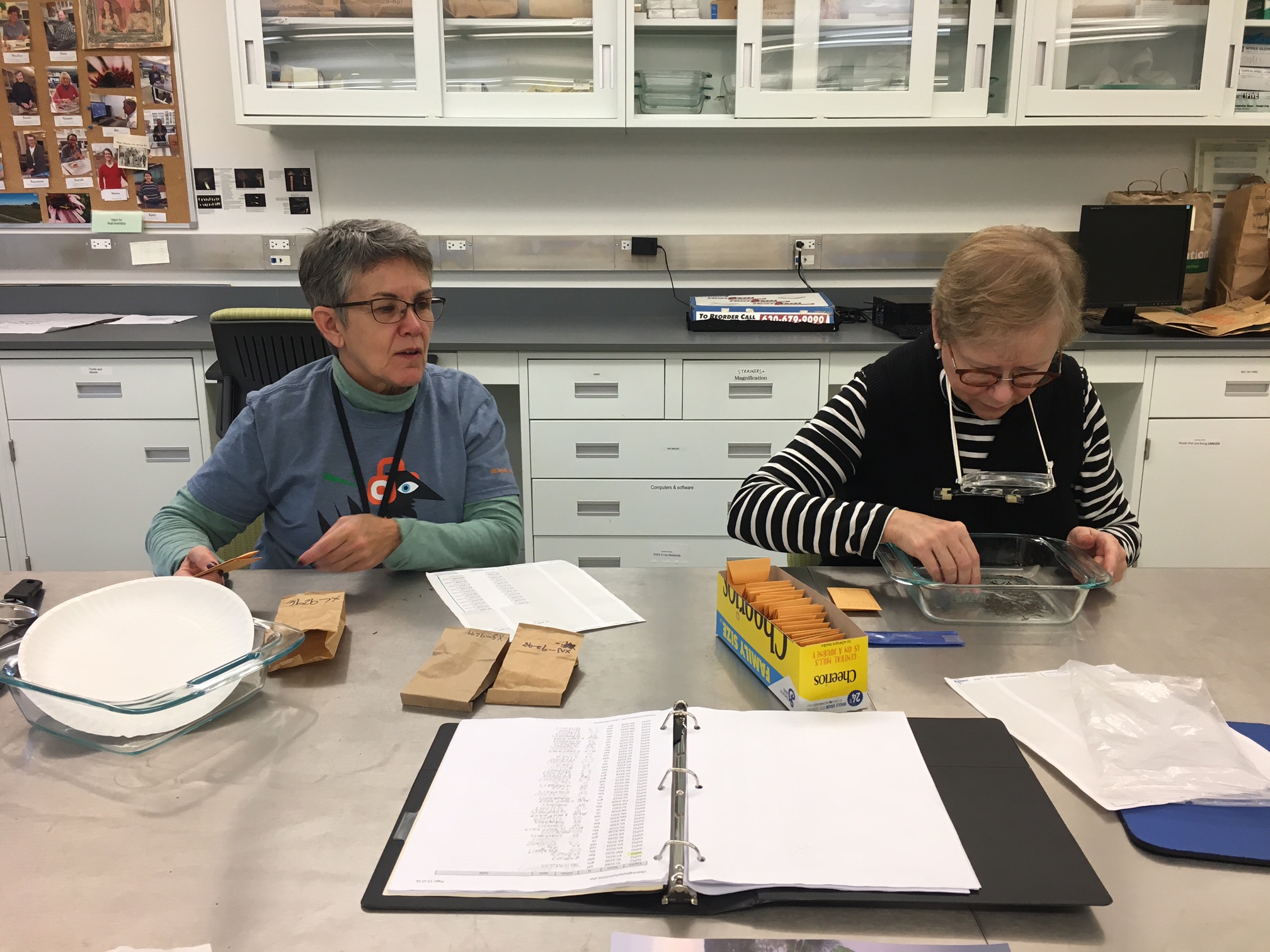
Anne and Leslie are hard at work rechecking heads that have been cleaned from 2016. This is an important job in our ACE protocol as it makes sure that no achenes are left behind before they get counted and randomized!
 Anne and Leslie rechecking Echinacea heads from 2016
In 2017, we searched in 7 recruitment plots for flowering Echinacea angustifolia plants. For each flowering plant, we took demographic data- counting the number of rosettes, counting the number of flowering heads, and shooting a GPS point of the exact location of the plant. Four plots had no flowering plants, but three of the plots had a total of 43 flowering Echinacea plants. Of the plots with flowering plants, two plots (with 35 of the flowering plants) are located at Hegg Lake, a site managed by the Minnesota DNR, and one plots (with 8 flowering plants) is located at Eng Lake.
This recruitment experiment was originally established in 2000 to quantify seedling emergence and juvenile survival of Echinacea angustifolia during its reintroduction to sites with varying land-use history and burn schedules. Before 2014, detailed data was collected on each plant in the plots. Since 2014, we’ve censused each plot yearly to collect demographic data for every flowering plant.
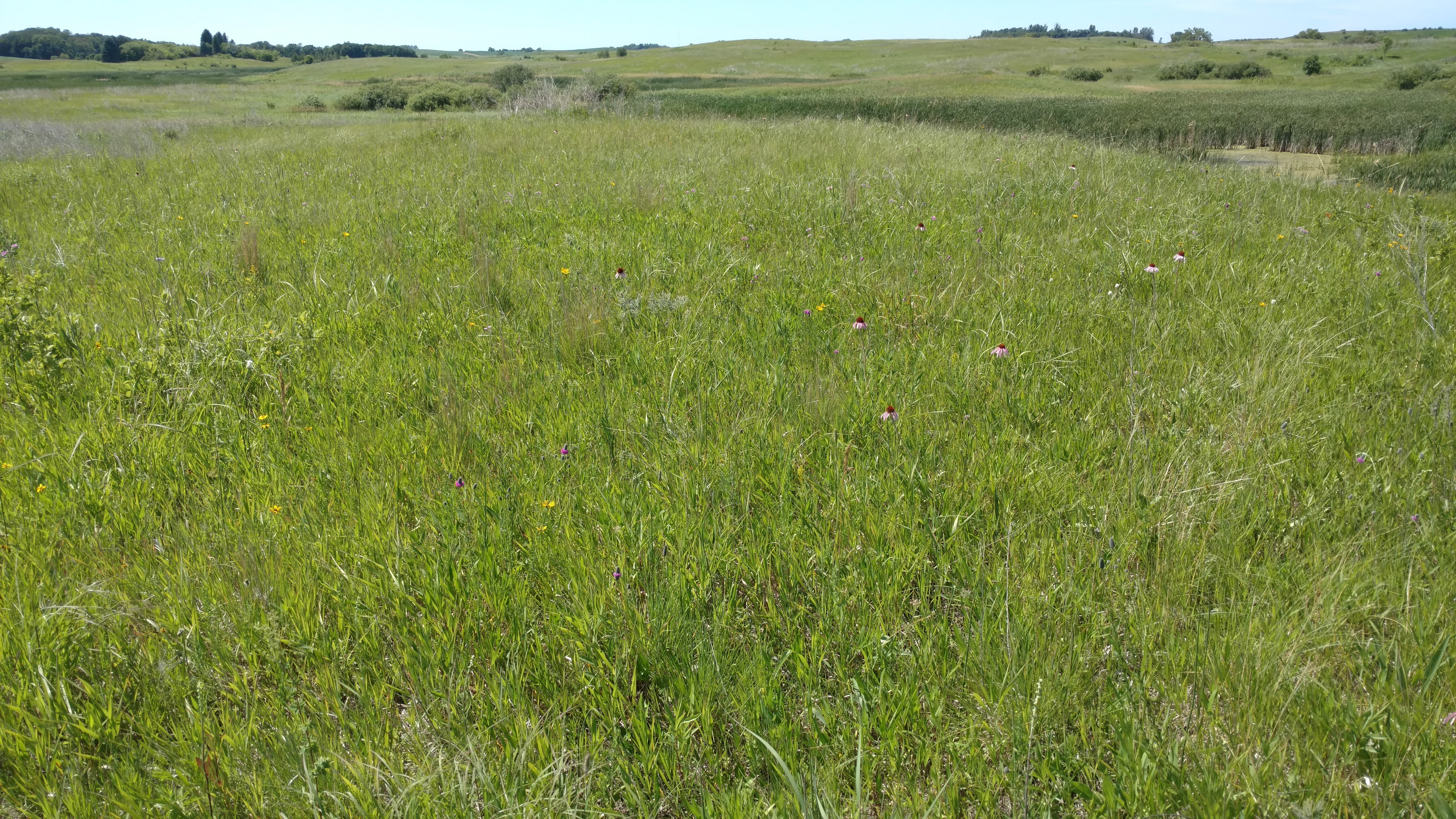
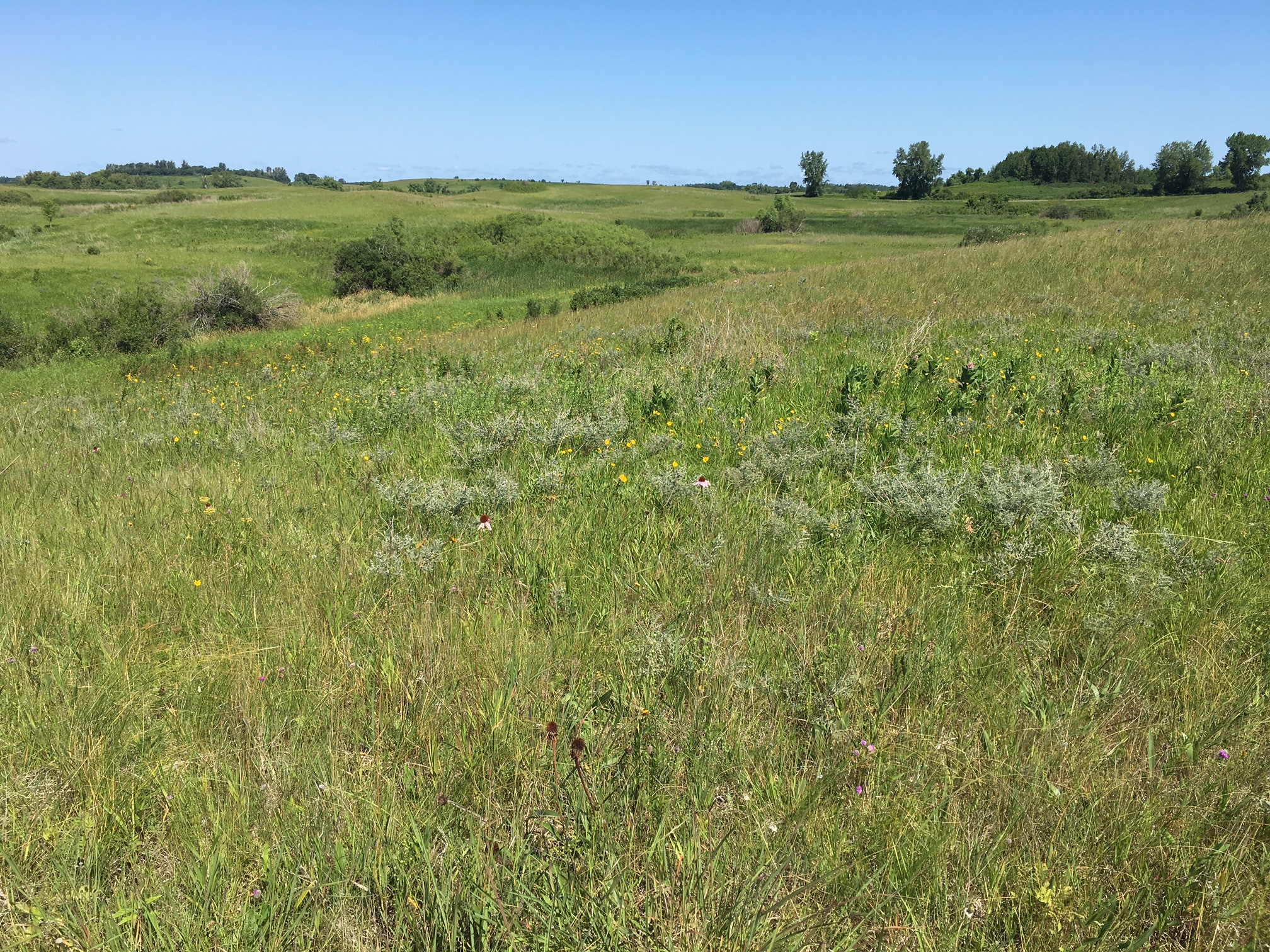
Echinacea at Hegg Lake, photo by Wes Braker
Year started: Plantings in 2000-2002
Location: Ten study plots on state land with different land use histories: old-field and restored grassland.
Overlaps with: Demographic census in remnants
Data collected: Status, rosette count, flowering head count, GPS point for each flowering plant in each recruitment plot
Products:A paper (Wagenius et al. 2012) published in Restoration Ecology.
You can find more information about the effects of fire on seedling recruitment of Echinacea angustifolia on the background page for the experiment.
This summer, Amy and members of Team Echinacea continued to monitor the progress of Echinacea plants in her local adaptation plots. We found 221 basal plants, but no flowering plants this year. Amy has 3 sites: Western South Dakota, Central South Dakota, and West Central Minnesota. At each site achenes from all sites have been sowed. Team Echinacea is able to help with the assessment of survival and fitness traits of the individuals in the Minnesota plot.
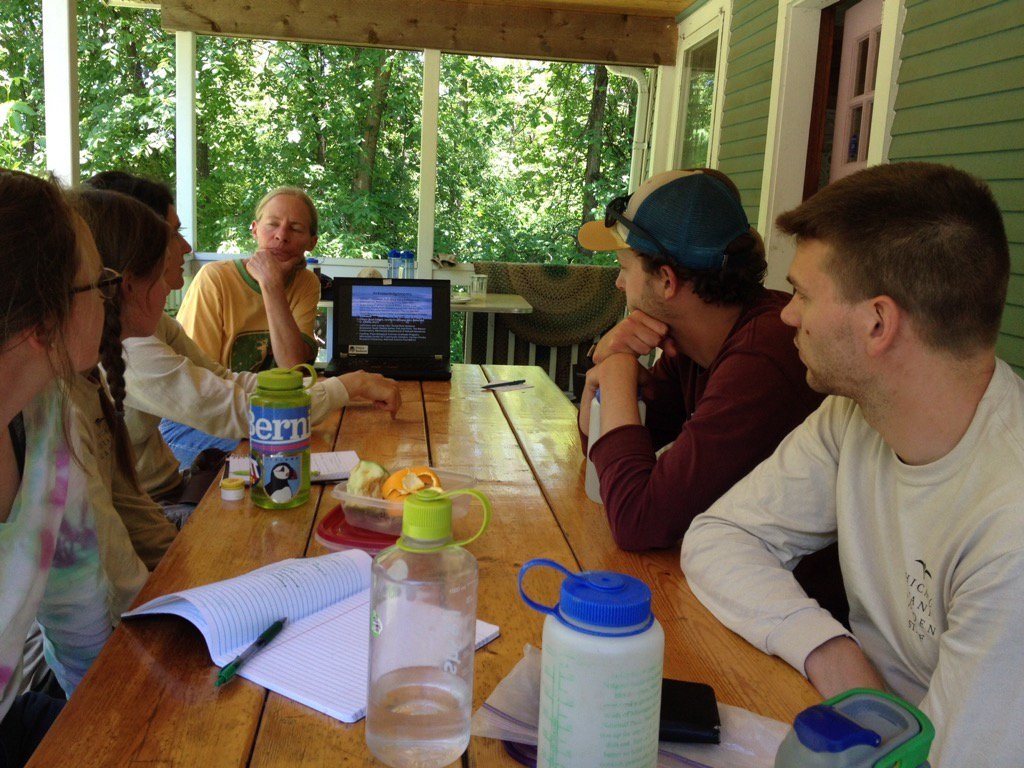
 Amy presents her local adaptation research so far at lunch this summer. Start year: 2008
Location: Grand River National Grassland (Western South Dakota), Samuel H. Ordway Prairie (Central South Dakota), Staffanson Prairie Preserve (West Central Minnesota), and Hegg Lake WMA (West Central Minnesota).
Overlaps with: Dykstra’s interpopulation crosses
Data collected: Plant fitness measurements (plant status, number of rosettes, number of leaves, and length of longest leaf)
You can find more information about Amy’s local adaptation experiment and links to previous flog posts regarding this experiment at the background page for the experiment.
This summer, we found 68 basal plants in the crossing experiment. None of these plants have ever flowered, but maybe next year! We measured plant status, number of rosettes, number of leaves, and length of the longest leaf of the individuals. We also noted damage (herbivory) to the leaves.
These data will allow Amy to test how mating with individuals from other populations affects Echinacea fitness. She planted 15,491 achenes, the offspring of crosses from six of the largest remnant populations. Populations might either benefit or suffer from crossing with plants from another population.
Hegg Lake WMA Start year: 2008
Location: Hegg Lake WMA
Overlaps with: Dykstra’s local adaptation
Data collected: Plant fitness measurements (plant status, number of rosettes, number of leaves, and length of longest leaf)
Products: Read about Amy’s analysis of the interpopulation crossing experiment in her flog post.
You can find more information about Amy’s experiment and links to previous flog posts regarding this experiment at the background page for the experiment.
 In 2017 only 2% of the surviving members of the 1996 cohort flowered! In 2017 only 7 plants flowered of the surviving 284 plants in the 1996 cohort. That means that 44% of the original plants are surviving and only 2% of the living individuals flowered! Five percent of living individuals flowered in 2016. In contrast, 45% of living plants flowered in 2015, followed by 37%, 34%, and 40% from 2014 back to 2012. We found that of the original 646 individuals, 284 were alive in 2017, only 7 fewer than last year. We are not sure why so few plants flowered this year. It’s possible that lack of fire in the plot influenced flowering rates. This plot was due for a prescribed burn in spring 2017, but weather and scheduling conflicts kept us from burning.
The 1996 cohort has the oldest Echinacea plants in experimental plot 1; they are 21 years old. They are part of a common garden experiment designed to study differences in fitness and life history characteristics among remnant populations. Every year, members of Team Echinacea assess survival and measure plant growth and fitness traits including plant status (i.e. if it is flowering or basal), plant height, leaf count, and number of flowering heads. We harvest all flowering heads in the fall, count all achenes, and estimate seed set for each head in the lab.
Start year: 1996
Location: Experimental plot 1
Overlaps with: phenology in experimental plots, qGen3, pollen addition/exclusion
Physical specimens:
- We harvested 8 heads. At present, they await processing in the lab to find their achene count and seed set.
Data collected:
- We used Visors to collect plant growth and fitness traits—plant status, height, leaf count, number of flowering heads, presence of insects—these data have been added to the database
- We used Visors to collect flowering phenology data—start and end date of flowering for all individual heads—which is ready to be added to the exPt1 phenology dataset
- Eventually, we will have achene count and seed set data for all flowering plants (stay tuned)
Products:
You can find more information about the 1996 cohort and links to previous flog posts regarding this experiment at the background page for the experiment.
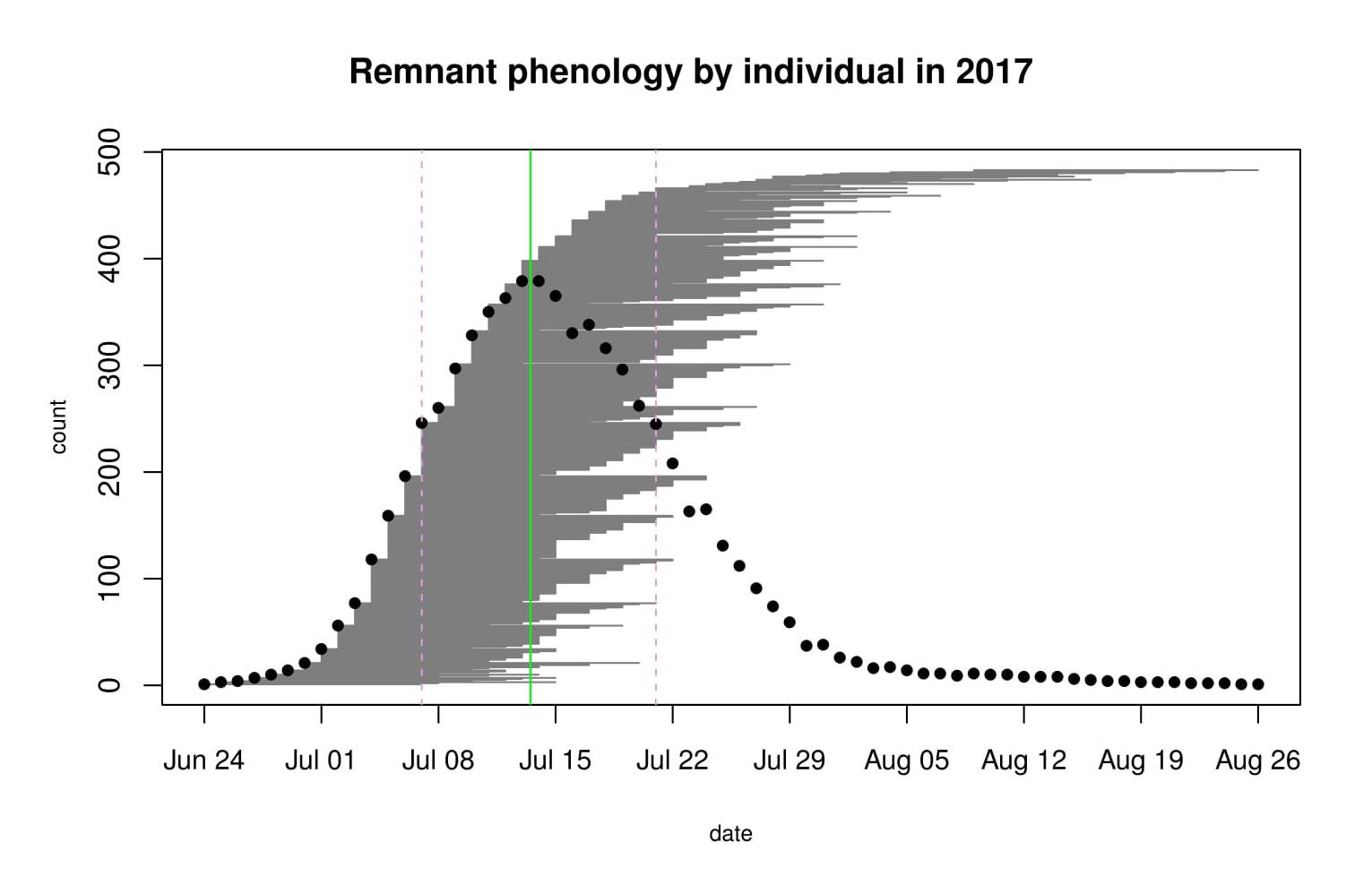
In 2017, according to our preliminary data, flowering began on June 24th with one head at the Aanenson remnant. The latest bloomer was a 5-headed plant at Steven’s Approach, and the last day its last head shed pollen was August 26th. Peak flowering for the 9 remnants we observed this year was July 13th. There was a total of 427 flowering plants producing 575 flowering heads. The figure below was generated with R package mateable, which was was developed by Team Echinacea to visualize and analyze phenology data.
 The gray shaded area is made up of horizontal gray lines, each representing the duration of one flowering head. The vertical green line represents the peak flowering date, July 13th. On average, heads flowered for approximately 2 weeks. From 2014-2016, determining flowering phenology was a major focus of the summer fieldwork, with Team Echinacea tracking phenology in all plant in all of our remnant populations. Stuart began studying phenology in remnant populations between 1996 and 1999 and several students also studied certain populations in following years. The motivation behind this study is to understand how timing of flowering affects the reproductive opportunities and fitness of individuals in natural populations.
Start year: 1996
Location: roadsides, railroad rights of way, and nature preserves in and near Solem Township, MN (2017: Aanenson, Around Landfill, East Elk Lake Road, Nessman, Northwest Landfill, Steven’s Approach, Staffanson Prairie Preserve, Town Hall)
Overlaps with: Phenology in experimental plots, demography in the remnants, reproductive fitness in remnants
Physical specimens:
- We harvested 121 Echinacea heads at 8 of the 28 remnants. These were harvested from Lea and Tracie’s “rich hood” (richness of neighborhood) plots. Not all harvested heads were monitored for the phenology dataset.
Data collected: We identify each plant with a numbered tag affixed to the base and give each head a colored twist tie, so that each head has a unique tag/twist-tie combination, or “head ID”, under which we store all phenology data. We monitor the flowering status of all flowering plants in the remnants, visiting at least once every three days (usually every two days) until all heads were done flowering to obtain start and end dates of flowering. We managed the data in the R project ‘aiisummer2017′ and will add it to the database of previous years’ remnant phenology records.
GPS points shot: We shot GPS points at all of the plants we monitored. The locations of plants this year will be aligned with previously recorded locations, and each will be given a unique identifier (‘AKA’). We will link this year’s phenology and survey records via the headID to AKA table.
You can find more information about phenology in the remnants and links to previous flog posts regarding this experiment at the background page for the experiment.
|
|