|
|
Trevor here, reporting on a day of momentous occasions; Nina and I completed step one in each of our projects! After being told, for the third time, that we look related to each other (hence the title), we decided that we had to get focused and finish cleaning—and so we did. I completed cleaning the 89 buds for the liatris species whilst Nina finished completed her 78 buds for the echinacea species; we were very excited! After taking a quick lunch break, we got back on the grind to begin phase two. Nina, being the diligent worker she is, began rechecking her echinacea buds for missed achenes. As for myself, I progressed onto the second species in my study: solidago.

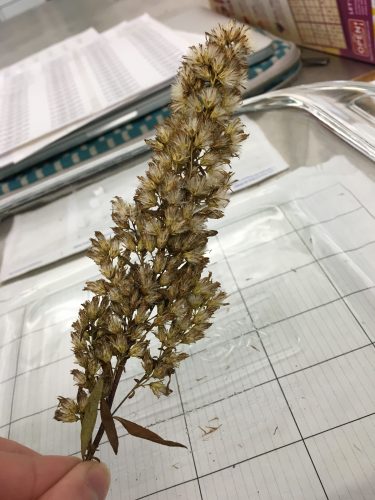
Here is an image of one of the buds from the solidago species I’m working on; isn’t it beautiful?! While liatris and solidago are generally similar in biological makeup, they do possess some noticeable differences. First of all, the achenes in solidago are quite tiny (think half the size of a mosquito), which makes them extremely difficult to separate efficiently for future x-raying. Additionally, they have so many achenes that it makes it impossible to effectively pull out all the achenes from the bud. Instead, I get to do a fun shaking method where I shake off achenes into the tray. Just shaking my way to success; I guess.
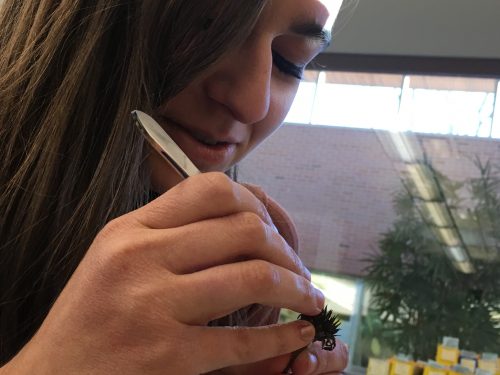
 Nina began meticulously rechecking her achenes. As you can see above, she was very focused. She actually invented a fun game where she would tally how many buds were missed by various people that assisted her in cleaning. As is stands now, Lea is in lead with 2 missed, Tracie second with 3 missed, and Nina (who did 60 of them mind you) is third with 4 missed. Max. On some, she even missed none! Marisol is in fourth with 5 missed, but who knows? She’s still counting! Updates to follow. Nina began meticulously rechecking her achenes. As you can see above, she was very focused. She actually invented a fun game where she would tally how many buds were missed by various people that assisted her in cleaning. As is stands now, Lea is in lead with 2 missed, Tracie second with 3 missed, and Nina (who did 60 of them mind you) is third with 4 missed. Max. On some, she even missed none! Marisol is in fourth with 5 missed, but who knows? She’s still counting! Updates to follow.
Until Next Time,
Trevor
Hey, this is Nina! Today at the Chicago Botanic Garden, Trevor and I continued cleaning Echinacea, Liatris, and Solidago heads. We learned a new technique to clean seed heads today, which involves sorting the achenes based on the location on the head. For my Echinacea heads, I separated 30 achenes from the top of each head and 30 from the bottom of each head (not including any ray achenes present at the bottom of the head). Here’s a timelapse of me cleaning one of the heads. I got some help today when Marisol, a lovely intern from Lake Forest College, helped me clean some of my Echinacea heads. Trevor separated achenes based on location on and counted the number present on each head. From preliminary data, Trevor thinks there is a lot of variation from plant to plant, but no trend between numbers of achenes based on location on the stem. Tomorrow, I hope to finish cleaning my seed heads and move on to scanning!
This summer we found 52 basal Stipa plants and 209 flowering plants! The flowering Stipa plants had a median of 15 fruit per plant. Our largest flowering Stipa plant had 301 fruits and 31 culms. We harvested around 5000 fruits from experimental plot 1! These Stipa plants, or porcupine grass (Hesperostipa spartea) were planted as seeds in 2009 and 2010.
 A Stipa collage created by Anna with collected fruits, a flowering plant, and Will and Wes searching for stipa. Start year: 2009
Location: Experimental plot 1
Physical specimens: Fruits from the 209 flowering plants were broadcasted in experimental plot 2.
Data collected: There are currently 3 datasets in the Stipa folder in CGData (~Dropbox/CGData/Stipa/225_measure/measure2017/)
- 20170628StipaSearchData.csv: 50 records from 28 June 2017. We searched for basal and flowering Stipa and recorded row and position, culm count, fruit count, aborted fruit count, missing fruit count, and notes.
- exPt1StipaSearch20170705.csv: 200 records from 28-29 June 2017. This csv includes rows with position 859 and status “Other (Note)”, indicating the row was searched but no stipa was found. When Stipa was found, status, row, position, culm count, fruit count, aborted fruit count, missing fruit count, and notes were recorded.
- 20171109StipaSearchData.csv: 69 records from 2 August 2017 and 9 August 2017. In this csv, predetermined rows and positions (where Stipa were found in previous years) were searched and the same information was collected as the other csvs. Since this was later in the season, all fruits had already dropped–but they could still be counted.
Products:
- Josh Drizin’s MS thesis included a section on the hygroscopicity (reaction to humidity) of Stipa awns. View his presentation or watch his short video.
- Joseph Campagna and Jamie Sauer (Lake Forest College) did a report on variation in Stipa’s physical traits within and among families in 2009
You can find out more about Stipa in the common garden and links to previous flog posts about this project on the background page for this experiment.
Hello, my name is Nina Denne and I am currently a freshman at Carleton College. I will be working as an extern at the Chicago Botanic Garden for the next 3 weeks, specifically looking at the relationship between reproductive fitness of Echinacea and the diversity of the surrounding habitat. For now, I’m mostly cleaning Echinacea heads and then I will be counting the achenes and X-raying achenes to determine whether they are viable. I’m very excited to be back at the Botanic Garden after having conducted a germination experiment with two species of Echinacea in high school. 
Trevor here! Today, me and Nina began our journey to clean the achenes of our respective species. I worked on my Liatris and Solidago species whilst Nina continued work on the echinacea species. A task of mental endurance, we did take a lunch break and another break to take bio photos on the green deck, which you can find on our introduction posts.

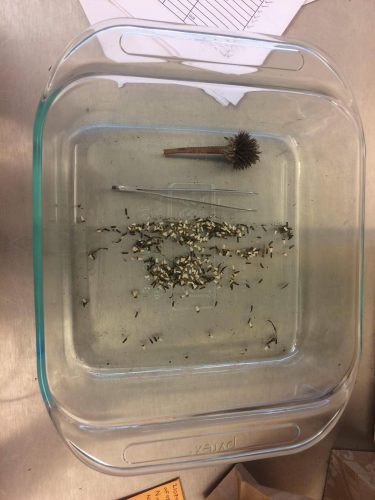
This is a picture displaying the echinacea bud (upper) and the respective achenes that Nina cleaned from the bud (lower). Nina admits that some of the buds were quite “stubborn” and she has to individually pluck each achene, which is not preferable. Nina prefers when the buds “behave themselves.”
 My buds are much less stubborn and the achenes easily fall off. In fact, my buds actually look quite different from the echinacea achenes, resembling a miniature version of the capitulum often emitted from dandelions, making them quite fun to work with! Pictured to the right, these are the achenes I separated into baggies for future x-raying (notice the formation!) My buds are much less stubborn and the achenes easily fall off. In fact, my buds actually look quite different from the echinacea achenes, resembling a miniature version of the capitulum often emitted from dandelions, making them quite fun to work with! Pictured to the right, these are the achenes I separated into baggies for future x-raying (notice the formation!)
Either way, Nina and I are extremely excited to begin our projects and continue cleaning first thing tomorrow! More updates to follow!
– Trevor
 Hello! My name is Trevor Hughes and I am a freshman at Carleton College in Northfield, MN. I am super fortunate to be joining Project Echinacea for an internship over my winter break; I’m super excited about it! Prior to my time at Carleton, I spent most of my time in high school working on the Conservation Ambassadors Board at Lincoln Park Zoo, planning events related to conservation. Fun fact: one of my events concerned urban prairie plant species (including echinacea!); how cool is that?! And through my time there, I grew to develop a passion for conservation, which will continue to grow in fortitude during my time at the Chicago Botanical Garden. Over the course of my internship, I will be working on cleaning, scanning, and counting achenes from the Liatris and Solidago species, hoping to discover findings comparable to echinacea, proving that conclusions made with regards to echinacea can be generalized to other prairie plant species in the future. Hello! My name is Trevor Hughes and I am a freshman at Carleton College in Northfield, MN. I am super fortunate to be joining Project Echinacea for an internship over my winter break; I’m super excited about it! Prior to my time at Carleton, I spent most of my time in high school working on the Conservation Ambassadors Board at Lincoln Park Zoo, planning events related to conservation. Fun fact: one of my events concerned urban prairie plant species (including echinacea!); how cool is that?! And through my time there, I grew to develop a passion for conservation, which will continue to grow in fortitude during my time at the Chicago Botanical Garden. Over the course of my internship, I will be working on cleaning, scanning, and counting achenes from the Liatris and Solidago species, hoping to discover findings comparable to echinacea, proving that conclusions made with regards to echinacea can be generalized to other prairie plant species in the future.
We had a big year for censusing plants in natural remnant populations. In 2017 we did both total demo, visiting all plants, and flowering demo, visiting just plants that flowered this year. Check out the chart below to see what we focused on at each site:
| Total Demo |
Aanenson, Around LF (partial), Common Garden, East of Town Hall, East Riley, Hegg Lake, Landfill West, Loeffler Corner East, NRRX, recruit he, recruit hp, recruit hs, Riley, RRX, South of Golf Course, Steven’s Approach, transplant plot |
| Flowering Demo |
Around LF, BTG, DOG, Elk Lake Road East, Golf Course, KJs, Krusemark, Landfill East, Liatris Hill, Loeffler Corner West, Near Town Hall, Nessman, NNWLF, North of Golf Course, NWLF, On 27, recruit el, recruit hw, recruit ke, recruit kw, RRXDC, Staffanson East Unit, Staffanson West Unit, Tower, Town Hall, West of Aanenson, Woody’s, Yellow Orchid Hill East, Yellow Orchid Hill West |
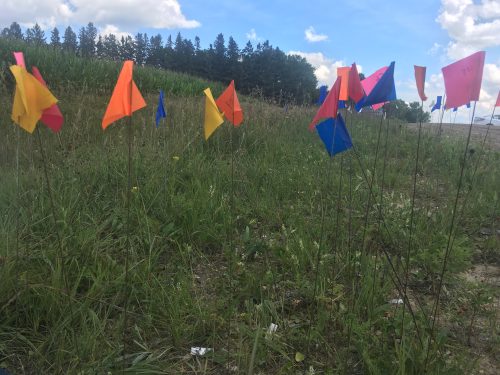
 We stake to locations where flowering plants have been found in the past and place a flag there. This is the East Riley roadside remnant, an area with a lot of Echinacea close together and a high chance of getting mowed. When we find a new flowering Echinacea plant, we give it a tag and get its location with a survey-grade GPS (better than 6 cm precision). Then, we can revisit this plant for years to come and monitor its survival and reproduction.
This season we added 5945 demo records and about 1375 survey records to our database. After over 20 years of this method, we now have a very rich longitudinal dataset of life histories including thousands of plants. REU Will Reed was a huge help organizing demo tasks for Team Echinacea over the summer and helping out with demap (the demographic census database) during the year.
Year started: 1996
Location: Roadsides, railroad rights of way, and nature preserves in and near Solem Township, Minnesota.
Overlaps with: Flowering phenology in remnants, fire and flowering at SPP
Data collected: demo records include Flowering status, number of rosettes, number of heads, neighbors within a 12 cm radius of plants found. These are all taken with PDAs that sync with an MS Access database. They are all transferred to the demap R repository in bitbucket with git version control.
GPS points shot: Points for each flowering plant this year shot mostly in SURV records, stored in surv.csv. Each location should be either associated with a loc from prior years or a point shot this year.
Products:
- Amy Dykstra’s dissertation included matrix projection modeling using demographic data
- Project “demap” merges phenological, spatial and demographic data for remnant plants
You can find out more about the demographic census in the remnants and links to previous posts regarding it on the background page for this experiment.
Wes Braker, an REU student in summer 2017, characterized the vegetation in remnant prairie, restored prairie, and old agricultural fields at Hegg Lake State Wildlife Management Area. Prairie communities with a large variety of native plant species are considered generally healthy communities. Wes wanted to characterize the plant communities at these sites and provide information to land managers.
Each area at Hegg Lake WMA was classified as remnant prairie, restored prairie, or abandoned agricultural field. Using Google Earth, areas were mapped out and labeled and three areas were chosen based on their availability for sampling, for a total of 27 study areas. Wes sampled vegetation each week for a total of 8 weeks across the growing season.
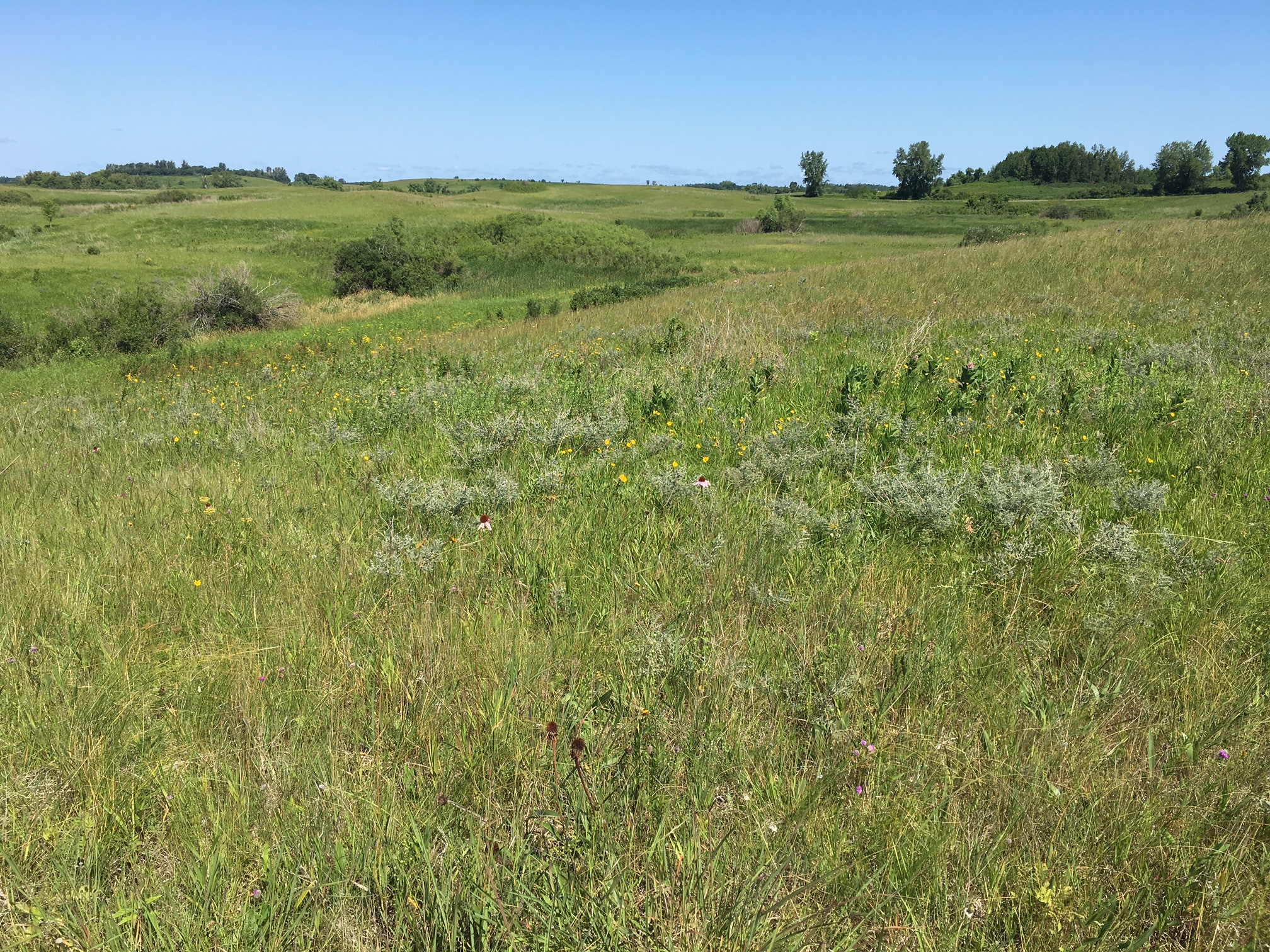
A snapshot of the landscape at Hegg Lake State Wildlife Management Area. The purpose of this project was to characterize the vegetation at this site, building a species list for use by the Minnesota Department of Natural Resources for potential use in local seed sourcing for future restorations. From this project, Wes identified 25 native prairie species for use in future Hegg Lake seed collections. In addition, he identified 80 unique plant species at this site.
 Reina, Pamela, and Mike with the photosynthesis machine used in Kittelson et al. (2015) In 2017, of the original 1,470 plants in INB2, 473 were still alive. Of the plants that were alive this year, only 4 were flowering (0.8%) and 71% have never flowered. Interestingly, there are differences in survival for each cross level. 31% of the most inbred plants were living in 2017, compared to 39% of the plants in the between-remnant cross level. All individuals were planted in 2006.
The INB2 experiment investigates the relationship between inbreeding level and fitness in Echinacea angustifolia. Each plant in experiment INB2 originates from one of three cross types, depending on the relatedness of the parents: between maternal half siblings; between plants from the same remnant, but not sharing a maternal or paternal parent; and between individuals from different remnants. We continued to measure fitness and flowering phenology in these plants.
Read previous posts about this experiment.
Start year: 2006
Location: Experimental plot 1
Overlaps with: Phenology and fitness in P1, Inbreeding experiment–INB1
Physical specimens: We harvested 2 heads from INB2 that will be processed in the lab with other heads harvested from P1.
Data collected: We used handheld computers to collect fitness data on all plants in INB2.
Products: The below papers were published in summer 2015:
Kittelson, P., S. Wagenius, R. Nielsen, S. Qazi, M. Howe, G. Kiefer, and R. G. Shaw. 2015. Leaf functional traits, herbivory, and genetic diversity in Echinacea: Implications for fragmented populations. Ecology 96:1877–1886. PDF
Shaw, R. G., S. Wagenius and C. J. Geyer. 2015. The susceptibility of Echinacea angustifolia to a specialist aphid: eco-evolutionary perspective on genotypic variation and demographic consequences. Journal of Ecology 103:809-818. PDF
You can find more information about the Inbreeding experiment–INB2 and links to previous flog posts regarding this experiment at the background page for the experiment.
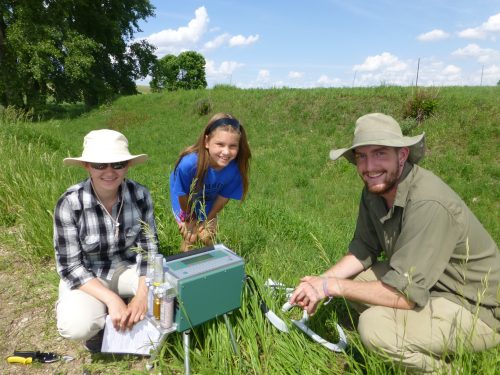
 Reina, Hattie, and Mike with the instrument used to measure photosynthesis in 2013. In 2017, of the original 557 plants in INB1, 180 were still alive. Of the plants that were alive this year, 7 (4%) were flowering and 23% have never flowered. Interestingly, there are differences in survival for each cross level. 21% of the most inbred plants were living in 2017, compared to 39% of the plants in the between remnant cross level. All individuals were planted in 2001.
The INB1 experiment investigates the relationship between inbreeding level and fitness in Echinacea angustifolia. Each plant in experiment INB1 originates from one of three cross types, depending on the relatedness of the parents: between maternal half siblings; between plants from the same remnant, but not sharing a maternal or paternal parent; and between individuals from different remnants. We continued to measure fitness and flowering phenology in these plants.
Read previous posts about this experiment.
Start year: 2001
Location: Experimental plot 1
Overlaps with: Phenology and fitness in P1
Physical specimens: We harvested 6 heads from INB1 that will be processed in the lab with other heads harvested from P1.
Data collected: We used handheld computers to collect fitness data on all plants in INB1.
Products: The below papers were published in summer 2015:
Kittelson, P., S. Wagenius, R. Nielsen, S. Qazi, M. Howe, G. Kiefer, and R. G. Shaw. 2015. Leaf functional traits, herbivory, and genetic diversity in Echinacea: Implications for fragmented populations. Ecology 96:1877–1886. PDF
Shaw, R. G., S. Wagenius and C. J. Geyer. 2015. The susceptibility of Echinacea angustifolia to a specialist aphid: eco-evolutionary perspective on genotypic variation and demographic consequences. Journal of Ecology 103:809-818. PDF
You can find more information about the Inbreeding experiment–INB1 and links to previous flog posts regarding this experiment at the background page for the experiment.
|
|

 Nina began meticulously rechecking her achenes. As you can see above, she was very focused. She actually invented a fun game where she would tally how many buds were missed by various people that assisted her in cleaning. As is stands now, Lea is in lead with 2 missed, Tracie second with 3 missed, and Nina (who did 60 of them mind you) is third with 4 missed. Max. On some, she even missed none! Marisol is in fourth with 5 missed, but who knows? She’s still counting! Updates to follow.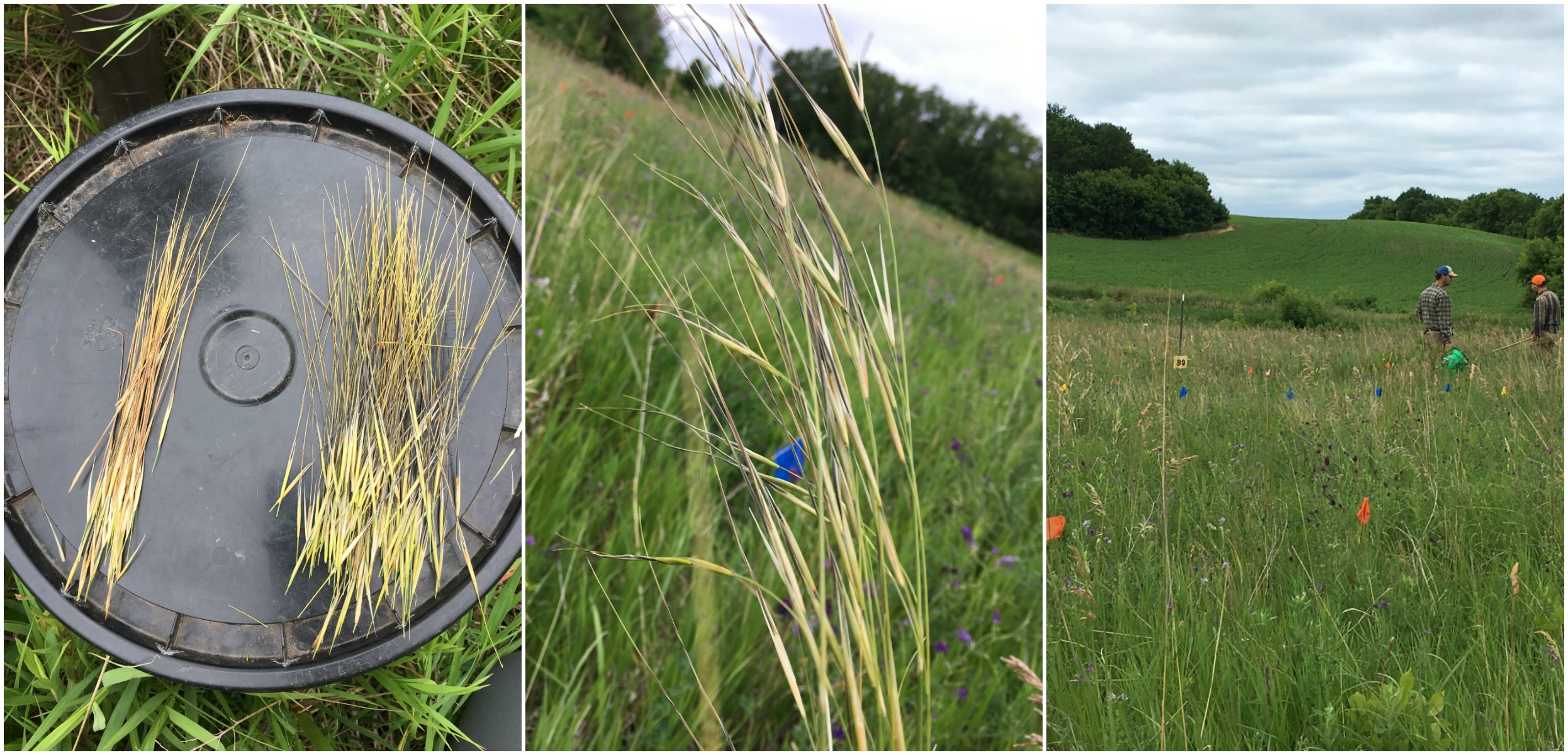

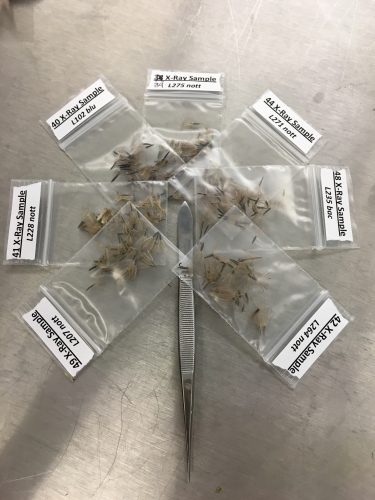 My buds are much less stubborn and the achenes easily fall off. In fact, my buds actually look quite different from the echinacea achenes, resembling a miniature version of the capitulum often emitted from dandelions, making them quite fun to work with! Pictured to the right, these are the achenes I separated into baggies for future x-raying (notice the formation!)
 Hello! My name is Trevor Hughes and I am a freshman at Carleton College in Northfield, MN. I am super fortunate to be joining Project Echinacea for an internship over my winter break; I’m super excited about it! Prior to my time at Carleton, I spent most of my time in high school working on the Conservation Ambassadors Board at Lincoln Park Zoo, planning events related to conservation. Fun fact: one of my events concerned urban prairie plant species (including echinacea!); how cool is that?! And through my time there, I grew to develop a passion for conservation, which will continue to grow in fortitude during my time at the Chicago Botanical Garden. Over the course of my internship, I will be working on cleaning, scanning, and counting achenes from the Liatris and Solidago species, hoping to discover findings comparable to echinacea, proving that conclusions made with regards to echinacea can be generalized to other prairie plant species in the future.