|
|
On to another job of the Echinacea project!
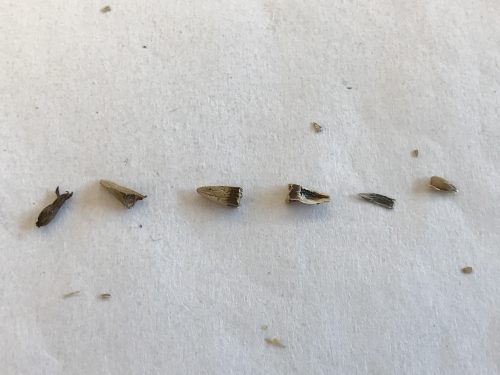
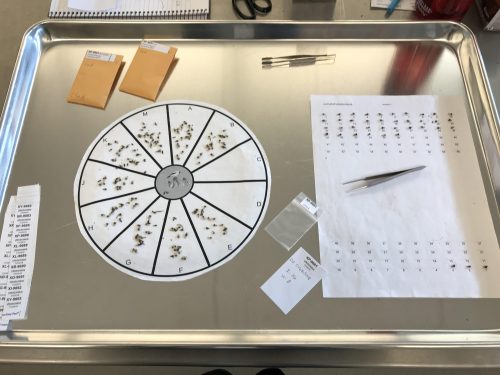
In recent weeks, I was trained in the process of randomizing the achenes collected from each Echinacea angustifolia head. After a thorough count is taken of all achenes per head, the measurement of seed count is also preferred. For clarification, the achenes are the fruit and if they have been fertilized then they will contain a seed. We measure seed count by taking a sample size of randomized achenes from each head to eventually be X-rayed. To begin the randomization process, I was given a chart that was divided into several sections. I took one of the labeled achene envelopes and scattered the achenes evenly over each section. I then used a computer randomizing application to generate two sections from the chart containing achenes. Once I moved the randomly selected achenes onto a separate sheet, I then examined each one and decided if they were informative or uninformative. An uninformative achene would either be shredded, contain a hole – which we believe is do to some sort of critter who may enjoy the achene or seed as a snack, or a ray-floret achene. The ray-floret achenes are three sided and infertile. These achenes surround the outer circle of the E. angustifolia head and hold the ray leaves, also known as the petals. The informative achenes are four sided and may possibly contain a seed. Once I determined informative versus uninformative, I re-enveloped the achenes and labeled them accordingly. The randomized achene samples will then be re-checked for conformation of informative versus uninformative achenes and later x-rayed.
The process continues with informative lessons on accuracy and precision of an unbiased experimental design. As I continue my exposure of important aspects on the Echinacea project sequence, I eagerly look forward to lessons awaiting my discovery. 🙂
Until next time floggers,
Danielle
 From left to right: dried floret, uninformative ray-floret achene (3 sided), informative achene (4 sided), uninformative achene with a whole, siding of a shredded achene, and a seed! Randomizing setup. -Notice the the two empty sections which were randomly selected. Those achenes are found on the right-hand sheet. The informative achenes are counted at the top and will be placed in the clear bag for X-ray. The uninformative achenes are counted at the bottom and will be placed in the white envelope.
Congratulations to Lea Richardson. She was just appointed a Dr. John N. Nicholson Fellow at Northwestern University for the 2018-2019 academic year!
Last week I spent more time familiarizing myself with the process of collecting achenes from Echinacea heads. Its become a therapeutic practice once you know what your looking for and find the best method to get each unique achene to wedge out from its previously fixed place. Some achenes are large and chunky, which makes them much easier to extract. Whereas, other achenes can range down to an extremely small size, they can almost be mistaken for a floret if not for the color change. The achenes that surround the outer base of the head like a ring are know as ray floret achenes. They often share a darker color than the others. The ray floret achenes are also classified as having three sides, while the rest have four sides. Interestingly enough, this happens to be a very small description for identifying achenes, as they can range in color, shape, and size. I’ve even come across a few with a tiny hole through the center. We puzzle over the cause of these holes and think, perhaps certain critters enjoy some part of the achene, or possible seed that may have been inside, as a snack. One of the aspects I’m really enjoying as a result of working on the Echinacea project is the limitless array of questions we can pose. Creativity is encouraged. 🙂
After taking the time to observe the varying appearances of achenes my mentor Tracie felt it was time for my training on a different task. I next learned the process of counting the achenes per Echinacea head. As I mentioned the week before, we want to examine the amount of fertilized achenes, but we also want to count the achenes on each head for all the Echinacea collected for the year as well. The counting software was surprisingly simple and efficient. Each set of achenes, collected from a head, was scanned onto the computer after several rounds of cleaning. Once on the software, the image loads and can be zoomed in or out to several degrees. By using the mouse, I simply click on every achene I see and it leaves a blue dot-like image. Likewise, each blue dot is counted by the software. The same achene set is counted at random by three different people. The median of 3 counts is what we end up using for our final data. Now it ties together. The experience of cleaning the heads lead me to gain observations of all the physically-varying achenes, and all of this has led me to identify the achenes for counting. To no surprise, there are more tasks to come, each intriguing and methodical as I progress. 🙂 Until next time floggers, enjoy the scenery, wherever you find yourselves.
Sincerely,
Danielle
|
|