Long time no see! I am a grad student at the University of Colorado now, but thankfully I have still had plenty of time to work on some Echinacea work. Last week I got to present at Botany in beautiful Tucson, Arizona 🌵.
First I presented a poster about fire and Echinacea demography. This is something we started in Chicago and Stuart, Amy Dykstra and I have been working on since. We used demap, the seedling search dataset, and the seedling recruitment experiment dataset to estimate vital rates (survival, flowering, and recruitment) within several Echinacea populations. We then estimated how these vital rates varied with fire. To see how these changes in vital rates affected actual population dynamics, we then constructed matrix models to estimate the average growth rates of several remnant populations under various fire frequencies. Finally, to see which demographic pathway was primarily responsible for changes in population growth, we decomposed the changes in population growth rates under different fire regimes into contributions from each vital rate’s response to fire. We used Bayesian modeling to estimate the vital rates. Stuart, Amy D. and I are putting the finishing touches on a manuscript for this project, so keep your eyes open!
I got some good questions from people at the conference. One is: would seed addition help bolster growth rates? Very interesting question – I think it probably would in populations with high juvenile survival, given that under these circumstances higher recruitment has the largest contribution to population growth. Another person asked about climate change and whether I thought the Echinacea range was likely to move north with warmer temperatures. I can’t answer that question but we did use climate data in our models; climate was warmer and wetter in our observation period than they were in the 100 years prior, and these covariates were featured in some of our models. It would be fun to incorporate climate change into estimates of vital rates and population growth.
I also gave a three-minute lightning talk to briefly present an idea I have had since I was in Chicago in 2017. Amy, Jennifer, Gretel, and Stuart have done some prior work looking at synchrony, mating opportunity, and mating success in Echinacea. I have been curious about whether populations exhibit nested structure in their flowering schedules, i.e., whether or not individuals which flower less often flower in the same years as plants which flower most often. There are some interesting potential consequences of deviation from non-nested structure. Hopefully I have time to study this in Colorado.
Also of note: Jennifer gave an awesome talk synthesizing a lot of the pollinator work done in the Echinacea system the last several years. It was great to see so many facets of Echinacea pollination discussed together. One of the most interesting parts of this talk was Mia’s poster, looking at the diversity of male pollen donors on bees, and how they varied by pollinator species. I remember when Laura was collecting this data in 2016. She was so good at wiping! Very cool to see final results for this project!
Otherwise, there were some great talks and posters. A couple of good ones: Joseph Braasch from Katrina Dluglosch’s lab at the University of Arizona talking about community shift with climate change and Jessa Finch (from CBG) talking about how gene flow affects early life stages of milkweeds. Maybe the best talk I saw came from a student in Julie Etterson’s lab at UM Duluth talking about how seed collections for restorations is artificially selecting for traits. Very cool question!
I’m glad I was able to make it out to the conference. Huge thanks to my advisors Brett Melbourne and Kendi Davies for allowing me to work on this project for the last two years. Also thanks to the BioFrontiers Institute at CU Boulder for providing me funding while I worked on this project, the United Government of Grad Students at CU Boulder for funding my trip to the conference, and friends at CU Boulder and Colorado State who allowed me to drive down with them and crash in their hotel rooms in Tucson. Hope to see everybody at ESA in Louisville, KY later this month, where I will have a poster about some of the non-Echinacea work I am doing in Colorado.
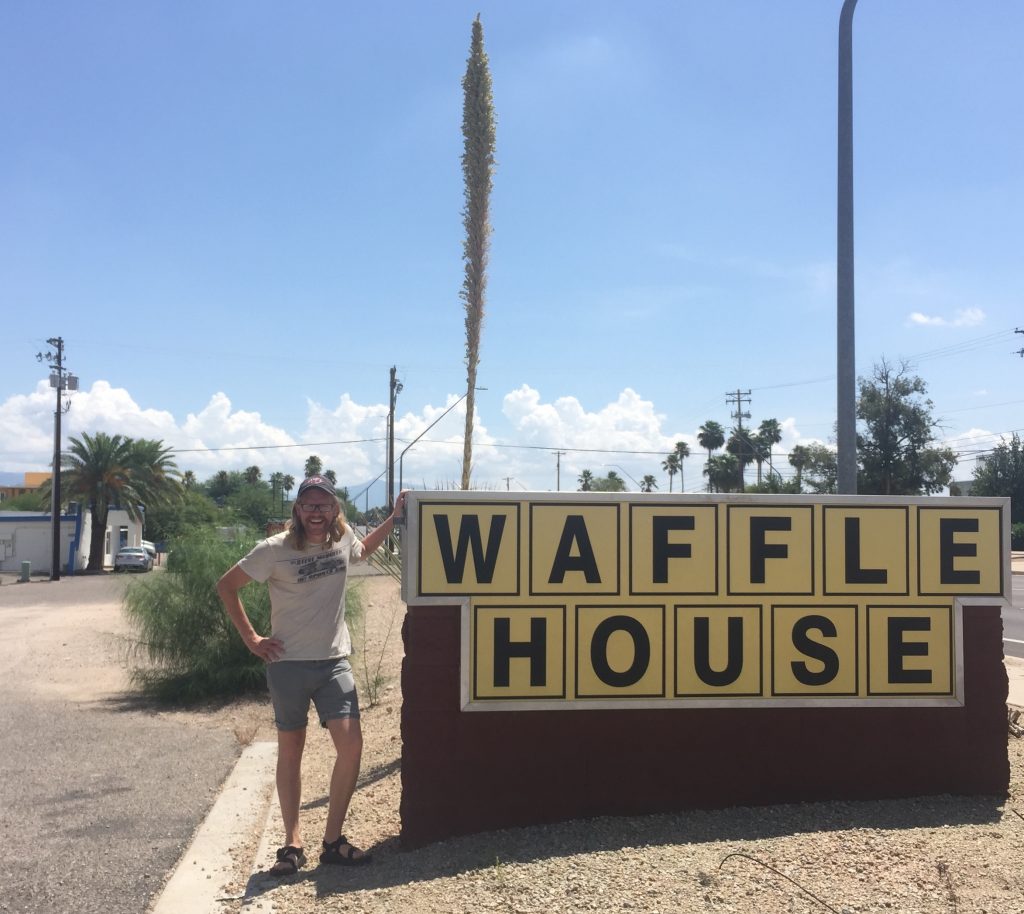
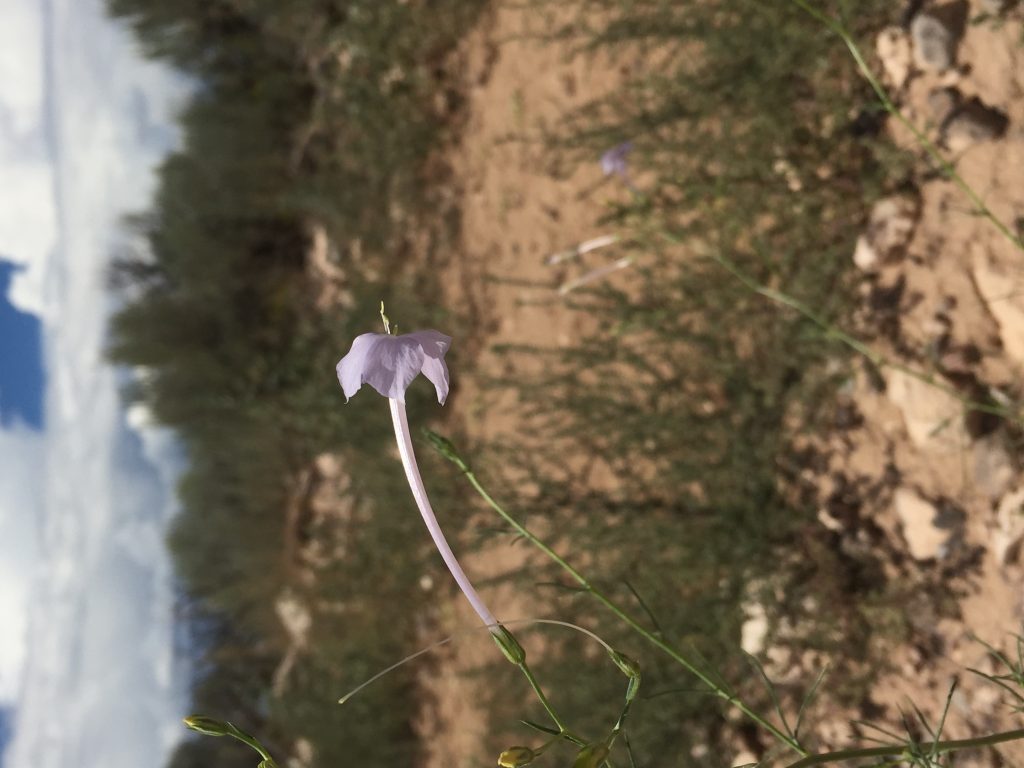
Dining in Tucson: Mexican food, no, waffles, yes!Ipomopsis longiflora I spotted on the drive back outside Taos, NM. The CO crew identified this plant with a key while I tried to find a gas station.
Today started off on a slightly less than auspicious footing, as the team’s morning plans of pollinating were largely rained out, as anthers don’t present transferable pollen until they dry. When the morning storms and damp stretched into the early afternoon, we began to realized that our hopes of performing the day’s pollen collection for our pulse/steady pollination experiment were likely to be dashed. Instead, we waited wistfully at the Hjelm House for the stormy weather to pass, working on indoor tasks like data frame cleaning or surv file arranging until the rain subsided enough for phenology data collection.
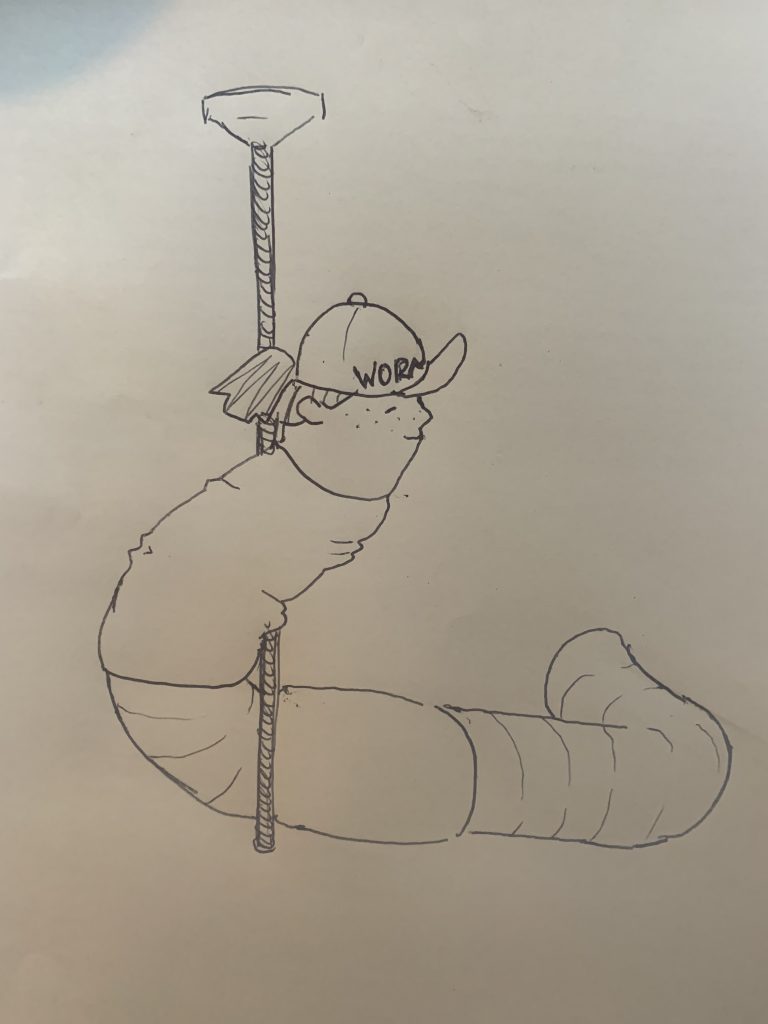
Over lunch, our discussion naturally turned to the age-old question of how a worm would wear a shirt, if shirts were made with worms in mind. Would they have small, empty sleeves, or would they disavow superfluous appendage coverings in their garments altogether? To aid us in our visualization, Erin handily mustered up her artistic skills and demonstrated exactly how a worm ought to properly attire itself with a tasteful tube top. To properly illustrate her point, she began composing perfect likenesses of the team members’ field outfits, like Jay’s signature flannels and JEGS hat, once adapted to the annelid form.
Lumbricus terrestris Jayicus in its conventional garbEven Darwin, our handy GPS point shooting unit, got in on the wormy fun!
Finally, the rain cleared! We scampered out to P2 to do phenology, and though our pollinating fears from the morning came true when pollen refused to present, the team kept up the momentum by remeasuring and rechecking some of P2’s most interesting and bizarre plants. We circled back to basal plants with leaves half a meter long, flowering plants with four heads on one stalk, and plants with more than 10 rosettes and 50 basal leaves (a rarity when most plants have only two or three rosettes with less than 10 leaves total). With half of P2’s 80 rows triple-checked, we shifted gears to remnant population demography, as Erin and Shea trained Jay and me in the system of PBORY flag ordering and surv file code naming. As we identified and recorded flowering plants, we started adapting the lyrics of AC/DC’s T.N.T. on the fly to fit our demography PBORY protocol (pronounced P-Bor-Ee). Our chorus went something like the following:
Cuz it’s PBORY Gotta stake it right PBORY Then flag the flowers in white PBORY Count rosettes and heads PBORY See how a population spreads!
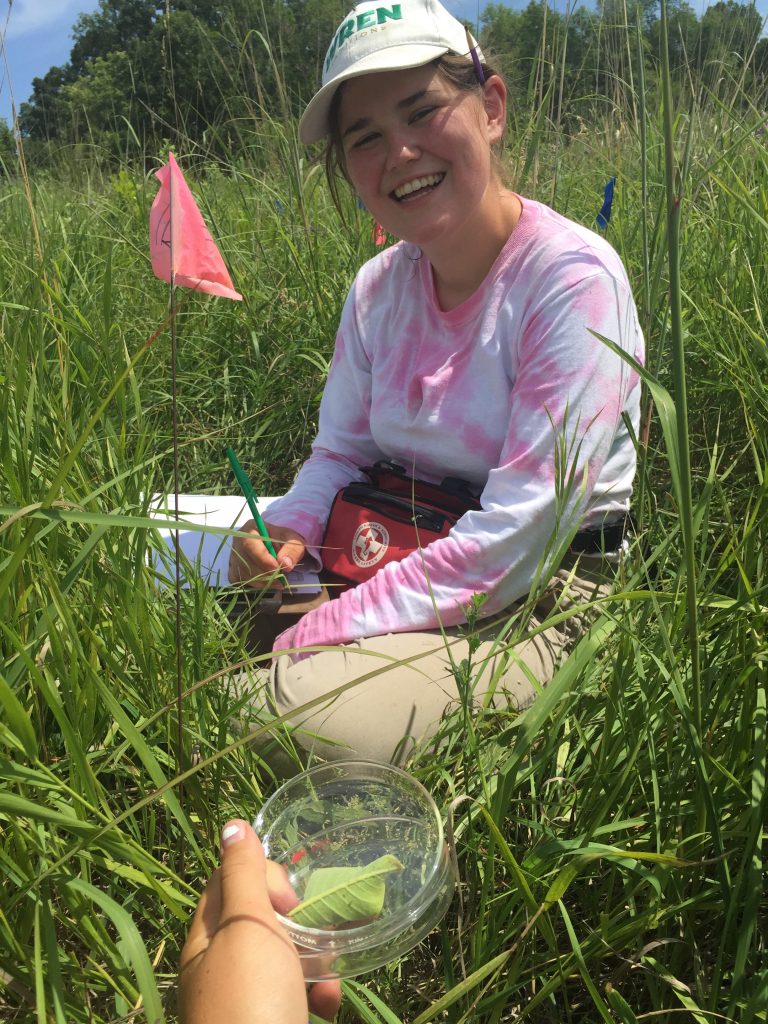
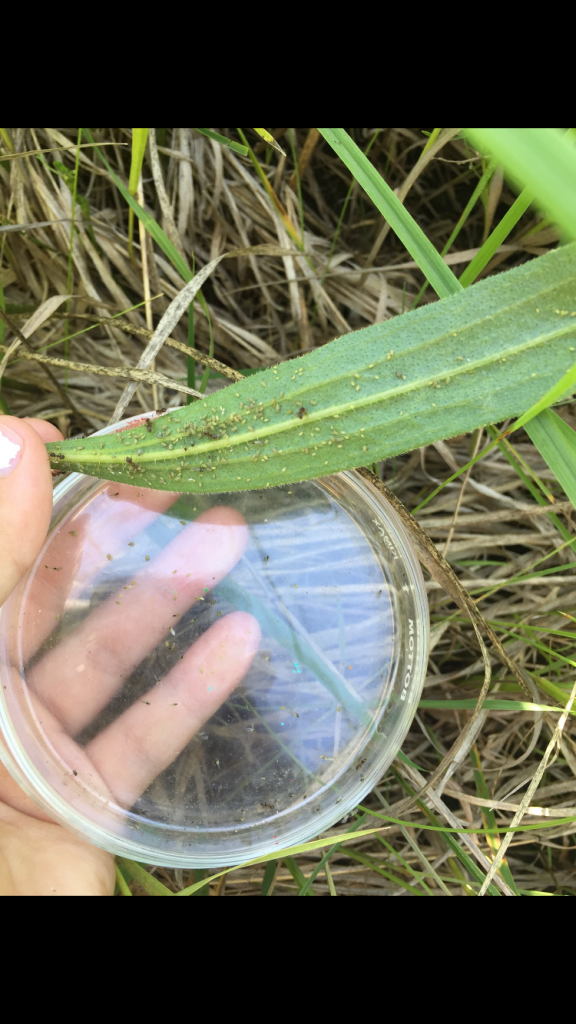
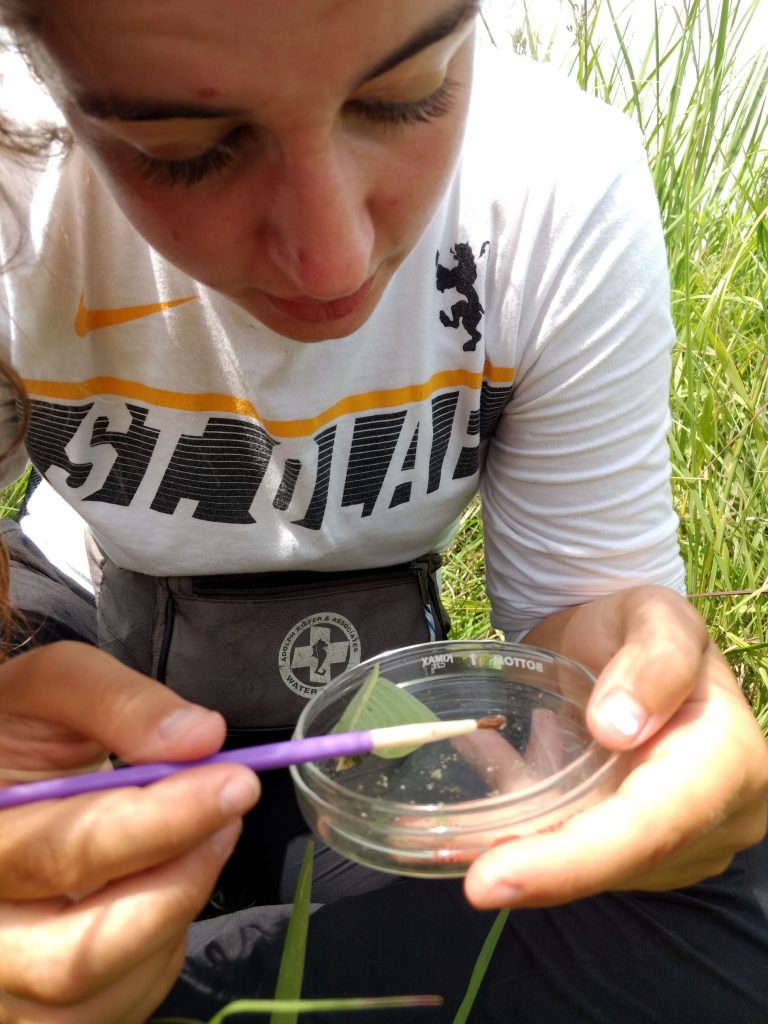
well, what feels like ages ago (actually about a month ago) Erin and I began the Aphid addition and exclusion experiment for the 2019 season. We volunteered for this task, not knowing a whole lot about what we were getting ourselves into, but we read up on past FLOG posts and procedures and even got a live demonstration from Stuart to learn how to properly remove and transplant aphids. What used to take us over 2 hours, we can now get done in just a little over an hour, so I guess you could say we are no longer novices. You’ll see in a picture or two below but these specialist aphids are not big, at all, and they definitely aren’t good cooperators, but once or twice a week Erin and I take to the field with our petri dishes and paint brushes ready for a fight.
We start each round by checking our 15 exclusion plants for aphids, and if we find any we record the amount and then harvest them for later. The tricky part about aphids is that they don’t like the sun, and they don’t like to move a whole lot unless they have to. So as we turn over leaves, exposing the aphids to the obnoxious UV, and poke at them with brush bristles, trying to agitate them into freeing themselves from the leaf, we wonder why they try to escape our dishes. As this experiment has progressed we’ve seen success in our exclusion efforts, which means that once we remove aphids from a plant we haven’t seen many come back.
Now on the other hand, we have addition. Our addition plants don’t seem too happy with us all the time. At each plant we record how many aphids it has retained and we carefully add some more. The majority of the time we add 10 aphids to each addition plants. With the passing of brushes, wrangling of aphids, and a steady hand, we get the job done. Most days, like today, the sun doesn’t give us a break, but we’ve learned to have some sort of patience as we putz around with bugs in the grass.
The management of Aphids has proven to be a much more complex task than Erin and I initially thought, but it’s been fun. The aphids make good company in the prairie as we like to talk to them, sometimes nicely, and while I can’t speak for Erin, this experiment has taught me a lot about the behind the scenes of field work. While it is a simple project, there’s nothing simple about getting 100+ speck sized bugs from one group of plants to another. This project has taught me a lot about the importance of having patience and finding purpose in our work.