Since 1995, the Echinacea Project has been mapping and collecting demographic information on Echinacea angustifolia to generate long-term records detailing individual fitness in prairie remnants. In summer 2023, Team Echinacea visited 42 prairie remnants to search at 2443 locations where adult Echinacea plants had been previously mapped. We call this “total demo.” At small sites, the team took records for all adult plants found at a site (no change in total demo protocol from previous years). At larger sites, we scaled down and visited a subset of adult plants. Burning led to high flowering rates and lots of newly flowering plants entering the census, which stressed our system for total demo. This year we did not visit plants that were “not present” for the past 3+ years and we also capped total demo points at 100 per site. For example, at Landfill, we searched at 100 locations at Landfill East and 100 Locations at Landfill West.
We used stake files on our high-precision GPS units to stake to each Echinacea plant in our total demo visit list, where we recorded flowering status, number of flowering heads, number of rosettes, and near neighbors of the plant on handheld data collectors (visors).
In addition to total demo, we searched and took records for all flowering plants in our remnant sites. For flowering demo, we visited 50 sites. In summer 2023, we took 5,601 demographic records in prairie remnants (demo) and 1929 GPS records (surv). We saw a much lower flowering year following 2022, with ~1586 flowering plants total. At Landfill, there were ~262 flowering plants and at Loeffler’s corner, there were 285.
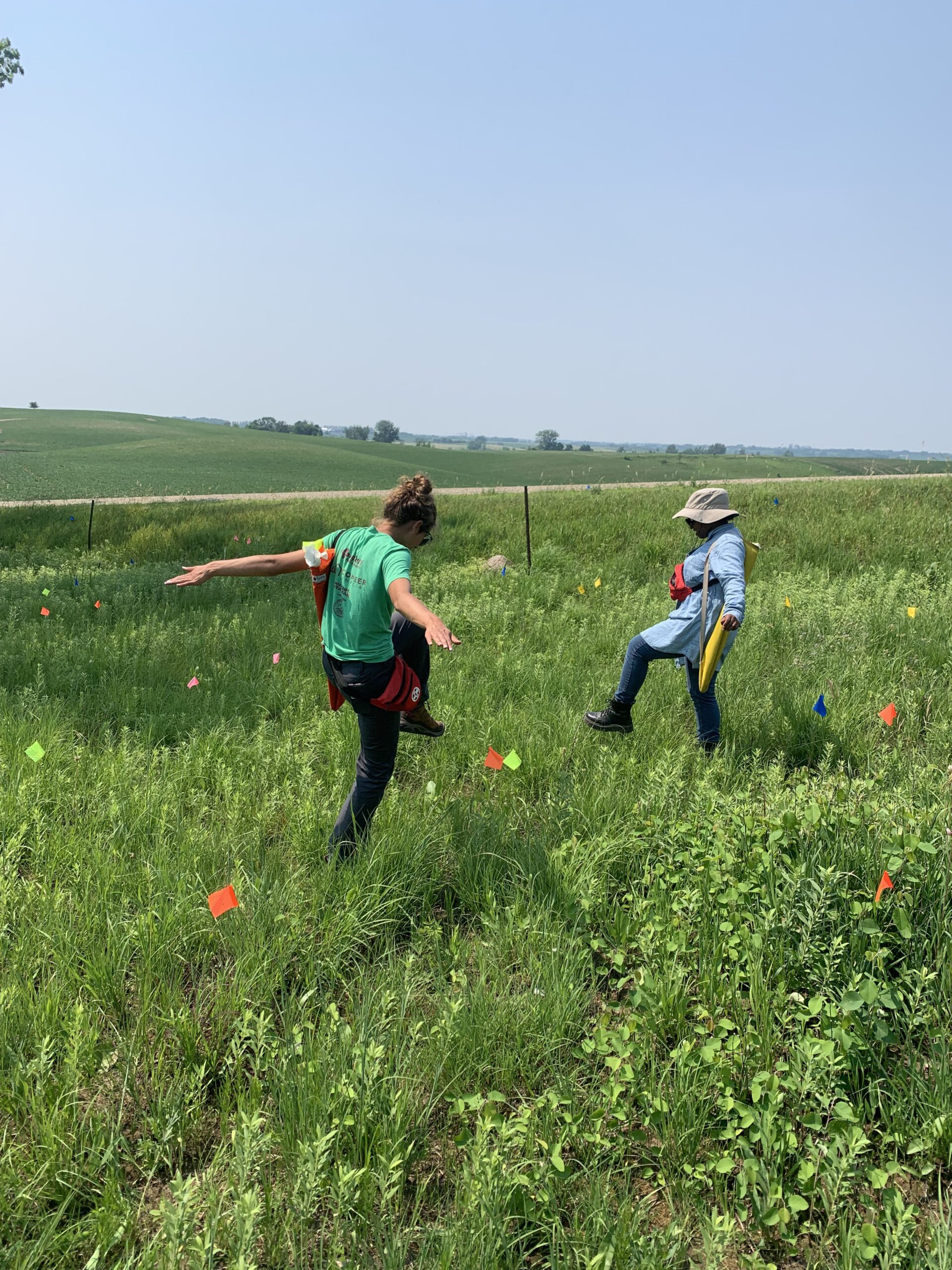
Alexa and Jak step carefully through Kjs as they search for flowering Echinacea plants. 63 plants flowered at Kjs in 2023!
We also took demo and surv data as part of our Pollen and Nectar project where we will compare characteristics of pollen and nectar in burned vs. unburned prairies. We collected demographic data at a subset of plants at several sites where we have never done demo or surv. We put out our first tags at hulze, hulzw, torges, torgen, hutche, hutchw, and koons.
This year, we put out 528 new tags which started at 28001. Two 29000 tags were accidentally created and placed in Landfill East, but those were quickly removed during our demo rechecks following completion of flowering demo and total demo.
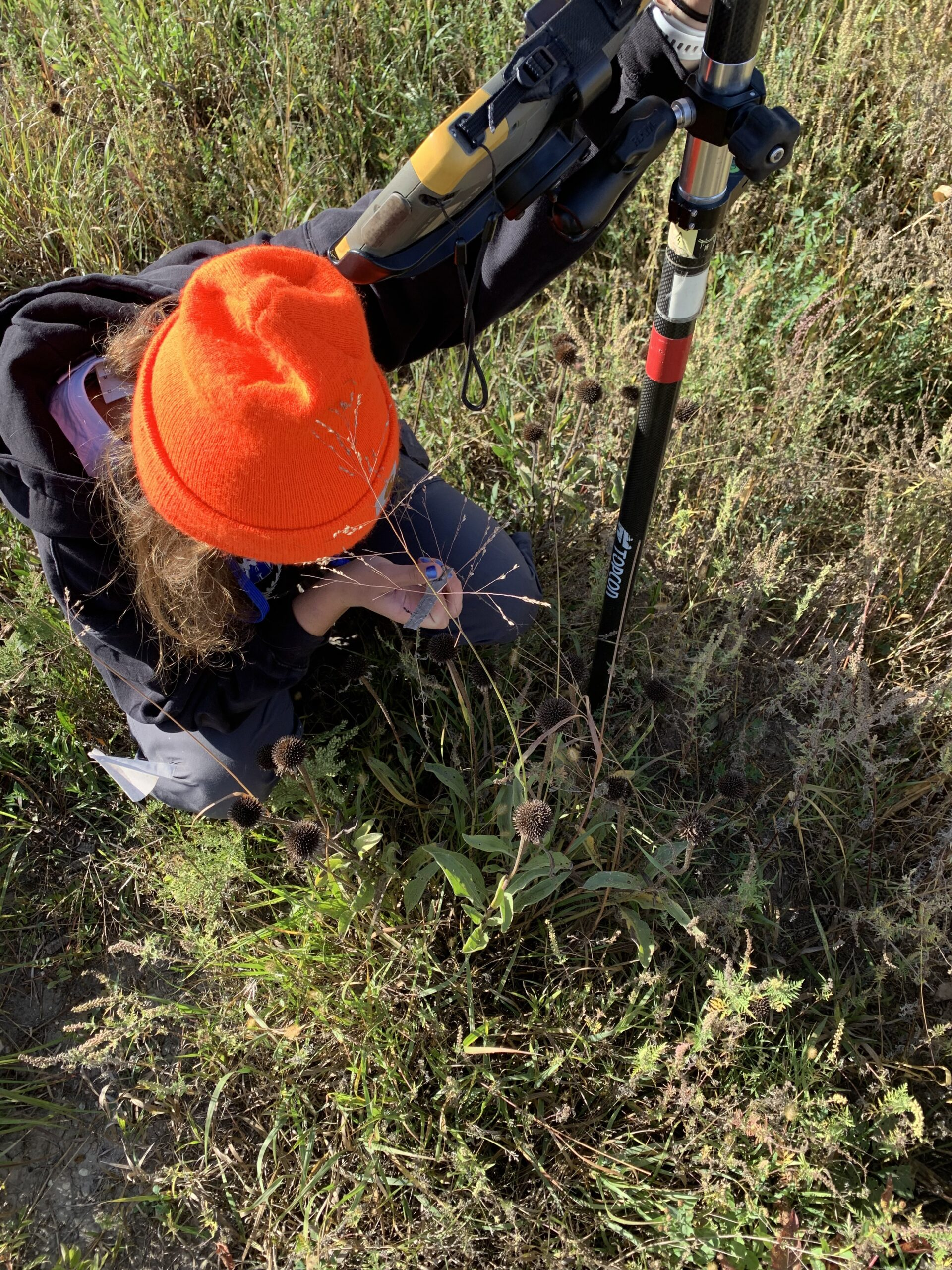
Lindsey visits an 18 headed Echinacea plant at Steven’s Approach. This plant produced the most heads of any this year.
After revisiting a final round of recheck plants during a trip to Minnesota in mid-November, we are just getting ready to move data from aiisummer2023 into demap.
Start year: 1995
Location: Remnant prairie populations of the purple coneflower, Echinacea angustifolia, in Douglas County, MN. Sites are located between roadsides and fields, in railroad margins, on private land, and in protected natural areas.
Total demo: Bill Thom’s Gate, Common Garden, Dog, East of Town Hall, Golf Course, Martinson’s Approach, Near Pallida, Nessman, North of Golf Course, South of Golf Course, Sign, Town Hall, Tower, Transplant Plot, West of Aanenson, Woody’s, Yellow Orchid Hill, plus the recruitment plots REL, RHE, RHP, RHS, RHX, RKE, RKW
Annual sample: Aanenson, Around Landfill, East Elk Lake Road, East Riley, KJ’s, Krusemarks, Loeffler’s Corner, Landfill, North of Railroad Crossing, Northwest of Landfill and North of Northwest of Landfill (lumped), On 27, Riley, Railroad Crossing, Steven’s Approach, Staffanson Prairie
Plant status (can’t find, basal, dead this year’s leaves, dead last year’s leaves, flowering), number of rosettes, nearest neighbors, and head count, if flowering
All GPS files are found here: Dropbox/geospatialDataBackup2023
All demo and surv records are stored in the aiisummer2023 repo
The most recent copies of allDemoDemo.RData and allSurv.RData can be accessed at Dropbox/demapSupplements/demapInputFiles
Samples or specimens collected: NA
Products:
Amy Dykstra’s dissertation included matrix projection modeling using demographic data
The “demap” project is a long-term dataset that combines phenological, spatial and demographic data for remnant plants
You can read more about the demographic census in the remnants, as well as links to prior flog entries about this experiment, on the background page for this experiment.
For many, the end of the year brings thoughts of final exams, final reports, and final projects. Here at the Echinacea Project, we don’t believe in final anything, but we do believe in updates! Last week, two of our Lake Forest College interns, Sophia and Olivia, shared project updates with the lab: a culmination of their semester in the lab.
Olivia shared results from her study on plant and reproductive health indicators (more here)
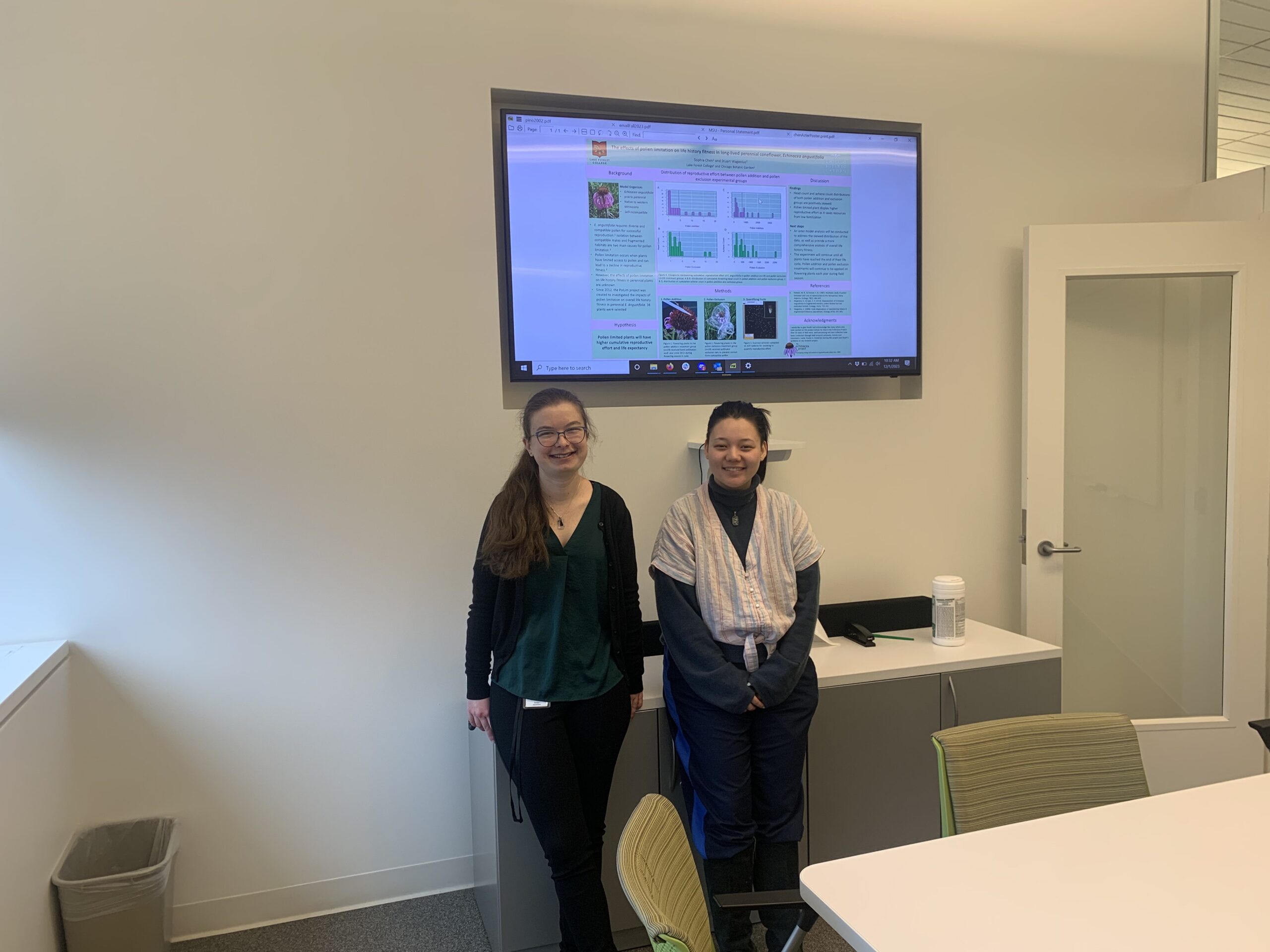
Olivia and Sophia present research updates at lab meeting!
Sophia shared a poster with the lab and also with attendees of a Lake Forest College research symposium! Sophia’s research focuses on the effects of pollen limitation on life history fitness in Echinacea. (More info to come!)
Sophia Presents a poster at Lake Forest College’s Glassman Symposium.
I’ve had an amazing semester here in the Echinacea Lab, and today I presented my final update on my internship project. I was able to receive feedback on how to improve both my project and presentation skills. One of the suggestions I received was to add more background to my presentation, so here is some supplemental information to go along with the PowerPoint (attached below). I was working with the P01-nat batch for two consecutive years, 2021 and 2022. I was looking at the plant health indicators of number of basal leaves and length of the longest basal leaf from 2021 because plants receive energy through photosynthesis. My though process was that leaves that are longer and more abundant would lead to a greater ability of an individual plant to photosynthesize and therefore invest more energy in reproduction. I was looking at the reproductive effort and success in the following year, 2022, since Echinacea angustifolia are long-lived perennials. The individual plants that I was working with were originally planted in 1996, so they were pretty well established in the study sites in Minnesota.
I also received feedback on my experimental design, including changing my experimental design a little bit. My current study is phrased as causally linked factors but is more in line with exploring an association between basal leaves and reproductive effort and success rather than a causation. In order to explore more of a causal relationship, one of the suggested studies was to clip leaves so that there was a randomized manipulation on the plants instead of an observational study. Limiting the basal leaves of random plants could allow for a stronger causal relationship to be established between the two factors. A second suggestion to strengthen my current study was to include data from multiple years, since Echinacea angustifolia are long lived and potentially have certain years where reproductive effort spikes over their life cycle and doesn’t spike again, as is one of the potential implications in Sophia’s pollen limitation study.
My hypotheses were not supported by my data, but they still have implications for the further potential future study I mentioned above. The data I collected did not support my hypothesis because the p-values were too high, meaning the data was not statistically significant. I received a suggestion that I should investigate one plant seen in the total achene count graphs (slide 6 of my presentation) that had no basal leaves but produced 200 achenes in the following year. It is possible that this individual only had cauline leaves in 2021, in which case it wouldn’t be relevant to a correlation between basal leaves and reproductive output. Two directions for additional studies that I suggested were the relationship between plant height and reproductive output and overall reproductive fitness as it relates to the number of heads on a plant. The latter question is one that I was going to explore, but I chose to combine the data for my study so that each data point represented the plant as a whole.
I am really grateful to have had the opportunity to be a part of the Echinacea lab this fall. I learned a lot about working in a lab and data analysis using R. I want to give special thanks to Wyatt, Stuart, and Sophia for helping me with R and my project overall, and to all the volunteers and student workers who helped me count, classify, and randomize the 2022 P01-nat data.