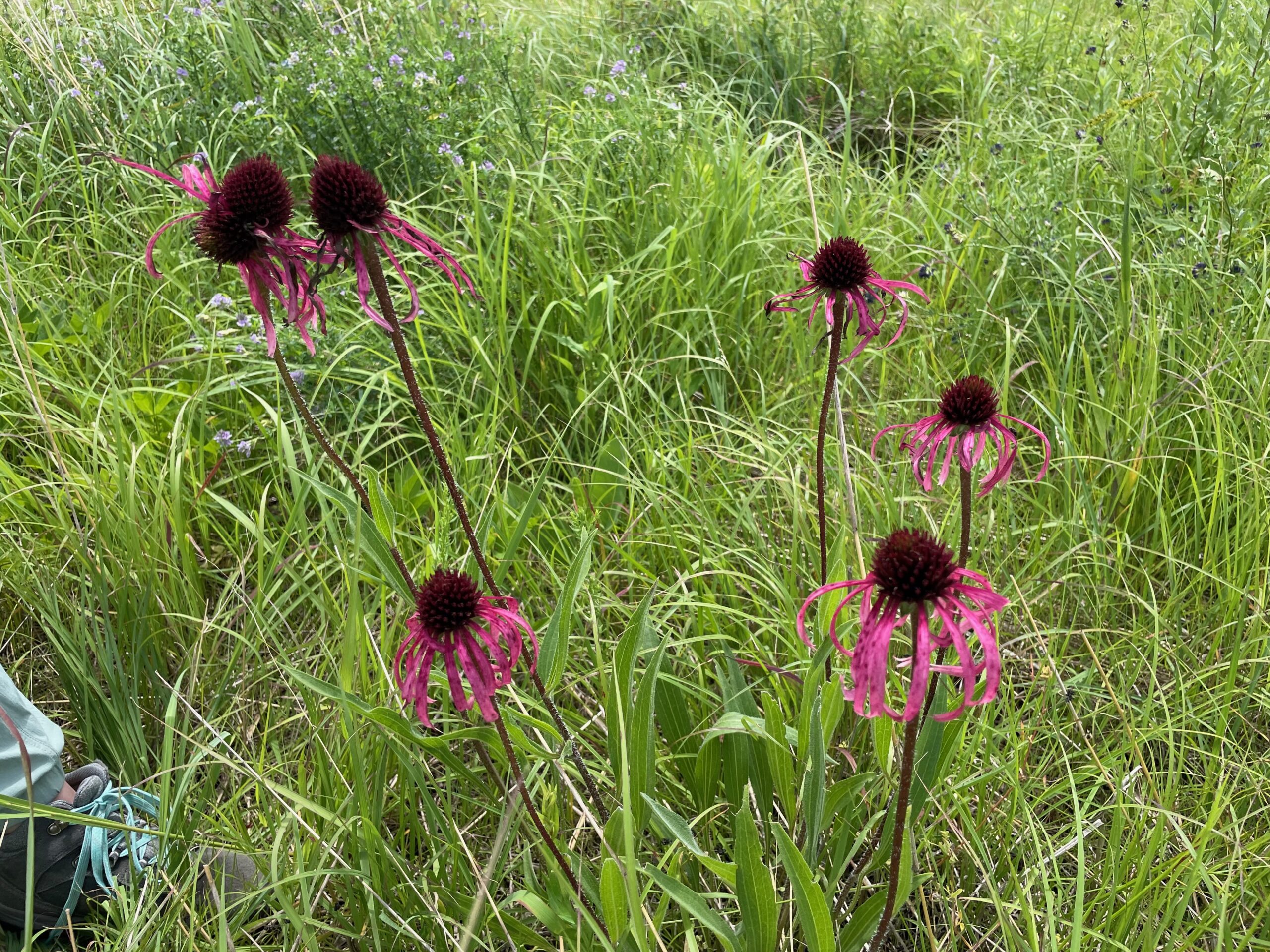
Echinacea pallida, a non-native relative to Echinacea angustifolia, is also a study species of the Echinacea Project. This year, we measured and managed E. pallida and E. pallida x E. angustifolia hybrids in experimental plots 6, 7, and 9. We also collected demographic data on E. pallida planted in the Hegg Lake WMA restoration, before removing all flowering heads.
exPt06
Only one flowering plant, a hybrid, was present in exPt06 this year. We took measurements on this plant and removed the head from the site. The plant had 1 head (83 cm tall), 1 flowering rosette, and 0 basal rosettes. The head had a blue twist tie, and its row/position was not recorded.
- Location: exPt06 (Wagenius property)
- Overlaps with:
- Samples collected: One Echinacea head (in an h-bag in Hjelm)
exPt07
Experimental plot 7 contains E. angustifolia x. E. pallida conspecific crosses and reciprocal hybrids. This year, we found a total of 37 flowering plants (29% of searched positions) in exPt07. We measured all plants in this plot and left twist-ties to identify individual heads.
Later, on 13-Jul-2026, we returned to the plot and removed all heads with the potential to produce achenes. The heads were left on the ground near where they were removed. A second look on 20-Aug-2026 revealed that we had missed one head, which was subsequently removed.
- Location: exPt07 (Hegg Lake WMA)
- Overlaps with:
exPt09
Experimental plot 9 contains a mixture of E. angustifolia plants, E. pallida plants, and E. angustifolia x. E. pallida hybrids. This year, we found 106 flowering plants (44% of searched positions) in exPt09. We measured all plants in this plot but did not leave twist-ties.
Later, on 13-Jul-2026, we returned to the plot and removed all heads with the potential to produce achenes. The heads were left on the ground near where they were removed. When we returned to the plot on 20-Aug-2026 we noted, to our surprise, that 4 heads had not been removed. Upon closer inspection, new heads had, in fact, resprouted from the peduncles below the site of decapitation. Needless to say, these heads were also removed.
- Location: exPt09 (Hegg Lake WMA)
- Overlaps with:
Pallida Restoration
An area of restored prairie at Hegg Lake WMA contains hundreds of mature E. pallida individuals. On 8-Jul-2026, we collected demographic records for all 217 flowering pallida plants in the restoration. We then surveyed the plants and decapitated them, leaving the heads on the ground near where we cut them.
- Location: Pallida restoration (Hegg Lake WMA)
- Overlaps with:
Leave a Reply