We didn’t have time in 2025 to write out full fleshed project updates, so here’s a bit of an abridged version for posterity.
Echinacea pallida is a species of Echinacea that is not native to Minnesota. It was mistakenly introduced to our study area during a restoration of Hegg Lake WMA around 2006 (Stuart’s recollection). This is concerning, because we don’t know how a similar species may impact or local Echinacea angustifolia! Will they hybridize? Could pallida outcompete angustifolia? Ever since pallida have started springing up, Team Echinacea has visited the pallida restoration, taken flowering phenology, and collected demography on the non-native plant. We have decapitated all flowering E. pallida each year to avoid cross-pollination with the local Echinacea angustifolia. Each year, we record the number of heads on each plant and the number of rosettes, collect precise GPS points for each individual, and cut off all the heads before they produce fruits.
Read more about these projects
- Echinacea pallida at Hegg Lake
- Hybrid Experimental Plot 6
- Hybrid Experimental Plot 7
- Hybrid Experimental Plot 9
Management Notes
- The Hegg Lake property burned prior to the 2025 growing season, meaning that the pallida restoration, exPt07, and exPt09 all burned
- ExPt06 did not burn, but exPt08 did right next door
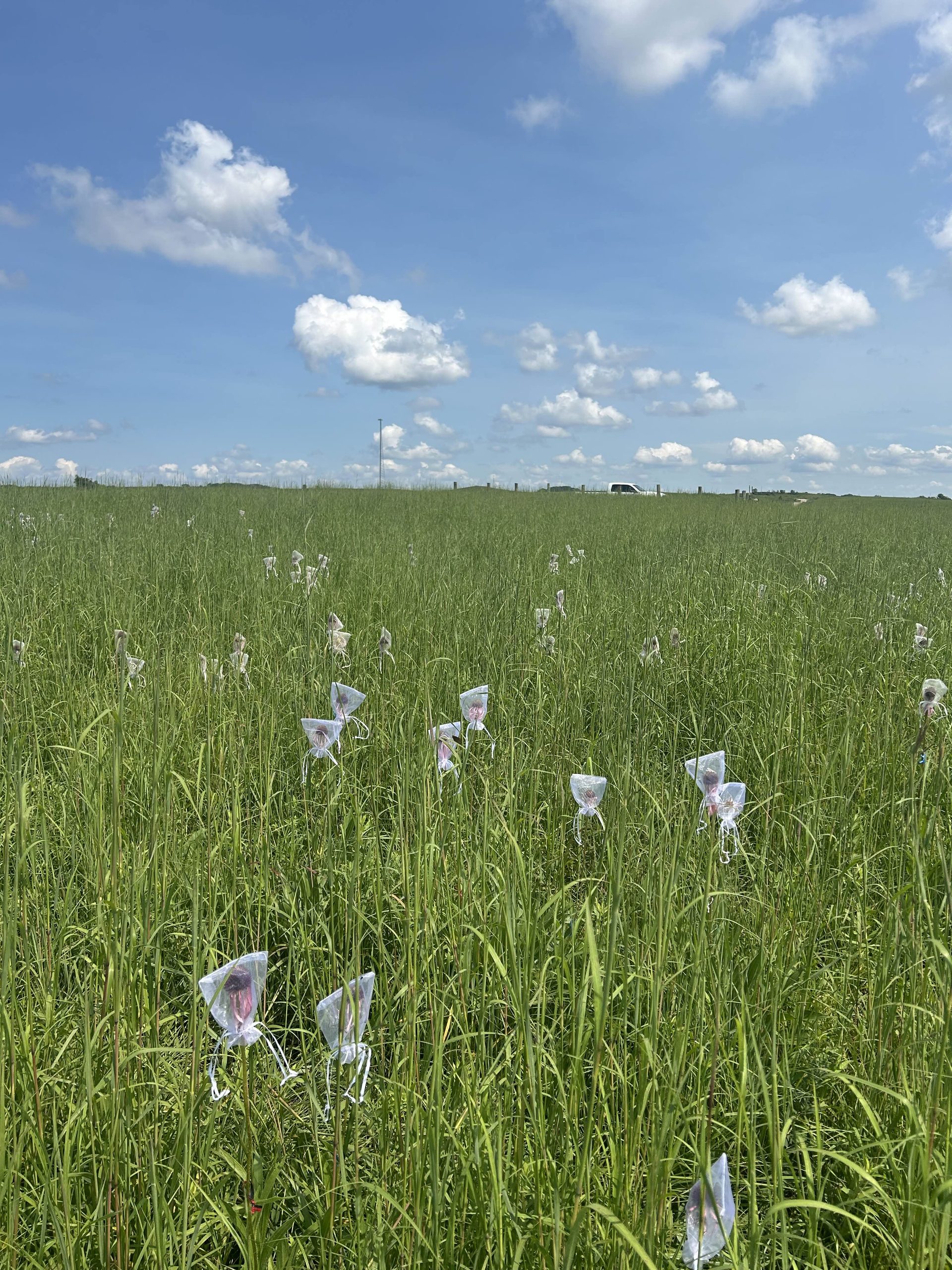
- We used pollinator exclusion bags in exPt07 and exPt09 to prevent pollination
- We decapitated heads from 125 flowering plants in the pallida restoration to prevent pollination
- We aren’t certain if any plants flowered in exPt06
Measuring deviations
- We did not visit exPt06 in 2025
- We did not record leaf counts or leaf lengths in exPt07 or exPt09 in 2025
- There may be additional data collection protocol changes that are missing from this list
- Plants with illogical data (e.g., bslRosetteCt > bslLfCt, headCt/stemCt mismatch, etc.) were not revisited in the field and corrected
- While making measureGood and reconciling for SQL, I (wm) added a note that includes the identifier DQI (“Data Quality Issue”) to identify the problem and describe what actions, if any, I took to compensate.
- These are worth searching for and looking at prior to any analysis. Hopefully they are eye-catching enough!
- Data that we would normally collect but did not or was missing this year (e.g., basalLfCt, some illogical data, etc.) are called
NULLin SQL
Summary statistics
| Experiment | exPt07 | exPt09 |
| Year planted | 2013 | 2014 |
| # Originally planted | 294 | 745 |
| # Found alive | 106 | 217 |
| # Flowering | 48 | 101 |
| # Flowering heads (incl. vds, duds, etc.) | 110 | 276 |
| # heads harvested | 100 | 267 |
Where are the goods?
- ExPt07:
- Phenology:
~/cgData/summer2025/exPt07Phenology/allTtPhenRecordsExPt07.RData - Plant/head measure data: SQL
- Harvest data: SQL and echinaceaLab (hh.2025)
- Harvest specimens: Hjelm basement
- Phenology:
- ExPt09:
- Phenology:
~/cgData/summer2025/exPt09Phenology/allTtPhenRecordsExPt09.RData - Plant/head measure data: SQL
- Harvest data: SQL and echinaceaLab (hh.2025)
- Harvest specimens: Hjelm basement
- Phenology:
Leave a Reply