|
|
Studying aphids on Echinacea requires looking much more closely than I would otherwise. Sure enough, the closer I look the more I see. Here are just a few of my discoveries (namely the ones I’ve made since learning how to make my phone take macro photos):
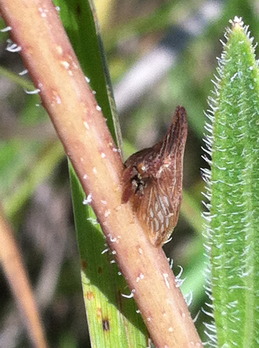
I’m assessing survival of aphids on different Echinacea species and hybrids in P7, an experimental plot at Hegg Lake. I also checked for aphids on the non-native E. pallida growing in a nearby restoration. As I expected, I didn’t find any Aphis echinaceae, but I did find this much larger phloem-feeder.

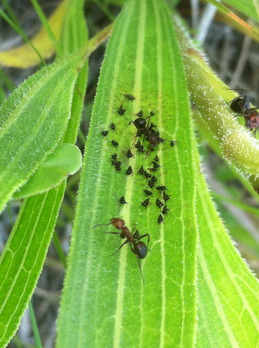
A nearby E. angustifolia didn’t have Aphis echinaceae either, but it did have ants tending a flock of a different species of insect.
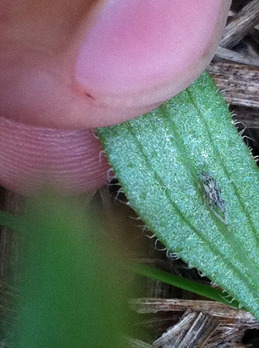
One week after the first aphid addition, two of the plants in my experiment had this little gray thing on them (but no aphids). It seems to be an exoskeleton. I wonder if it belonged to the aphids or something else?
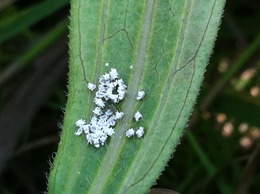
Gretel and I found this winged adult surrounded by “white fuzzies” (the technical term we use in our records) on a plant in P1 today. The leaf they were on looked diseased, with lighter coloring overall and purple venation.

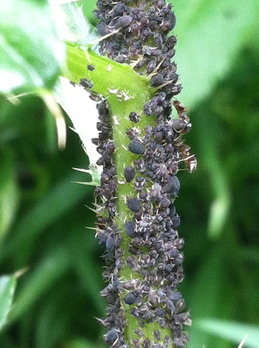
Finally, here are some ants tending a humongous herd of generalist aphids on a thistle. A dowry fit for any ant princess!
In case you’re missing the exciting happenings at Staffanson Prairie Preserve, here’s the first issue of The Staffanson Almost Weekly. This periodical will keep you up to date on the new plant of the week, a plant that is nearing the end of it’s flowering period, and one that will most likely begin to bloom in the next week (all voted on by Claire and Jared). There are also some other exciting tidbits about current experiments and other interesting sightings.
-Claire

We started off the morning working on independent projects, collecting and relocating aphids in P1 and doing phenology in P1. A few of us headed out to Hegg lake before lunch to help Amy search for plants in her plot dedicated to her local adaptation study. As we worked we could see the sky darken to the west, and right before we headed in for lunch we heard the first clap of thunder. Our plans to begin measuring Echinacea in P1 for the afternoon were thwarted by the storm. We spent the afternoon doing data entry and tidying up around the Hjelm house before we headed out for the day.

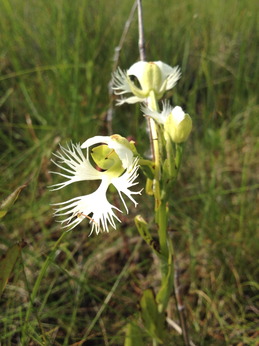
Today, Team Echinacea left the comfort of Kensington for a very exciting day at a Nature Conservancy Preserve near Fertile, Minnesota. We helped Gretel survey two plots of Western Prairie Fringed Orchid, a federally threatened species. Gretel is monitoring these plants to examine the effects of different land management practices. Here is a picture of the study species:

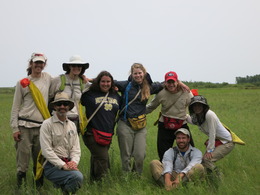
The team powered through both plots with plenty of time left over for a trip to LaLa’s for delicious homemade ice cream. Following ice cream, we spent some time at Agassiz Sand Hills to check out some unique prairie plants (as well as some very beautiful poison ivy). Here is a picture of the team post-completion of the second plot:
Thank you Gretel and The Nature Conservancy for dinner, ice cream, and an adventurous day!
For Keaton and I, Sunday began with a refreshing early morning bike ride to the Hjelm House for a run-through of the protocol for our pollinator efficiency experiment. The weather was lovely and we observed agapostemon, augochlorella, and a halictus bee pollinating E. angustifolia! Here is a picture of one of the heads we bagged to exclude pollinators:
After biking back to town hall, the usual Sunday activities followed: napping, reading, laundry, and cooking Spinach Mushroom Quiche for the team. I was very sneaky and added some of the Kefir that both Claire and I have been cultivating as a replacement for Buttermilk. This is what the Kefir grains look like:

Today was a successful day for Team Echinacea! This morning Stuart, Gretel, Maureen and I FINISHED RECRUITMENT!!! Check out the twitter feed for some awesome pictures of that. Also, we were able to flag flowering plants at 5 sites this morning! In the afternoon, I finally got to flag flowering plants at the sites I will be working on for my project, with the help of Elizabeth and Will! Check out this cool picture of some heads I flagged at East Elk Lake Road (and note the beautiful White Spruce plantation in the background)!!!

The past two weeks have gone great for Team Echinacea. We finished up measuring seedlings in Q2, set up flags for P1 and Hegg lake, as well as marked flowering plants in P1 and other remnant populations. Although these weeks have been fairly laid back, the pace is about to pick up very quick. With Echinacea beginning to flower, there is a lot of work to be done, whether it be independent projects or adding data to larger, long-term projects. To sum up, we have a lot of work ahead of us, but that’s what we at Team Echinacea look forward to!
And on a lighter note, here is a picture of an awesome, mutant Echinacea plant which has two almost identical flowering heads emerging from the same peduncle. This is the first plant of its type seen since the start of the Echinacea Project. Sorry about the blurriness, but you can still get the general idea.

Hello everyone! My name is Maureen Page and I am a rising Junior at Scripps College majoring in Biology. If you would like to know more about me and my research project you can check out my bio on the Echinacea Project website.
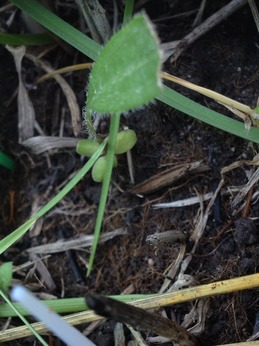
Tuesday’s morning started out similar to the past few mornings. The team worked on finding Echinacea seedlings and measuring them in the Quantitative Genetics plot 2 (a.k.a. Q2). We were a little worried that we would be rained out, but the gloomy, foggy weather quickly passed and the sun emerged to make for a beautiful day. The team split into pairs and measured multiple segments of seedlings. During this time, two members of the team, Jared Beck and Will Reed, discovered a rare Echinacea seedling with 3 cotyledons, also known as a tricot.
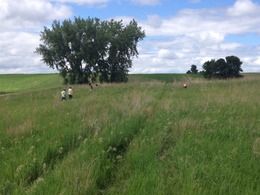
For the afternoon portion of Tuesday’s workday, we were introduced to Common Garden 1 (a.k.a. Experimental Plot 1), a site that has lead to numerous important findings concerning the biology of Echinacea. Some of these plants were planted as early as 1996! (fun fact: some of these plants may be as old as our youngest team member, Will Reed) The majority of the team spent the afternoon flagging a plethora of Echinacea plants, or points where Echinacea had once thrived but now cease to exist (may those plants now rest in peace). While we worked on flagging, Stuart was hard at work mowing in between the transects, creating an easily visible and safe walkway. Personally, I had the pleasure of working with Stuart and Gretel’s son Per. There was never a dull moment as we discussed funny pranks, the joys of having uncommon names, and the mystery/absurdity that is art. During this time, Per managed to concoct a ninja/airplane/bird out of old, flag-less pins (we couldn’t decide which one it was). All in all, it was a very productive, pleasant day in the field for Team Echinacea.
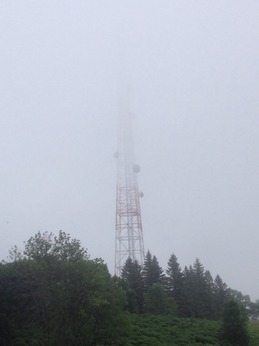
A picture of the electric tower near Q2 which illustrates the gloomy start to our day.
Here you can see the tricot discovered by Will and Jared.
The team hard at work in Experimental Plot 1
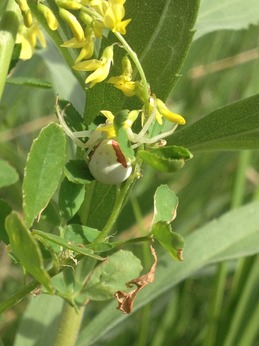
Finally, an interesting spider that Per and I found later identified as a Goldenrod Crab Spider
|
|






-thumb-260x195-193329.jpg)
-thumb-260x195-193332.jpg)