|
|
It’s great to think of the arrival of so many new Team Echinacea members in Douglas County today!! I’ve been glad to get to know Ilse in advance of the field season – she did a great job analyzing one of the long-accumulating Echinacea datasets, using aster analysis, a statistical approach for evaluating lifetime fitness from its underlying components of survival and fecundity. Charlie Geyer’s work to develop aster modeling was stimulated by our data on Echinacea. We have learned a lot about our remnant populations of Echinacea from the aster analyses we’ve completed over the last several years (see Resources page), and other analyses, in addition to Ilse’s, are in progress. Besides our regular use of aster modeling, it is now being used to study fitness in many other species.
I’m looking forward to seeing you all and working with you on Wednesday!

Hello! I’m Amy Dykstra, and I will be participating with the Echinacea project part time this summer, beginning sometime after June 18.
I have been involved with the project since 2006, and am looking forward to meeting this year’s Team Echinacea!
Thursday marked my last day in the lab for the spring and I was able to discuss my plan for the upcoming fall quarter. I will continue to complete my data set identifying ants from sites in order to compare the effect of proximity to Echinacea with ant diversity. I look forward to getting a more complete picture of the species composition in these areas and hopefully seeing some interesting trends! Hope everyone has a wonderful summer!
Hello again!
This past week I was given the chance to present my findings from my project this quarter at a research expo held at Northwestern. I used a poster (attached) as a visual aide to help compare the trends and correlations observed between the frequency of fire and the presence of Echinacea on ant diversity in the two sites, SPPE and SPPW. It was a great experience to be able to talk to others about what I have been working on and getting to see what my classmates at Northwestern have been researching too!
linkingants3.pdf
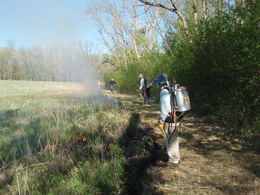
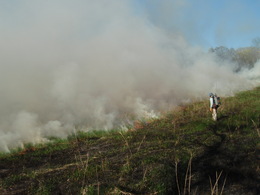
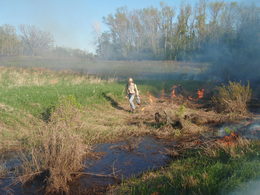
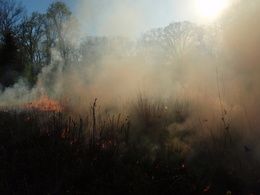
On Thursday, 23 May 2013, Brad Dykstra and I (Amy Dykstra) helped Stuart and his parents burn the common garden (C1). The burn was slow and thorough. Some photos follow.
 We started at the south end of the plot. We started at the south end of the plot.
At times, the fire was quite smokey.
Here, Stuart lights vegetation in the ditch along the west side of C1.
We also burned the ’99 South plot.
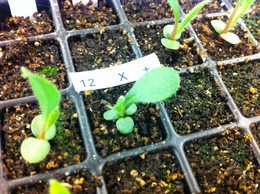
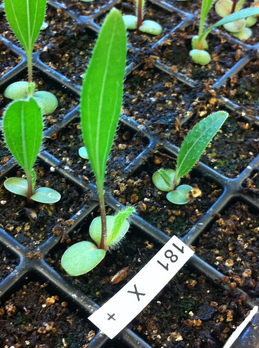
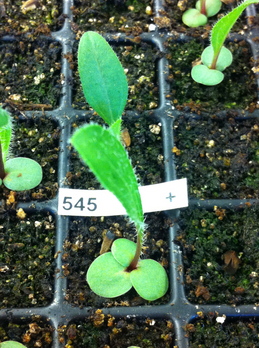
Throughout the past semester, I have been interning in Dr. Stuarts lab, working with Echinacea angustifolia. I performed two experiments during my time there. One comparing the differences in growth for two pre-germination methods. For this experiment, I measured the hight of the plant on three separate dates in order to determine the plant success for five cohorts.
No analysis was performed on Cohorts 4 and 5 because there was no growth for any of these plants. All plants with a height of 0 at the last day of measurement were considered dead.
We performed an ANOVA using R to compare the mean heights of Cohorts 1 and 2 at each age at which they were measured. After performing analysis for Cohorts 1 and 2, we found that there was no significant difference in the heights of the plants germinated using the Blotter method than those plants germinated using the Agar method. These results were similar for each of the three ages at which the plants were measured: 14, 28, and 35.
In addition to the three measurements performed on each of the plants, I also chose a single day in which to measure all of the plants. On March 19, I measured each of the 418 plants. We performed an ANOVA analysis on the mean heights of living plants on this single day in order to see if there was a cohort effect on the measurements. We found that there was no difference in measurements of the plants among treatments, but that height does differ among cohorts 1 and 2, according to a linear model, which we had expected.
There is much more analysis which can be done with the data collected and which we hope to do in the future, including comparisons for rate of emergence, timing of emergence, and survival of individual plants.

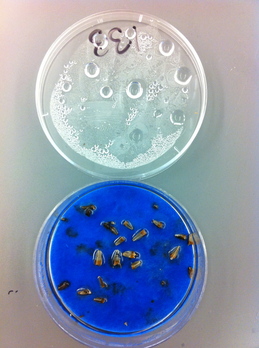
This image shows a dish of achenes pre-germinated using the blotter method.
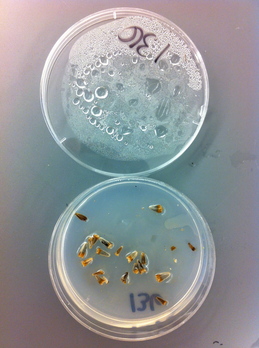
This image shows a dish of achenes pre-germinated using the agar method.
I will also be working on the analysis of my second experiment throughout the summer, involving the comparisons of plant growth and plant morphology for four crosses between Echinacea angustifolia and Echinacea pallida. So keep an eye out for updates!
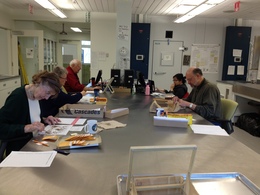
The Thursday crowd is undertaking variety of tasks today: Bob (back left) is counting achenes using the new online data entry system, Char and Suzanne (left) are taking a random sample of achenes to weigh, Bill (front right) is extracting achenes from Echinacea heads, and Maria (back right) is working on her senior thesis on pollen limitation in a prairie grass. Gia (not shown) is identifying ants from the Staffenson prairie preserve.
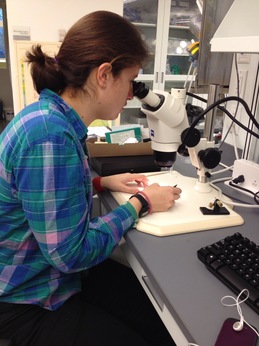
Hello! My name is Gia and I am one of the undergrads interning at the lab this quarter. I recently applied to the undergrad research expo that is held at Northwestern every year in May to try and present my findings about ant communities as part of the broader Echinacea project. Below is the abstract/ summary of my project that I sent in for the application.

Gia Hallaman
Katherine Muller, Stuart Wagenius
Linking Prairie Ant Communities & Fire: The Effect of Fire on Ant Diversity in Prairie Remnants of Western Minnesota
Research within the field of conservation emphasizes the maintenance of diversity. The Echinacea project focuses on the diversity of several prairie remnants in Western Minnesota, specifically upon a native plant living within these remnants called Echinacea angustifolia. For my project, I joined this long term effort by delving into some of the complexities surrounding the diversities of these prairie ecosystems. I evaluated the diversity of ant communities, which interact with an aphid species that feed exclusively on this plant, in remnants affected differently by fire. Historically, the presence of fire in long grass prairies has been positively correlated with the quality of the prairie by maintaining the dominance of grasses over woody plants. Specifically, I test the hypothesis that the ant communities differ between burned and unburned areas of native prairie remnants in Minnesota.I identified approximately a thousand ants, using dichotomous keys collected in 24 pit fall traps at two different sites on two separate dates during summer 2012, in order to evaluate the community composition and diversity. Preliminary analyses indicate that the diversity between recently burned and non-burned remnants was highly unique, with a disproportionately higher morphospecies count at one remnant, and with several morphospecies of Myrmica and Formica appearing exclusively in one location. This study shows that even by studying small organisms within an ecosystem, a great deal can be discerned about the health and diversity of the overall area and adds to out knowledge of the importance of fir in maintaining quality prairies throughout the Midwest.
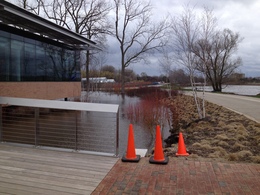
Due to the epic storm system pummeling the midwest, the Chicago area has experienced quite a bit of flooding over the past few days. The cute little lagoons dotting the Chicago Botanic Gardens have grown into murky lakes. Access to service roads is restricted by flooding. One upside to all the rain is that the Plant Science Center (home of our lab) has acquired a moat fine enough for any medieval fortress:
|
|