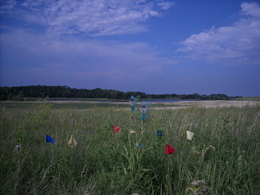
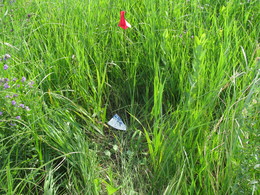
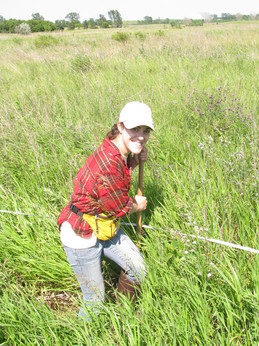
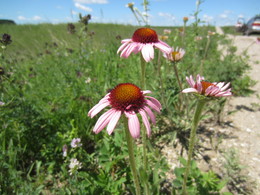
Here are two of my Echinacea heads at Hegg Lake, bagged to exclude pollinators and thoroughly flagged to help protect them from being mowed.
This morning we split our time between work on individual projects and observing phenology in the common garden and at Hegg Lake.
I spent my morning at Hegg Lake again crossing the E angustifolia and E paliida that I painted yesterday. And when Gretel arrived to do phenology at Hegg Lake and pick me up she found a new E pallida in its first day of flowering!
Andrew observed his first pollinators on Echinacea with a video camera, and even managed to catch a few for specimens, as well as working on phenology in the common garden.
Kelly went out to observe phenology in some of her remnants, and is starting to see many flowering heads.
Lydia went to make her first compatibility crosses, but had a few problems with cross contamination so will have to make more crosses tomorrow.
Jill and Katherine GPSed the pitfall traps they had set up earlier at Staffanson and Nessman as well as helping with phenology.
Maria had another early morning at Hegg Lake learning about Dichanthelium pollination and found out that Dichanthelium has two sets of anthers.
Greg Dierson also arrived this morning, and will be joining us for a while.
After a long lunch Gretel and Stewart explained the procedure for measuring plants in the common garden, and we completed the first few hours of what is going to be a lot of searching for and measuring plants. Of course, we also got to stand outside and enjoy the day, which thankfully wasn’t quite as hot or humid as yesterday.
With the help of Andrew and Kelly, I finished setting up all of my pitfall traps for my ant survey today–a grand total of 12 5x30m plots and 144 pitfall traps! I started on Monday with Katherine, setting up Nessman, the smallest of my sites. We quickly learned that digging holes with the soil core sampler is much more efficient when we have some sort of sharp object to dislodge soil from the sampler & that having a dibbler to pre-form holes speeds up the process.
On Tuesday Katherine, Lydia, Kelly, and I set up the plots on East Elk Lake Road, Northwest Landfill, and North Northwest Landfill. Today Andrew, Kelly, and I braved the ticks out in Staffanson prairie preserve, knocking out the final 4 plots, 2 on the east unburned side and 2 on the west burned side.
To give the disturbed areas some time to settle, I’m leaving my traps capped until next week, after which I’ll collect specimens weekly and get cracking on ID-ing. For more details about why I’m doing what I’m doing, see my proposal.
Also, a brief protocol for setting up and collecting from my pitfall traps is below: Pitfall Trap Procedure.pdf
Here’s my summer project proposal explaining my work with the ants in the prairie. I still need to tighten up the methods a bit, so keep an eye out for updated versions! JG_REU Project Proposal 2012.pdf
And all of the team members are busy working on their individual projects! Here’s what we did today:
-Maria woke up at the crack of dawn to observe the Dicanthelium at Hegg Lake and even try out some crosses!
-Shona was also at Hegg Lake this morning painting the heads of 9 different Echinacea for her pallida-angustifolia hybrid research.
-Lydia also painted Echinacea heads today. She spent the morning at the Around Landfill site working with Gretel to prepare for her compatibility crosses.
-Jill and Kelly tag-teamed this morning to combine Kelly’s work on phenology at Around Landfill, Northwest of Landfill, and North Northwest of Landfill with Jill’s ant survey plot preparation at Staffanson Prairie Preserve.
-Andrew perfected his bee-catching skills this morning in preparation for his pollinator observation research. He caught over two dozen bees right in Hjelm House yard!
-Katherine was also hard at work in C1 this morning. She’s making great progress on her aphid addition/exclusion experiment.
-Stuart plugged away at map making in Hjelm House this morning. He’s using data from a GPS device in order to make maps of the locations of experimental plants in the remnants. They’re incredibly useful when you’re trying to keep track of over 50 plants in the same remnant.
Work proceeded as usual this afternoon despite a brief thundershower. In addition to continued individual project work, Lydia and Shona trimmed the rest of the Ash in the Common Garden. Here’s to a productive Wednesday!
I am slow to arrive at K-town this year because I am in transition of careers. I am moving from Great Plains Lutheran HS in Watertown, SD to Martin Luther College in New Ulm, MN where I will be a teaching professor in the biology department. I am excited to teach ecology in the fall with a summer background with team echinacea. I will still be only about 150 miles from K-town, just a different direction. I look forward to meeting the 2012 team and starting to help with projects. Our family moved the earthly possessions last week and we are settling in after making a wedding/reunion trip to Wisconsin.
It has been great getting to you a bit these last 3 weeks, now allow me to formally introduce myself. I’m Andrew Kaul, a rising senior at St. Olaf College in Northfield MN. My academic interests are focused in terrestrial ecology, especially applications to conservation and restoration of endangered biomes. Outside of the classroom, you’d most likely find me listening to, or making music. I sing tenor and play a whole spectrum of percussion instruments, my favorite being bongo drums. My other hobbies include running, watching movies, board games, and of course spending time in nature. Since i was 9, the best week of my year has always been an annual camping trip with some of my extended family. I love trail bike-riding, hiking, and fishing. i’m really excited to be here in Kensington learning about habitat fragmentation and I can’t wait to post my project proposal. Be looking for that soon! Having a great time at the Runestone Days pancake breakfast: Kensington is such a fun little town!
This is the poster I presented at the Midwest Ecology and Evolution Conference (MEEC) back in March. I analyzed the data Lee Rodman collected in her experiments last summer and added my own observations of Helianthus pauciflorus. Style Persistence appears to be a good measure of pollen limitation in species other than Echinacea. This field season, I will test Style Persistence as a measure of pollen limitation in Helianthus species.
The Echinacea Project posted a job description for a postdoctoral position and details about how to apply. Applications will be reviewed starting 19 March 2012 and will be accepted until positions are filled. Learn more.
The Echinacea Project posted job descriptions for field research internships for summer 2012 along with details about how to apply. Applications will be reviewed starting 29 February 29, 2012 and will be accepted until positions are filled.
The text of an ad to be distributed is copied here…
Are you interested in gaining field research experience and learning about the ecology and evolution of plants and plant-animal interactions in fragmented prairie? We are looking for 3-5 summer field researchers for an NSF-funded project on habitat fragmentation of the tallgrass prairie. We are investigating how small plant population size influences inbreeding, demography, pollination, and herbivory in the purple coneflower, Echinacea angustifolia. This is a great summer internship, REU, or co-op for those interested in field biology or conservation research.
No experience is necessary, but you must be enthusiastic and hard-working. You will survey natural plant populations, measure plant traits in experimental plots, hand-pollinate plants, observe & collect insects, and assist in all aspects of research. Housing is provided and there is a stipend. Undergraduate students have the opportunity to do an independent project as an REU participant.