|
|
Today was a pretty standard mid-summer day for Team Echinacea. Because of the early flowering, there is no lack of work to be done in order to keep up with the flowers. In the morning, Jill and Katherine emptied Jill’s pitfall traps at the Northwest Landfill, North-Northwest Landfill, and East Elk Lake Road sites. They found lots of insects including thatch ants and several different types of ground beetles. Lydia and I went out to several of the remnants to work on our phenology and incompatibility research. Andrew and Shona worked together on Andrew’s pollinator observations in the C1 Garden. After a string of unlucky days it looks like the bees are finally coming out again! Maria continues to wake up before the sun to observe Dicanthelium , although it sounds like they have stopped producing pollen so a well-earned reprieve might be on the way.
In the afternoon we measured away in C1. We’ve finally made it to the ’99 garden! I think we might be half way done!
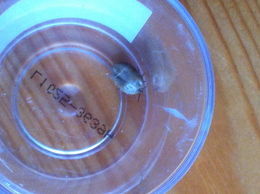
Here’s a picture of our new mascot. He was generously brought to us by Roxy last Thursday and we’re all very excited to have such a unique pet!

In case you can’t tell from the picture, that’s a pretty swelled up tick. Ew!
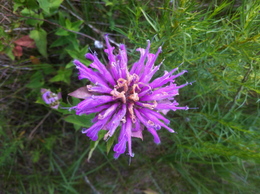
To end on a slightly prettier note, here’s a picture of Monarda fistulosa, also known as Bee Balm. This plant was flowering at Pembina Trail Preserve yesterday, but I saw others flowering today at Staffanson Prairie Preserve. To me they look like something straight out of a Dr. Seuss book!
This morning most of us got a taste of Maria’s regular schedule when we arrived at the Hjelm house by 6am for a special trip. We drove three hours Northwest to the Pembina Trail Preserve to help Gretel count western prairie fringed orchids for her work with the Nature Conservancy.
Unfortunately it seems to be a bad year for orchids and we only managed to find one that wasn’t even in either of the grids we were searching (In previous years there have been as many as 2,000 in the combined grids). As we were searching we met another group that was surveying the entire preserve, and they reported that they had only found 23 flowering orchids, so I guess we were lucky to see any at all!
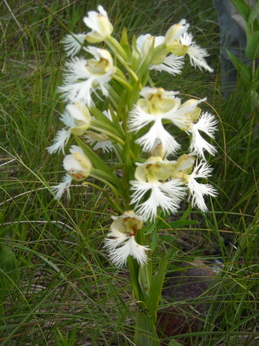
here is the one flowering orchid we did see:

Gretel isn’t sure exactly what has caused this sad state, but a few of her hypotheses are the late frost, a potential disease, or drier conditions than in previous years.
Although we were disappointed by the lack of orchids, we did see many new plant species and wildlife that we haven’t seen around K-town. Here are a few of them:
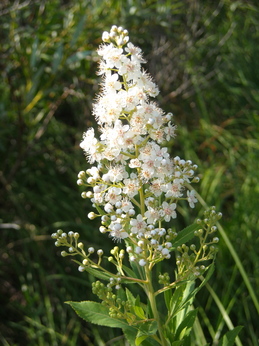
Spiraea alba
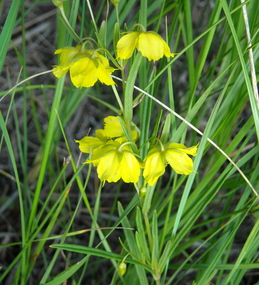
prairie loosestrife- Lysimachia quadriflora

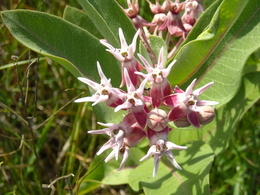
Showy milkweed-Asclepias speciosa

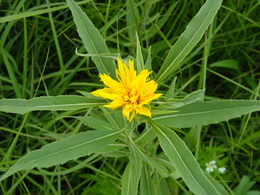
Helianthus maximiliani
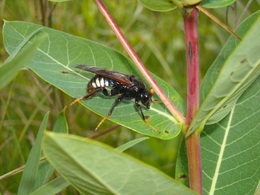
along with an insect that I have yet to identify:
I wasn’t able to get photos of any of the birds, but we saw northern harriers, red tailed hawks, meadow larks, king birds, bobolinks, a whole flock of sandhill cranes, an upland sandpiper, an american bittern (Stuart claims that they are also called prairie pump handles for the sound they make), and a dick cissel perched on a shrub near the path singing to whoever was listening.
On the way home, after ridding ourselves of as many ticks as possible, Gretel treated us all to delicious locally made ice cream, and dinner at a Mexican restaurant, in that order.
While we were all gone Katherine and Maria stayed behind to work on their projects.
Maria collected dichanthelium seeds and kept track of phenology at Hegg Lake, and Katherine cleaned and entered data.
Today was a quiet Sunday in K-town. While I indulgently slept in this morning, here’s what was going on in the field:
-Katherine, Shona, and Kelly surveyed flowering Echinacea in the common garden
-Andrew successfully observed 5 pollinators of Echinacea today, a much more productive session than some of his sessions earlier in the week
-Lydia crossed some Echinacea and painted floret bracts at Around Landfill and East Elk Lake Road, two of the prairie remnants
-Kelly visited all of her prairie remnants today, observing and recording the various stages of flowering Echinacea in each
-Maria worked with her Dicanthelium at Hegg Lake
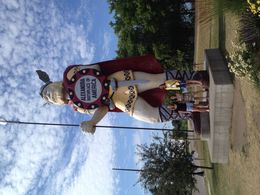
Other than fieldwork, a few of us went out to Alexandria yesterday to explore the downtown, visit Big Ole, and nab some Cherry Berry, our favorite self-serve frozen yogurt bar. We also discovered that if you buy a t-shirt and wear it to Cherry Berry on Tuesdays, you can get free frozen yogurt! Yum!
Tomorrow, the gang is heading out to Pembina Trail Preserve (between Fertile and Crookston, MN) to count Western prairie fringed orchids (Platanthera praeclara) in wet prairie. Photos to come!
(Again, I can’t figure out why my photos always flip sideways when I upload them or how to fix it)
Despite the wet and windy weather, the morning proceed as usual with each of us working dutifully on each of our respective projects. Jill and Katherine were especially productive, flagging and surveying all of their plants in Staffanson, a task which took all morning until 2. Shona completed her last hybrid cross and Lydia, Maria, and Kelly continued their field work. Unfortunately, I was not quite as successful since the pollinators do not seem to like eating during storms. The clouds retreated in the afternoon and we were able to get a substantial amount of measuring done; It’s a large garden, but we are making great progress. The exciting event of the day was a discovery: Josh’s Nalgene which he lost in the west side of Staffanson last summer. It survived a year of weathering and a spring burn just fine and still had water in it and a functioning lid.
Nope we did not sleep in until 9pm. On the contrary, we spent our Saturday morning doing fieldwork! Team Echinacea is really dedicated to our independent projects!
Saturday was a clear day with cool temps in the morning but temperatures rose around mid morning.
Kelly was doing phenology and Lydia was painting bracts and bagging heads for her crosses at the remnants.
Jill and Katherine finished up their aphid remnant survey, and Katherine stayed on at C1 to do her aphid addition/exclusion. It was a full day for Katherine (9 hours and 20 min lunch break).
Andrew went to C1 to watch pollinators, but unfortunately not many were up and about.
Shona was at Hegg Lake observing the last taking photos of Echinacea
Yours truly was also at Hegg Lake from dawn till 11.30am, doing Dichanthelium pollen addition (only 4 spikelets needed pollen addition, looks like the Dichanthelium are finishing up flowering!)
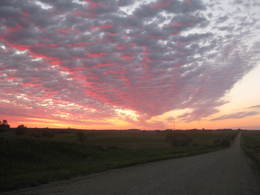
One of the great things about doing fieldwork in the early morning is the chance to witness spectacular views of the outdoors. I stopped several times on the way to my site to get pictures of this magnificence:
5:32am on Kittleson Road.
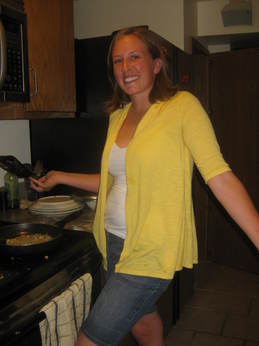
In the afternoon, some of us chilled out at home, took naps, went for a run, did groups abs exercise. Kelly, Lydia, Jill and Shona went to downtown Alexandria for some sightseeing and groceries. After they got back (around 8pm), we started making pancakes (gluten free corn pancakes, Katherine’s recipe) and Kelly’s authentic Spanish dish Tortilla Espanola. The pancakes turned out to be scrambled as we did not know the secret (=patience!). Thanks to the help of Jill and Shona, we managed to commence dinner at 9pm. After dinner, we all helped clean up. Then everyone (except myself because I had to get myself to bed) played bananagrams.
yay Kelly!
After three very hot days, the humidity dropped slightly today, to the point where we weren’t all sweating just standing outside, and there was even a nice breeze off and on.
As usual most of us spent the morning working on individual projects.
Kelly and Lydia helped Katherine and Jill with their projects and collected lots of ants.
Gretel and Andrew have teamed up to add a new piece to Andrew’s pollinator efficiency project where they will paint the bracts of pollinated styles, germinate seeds, and determine their genetic heritage to gain a better idea of how much pollen bees spread and from where (maybe one of them will explain more about that later).
Maria and I were out at Hegg Lake again, but it looks like I’ll be done with my crosses by the end of the week! So soon I’ll be able to start the next part of my project and help more with the main group work.
In the afternoon the whole crew went out into the common garden to work on measuring and we worked quickly enough that we even managed to finish a little bit early.
It’s only my fourth week here but I already feel like the colors of the prairie and the flowers I see are changing.
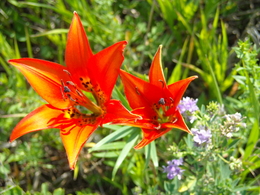
Here is a photo of one of my favorites that I’m beginning to see less frequently.
Lilium philidelphicum:
Who needs a sauna when you have the great outdoors? Yes, it was another hot and sticky day in Kensington, and we took it on and beat it. This morning, Katherine, Jill, and Lydia went to several remnants while Katherine used Sulu, the GPS, to find last year’s and this year’s flowering plants to use for ant and aphid surveys, and Lydia performed crosses on several plants at East Elk Lake Road and Around Landfill. Bug Catcher Kelly and Bug Catcher Andrew used Sweepnet in the Common Garden to collect pollinators. It was super effective! Shona and Maria were found over at Hegg Lake performing/analyzing crosses on echinacea and dicanthelium. This afternoon (or rather, last afternoon), a number of us continued measuring all the plants in the Common Garden. We’re 1/4 done!!!
Monday was incredibly hot in Kensington, but the heat could not keep Team Echinacea from their work! Everyone is very busy working on their individual projects. Some members are beginning to get results in the form of shriveled styles, aphid counts, video footage of pollinators, and the end dates for Echinacea that have already finished flowering! The first flower to finish up in my phenology experiment was done flowering on Sunday, July 1st! Isn’t that crazy? It seems like it’ll be an early season for Echinacea this year.
Other than individual projects, a few members of the Team went out and continued with phenology in C1 Monday morning. We also had a crew go out in the afternoon. They finished measuring in the inbred 1 garden.
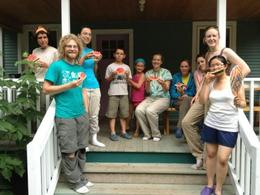
At the end of the day, everyone cooled off on the porch of Hjelm house with some refreshing watermelon slices.
We, well, most of us, headed out to the Hjelm House to assess phenology in the Common Garden. Those that were not there were out in the remnants/preserves working on individual projects. Shona went out at Hegg Lake to perform some angustifolia and pallida crosses. Maria also went out to Hegg where she looked at dicanthelium. Once Common Garden phenology was finished, Andrew worked on his pollinator efficiency experiment. Kelly and Lydia headed out to a few remnants to do phenology and assess within-remnant crosses, respectively. Lydia had a few crosses that were entirely successful as well as some ambiguous results.
The afternoon was fairly relaxing and comprised of a trip into Alexandria, laundry, frisbee, and playing with Felix, the new kitten.
Despite the heat and humidity, Friday was yet another productive field day for Team Echinacea.
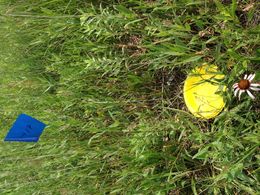
This morning everyone worked on their individual projects. Since my pitfall traps are ready to go, Greg and I placed pollinator traps on different prairie remnants. Pollinator traps are these nifty –and apparently hard to come by– yellow bowls that you fill with soapy water. Traveling from remnant to remnant, we also discovered that there’s a giant hole where the landfill prairie remnant used to be…
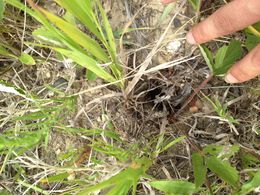
Later this morning, equipped with buckets as chairs, Greg and I headed up to one of the hills around Hegg Lake to observe some large soil-nesting bees. After an hour of watching, we saw two bees land in different holes, but no bees emerge. We’re not sure whether these bees are solitary or eusocial.
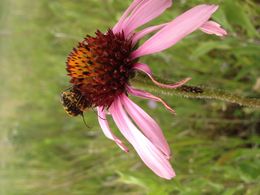
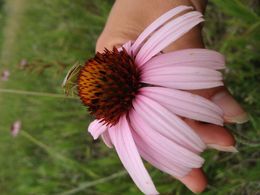
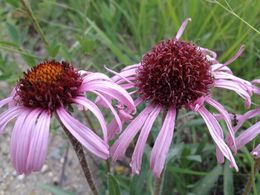
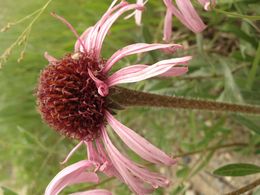
I also scored some pictures of the arthropod life on Echinacea heads.
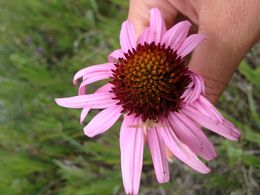
Here is the “fuzzy” Echinacea head from the Kittleson roadside. Echinacea styles typically shrivel when successfully pollinated and persist when unpollinated or pollinated with incompatible pollen. In the case of this poor plant, the “fuzziness” is caused by all of the styles persisting, indicating that this plant hasn’t been successfully pollinated yet.
After lunch, the team trekked out to the common garden (C1) to measure Echinacea that had been planted in previous years. Measuring each plant year after year gives us a sense of the fitness of the individuals. We recorded things like the number of basal rosettes, number of basal leaves, as well as the length of the longest leaf, insect presence, among a slew of other characteristics.
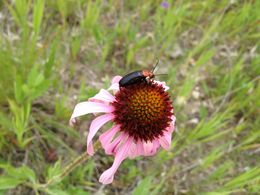
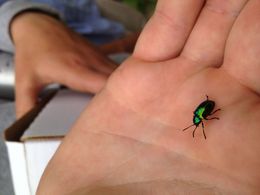
Greg and I took off a bit early from measuring to go collect the pollinators from the traps we set out earlier in the morning. Also, Shona made a beetle friend! We’re still trying to figure out what exactly this little guy is and I’ll post it once we figure it out.
I realize that most of these pictures are sideways and I don’t know how to fix it at the moment. All of them were rotated the right way when I uploaded them…go figure.
|
|