|
|

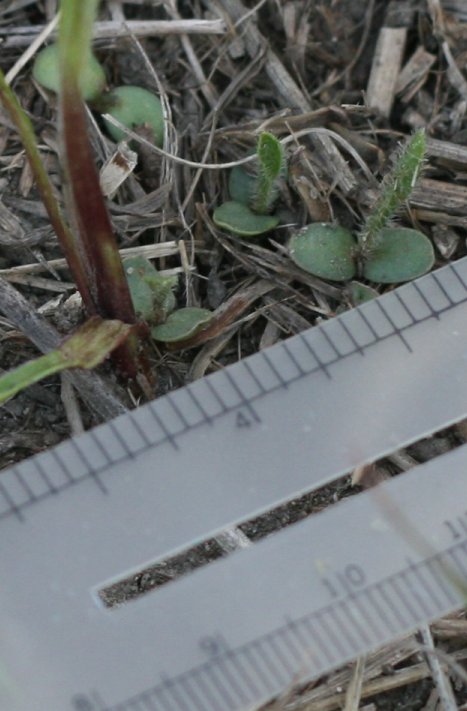
This photo by Christine shows fours seedlings near Echinacea plant 2044 at StApp on 17 June 2008. The seedlings are mapped & uniquely identified on pages 56 & 56 of “Seedling search 2008.” The ruler is marked with 16th of inches on the top and millimeters on the bottom.
Today we finished searching for seedlings for the season. We searched near about 200 plants that flowered last year in 15 sites. We found about 239 seedlings. We made maps so that we can refind all the seedlings in August–at least those that survive. In August we will make sure we can find the seedlings again next year so we will be able to follow this cohort for several years to determine their survival, growth, and eventual reproduction.
Searching for seedling is fun, but we are ready to move on to other exciting developments!
So about a week ago, Team Echinacea was counting and mapping tiny little seedlings. I was working with Gretel, and we had found a plant that apparently knew how to reproduce 47 times in one season. Yes, we mapped out 47 seedlings but not before a spray truck came along.
Because of the strong winds, we could not hear and were quite surprised when a large truck spraying chemicals on a nearby farm rode by us, emitting a putrid scent. Not wanting to breathe in chemicals, Stuart and Gretel began to yell at the spraying perpetrator: “Stop! What are you doing?!��?
The driver stopped, and we all moved upwind, away from the chemical mist. Stuart argued some with the driver who was standing close to the sprayers. Eventually, the driver realized that he was losing the argument (you are not supposed to spray people with chemicals) and drove away.
We decided to move to another spot, and on the way we saw a Bobcat (farm machine, not the animal) on fire. A bunch of cows stood around looking confused. Strange afternoon.
Here’s an update on the main research activities this spring. The cool spring with a late snow (~15 inches -38 cm- at the end of April) delayed burning weather somewhat and we think seedling recruitment may be later than in the past few years.
Recruitment/Establishment Experiment
On May 9 I mowed burn breaks so the DNR burn crew could burn the plots. They burned the middle unit at Hegg Lake WMA on May 28. Two plots were in this unit. Here’s a photo of one plot just after the burn. Nice work! There are 3 plots to be burned at Hegg Lake WMA, two at Kensington Duck Refuge, and one a Eng Lake WMA. At the duck refuge I saw 2 Sandhill cranes and a Red-necked grebe (among the regular, awesome array of water birds).
Common Garden
Dwight, Jean, and I burned the common garden on May 22, starting just after noon. The weather was within prescription, but the wind was a bit strong and the fire jumped the gravel road and started some corn stubble. The fire worked its way to some reed canary grass and we managed to put it out there. If it had gone a little longer it would have torched the cattails and burned the whole slough west of the common garden. Whew!
The running fire was great in the 99S garden, but there were quite a few unburned spots in the main garden. We burn the CG every other year and we mow paths annually, so we don’t have quite enough fuel for really complete burns. Maybe in 2010 we should augment the fuel load with some prairie hay.
A big tree just east of the CG caught on fire. It was hollow, but quite strong. It finally broke and fell over around 7 pm. To put it out we scraped all the embers and coal from the trunk with an axe and shovel. We couldn’t reach a spot of punky wood 8 – 9 feet (2.5 m) off the ground. So I climbed up the trunk and used a 5 lb. pick mattock to scrape out the embers and punky wood. Then Dwight lifted the smith Indian backpack sprayer over his head and I sprayed and sprayed and sprayed. We put it out by around 10 pm. Exciting! We need to cut up the part of the tree that fell on the CG.
An adult bald eagle flew over the CG just as we started to burn and then again around 8 pm — great!
On 24 May, Gretel and I broadcast seed over the CG. We seeded Galium boreale, Bouteloua curtipendula, and Schizacharium scoparium. Gretel, Per, and I seeded the ditch with many species of seed, including Stipa spartea and Spartina pectinata. We forgot to seed the 99S garden.
Seedling Search
On 27 & 28 May Ruth, Amy, Julie, and I searched for Echinacea seedlings in five remnant prairies. We searched about 75 circles with 41 or 50 cm radius and found 17 seedlings. Several had only cotyledons and the tallest first leaf was 24 mm. We got rained out yesterday (29 May). It was also cold and windy.
Hjelm house
Last weekend Pete, Dwight, Gretel, and Stuart cleaned out all the sheetrock and insulation (yuck) in the house. That was a job. We got the house all ready to have the floors sanded. We have a lot left to do to get the house ready for the main field season. The highest priorities are bathroom and computer network.
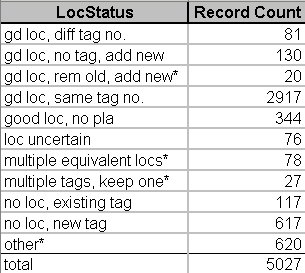
Here’s a quick tally of the demography data that we took in the natural remnants this summer. I think we did a lot! We took a total of 5027 records. Here they are broken down by loc status…

This is just the first rough pass through the dataset. There is a lot of clean-up to do and mysteries to figure out. For example, of the 81 “good loc, diff tag no” records, 12 have no loc and 1 has no tag (gulp).
Flowering rates seemed to be high this year. 1700 records list one or more normal flowering heads and another 223 records had only non-normal heads. There were some big plants too: two plants had 11 flowering heads and two had ten! The greatest number of rosettes was 47 (that’s good ol’ plant #1540 at NGC.) We counted 9276 total rosettes.
The summer field season is done for me. We drove back to Illinois on Saturday. I’ll try to post reviews of the datasets occasionally and maybe some photos too.
Jennifer is the only one still in the field. She is harvesting seedheads today & tomorrow, then returning to IL.
Georgiana May and I had a great day working with Amy M., Gretel, Ian, Jennifer, Julie, Rachel and Stuart. Though we had specially chosen Thursday as having the most promising weather, it was raining when we arrived at 9, but that didn’t stop us from piling into the truck for the trip out to the beautiful prairie remnant at Krusemark’s where we relocated previous flowering plants and collected demographic data on them. The water resistant paper kept the maps from thoroughly shredding, and we finished the job – but not before 1. Back at the farmhouse, water had been restored (after a break the night before) AND there were 3! batches of cookies – great reward!! After lunch, Gretel and Jennifer visited several remnants to relocate seedlings we marked in May. Amy, Rachel, Georgiana and I did the same at E. Riley – it was satisfying to see even just a few survivors! Stuart, Julie and Ian surveyed at Riley and E. Riley. All this, under beautiful, warm sunshine – what a difference a few hours makes! Georgiana and I enjoyed a look at Staffanson and Hegg Lake on our way out back to the TC’s. It was a great summer working with all of you!! My best wishes to all of you. Ruth
Here’s a map (pdf format) of plants in the common garden. A purple asterisk indicates a plant that flowered this year. The size of the asterisk is proportional to the number of heads produced. Download file
We harvested a lot of heads today & yesterday. It’s early for us to be harvesting.
I thought I would spend some time comparing the 2006 and 2007 measuring of the plants at Hegg Lake. The Hegg Lake common garden is located on Minnesota DNR land and is approximately a 7.5 mile drive from the main common garden. In May 2006 3,941 seedlings were planted at Hegg Lake after they were first germinated and grown in a green house at the Chicago Botanic Garden. To learn more about this large seedling growth experiment read this description.

Measuring plants:
In both years we counted the number of leaves and measured the longest leaf. However, this year we also recorded insects and any herbivory damage on the plants. The average tallest leaf of the living plants was 6.4 cm in 2006 and 13.7 cm in 2007.
“Can’t finds��? and mortality estimates between years:
When we are measuring plants and can’t find a plant we don’t assume the plant is dead. Instead the measurer records that the plant is a “can’t find��? and places a flag in the position he/she was searching. Later we have a different person come back and searches for the plant so that two pairs of eye look for every “can’t find��? plant. In 2006 we had approximately 21% of the plants were found by the second person who went back and searched for the “can’t find��? plants. Our overall estimate for mortality in the plants first year of growth was around 6% with 243 plants that were “can’t finds��? after two people searched for the plant.
This year we have just started having the second person go back and search for “can’t find��? plants. We have a total of 698 plants that were not found by the originally measurer. This puts the mortality estimate at 17.7% plants (cumulative) however I feel this percentage will drop significant after the second person rechecks the “can’t finds��?.
One interesting note is there were 30 plants found by the originally measurer this year that were not found by EITHER person who searched for the plant in 2006. Therefore, in 2006 there were really (at most) 213 plants that died making the currently mortality estimate for 2006 at 5%.
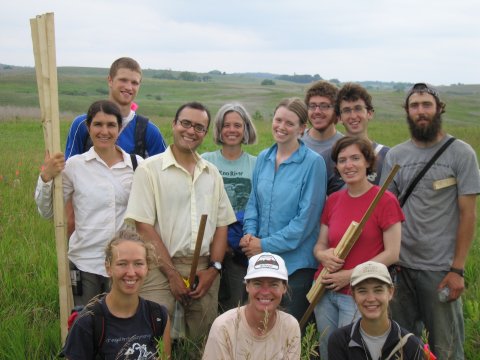
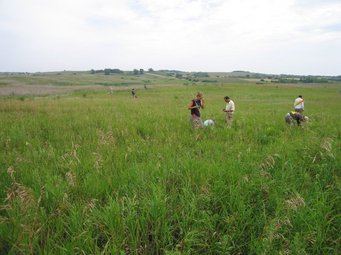
Here’s a photo of the measurers and datatakers at the Hegg Lake common Garden on July 26th.

(L to R) Kneeling: Amy, Amy, Jennifer. Standing: Gretel, Ian, Andy, Ruth, Julie, Josh, Rachel, Colin, Jameson. Photo by Stuart–he measured too.
The weather for measuring turned out to be much nicer than predicted: Temp 85 degrees F; dewpoint: 70 degrees F; mostly cloudy with a W wind at 13 mph. It started raining, so we packed up to leave. As we were walking out the rain stopped, so we paused to take this photo. After the photo, it started to rain again.
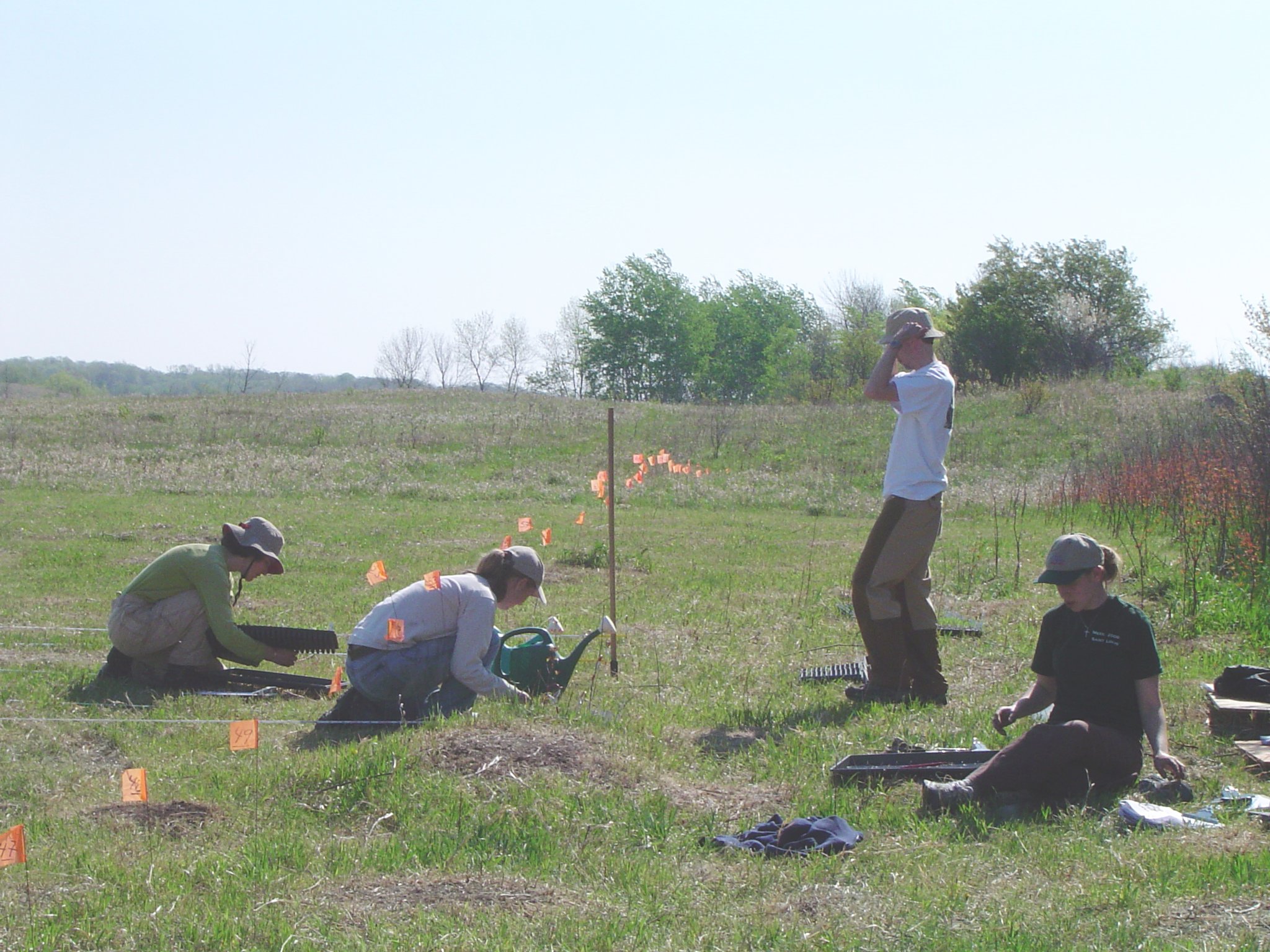
We measured plants efficiently. Most plants have two leaves and the longest is 8-19 cm tall. It can be very difficult to find a plant because the thick grass is about 50 cm high. The only way to find it is to measure from another Echinacea plant. The ~4000 plants are spaced on 1m apart on a 80m x 50m grid. That can seem like a vast distance between plants. Jennifer made measuring sticks 2 meters long to help us stay on line and find the plants. After finding two plants you could keep on line fairly well and go fast. If there was a missing plant or a particularly sneaky plant, then it was very easy to get disoriented. Some folks worked in pairs (one measuring, one taking data); others solo. Here’s a photos of folks at work…

At last, after car trouble aborted my trip last week, I made it back out to Douglas County to join in field work with Team Echinacea. What a difference from the 2 days in late May, when Stuart, Jennifer, Andrea, Amy Mueller, and I were there searching for seedlings in the remnants! On Wed, the team numbered 12, and we made great headway measuring plants in the common garden. We were undaunted by the heat and humidity, though we did welcome every breeze. Today, we had the benefit of clouds all morning, and 13 of us measured quite a few plants at the Hegg Lake experimental site before rain, which we’d been seeing in the distance all morning, chased us in for lunch. The weather canceled field work for the afternoon, but we received instruction from Rachel about the upcoming work to evaluate species composition at her research sites, and I conferred with Stuart on analysis of pollinator visitation data before I headed back to the Twin Cities. I enjoyed the opportunity to meet the new members of the crew and working with them and look forward to the next time.
Hi all,
So I arrived up at the field site about a week and half ago to finish up monitoring flowering and help out with measuring and demo. Except for the recent death of my computer’s hard drive it has been an excellent start to my field season. As you may know flowering was about a week earlier this year with many more flowering heads than expected. I would have estimated around 800 (max) flowering heads but we had over 1,100 flowering in the common garden. Last year was also a huge flowering year (over 1,300 heads) because it was a burn year. I am excited to now have two years of flowering data on a large of plants in the common garden.
We have spent a large part of the last week I have been here measuring both in the common garden and at the hegg lake common garden. The hegg lake common garden was established back in May of 2006 to as part of my graduate research. It is about 6 miles from the main common garden on Minnesota DNR land. It has around 4,000 plants planted on a 1m X 1m grid. Today we had the entire field crew out at hegg lake measuring for a total of 13 people and measured nearly half of the entire plot just today…it was great!
Besides the field work I have been keeping myself busy in rural Minnesota by fishing (Ian has promised that I will actually know how to fish by the end of the summer), playing poker, and going to a dirt track race. In the near future I plan on flogging all non-Echinacea related activities that can be done in rural Minnesota….however now I’m tired so it will have to wait until the weekend.
Night!
Jennifer
|
|