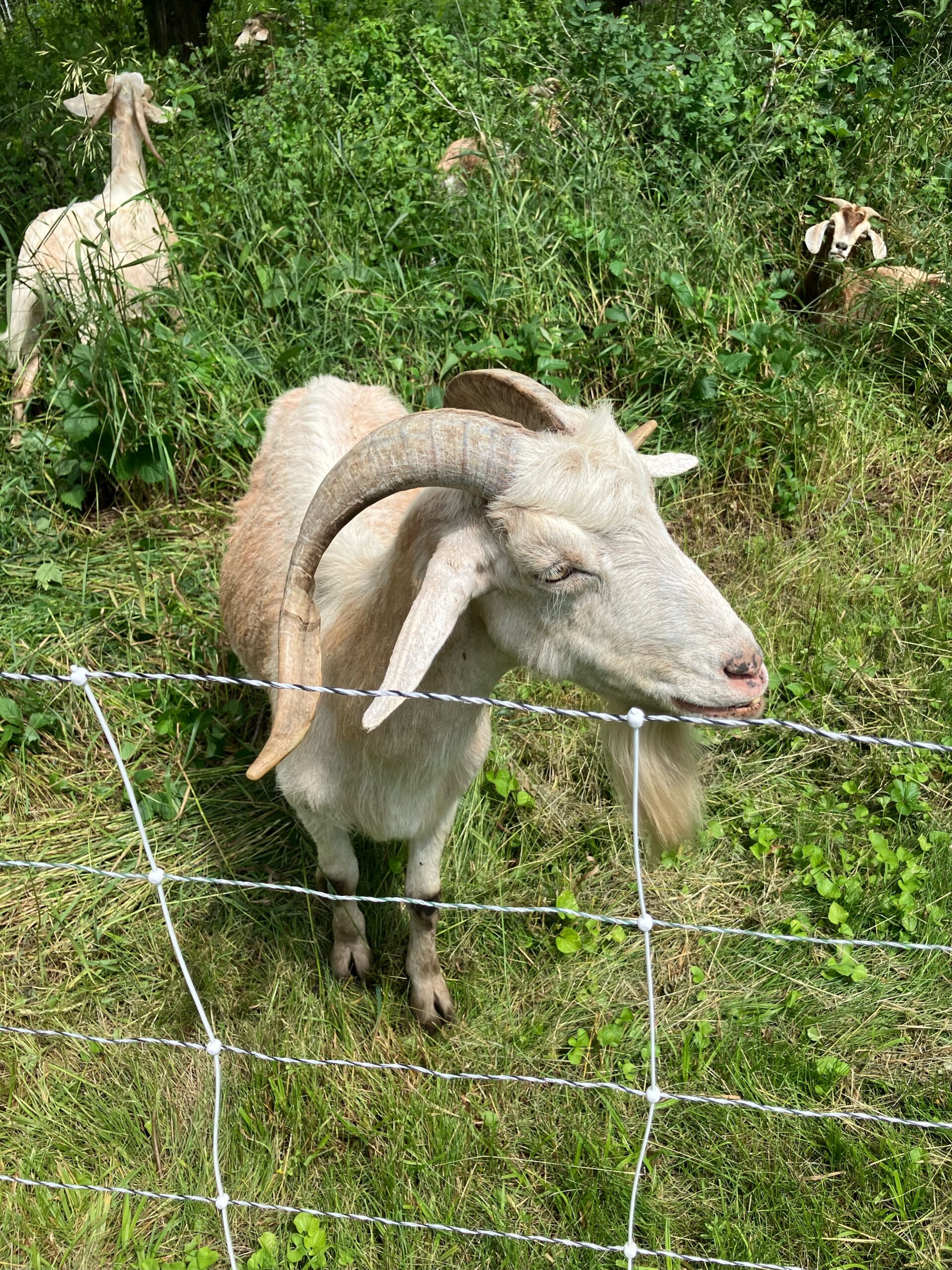
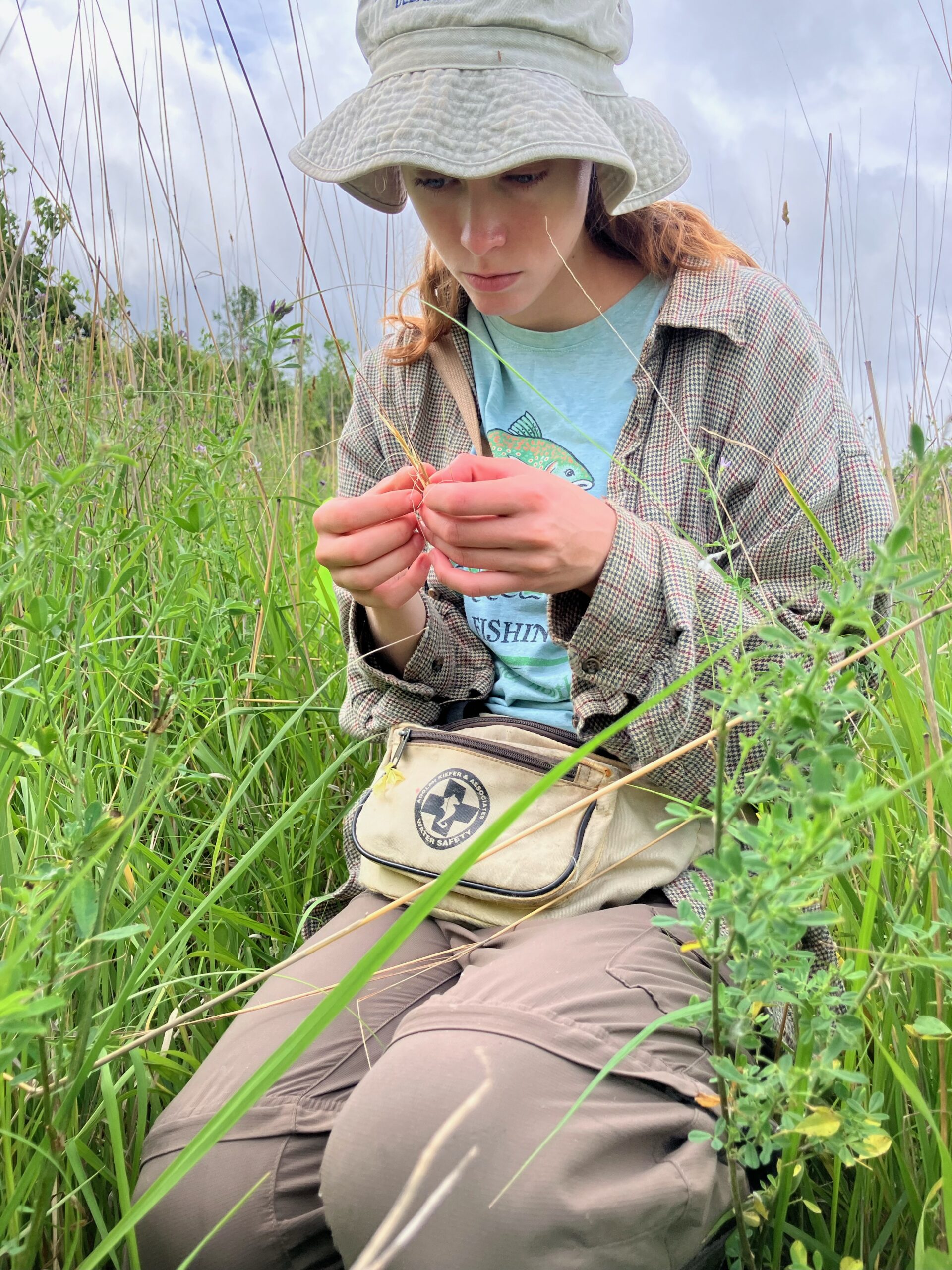
Today we welcomed goats to Hjelm. They are already hard at work eating their way through the foliage. Keep up the good work, goats! Most of the humans worked on finishing searching for Stipa in p01 and started planting a new production garden to generate seed to add to the experimental plots. Ian and Liam valiantly continued staking points for the pollinator emergence study. Wyatt and Abby are getting ready to begin a study investigating the effects of fire on pollen and nectar production in Echinacea angustifolia. This project has many excellent collaborators and is part of the MN ENTRF funded research on prescribed fire and ground nesting bees.
We’re interested in investigating what resources are available to Echinacea visitors and learning more about the pollen and nectar Echinacea produces. We hope to learn if the nutritional resources available differ before and after burns. In 2022, Britney House developed methods for collecting nectar from Echinacea using microcapillary tubes. Read more about her methods here.
During the summer of 2023, the team collected pollen and nectar samples from Echinacea angustifolia at 19 sites in and around Solem Township, MN (plants at Hegg Lake were Echinacea pallida). We searched for and shot the ~20 plants (or, if few were available, as many as we could find) at each site that were closest to a random point. We then selected ten of those plants to bag up to three of their heads with pollinator exclusion bags. Throughout the duration of their flowering, we collected pollen from all bagged plants and nectar from five of them per site.
Stuart collects nectar from an Echinacea head
Midway through the experiment (mid-July), we removed bags from some of the pollen only plants to adjust our sample size to only the five pollen/nectar plants plus two backups per site. We removed bags from pollen/nectar plants and backup plants when they were done flowering, we’d collected a cumulative 50 mm of nectar from them, or we had received less than 15 mm of nectar from the plant in the last three visits (the latter was more of a guideline than a rule, used to save time by eliminating plants that were unlikely to provide us with enough nectar for analysis). At the Hegg pallida restoration, any heads that were not originally bagged were decapitated, and all heads were decapitated upon the final removal of their bags.
Following some experimentation, we conducted nectar collection only in the afternoons, while pollen collection could be done any time of day. In total, we collected 856 vials of pollen and 580 vials of nectar from 104 plants. These were given to Rahul Roy and Margaret Medini at St. Catherine University in St. Paul, who will be doing data analysis.
Data entry for collection datasheets is complete, and verified csvs for each site can be found at: Dropbox/teamEchinacea2023/z.pollenNectarDataEntry/coreVerified. Scans can be found at: Dropbox/teamEchinacea2023/z.pollenNectarDataEntry/scans.
Start year: 2023
Location: Various prairie remnants and one restoration (Hegg Pallida) around Solem Township, MN