|
|
Today will mark the completion of my first work week here at the garden so I just wanted to summarize some of the tasks I’ve been doing for the past five days. The start of the week was dark and gloomy, like any typical Monday, but it was accompanied with a downpour that left me soaked when walking to the Plant Science Center from the train station. Because of the weather I wasn’t able to go out and collect any solitary bees to use in the emergence traps for Kristen’s experiment. Instead I cleaned a few Echinacea heads, identified foreign pollen and continued to develop my skill for identifying the different bees native in Minnesota. Tuesday was a little better. I wasn’t completely soaked, but it was still cold on the walk in that morning. Once again I wasn’t able to go out and collect any bees. However, I was able to identify a large portion of the pollen slides. Also, I found my own method of cleaning Echinacea heads. I use a smaller pair of tweezers to pluck out the achenes and use the larger pair to brush out any that I may have missed. It’s not the fastest way of cleaning, but I think it’s pretty effective.

Wednesday it was finally warm enough to go out and collect solitary bees. My first day out catching solitary bees didn’t go so well because I didn’t catch any. I did catch a few hoover flies and honey bees and recorded their behaviors in the emergence traps. Before leaving that day, Tracie, Kristen and I set up an emergence trap in the prairie area to see if we would catch anything. The next day when I checked the trap we had a few specimen in the trap. They weren’t bees, but now we know that the traps work! Later that day I was able to collect some solitary bees and record their behavior. Today I was able to catch more solitary bees and record their behavior. This time around I decided to film their behavior in the emergence traps using my phone which I will continue to do. I was able to take a video of a Ceratina that I collected, but because the video size is too large I can’t upload it here. However, I was able to upload another recording of an unidentified solitary bee in the emergence trap. I wasn’t able to put the bee into a vial and identify it back in the lab once it crawled from under the trap, but hopefully I’ll catch another one and identify it next week!
Echinacea Project 2018
Biology, College of Wooster 2020
Research Interests
Ever since I was a kid I’ve always had an interest in forensics. It wasn’t until my second year in college that I started developing a passion for studying ecology. I decided to take a gateway to ecology, evolution, and organismal course as well as an agricultural entomology course and have enjoyed the subject matter. I’m not fully committed to the subject yet, but I am looking forward to working in the field this summer!
Statement
I’m from Chicago, Illinois and I am currently working in the Chicago Botanic Garden’s lab. I’m currently working in the Plant Science Center where I’m cleaning Echinacea heads, identifying pollen, and becoming familiar with the types of bees that visit Echinaceas. When I’m not working in the lab, I’m at home spending time with my family or making music.

During the summer of 2017, Lea and I carried out a project we called “Rich Hood” (richness of floral neighborhoods). This involved setting up 2 x 2 m square plots around Echinacea plants in the remnants, and getting cover class estimations for all species present. We also harvested flowering Echinacea heads, and there is more specific information in the flog post about reproductive fitness in the remnants. Nina Denne, a student at Carleton, completed an externship project comparing the floral neighborhood with the seed set of the collected Echinacea heads.
On May 6th and May 7th, 2018, I returned achenes to the remnants that were not sampled for the x-ray. I returned achenes to all the remnants that were in our study except for Landfill and SPP, which will hopefully be rematriated later this spring. At each site, I staked to points where heads had been collected (using stake file stakeReturnRichHood.csv), found the matching tags within the plot, and spread achenes in about a 20 cm radius around last year’s stalk. In some cases, if I couldn’t find the tag within a reasonable time of searching, I spread the achenes around the point I staked to.
It was nice to see what the remnants looked like in the spring, but I didn’t see any tiny Echinacea rosettes yet. Some of last year’s heads out there had dispersed all of their achenes, but many were still holding on to a few.
 An Echinacea head with a few achenes left to disperse.
Greetings floggers!
The interspecific competition has offered the following results:
- Interspecific competition of growth rate is greater for Bromus kalmii with Elymus canadensis compared to intraspecific competition of Bromus kalmii at this stage of growth.
- The growth rate of interspecific competition for Elymus canadensis with Bromus kalmii demonstrated a negligible change compared to intraspecific competition.
*To view the full write up click here: Interspecific comp.
 Fig 1: Vertical black line on each histogram indicates the mean value for each treatment (E. canadensis vs B. kalmii, E. canadensis vs E. canadensis, B. kalmii vs E. canadensis, or B. kalmii vs B. kalmii) of interspecific competition and intraspecific competition. (F) indicates the focal plant. Likewise, my spring semester internship has concluded as well. This experience has been an amazing and immersive learning opportunity. Within the past week, since the end of my internship, I’ve noticed a shift in the way I think. I’ve started observing plants, not just for their beauty, but also for their seed composition and amazing structures. I have found an appreciation and curiosity for the conservation of our native species and the ecosystems they take part in.
The CBG is a wonderful place that cultivates the excitement of science. Whatever the future holds, I will maintain the same attitude as I have during this experience. From day one, I knew I was in a special place and needed to absorb every moment of it. This internship has truly exceeded my expectations.
In closing, I’d like to thank Stuart and Tracie for their guidance, support, and exposure to a fascinating study of plant science. I also would like to thank them for transplanting my grasses to the prairies of Minnesota, where they can grow to their full potential 🙂
 E. canadensis transplanted to the MN prairie by Tracie Hayes and Stuart Wagenius. Grown from seed by Danielle Oilschlager 🙂 Sincerely,
Danielle
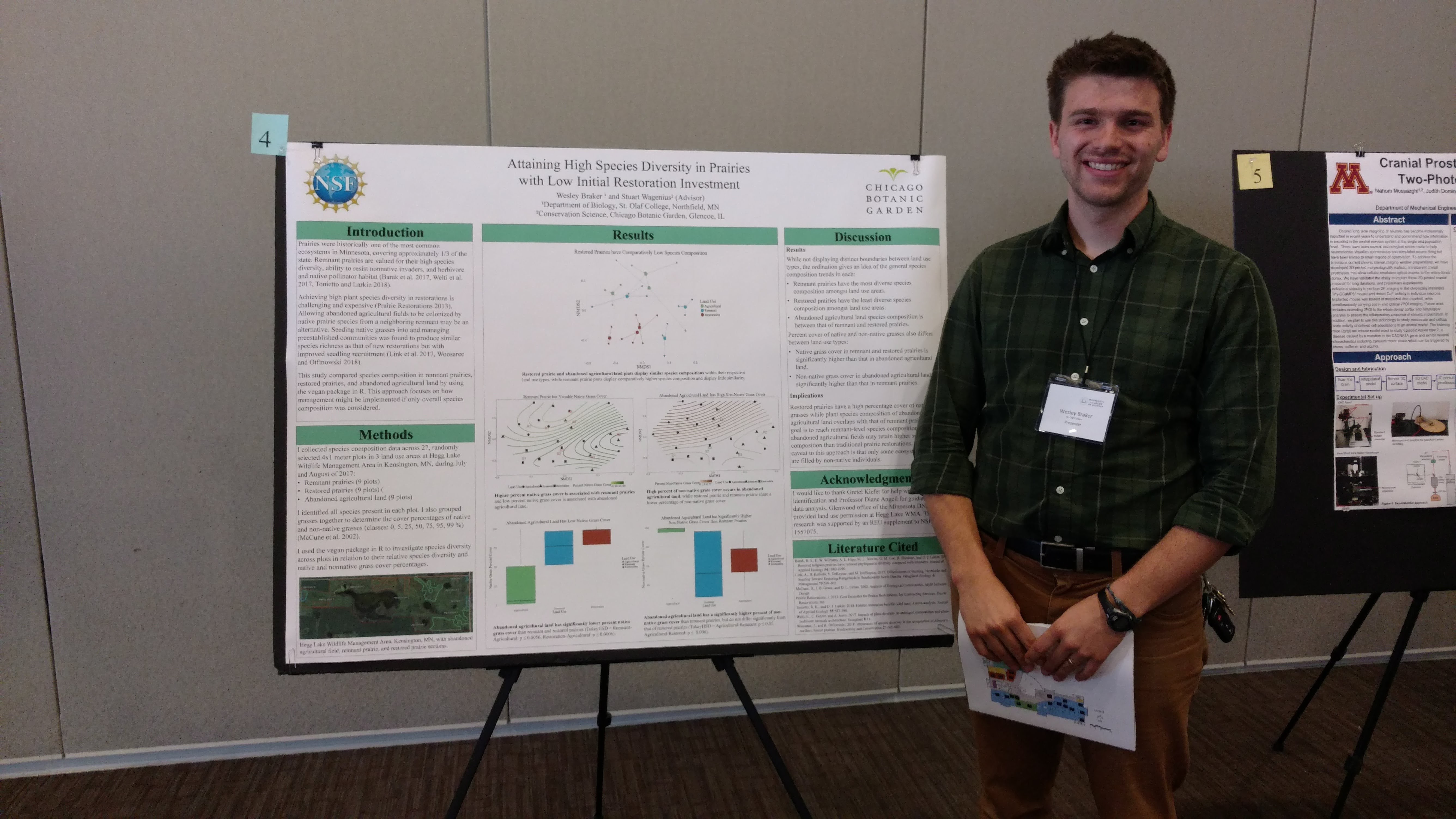
Wes presented the poster “Attaining high species diversity in prairies with low initial restoration investment” at the 85th Winchell Undergraduate Research Symposium & 31st MAS Annual Meeting with Stuart as co-author at the University of St. Thomas, St. Paul, MN on 21 April 2018. Here’s the poster.
Yay, Wes!
 Wes presents his poster.
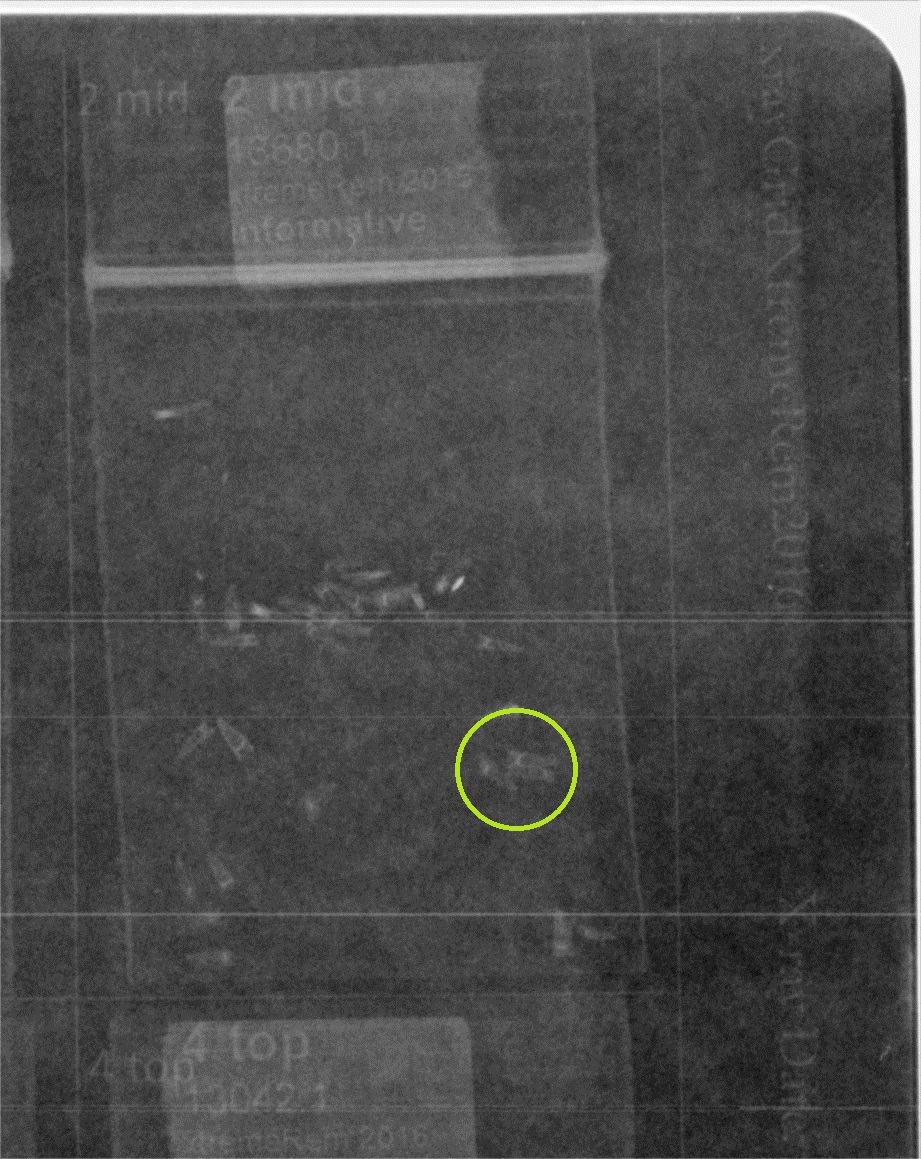
Hi all! Stuart and I are in the process of figuring out the best way to edit our x-ray images of Echinacea achenes so that it is easy to classify them:
- Are all achenes (full and empty) visible?
- Is it easy to tell between full and empty achenes?
- Can achenes within clumps be identified individually?
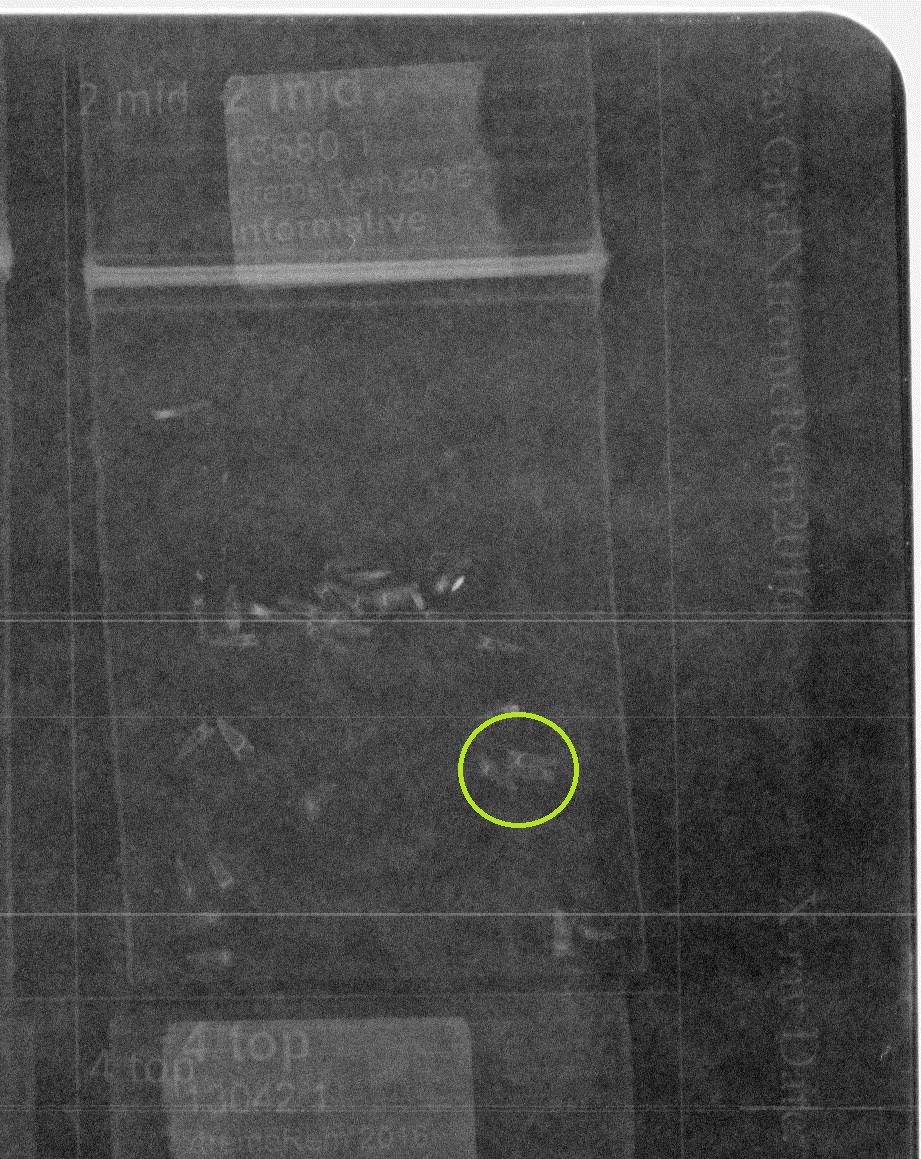
 Example x-ray image with achenes, before edited Here is an example of an x-ray image that is tricky to classify. All of these achenes are empty, so they are more translucent and harder to see. Also, many of these achenes are in clumps, so getting the correct count of empty achenes is a challenge.
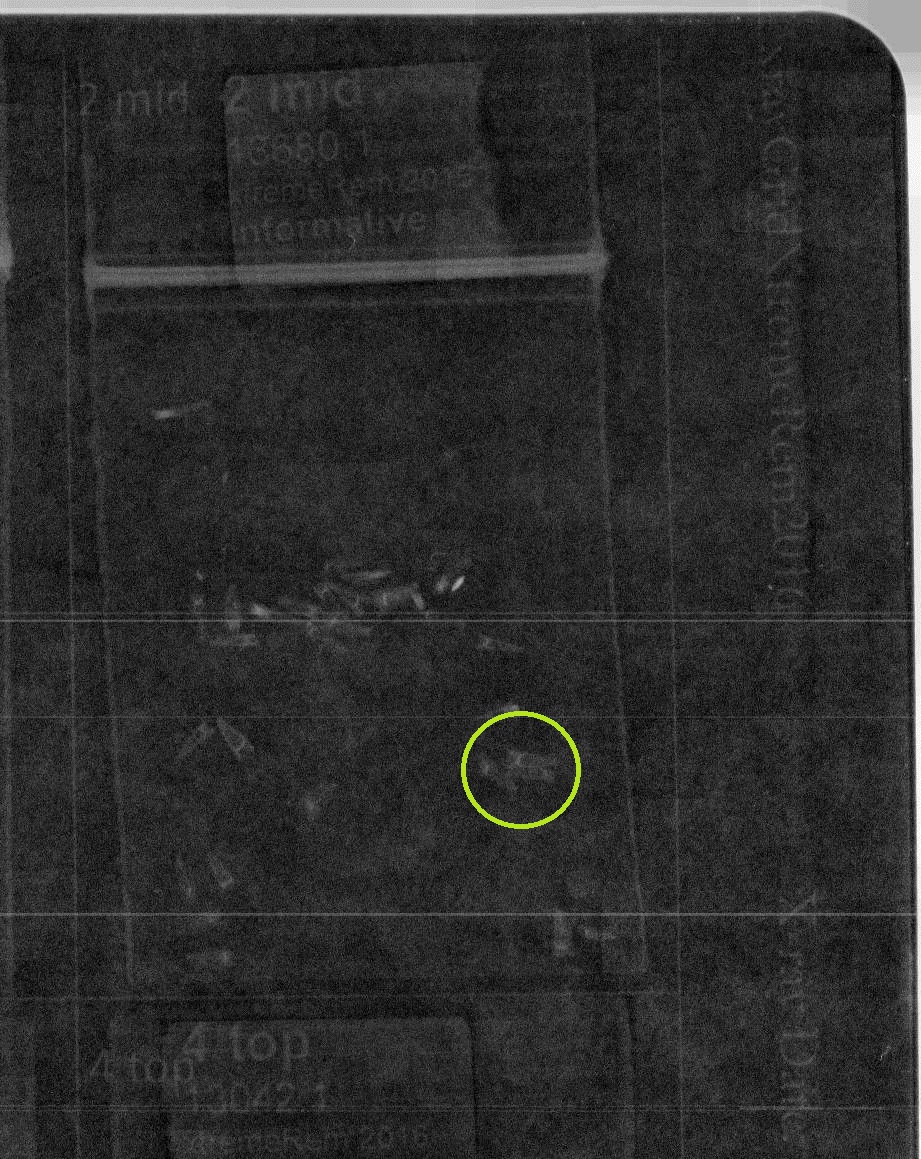
Example x-ray image before edits, with circled clump A single clump has been circled in green in this image. This clump has 3 empty achenes, but we want that to be more obvious. To edit our images, we have been working with the EBImage package in R. Here are a few examples.
Edited example #1 This edit is helpful because it makes the background darker so that it’s easier to pick out achenes. The 3 in the clump are still kind of hard to pick out, though. Here is the code we used:
library(EBImage)

x <- readImage('https://echinaceaproject.org/wp-content/uploads/2018/04/x2mid.jpg')
display(x)

kern = 2000*makeBrush(99, shape = 'Gaussian', sigma = 5)
display(whiteTopHat(x, kern))
This example is blurred a bit, which is helpful for seeing achenes in their entirety. This is the code we used:
library(EBImage)

x <- readImage('https://echinaceaproject.org/wp-content/uploads/2018/04/x2mid.jpg')
display(x)

display(gblur(x, sigma=0.8))
There are endless possibilities if using multiple EBImage functions on one image, and we are looking for some guidance. If you have experience with EBImage, what do you think are the best combinations of functions for reaching our goals? Thanks for the help!
Do you want to germinate some seeds? A while ago Andrea Kramer recommended four resources to find out about seed germination. I’m copying them here:
1. A good place to start with when you are working with a new species: http://www.charlesgwillis.com/baskin-dormancy-database/ This database goes along with the 2014 Baskin seed book, below. It is free but requires sharing your contact info.
2. The book: Baskin, C. and J. Baskin. 2014. Seeds: Ecology, Biogeography, and Evolution of Dormancy and Germination. 2nd ed. Academic Press, New York.
3. The Royal Botanic Garden Kew has a Seed Information Database: http://data.kew.org/sid/
4. A handy paper with guidelines for a “move-along” experiment: Baskin, C. C., and J. M. Baskin. 2003. When Breaking Seed Dormancy Is a Problem: Try a Move-along Experiment. Native Plants Journal 4:17-21.
Bonus:
5. Prairie Moon Nursery has a Cultural Guide that lists germination requirements for hundreds of Midwestern U.S. species. It’s a big excel spreadsheet that you can access from this page….
https://www.prairiemoon.com/blog/resources-and-information
6. For germinating Echinacea angustifolia, we use a modified version of the protocol developed by Feghahati & Reese in 1994. We don’t use fungicide, but otherwise stick pretty close to their recommendations. If you use this protocol, please cite this paper.
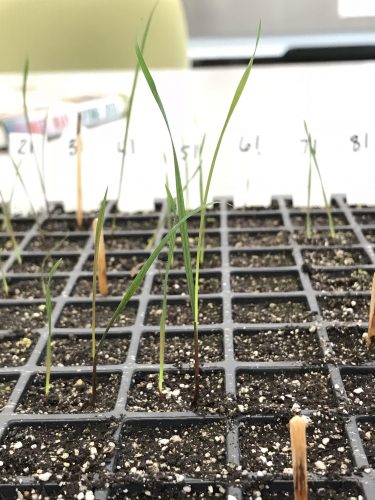
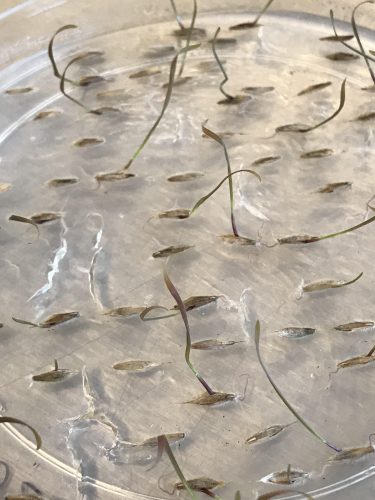
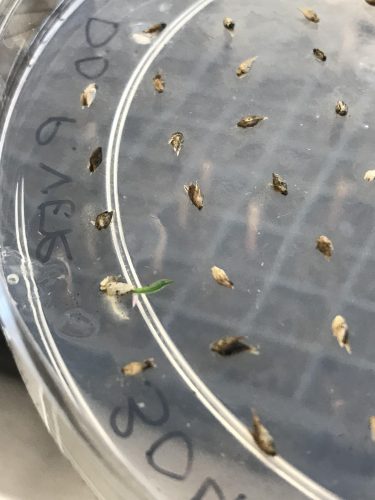
Over the past few weeks, Elymus canadensis and Bromus Kalmii have taken to the plots for a battle of resources. When I initially began this experiment, I hypothesized that Panicum virgatum would take the lead, since it develops a ribosomal root system and is known to be an aggressive prairie species. However, out of 500 seeds, only 1 P. virgatum has germinated and sprouted. For that reason, I’ve decided to eliminate P. virgatum from the data analysis. Although, I have planted the lonely P. virgatum so that it can later be transplanted to the prairies of Minnesota. I later suspected that E. canadensis would take the lead in sprouting. However, B. kalmii has currently overthrown the number of germination/sprouting. There are still a few weeks to go with this experiment before analyzing the data collected on height. With that said, it could go either way. The grasses are growing taller and faster than any of us expected. I take measurements weekly and can already conclude that competition is occurring. The leading height in each treatment varies, indicating that one of the species is achieving more resources than the other. More updates and photos to come!
Sincerely,
Danielle
 Competing species – 2 seedlings to a cell  Bomus Kalmii germinating/sprouting in the agar-petri dish  The one and only germinating/sprouting Panicum virgatum
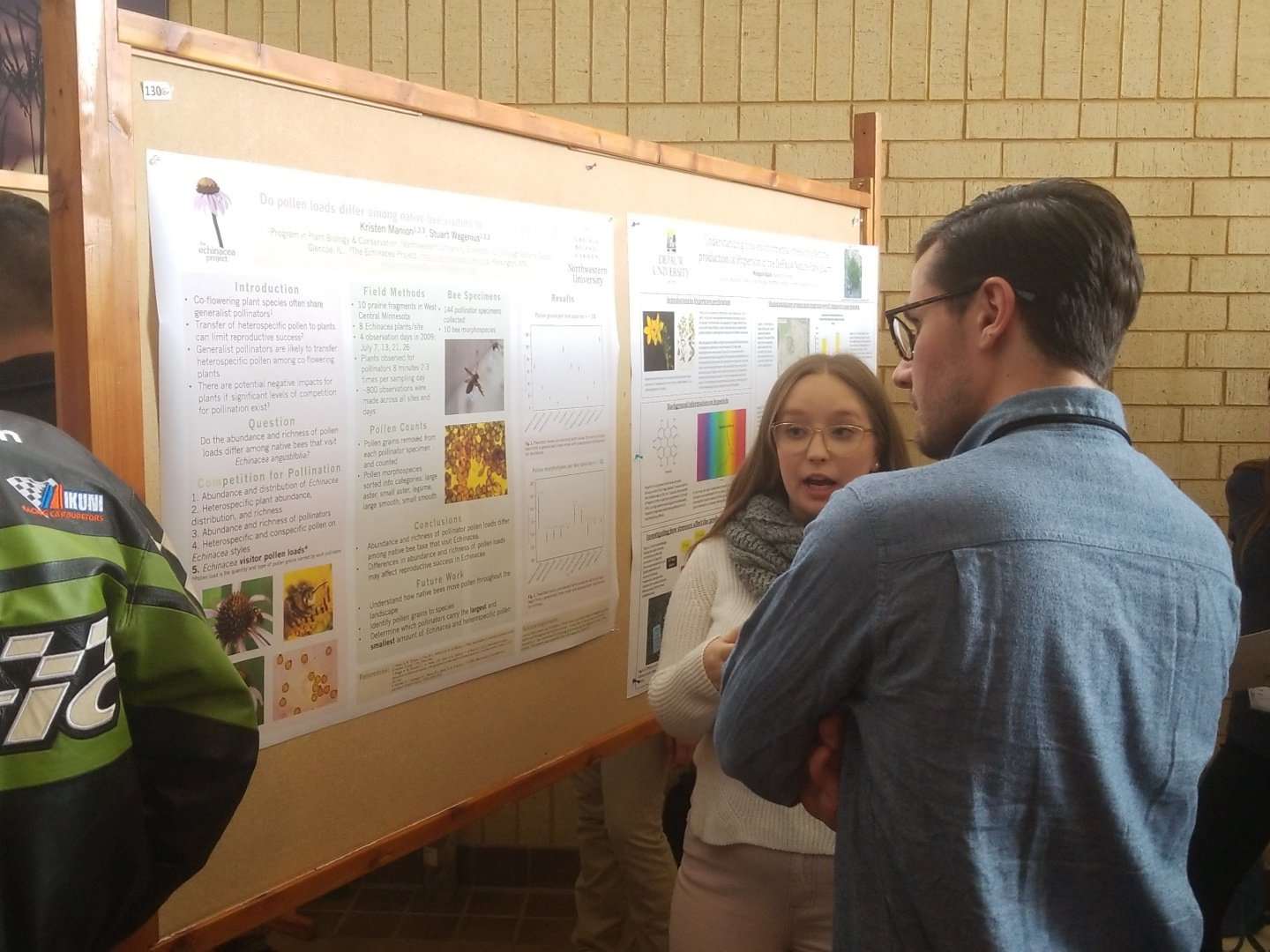
Hi everyone! Tracie, Kris (another PBC grad student), and I had a great time presenting this year at the Midwest Ecology and Evolution Conference in Kalamazoo, MI. Here’s a look at my poster that I presented about pollen on Echinacea as a part of the ongoing Floral Neighborhood Communities project:
 Do pollen loads differ among native bee visitors to Echinacea angustifolia? A picture of me presenting! MEEC 2018 was awesome! For any undergrad or graduate student interested in attending an inexpensive, regional conference I would highly recommend it. It was great to network with fellow graduate students and hear all about the great research ongoing here in the region!

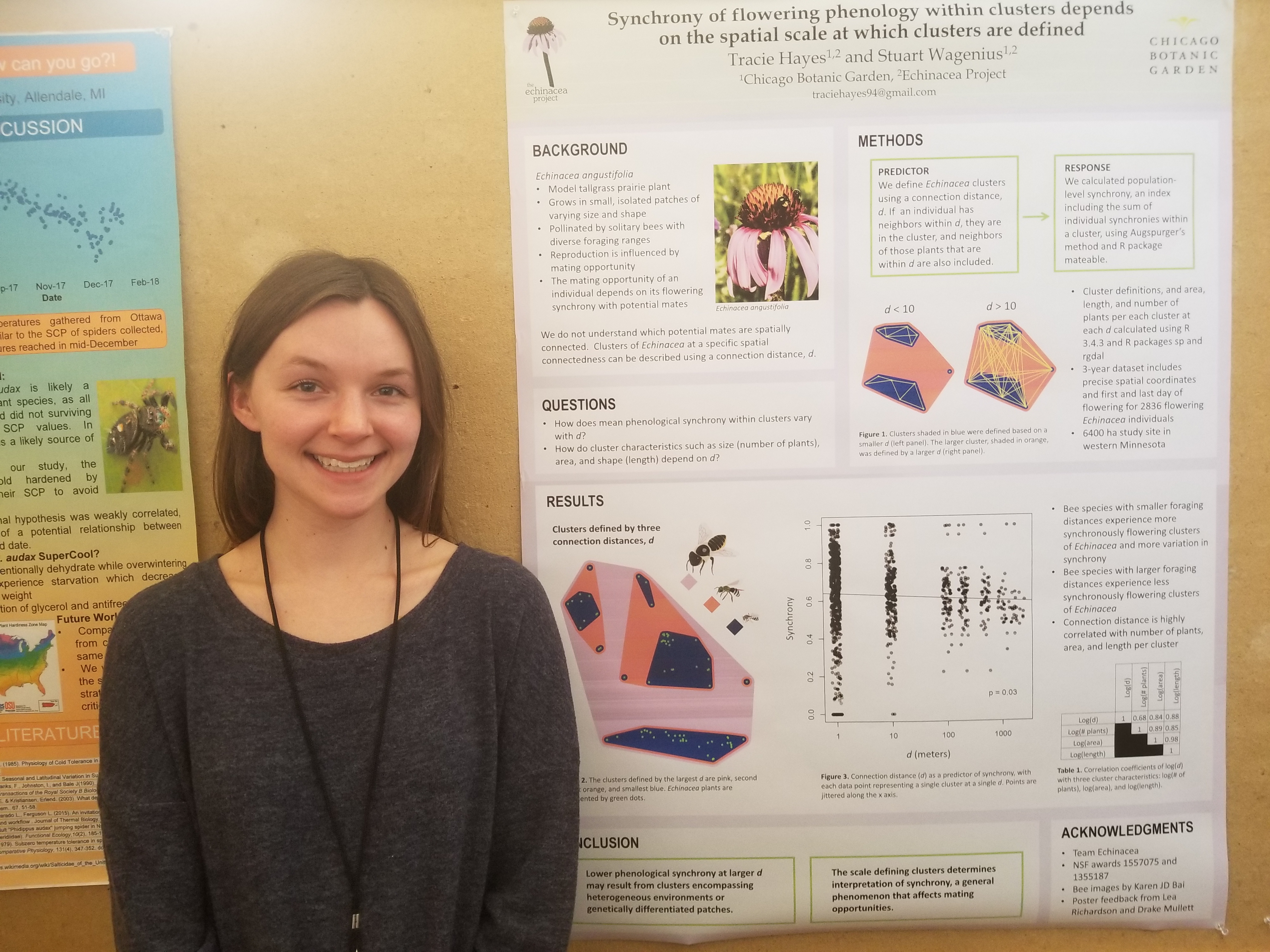
Hi flog! This past weekend I presented my cluster/spatial scale research at the Midwest Ecology and Evolution Conference at the Kellogg Biological Station. Check out my poster!
 Synchrony of flowering phenology within clusters depends on the spatial scale at which clusters are defined – Tracie’s MEEC 2018 poster Tracie with her poster at MEEC 2018
|
|