|
|
In 2014, members of Team Echinacea did an experiment to test methods of removing Hawkweed. Last year Ali assessed the results of the different methods that they used: cutting the head and painting the stem with herbicide, painting the leaves with herbicide, hand pulling with and without tools, and a control treatment. You can read her post describing the experiment and with the results from 2015 update here and the original post with methods here.
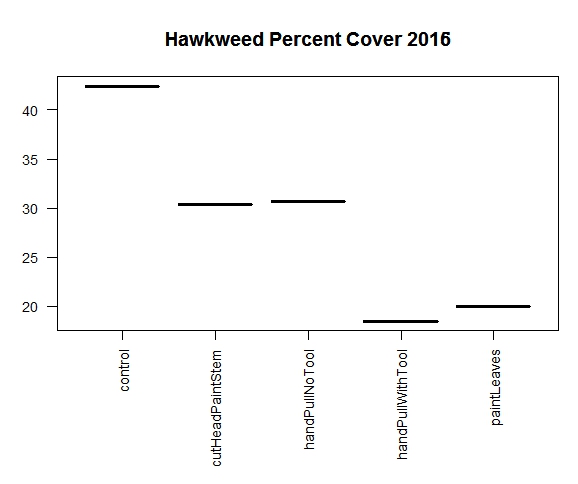
I went back to the treatment plots this morning and assessed Hawkweed percent cover two years after the treatment. The plots with the lowest percent cover this year were those where they removed hawkweed by hand, with tools. These plots also had the smallest percent change from 2015 to 2016, indicating lasting effects of removal. This was in contrast to those that had been treated by painting leaves with herbicide, where plots had an average of 4x increase in Hawkweed. From now on, we’ll use this method to remove Hawkweed in P1. We’ll assess percent cover in the treatment plots and the status of other Hawkweed plants in p1 to keep track of our progress at eradicating Hawkweed from the common garden.
Here’s the percent cover data from this year:
hawkweedData2016

The gang had a busy day today, almost all of it in the warm June sun. Alyson continued setting up her experimental plots in the Staffanson bog, and spent the afternoon measuring canopy cover and soil pH for her IS project. Meanwhile, the rest of the team (minus Gretel, who was setting up work for q2 juvenile counts) picked up our fleg begs and counted Hesperostipa spartea and weeded in p1. Amy and James found one H. spartea specimen with 137 seeds! We are now up to 17 out of 59 rows surveyed. Meanwhile, Will, Alex and Per led the crew in weeding out the non-native yellow sweet clover (Melilotus) from the periphery of the plot area. Hopefully we eliminated a lot of potential seeds form the seed bank, meaning that in future years the rows will be devoid of this weedy legume and the study Echinacea will have less competition. Stuart also showed me what poison ivy looks like for the third time, and I still don’t think I could pick it out of a lineup.
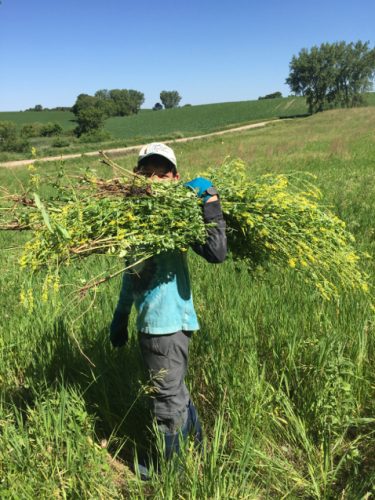
 Per with a bundle of sweet clover picked from around p1. This is probably less than 10% of what was removed today. After some brief (or for Alex, who was cleaning the bathroom, not so brief) chores at the Hjelm House, the team returned to exPt8 (experimental plot 8) to search for juvenile Echinacea crosses planted in 2013. This meant more time bent over, although now instead of looking for seedlings we were looking for melted bits of toothpick (which were placed to mark seedlings). Some seedlings were in great shape — Alex and I found a couple with basal leaves over 10 cm tall. Others were not in great shape, either dead or missing like Jimmy Hoffa. We got about a third of the work for qGen2 this afternoon. It may rain tomorrow, so we’re bracing for indoors-work and hiding our bicycles inside.
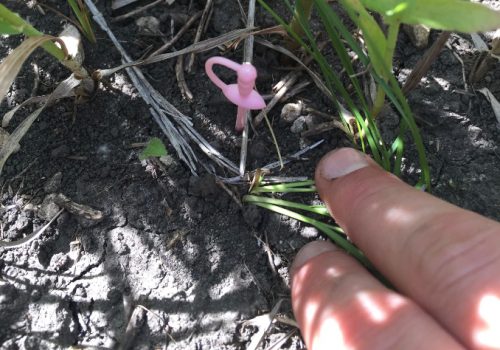
 Using a pink sword to claim the new seedling (left) for Team Echinacea. We used cocktail swords to denote seedlings germinating this year from achenes sown in 2013.
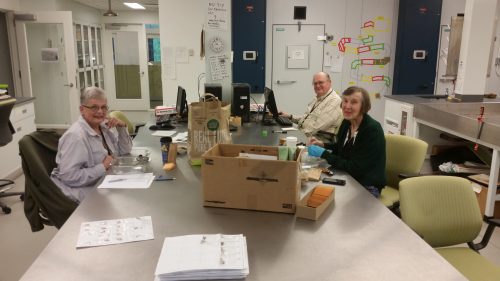
It’s been steady work back here at the Chicago Botanic Garden. The heads from exPt2 collected in 2015 have begun to be re-checked for any remaining achenes. We’re also about halfway done cleaning the heads from the 4th of 12 bags for exPt2. Overall, this is a BIG job as 1,215 heads were collected last year in this plot, an amount nearly five times the amount of heads seen in 2014. Only time will tell how this year will compare! Everyone in the lab and in the field keep up the great work!

Char, Aldo, and Susie cleaning heads from exPt2.

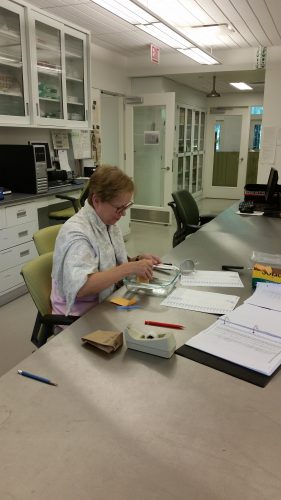
Leslie making sure the heads are cleaned of all achenes.
As the day began, we had one mission: finish searching for q3 seedlings. With Per helping out, Alyson was free to go down to the bog and begin setting up her experimental plots for removal of buckthorn. The rest of us paired off and started the work of finishing q3. Amy and I worked together. The most surprising seedling we found was 29cm west of the line.
All working in on one row of q3 Lone seedling 29 cm from the main line! After lunch, we headed down to p1 to learn how to search for Hesperostipa. This was the first time Team Echinacea 2016 worked in p1. As I worked with James the first time, we struggled to find plants in our first row. Working our way back though, we found one plant with 78 fruits.
James counts the fruits! We all spent the end of the afternoon back at q3 finding the remaining seedlings. Working in teams of three and five we wondered if we were more efficient than working in just pairs. With an odd numbered team, one person can enter data and the rest can search for seedlings. We found 644 seedlings in 849 planted segments- the winter was hard on these q3 seedlings. But the data is exciting nonetheless!
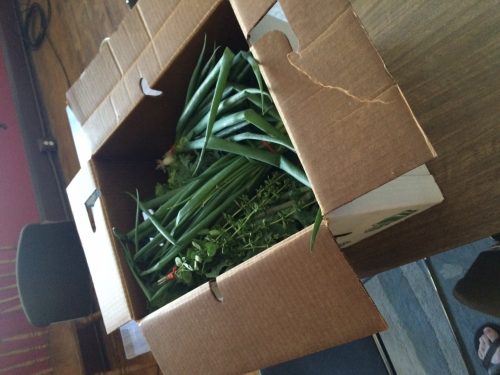
 We just finished q3! When we returned to Town Hall, Laura started making an amazing curry lentil dish while Leah, James, and I participated in Leah’s “leg day” workout routine and Amy picked up the CSA box from Morris. We now have a refrigerator full of lettuce, kohlrabi, scallions, radishes, and even two summer squash.
Opening the box
Look at all of our veggies!
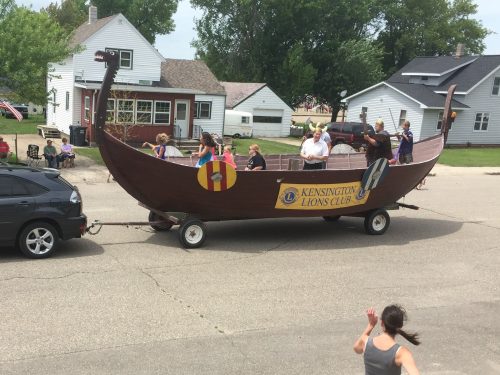
Team Echinacea embarked on another exciting day of festivities at the Kensington Rune Stone Days. In particular, we enjoyed the Rune Stone Days parade, where we gorged ourselves on free candy and watched fantastic viking ships, ATV performances, and band stand floats go by. Some members of the town hall “Flower Children” also ventured out the previous night to dance at the street dance.
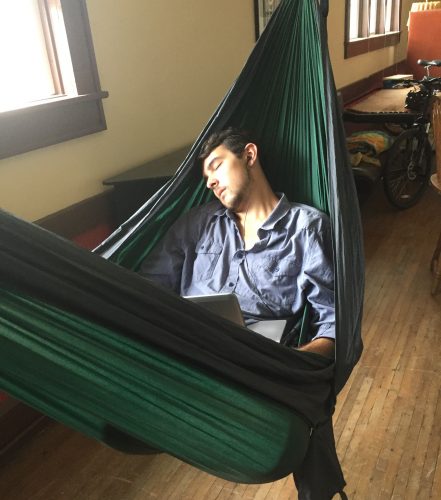
Besides dancing last night and the parade today, the “Flower Children” spent the day napping, reading, and working on their individual projects. It was a fine day for preparing for the next set of adventures this coming week!
The Kensington Lions Club Viking ship float.  Alex Hajek, asleep in his hammock in town hall
This weekend is “Runestone Days” in Kensington. Last night, we got the chance to scope out the scene and talk to a few people in town. This morning, the Lions Club of Kensington gave us way too much food at the Pancake Breakfast. It was so much fun to have time to eat, chat, and be able to learn more about each other. Then, we walked around town, checking out the garage sales. We headed back to Town Hall once it began to rain and spent the rest of the afternoon relaxing.
 Leah, Lea, Laura, Alex, James, and I experiencing the atmosphere at Runestone Days Alex shows off his new hat and honey that he bought from the garage sale
Today we returned to q3 and continued searching for Echinacea seedlings. The seedlings found in q3 from yesterday and today totaled to 432 individuals! We’ve searched 556 of the 849 meter sections. Woohoo! We probably have one more half-day of searching. This total is lower than last year which we hypothesized could be related to the rough winter.
Lea and Alex found a seedling. Woot! We only worked a half day today and headed home around noon. Kensington is getting ready for Rune Stone Days this weekend. We are looking forward to the pancake breakfast tomorrow!
Other notable events:
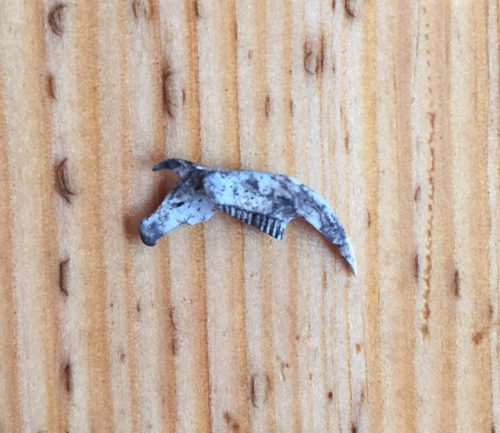
- Half of the lower jaw of a rodent was found in q3.
 Rodent remnants.
- A lively game of “Is that Thunder or a Big Truck?” was played.
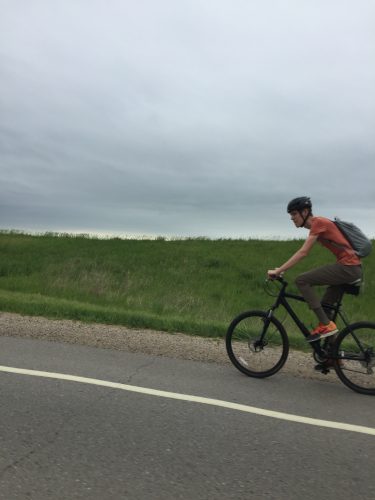
- The paparazi spotted James riding riding back to town hall after work.
 James, the lean, mean bike-riding machine
Today we began by presenting some of our independent projects to the group. Alex presented his proposal about studying the effects of neonicotinoid pesticides on native solitary bees. His study will analyze soil samples from several of our plots in addition to a behavioral study on the bees. Alex is very excited to be one of the first researchers to look at the effects of pesticides on solitary bees because so much research has been solely focused on honey bees. Alyson taught us about bogs and invasive species. There is approximately 10 acres of bog behind the farmhouse that Alyson is going to use to examine the impacts that non native buckthorn has on the bog ecosystem. She will remove buckthorn from half of her plots and compare them at the end of the season to the untouched plots. Assessing leaf litter, nitrogen levels, sunlight, and soil pH are some of the possible measures Alyson wants to use to compare the two. I presented my project which looks at how pollinator behavior towards Echinacea changes over the flowering season in a community context. I will be looking at the co-flowering densities throughout Echinacea‘s flowering period and comparing this to the pollen loads of several native bees. By collecting bees from several taxa, removing their pollen loads, and analyzing under a microscope I hope to determine what ratios of co-flowering pollen to Echinacea pollen is being carried and how this changes over time. I will also be conducting a behavioral study in which I observe what flower pollinators visit before and after visiting an Echinacea flower.
After our presentations we went out to Q3 to mark seedlings. It was a beautiful sunny day which a cool breeze, perfect for searching for Echinacea! We recorded seedling position in order to update our GPS coordinates, leaf height, and presence of cotyledons. The tallest seedlings we found were 9cm tall, one section had 8 seedlings present! We will return to Q3 tomorrow to continue our data collection and marking. This project will allow us to test Fischer’s Fundamental Theorem of Evolution in nature.
Gretel and Alyson record Echinacea seedling data in Q3 Other notable events from June 16, 2016:
- We saw a bald eagle fly over us at Q3 and a vulture almost preyed on us. While there is a fine line between speed and accuracy in data collection, the vulture realized we were all alive and moving fast enough.
- I encountered my first tick and James taught me how to sex them, it was a female and I was not bitten.
- Jennifer left for the Evolution Conference in Texas and we all wish her the best of luck!
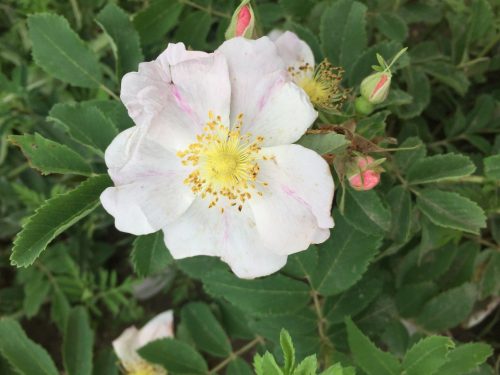
Today, we (Alex and Laura) visited the Landfill remnant prairie site and saw some pretty cool stuff. This site is unique because of its long and narrow shape along Sandy Hill road, and because of its shared border with a soy bean field and the local landfill! Luckily, the wind was not blowing toward us and all we could smell were the sweet prairie roses.
A prairie rose (and buds) spotted on the side of Sandy Hill Road. We believe that this site’s unique fragmentation makes it a good plot for The Echinacea Project. This area still has native prairie plants likely including Echinacea later in the season.
We observed three of the four main types of prairie plants. Most abundant was the non-native, cool season grass, brome. This was really the only grass we saw, and there were no warm season grasses visible. Along the road there was a profusion of prairie roses. We did not see this forb deeper into the fragment, which was interesting and puzzling because in other locations that we visited this week, prairie roses were found throughout the plots. Unlike the prairie rose, another forb, white sage was only found in the interior of the site past the ditch along the road, and was sprinkled with milkweed. Among the white sage, we found a lone false sunflower. It was likely disgruntled because, not only was it lonely, but the sun was nowhere to be found. We also spotted legumes, such as alfalfa and sweet clover, who were much less lonely and basking in the glory of their opulence.
A view of the landfill prairie fragment and its various plants along Sandy Hill Road. (landfill visible in top left corner) When we visit sites and identify plants, seasoned members of Team Echinacea can predict how this fragment got this way and why these specific plants are present. Today we tried our hand at this game. Considering that the most abundant grass was brome, we believe that this area (the soy bean field and landfill included) was used as land to feed livestock, as brome was initially imported to the New World as fodder for bovine and other grazing creatures. When the agricultural field and landfill were added to this area, the grass persisted in the undisturbed areas. Brome is a nonnative grass that could easily thrive in this area and bounce back from disturbances. Other nonnative plants include alfalfa and sweet clover, which could both thrive in this area for similar reasons. Native plants seem to be lacking at this site, which we attributed to the take over from the grass and legumes and the limited space with strange features. A few native plants, the prairie rose and white sage, were plentiful. They must have persisted through disturbances and been more capable of bouncing back and coexisting with nonnative species than other native prairie plants. We could not account for why all the prairie roses were lined up along the road, but we hypothesized that they were trying to hitch hike to Pasadena for a viewing of the Rose Bowl. Or perhaps, they are just trying to get a ride away form the landfill.
All together, a fun day of developing new skills and strengthening old ones.
Alex and Laura refusing to leave our new favorite site (and also getting splinters).
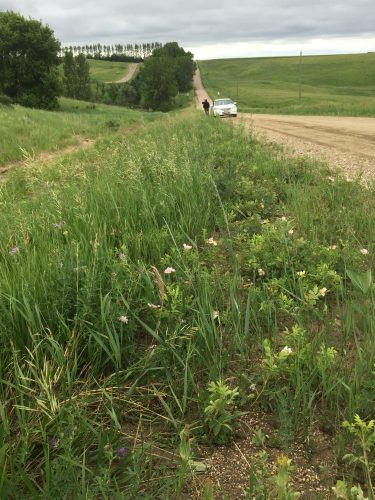
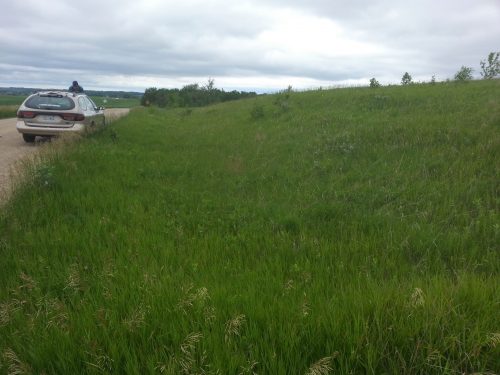
All the first year researchers were assigned a study site to visit and observe. East Elk Lake Road, located in the northwest corner of the study area, is a small reserve that has not been actively maintained. The site lies just off a gravel road and consists of plants by the roadside, with a ditch and hillock that run for around 200 meters alongside the road. A wetland surrounded by trees lies at the western edge of the study site, and the trees are encroaching on the prairie fragment. The study site is across the road from a larger prairie fragment contributing to a larger gene pool. The site south of the road had similar plant diversity suggesting more active management.
This study site was characterized by three different sets of plants. The edge of the gravel road is disturbed and the flora consists of a high abundance of brome as well as dandelion and Poa. Just beyond the disturbed road edge is a shallow ditch and sloping hillside. This area contained the highest diversity of forbs, grasses and legumes, many of which are native. Grasses included big bluestem and needle and thread grass. There were many native forbs, including Canada anemone, goldenrod and bedstraw. This was the only area in which Echinacea (a clump of four individuals) was found. We also found asparagus plants, some of which looked ready to eat! While many legumes are found in most study sites, this site had a surprising few native and nonnative legumes. Leadplant also grew along the hillside. The top of the hillock was densely covered in nonnative brome, along with some relatively dense dogbane and prairie rose, but this area showed lower diversity than the hillside. This summit also featured tree saplings, no higher than five feet tall.
The size of woody trees and shrubs in the area and the large amount of duff on the hilltop suggests the site had not been burned for many years. Plant cover on the hilltop as well as an overgrown access road (we call this an approach) to the hilltop suggested the area had been used for grazing or farm fields.
View West from approach with brome along the gravel road shown on the left
|
|