|
|
Echinacea Project 2016
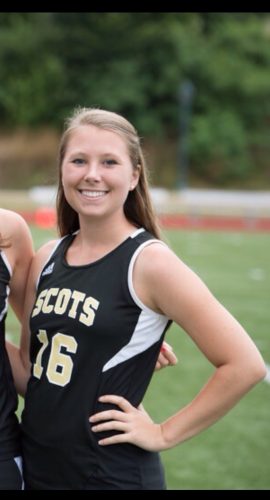
I’m a double major in biology and English and working on getting a minor in economics. I will be graduating from The College of Wooster in 2017.
Research Interests
I have always loved ecology and conservation biology. My biology Senior Independent Study at Wooster will look at pollinator constancy behavior towards Echinacea by observing pollinator visits and the species composition of pollen loads.
Statement
I’m from Rochester, New York. I love sports, play field hockey at Wooster, and am also a huge Syracuse basketball fan. In my free time I like to run so I am super excited about the beautiful hills in Minnesota, but will miss my dog, Chloe, who is my running buddy.

Echinacea Project 2016
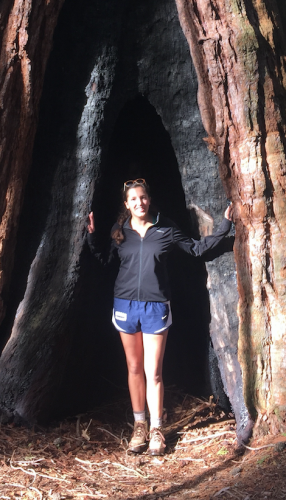
I will graduate from the College of Wooster in 2018 as a biochemistry and molecular biology major and environmental studies minor.
Research Interests
I am interested in studying echinacea and its different pollinators. Previous research I have done involved extracting and analyzing the DNA from pollen samples from honey bees around Ohio for protein and nutritional content.
Statement
I am from Akron, Ohio. In my free time I like to run, read, and walk in the good ole’ outdoors AKA hiking/frolicking/romping. I also hope to develop some banjo skills in Minnesota this summer.

My name is Chris Woolridge and I’m very excited to begin as a Seasonal Researcher with the Echinacea Project this summer! I’ll be helping Danny and the citizen scientists in the lab while the rest of the team is in Minnesota conducting field work. I’m currently a graduate student in the Plant Biology and Conservation Program at the Chicago Botanic Garden and Northwestern University. My research is focused on better informing seed sourcing for restorations. Some researchers and managers have proposed sourcing seed from more southern latitudes to foster populations that are pre-adapted to climate change. In order to test this strategy’s feasibility, I’m conducting a common garden experiment in Grayslake, IL, investigating relative fitness of plants sourced across a latitudinal gradient in five savanna/prairie species used in restorations. With that being said, I’m very interested in the questions the Echinacea Project is asking and I’m thrilled to be joining the team!

We were curious about the average sizes of our various remnant populations so I did some quick calculations and created this csv. As you can see, landfill is quite large with a median of 315 individuals found per year, whereas sites like dog and mapp are tiny, with only 3 plants found per year. At dog, to the best of our knowledge, there are only 3 Echinacea to be found, so we have regularly gathered demographic info on all of them. It’s important to note that these numbers are preliminary, rough estimates. Sometimes we have to redo a site during the summer so there will be twice as many records (hence the right skewed means), most of the time we focus on only finding flowering plants, but in some years at certain sites (e.g. landfill in 2005 and 2007) we’ve attempted to find every single individual whether or not it was flowering. All that said, here are some histograms showing numbers of demography records at each site per year:
demoSizeGraphs
Read Rachael’s final paper, in which she investigates the extent to which flowering schedules differ between plants with only one head and plants with multiple heads.
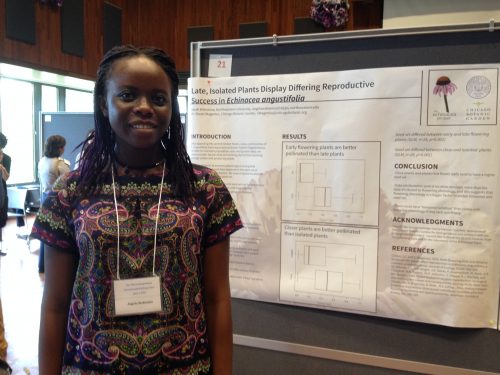
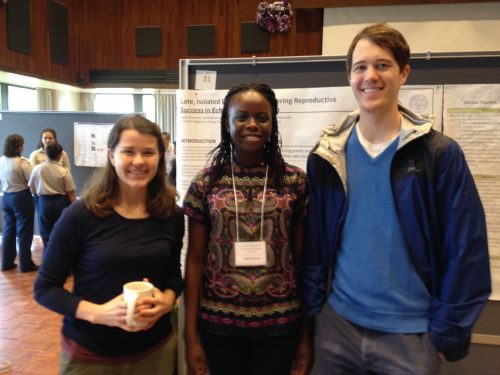
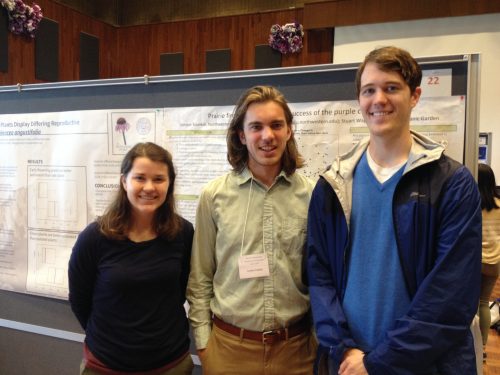
Sarah presented her poster, “Late, Isolated Plants Display Differing Reproductive Success in Echinacea angustifolia” at the Northwestern Undergraduate Research and Arts Exposition. Here are some pictures from the event and her poster, which you can find here.

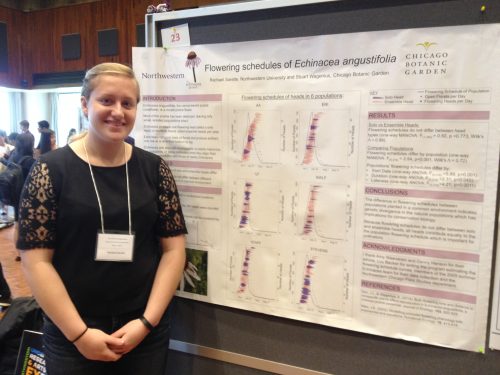
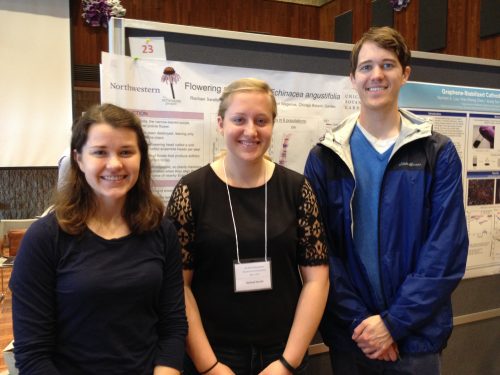
Rachael presented her poster, “Flowering schedules of Echinacea angustifolia” at the Northwestern Undergraduate Research and Arts Exposition. Here are some pictures from the event and her poster, which you can find here.
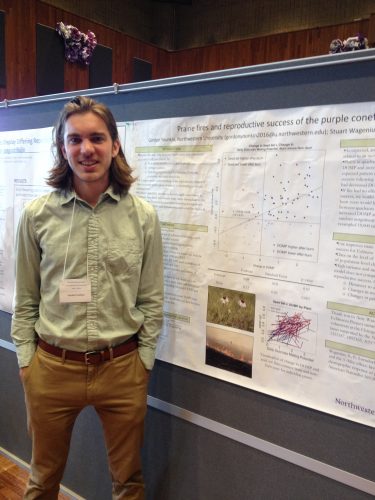
Gordon presented his poster, “Prairie fires and reproductive success of the purple coneflower” at the Northwestern Undergraduate Research and Arts Exposition. Here are some pictures from the event and his poster, which you can find here.

We had a great turnout for our annual lab potluck yesterday. Good times were had by all as we heard updates about what the lab accomplished this past year. Here are some highlights:
- This year, Bob and Aldo counted their 250,000th achenes. Anne counted her 400,000th, and Bill counted his 500,000th. Just yesterday morning, Lois, our reigning “achene queen,” counted her 700,000th!
- We finished doing all the hands-on work for 2014 and have already made great progress on cleaning and randomizing heads from the 2015 harvest.
- Stuart summarized progress and preliminary analyses of the qGen_a experiment, which tests for the heritability of fitness traits in Echinacea.
- The lab interns, Rachael, Gordon, Danny, and I, talked about our independent projects, all of which push the frontiers of science!
- We talked about plans for this summer. While Stuart, Gretel, and I head back to Minnesota, Danny and our citizen scientists will be busy in the lab cleaning last year’s (huge) harvest from Experimental Plot 2 and counting experiments from 2015. They’ll be joined by Chris, a MS student at Northwestern who will help get our (many) achenes organized for storage in the seed bank.
- There were too many tasty dishes to name all of the ones I enjoyed here. However, as a sampling, there was homemade spinach dip, mashed sweet potatoes, several broccoli dishes, iced tea, and a rhubarb crisp, which we polished off.
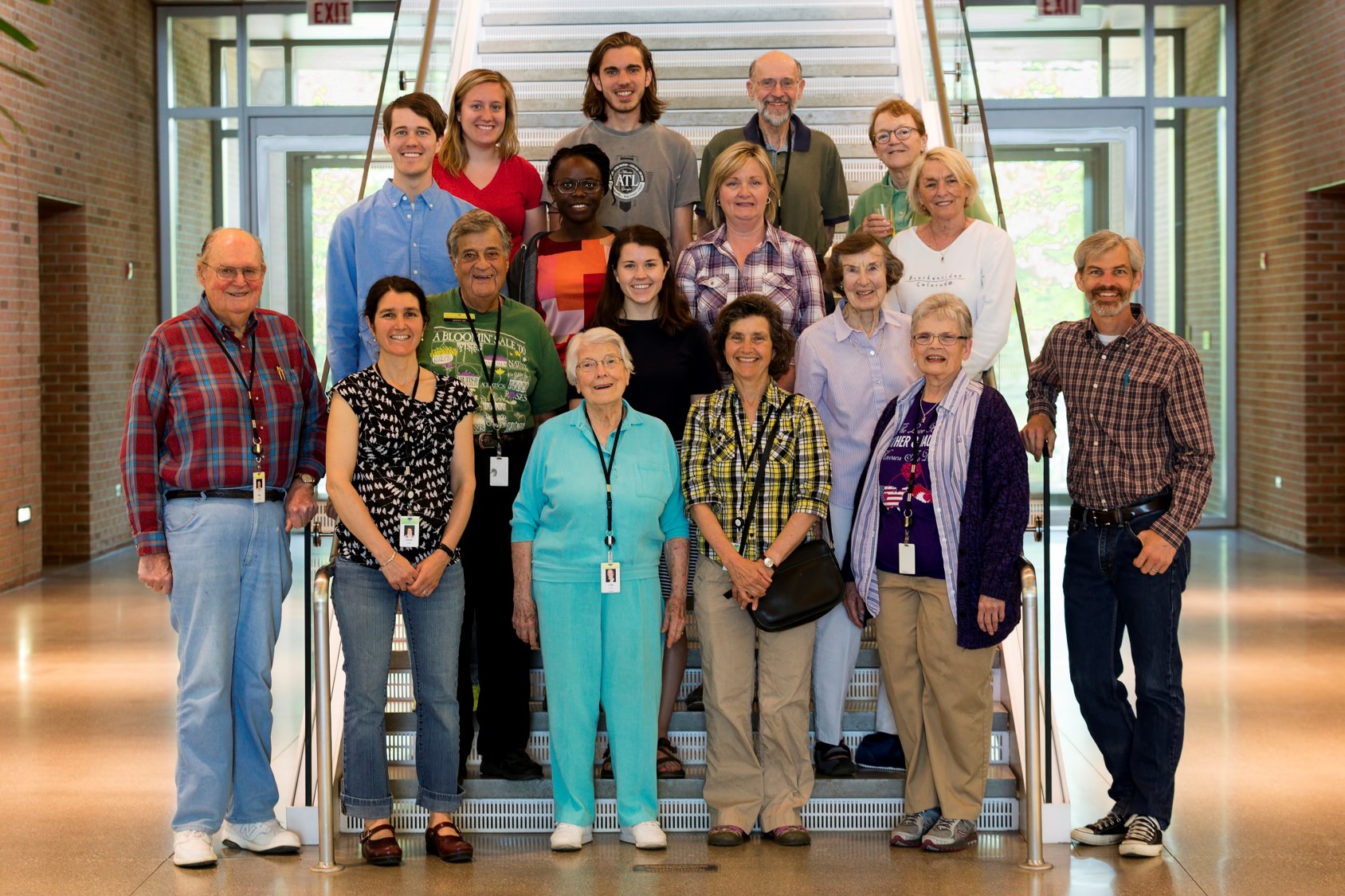
We took a group photo:
 First row (L to R): Aldo, Gretel, Lois, Shelley, Char, Stuart; Second row: Art, Amy, Susie; Third row: Danny, Sarah, Kathryn, Susan; Fourth row: Rachael, Gordon, Bill, Suzanne; Not pictured: Anne, Bob, Laura, Leslie, Marty, Sam, and interns Mackenzie, Keke, and Nina Thanks for coming, those of you who could make it, and for a great year!
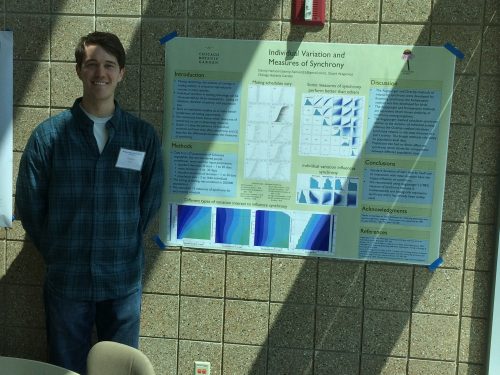
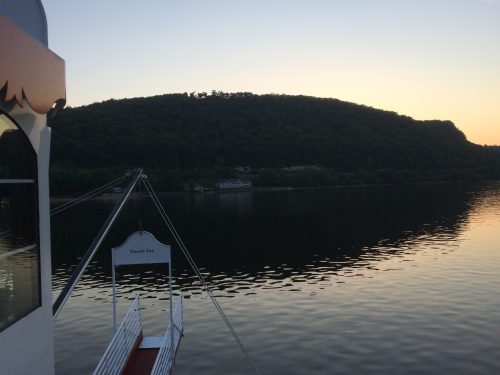
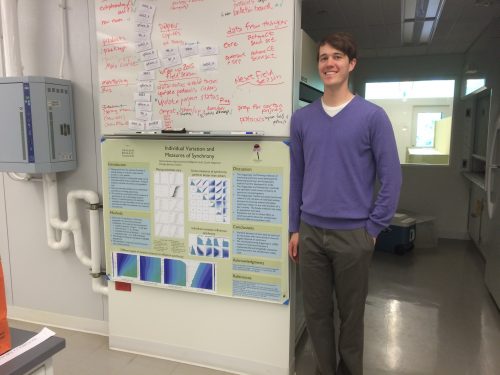
This past weekend, I attended the second, biannual Midwest Mathematical Biology Conference (MMBC) hosted at the University of Wisconsin La Crosse. There were a lot of great talks throughout the weekend including plenary speakers Dr. Louis Gross, Dr. Carina Curto, and Dr. Mark Craven. I learned a lot about mathematical biology, including a multitude of uses for differential equations and some great techniques in evolutionary computing. At the end of Saturday, there was a poster session that included 6 posters. After the poster session, most of the people at the conference went on a wonderful Mississippi River paddlewheel river boat replica and ate pizza.
The next day we had more great talks, then a long drive back to Chicago. You can find my poster in its new home in the lab, or you can see it here.
Standing with my poster in the atrium at UW Lacrosse A beautiful view of the Mississippi River at sunset My poster in its new lab location.
|
|