|
||||
|
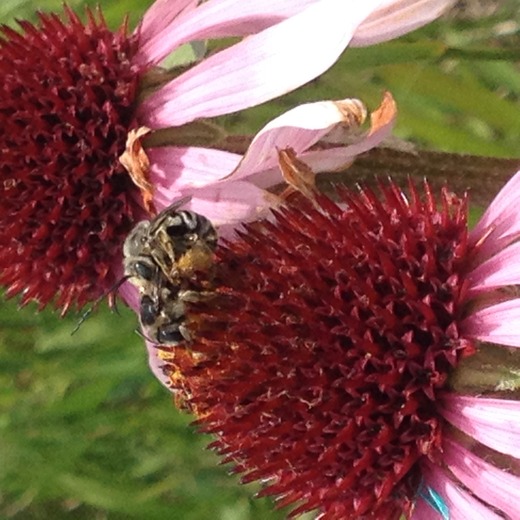
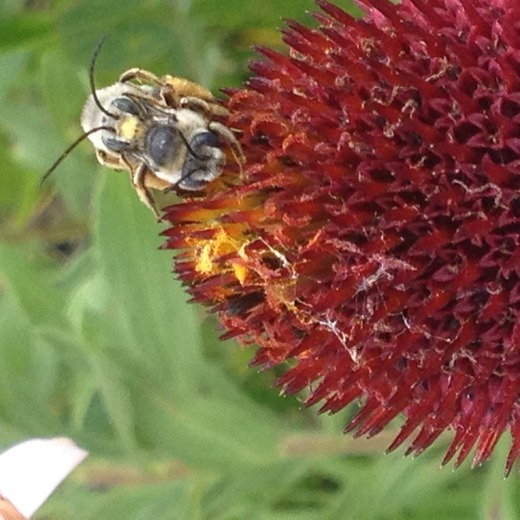
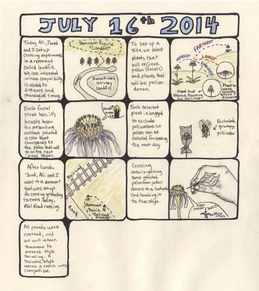
With Echinacea’s flowering reaching its peak, there isn’t a better idiom to describe the team’s work schedule for the week. Remnant phenology, independent projects, and a large scale compatibility project are just a few of the tasks being carried out on a regular basis. As for the pollinator project Maureen and I have been working on, things are going great. After alternating back and forth between P1 and P2, we have accumulated over 60 observations, which is a little over half of what we are aiming for. Towards the beginning, we saw mostly small green bees, but recently we have started seeing more and more of the larger bees, such as Melisodes and Andrena. For example, we added 7 more Andrena observations just today, which more than tripled the Andrena observations we had up to this point. Things may be a little hectic at Team Echinacea headquarters, but this doesn’t mean we are all work and no play. Just tonight we enjoyed a post work bonfire with s’mores, badminton, and croquet. You might even say it was the…… bee’s knees! And just in case this post didn’t contain enough corny pollinator references, here’s a couple of pictures of a pair of Melisodes teaching us a lesson about the Birds and the Bees.
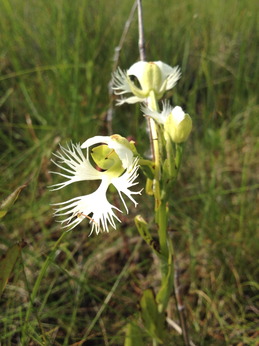
Today marked the first weekday of the peak week of flowering for Echinacea. We are working on phenology at all the remnants as will as P1. Several flowers are already on their last day of flowering. Despite the cold and blustery conditions of today the team did crosses for the compatibility project at Loeffler’s Corner and set up the project at East Elk Lake Road. Cam and I worked on my exhaustive crossing project at Yellow Orchid Hill. We weren’t able to collect pollen and cross until after lunch, but fortunately the pollen was not blown away by the wind! Tomorrow will be more phenology and compatibility! Today was a big day for remnant phenology surveys–possibly our biggest of the season. We made the process more efficient by not recording style persistence on flowers on their 3rd, 6th, 7th, and 8th days of flowering. But we didn’t stop there. We also collected pollen, painted bracts, and performed the first crosses with the 10 focal plants at Riley. Each focal plant was crossed with its nearest neighbor, its farthest neighbor within the remnant, the earliest flowering plant, and the latest flowering plant. This is to help us understand how compatibility varies across space and flowering time. In other news, Will and I saw an immature bald eagle amongst the gulls and turkey vultures at the landfill. Today Team Echinacea 2014 completed our fourth week of work. All in all it was an eventful week complete with phenological observations and an orchid adventure but fireworks still awaited us… While the team has grown accustomed to watching sparks fly in the field (between compatible Echinacea plants of course), we were not entirely prepared for the sparks that surged forth during dinner this evening. Content with our fine meal, Team Echinacea was reveling in stimulating conversation as our refrigerator (Sparky) began to hiss, pop, and buzz before bursting into flames (only a slight embellishment of actual events). Though the electrical fire and accompanying pyrotechnic display was short-lived and the damage negligible, the smell of melting rubber lingers on. RIP Sparky, we will miss your cold touch. Today, Team Echinacea left the comfort of Kensington for a very exciting day at a Nature Conservancy Preserve near Fertile, Minnesota. We helped Gretel survey two plots of Western Prairie Fringed Orchid, a federally threatened species. Gretel is monitoring these plants to examine the effects of different land management practices. Here is a picture of the study species:
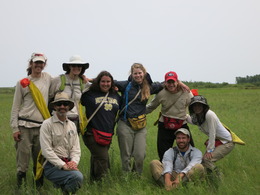
The team powered through both plots with plenty of time left over for a trip to LaLa’s for delicious homemade ice cream. Following ice cream, we spent some time at Agassiz Sand Hills to check out some unique prairie plants (as well as some very beautiful poison ivy). Here is a picture of the team post-completion of the second plot:
Thank you Gretel and The Nature Conservancy for dinner, ice cream, and an adventurous day! Here is the latest draft of my proposal to investigate the survival rates of Aphis echinaceae on Echinacea hybrids and the impact they have on host fitness: I’m excited to get started. In addition to my main project, I will be conducting and coordinating a variety of side projects related to aphids and Echinacea hybrids: 1. Katherine Muller and Lydia English’s aphid addition/exclusion experiment in P1. Today Jared, Will and I spent the afternoon at Staffanson Prairie Preserve wrangling the blooming Echincea with flags and twist ties while also updating our flowering map of 2014. We’re working to find plants that were used in phenology studies in previous years so we can look at how a single plant’s flowering pattern changes over time. Here’s a map of the plants we’ve found so far this year, overlaid on multiple years of previously mapped plants. While out and about in Staffanson it’s easy to get drawn into the morphing landscape as new species begin to bloom. Here’s a picture of one of our favorites, Delphinium carolinianum.
Today the whole team was busy mapping and monitoring the phenology of Echinacea at numerous remnants. Although mosquitoes, gopher holes, and construction crews conspired against us, we were able to complete all monitoring before a bout of afternoon rain. Here is a quick and dirty map of flowering Echinacea plants at Staffanson prairie that were mapped between 2011 and 2013. Please note that west, rather than north, is “up” on this map (the unusual orientation of this map is just for my convenience)… For Keaton and I, Sunday began with a refreshing early morning bike ride to the Hjelm House for a run-through of the protocol for our pollinator efficiency experiment. The weather was lovely and we observed agapostemon, augochlorella, and a halictus bee pollinating E. angustifolia! Here is a picture of one of the heads we bagged to exclude pollinators:
After biking back to town hall, the usual Sunday activities followed: napping, reading, laundry, and cooking Spinach Mushroom Quiche for the team. I was very sneaky and added some of the Kefir that both Claire and I have been cultivating as a replacement for Buttermilk. This is what the Kefir grains look like:
|
||||
|
© 2026 The Echinacea Project - All Rights Reserved - Log in Powered by WordPress & Atahualpa |
||||