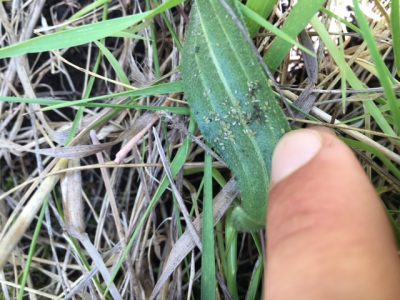
Small remnant Echinacea populations may suffer from inbreeding depression. To assess whether gene flow (in the form of pollen) from another population could “rescue” these populations from inbreeding depression, we hand-pollinated Echinacea from six different prairie remnants with pollen from a large prairie remnant (Staffanson Prairie) and from a relatively small population (Northwest Landfill) in 2008. We also performed within-population crosses as a control. Amy Dykstra (with help from Caroline Ridley) planted the achenes (seeds) that resulted from these crosses in an experimental plot at Hegg Lake WMA.
We sowed a total of 15,491 achenes in 2008. 449 of these achenes germinated and emerged as seedlings. Each summer, we census the surviving plants and measure them.
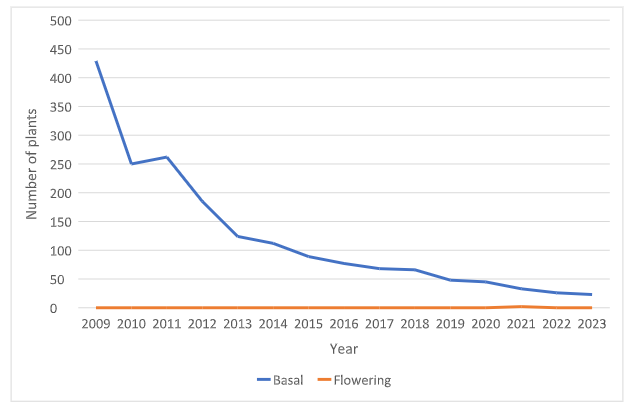
In the 2023 census, Amy found 23 surviving basal plants and no flowering plants. She had observed 26 basal plants in 2022. Mortality was high during the first four years, but has been lower as the surviving plants have increased in age.
Number of plants observed in annual censuses 2008-2023
Data collected: Plant fitness measurements (plant status, number of rosettes, number of leaves, and length of longest leaf), and notes about herbivory. Contact Amy Dykstra to access this data.
Samples or specimens collected: NA
Products: Dykstra, A. B. 2013. Seedling recruitment in fragmented populations of Echinacea angustifolia. Ph.D. Dissertation. University of Minnesota. PDF
You can read more about Dykstra’s interpopulation crosses, as well as links to prior flog entries mentioning the experiment, on the background page for this experiment.
Reproduction in plants can be limited by access to pollen and resources. We previously found that Echinacea plants in the remnants are pollen limited, meaning that if they had access to more pollen, they would produce more seeds. However, the long-term effects of pollen limitation are unknown. Do plants that are super pollen saturated and have high amounts of pollen have a higher lifetime fitness than plants that are pollen limited? Also, we know that the plants in the remnants are pollen limited, but are the plants in the common garden environment also pollen limited? To answer these questions and more, 13 years ago Gretel randomly selected 39 plants from p1; half of these plants were randomly assigned to the pollen addition group, and the others were assigned to pollen exclusion. Every year, plants in the pollen exclusion have their heads bagged and they are not pollinated, while we hand cross every style in the pollen addition group.
In the summer of 2023, six of the original 39 plants were flowering, three from the addition treatment and three from the exclusion treatment. The exclusion treatment plants were covered with exclusion bags to prevent pollination, and the addition plants were hand-pollinated three times throughout the summer.
Start year: 2012
Location: exPt01
Physical specimens: 6 heads harvested from group receiving treatments, and an additional 18 heads harvested from plants in an open, control treatment. Heads are at the Chicago Botanic Garden awaiting processing
Data collected: Plant survival and measurements were recorded as part of our annual surveys in P1 and eventually will be found in the echinaceaLab R package. Data sheets were scanned and entered and can be found here: “~/Dropbox/CGData/115_pollenLimitation/pollenLimitation2023”
You can find more information about the pollen addition and exclusion experiment and links to previous flog posts regarding this experiment at the background page for the experiment.
In 2023, the team continued the seedling recruitment experiment begun in 2007. The original goal of the project was to determine seedling establishment and growth rates in remnant populations of Echinacea angustifolia. Seedling recruitment rates are rarely studied in the field, and this is one of the few studies tracking recruitment in the tallgrass prairie. From 2007 to 2013 in spring, Team Echinacea visited plants which had flowered in the preceding year, and they searched near these maternal plants to find any emerging seedlings. Each fall since then, the team has searched for the seedlings, then juveniles, and measured them.
This year, we visited 51 focal maternal plants at 10 prairie remnants and searched for 86 sling plants, a subset of the original 955 seedlings. We completed sling in two days: September 15th and September 18th. Like last year, team members used the demo form to collect data on the visors, and we also shot any seedlings we could find that didn’t already have a GPS point. In total, the team found 47 basal plants and 5 flowering plants!
Start year: 2007
Location: Remnants in Douglas County, MN
Sites with seedling searches in 2022: East Elk Lake Road, East Riley, KJ’s, Loeffler’s Corner, Landfill, Nessman, Riley, Steven’s Approach, South of Golf Course, Staffanson Prairie
The data were collected on a visor using the demo form. The team recorded plant status (can’t find, basal, dead this year’s leaves, dead last year’s leaves, flowering), number of rosettes, leaf count, nearest neighbors, and head count, if flowering.
Scanned datasheets are in Dropbox: ~Dropbox\remData\115_trackSeedlings\slingRefinds2023
Physical copies of datasheets and maps can be found in the “Search For Sling 2023” black binder located currently in Hjelm on the back desk.
Samples collected: NA
Team members who searched for slings in 2022: Abby Widell, Ellysa Johnson, Jan Anderson, Lindsey Paulson.
Products:
Amy Dykstra used seedling survival data from 2010 and 2011 to model population growth rates as a part of her dissertation.
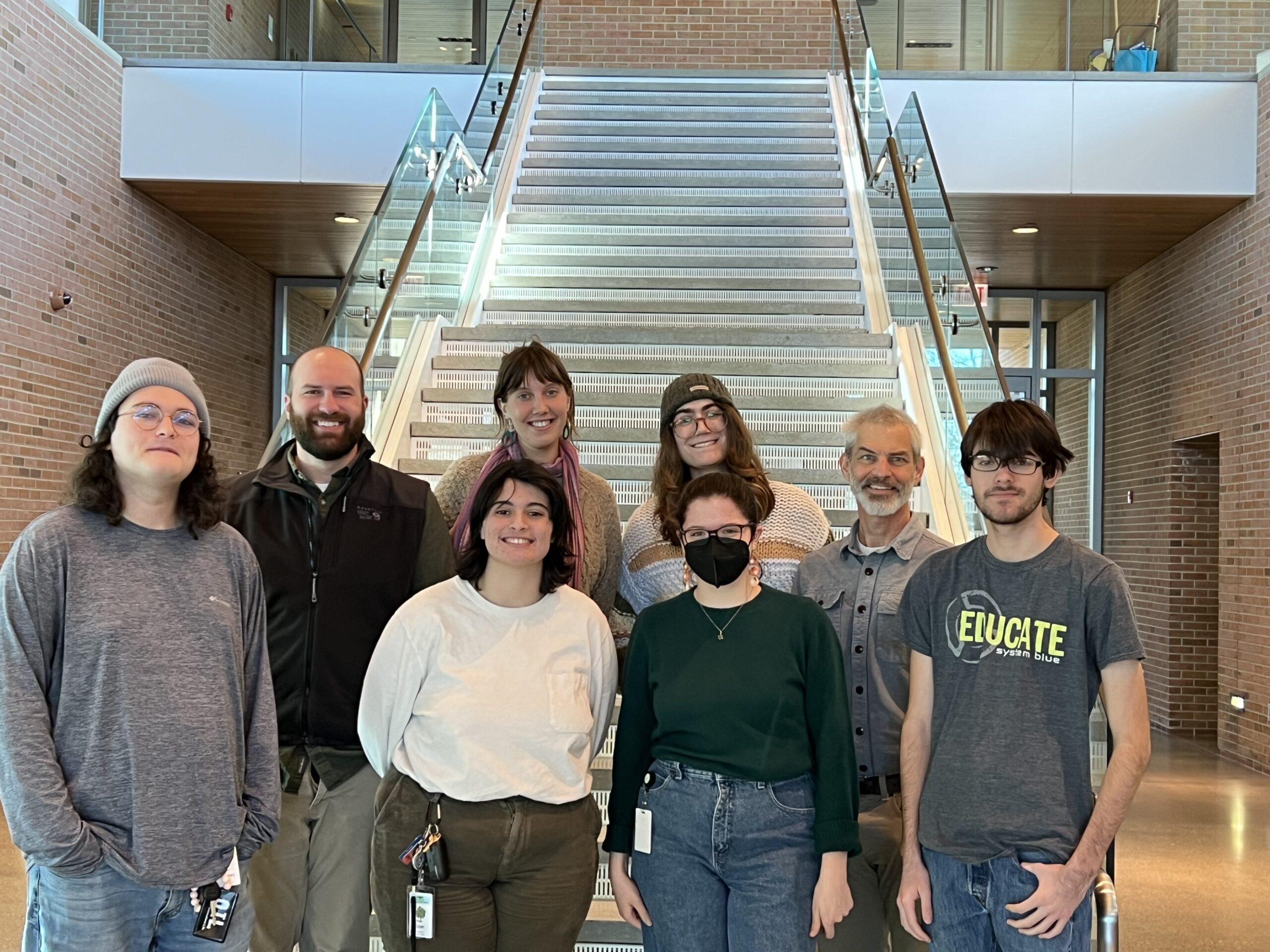
You might think three weeks is too short a time to conduct research, but our 2023 Carleton College externs can prove you wrong! We just said goodbye to 4 undergraduate students who spent their winter break in our lab at Chicago Botanic Garden. During this time, they processed data, explored statistics, dove into the world of R, and learned more about the research objectives of the Echinacea Project. All of this contributed to their investigations into research questions of their own. The externs were also able to explore Chicago and the gardens, and connect with other scientists.
Rebecca and Vo worked with Jared to investigate effects of fire on reproduction in Andropogon gerardii. They developed methods for quantifying seed set in Andropogon, and put them into practice during the externship! Learn more about them and their research here and here!
Io worked with Abby and Wyatt to investigate vegetative and reproductive patterns in Echinacea Angustifolia. She was specifically interested in understanding how traits like basal leaf count and longest basal leaf length over time may influence reproductive effort. Read more about her project here.
Conlan worked with Abby and Wyatt to investigate structural reproductive traits and their relationship with pollination success. He wondered if taller head heights and larger head numbers led to higher pollination rates. Read more about what he found here!
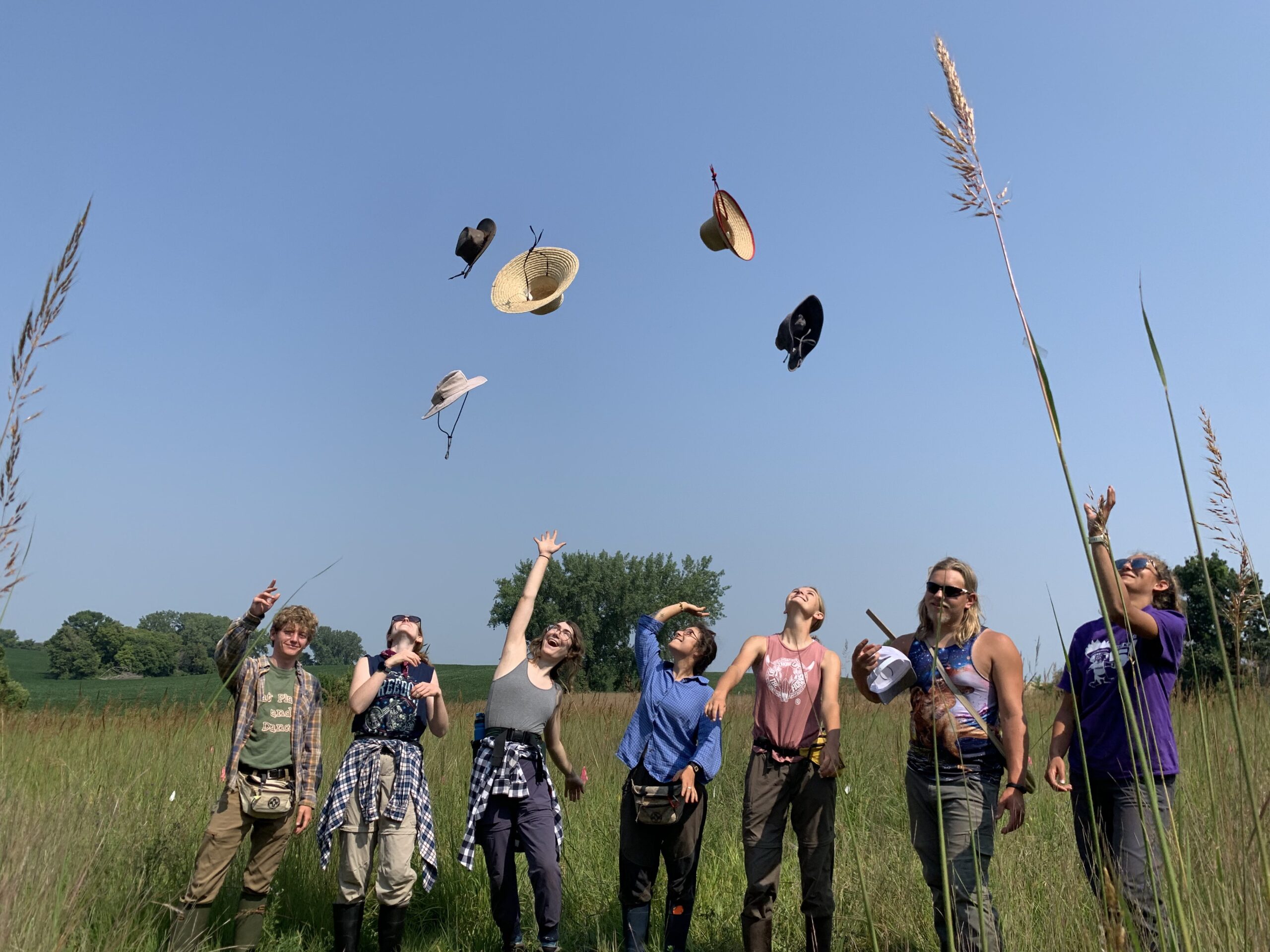
There was some disagreement as to whether we were saying, “Echinacea” or “Andropogon” in our group picture this year. No matter- the photo still turned out nicely!
It was a pleasure to work with these 4 externs this year! We wish them the best!
During the summer of 2023, Team Echinacea embarked on an ENRTF funded mission to better understand how prescribed fires influences solitary bee nesting habitat, food resources, and diversity is critical for providing recommendations about how prescribed fire should be used to promote pollinator conservation and healthy prairie.
We surveyed solitary bee diversity and nesting habitat before and after prescribed fires in a subset of 30 prairie remnants and 15 prairie restorations to determine how prescribed fire affects solitary bee nesting habitat and abundance. We used emergence traps to investigate composition of solitary bees in prairies. This was complemented by detailed measures of soil and litter to characterize how prescribed burning influences the nesting habitat (read more here).
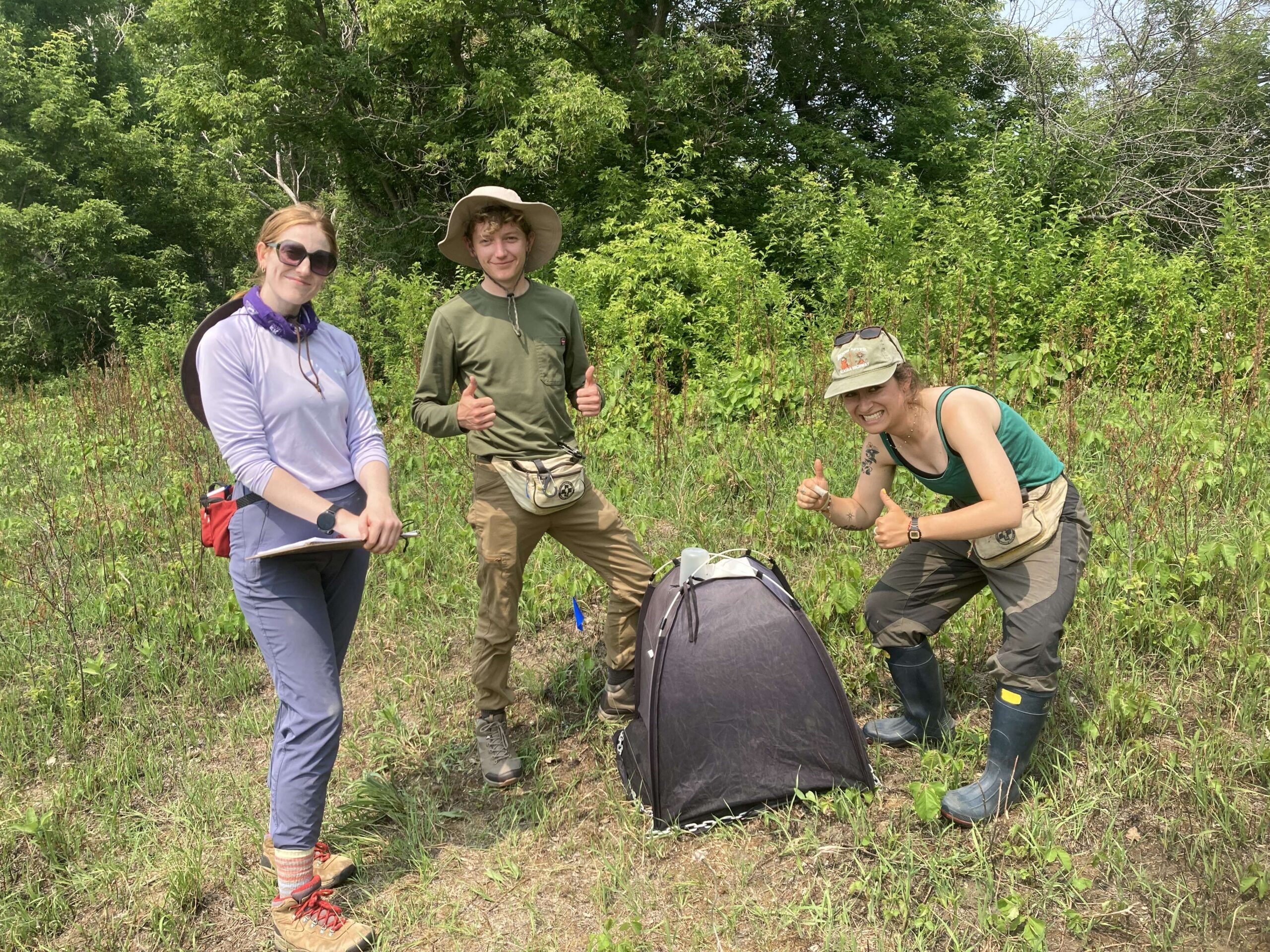
We deployed emergence traps at our random points (bb points) in prairie remnants and restorations in mid-June – early September. Our deployment spanned three rotations of bb points and we put out a total of ~1,238 emergence traps.
El, Luke, and Jan, 2023 pollinator crew, deploy an emergence trap at a bb point.
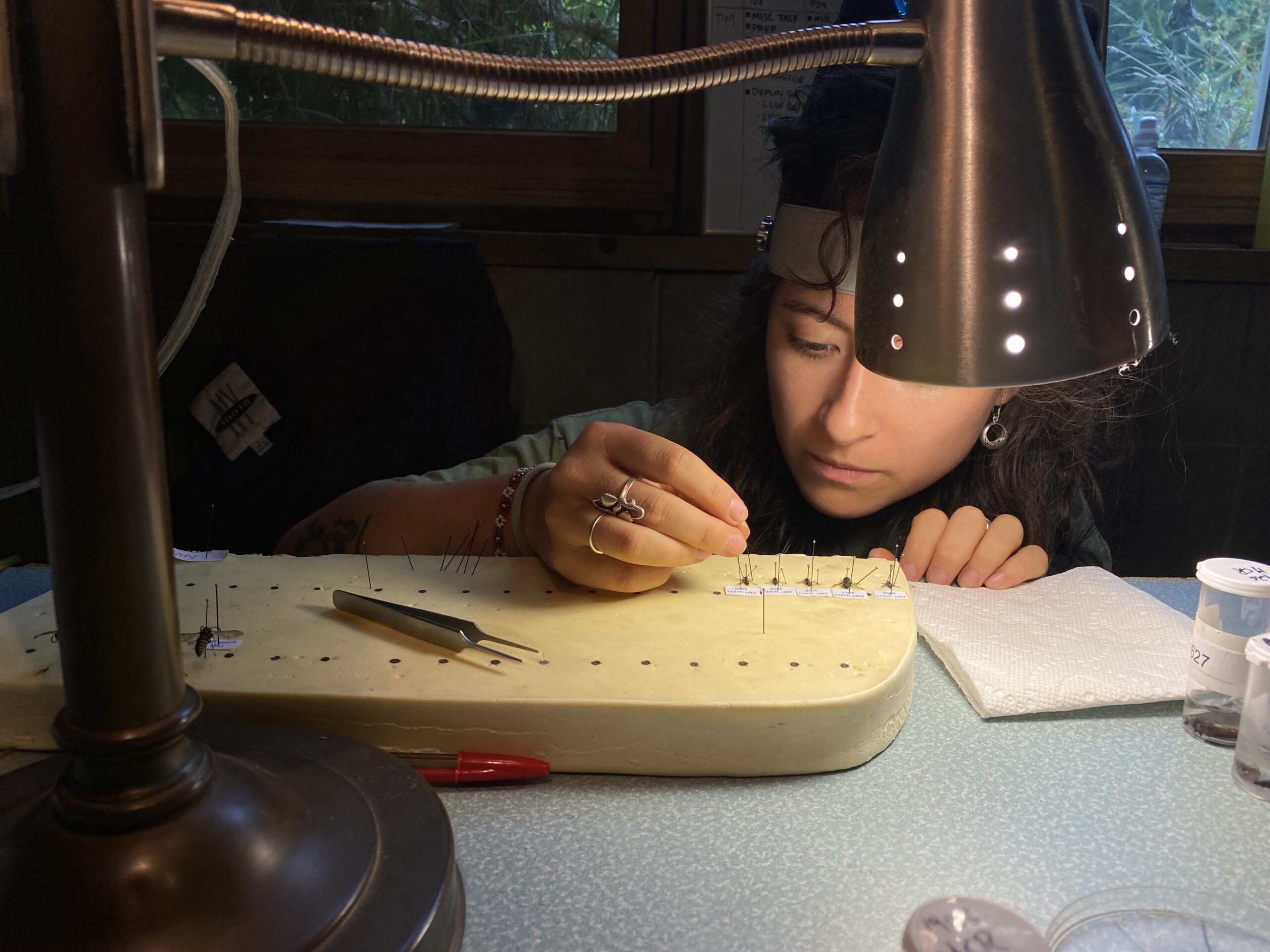
As of September 28, members of Team Echinacea had processed 850 vials, 122 of which contained bees. Our preliminary catch rate is 14%! These specimens were pinned and are currently at Chicago Botanic Garden, awaiting transportation to University of Minnesota where Zach Portman, a bee taxonomist, will identify them. Team Echinacea also collected lots of non-bee bycatch while processing specimens collected in the traps. Bycatch is currently stored in our freezer at Chicago Botanic Garden.
Jan pins a bee that they found while processing vials from emergence trapping!
Ian Roberts, a M.S. student with the Echinacea Project, has taken charge of the Emergence trapping project and is currently coordinating data entry. When emergence trapping resumes in the 2024 field season, we will be well set up, thanks to detailed written and videotaped protocols made by our summer 2023 pollinator team. The prtocol can be found here: “~/Dropbox/enrtf/emergenceTrapping2023/Emergence Trap Protocol.pdf”. Video instructions are located in “~/Dropbox/enrtf/emergenceTrapping2023/exampleVideos”.
Start year: 2023
Location: prairie remnants and restorations in Solem Township, MN.
For the ENRTF-funded research project investigating fire effects on ground-nesting bees, plant-pollinator interactions, and other insects within fragmented prairies, Team Echinacea sampled 45 total prairie sites (30 remnants and 15 restorations).
To obtain robust inferences, it is important to sample randomly so that our sampling effort is not biased by what we perceive to be “good” or “bad” habitat, even subconsciously. To this end, we sampled at random locations within each site. At each site, we established between 30 and 72 sampling locations with unique identifiers (four-digit bbpts, for “burning and bees sampling points”). Early in the summer, before sampling at these points began, we ground truthed the points to ensure we were not choosing in places where we could not sample at all (e.g., think a big rock, a water body, a big patch of poison ivy, a gravel road, etc.).
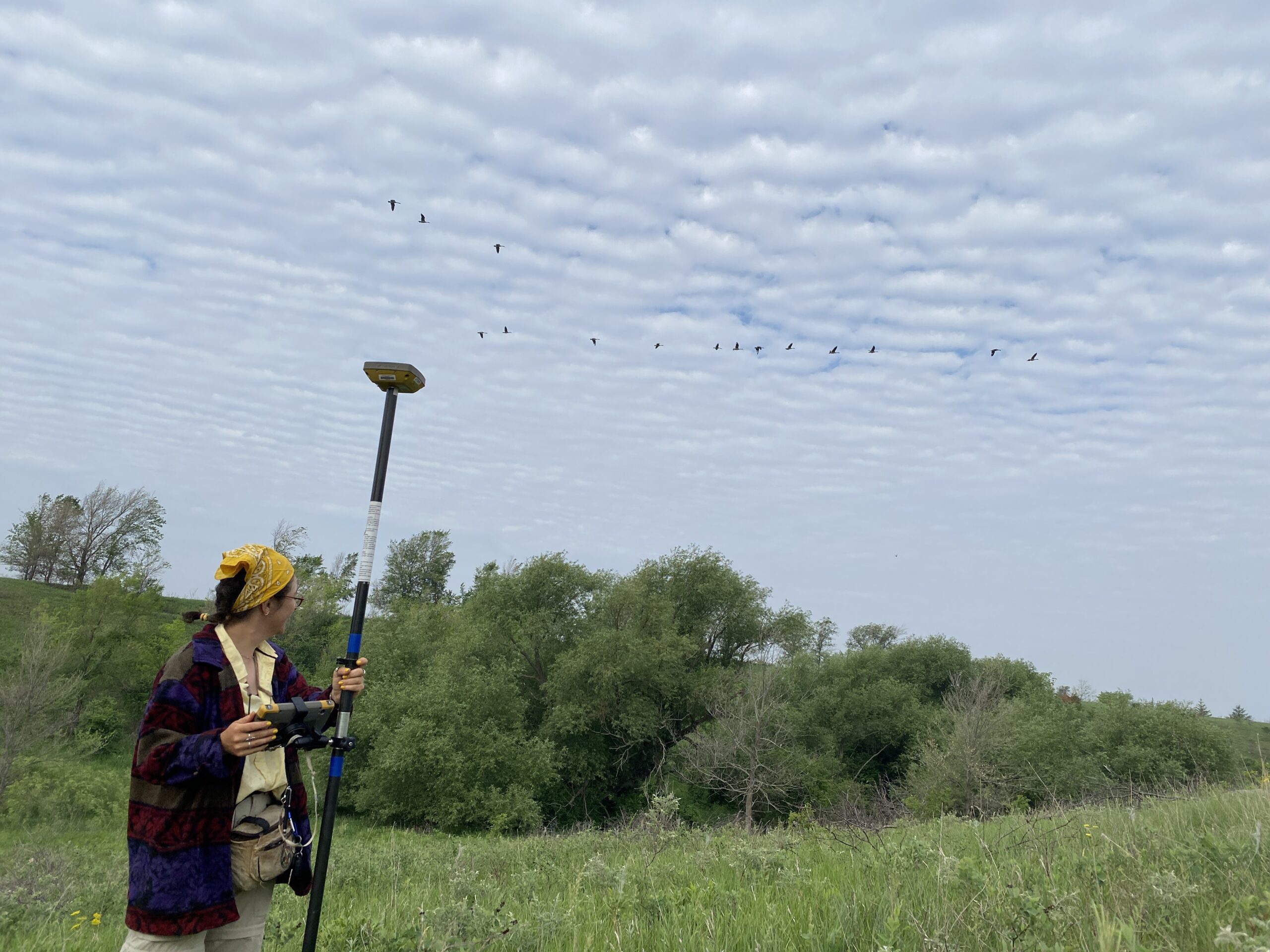
Jared generated a large number of random points for each site, more points than we actually intended to sample. trap. We visited these points using a high precision gps unit and evaluated whether to “keep” the points and assign them a bbpt or “reject” the point if it could not be sampled safely or effectively.
Jan, 2023 pollinator team member, ground truths bb points at Torgen.
Start year: 2023
Location: prairie remnants and restorations in Solem Township, MN
Overlaps with: ground nesting bees, fire x fragmentation, soils in remnants and restorations, floral resources in remnants and restorations, microhabitats in prairie remnants and restorations
Data collected: spatial locations of accepted bb points are in “~/Dropbox/geospatialDataBackup2023/convertedXML2023/bbptsForEnrtf”. Maps of bb points are located in “~/Dropbox/enrtf/emergenceTrapping2023”
During summer 2023, Team Echinacea Echinacea characterized local environmental conditions to better understand which environmental factors are associated with good habitat for ground-nesting bees. This microhabitat assessment complemented emergence trapping for our ENRTF funded research on fire’s influence on ground nesting bees habitats. We sampled local environmental conditions near randomly placed bbpts in remnants and restorations.
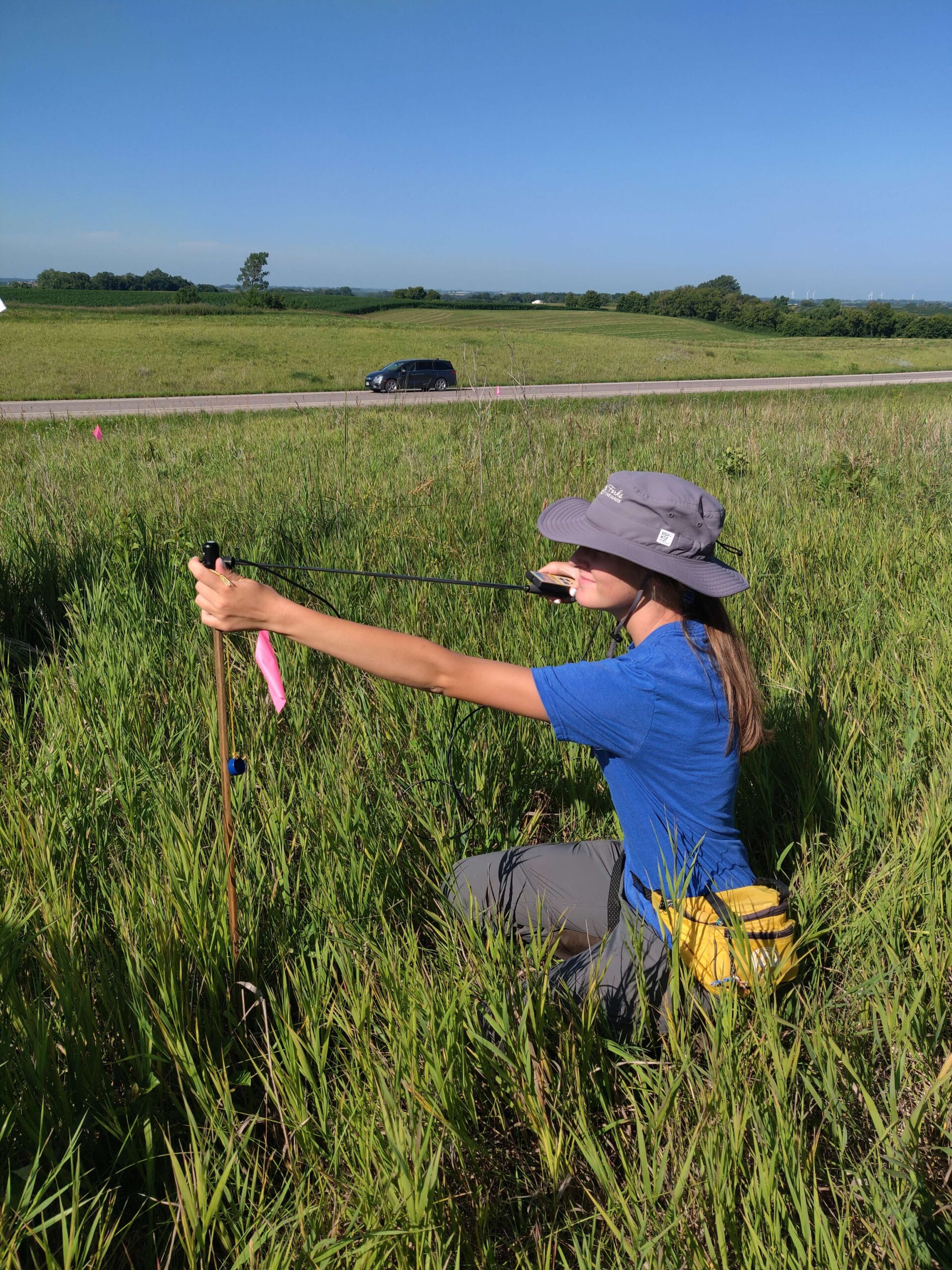
We used a light meter to quantify light availability via a measure of photosynthetically active radiation. We took PAR readings at 1 meter and at ground level ~40 cm NE of the bb point. We also used a soil penetrometer to quantify soil compaction at ~40 cm NE of the bb point.
Team Echinacea conducted microhabitat assessments for three rotations of bb points (rotations 1,2,&3) across 46 sites. Over the summer, we took microhabitat assessment measurements at a total of 1,238 bb points.
Blaire, high school participant 2023, takes a light measurement at a bb point. We were particular about position and timeframe to ensure consistent measurements.
Start year: 2023
Location: prairie remnants and restorations in Solem Township, MN
Data collected: light availability (par measurements) and Soil Compaction (psi measurements) are stored in ~Repos/bbnest/data/microhabitatDataCuration/curate2023MicrohabitatData.R
The aphid addition and exclusion experiment was started in 2011 by Katherine Muller. The original experiment included 100 plants selected from exPt01 which were each assigned to have aphids either added or excluded through multiple years. The intention is to assess the impact of the specialist herbivore Aphis echinaceae on Echinacea fitness.
Last summer (2022), team members Emma Reineke and Kennedy Porter were in charge of the experiment and did not find any aphids in exPt01, so they introduced a new population of Aphid echinaeceae into ExPt1. Learn more in the 2022 summer aphid update. During summer 2023, we did not do any fieldwork for this experiment and we didn’t see any aphids while measuring exPt01.
Andy Hoyt’s poster presented at the Fall 2018 Research Symposium at Carleton College
2016 paper by Katherine Muller and Stuart on aphids and foliar herbivory damage on Echinacea
2015 paper by Ruth Shaw and Stuart on fitness and demographic consequences of aphid loads
You can read more about the aphid addition and exclusion experiment, as well as links to prior flog entries mentioning the experiment, on the background page for this experiment.
Every year since 1996, Team Echinacea members record flowering phenology, taking measuring data and harvest heads of thousands of Echinacea angustifolia plants in common garden experiments. These experimental plots are prairie restorations and abandoned agriculture fields that are managed as grassland habitat. Some plots have multiple ongoing experiments within. Currently, the Echinacea Project currently has 10 established experimental plots.
This project status report will contain updates on experimental plots 1, 2, 4, 5 and 8, as well as management updates for all plots. Specific reports for the remaining experimental plots can be found on separate posts including Amy Dykstra’s plot (exPt03), the hybrid plots (exPt06, exPt07, exPt09), and the West Central Area common garden (exPt10).
exPt01: Experimental plot 1 was first planted in 1996 (cleverly termed the 1996 cohort), and has been planted with nine other experiments in subsequent years, with the most recent planting being Amy Waananen’s inter-remnant crosses. It is the largest of the experimental plots, with over 10,000 planted positions; experiments in the plot include testing fitness differences between remnants (1996, 1997, 1999), quantifying effects of inbreeding (inb1, inb2), and assessing quantitative genetic variation (qgen1). There are also a number of smaller experiments in it, including fitness of Hesperostipa spartea, aphid addition and exclusion, and pollen addition and exclusion (the last experiment was continued the summer of 2023 and will have separate update posts). In 2023, we visited 3,699 of the 10,992 positions planted and found 3,118 alive. 560 plants were classified as “flowering” in exPt01 this year. This is a little less than half of the plants that flowered in summer 2022 (1,111) – an interesting note considering exPt01 was burned the spring of both 2022 and 2023. In summer 2023, we harvested 796 total Echinacea heads in exPt01. We also added 270 additional staples to the experimental plot this year, signifying positions were a living plant has not been found for over three years.
Some numbers for experiments within exPt01
Inb1: The INB1 experiment investigates the relationship between inbreeding level and fitness in Echinacea angustifolia. Each plant in experiment INB1 originates from one of three cross types, depending on the relatedness of the parents: between maternal half siblings; between plants from the same remnant, but not sharing a maternal or paternal parent; and between individuals from different remnants. All individuals were planted in 2001. We continued to measure fitness and flowering phenology in these plants. In 2023, of the original 557 plants in INB1, 85 were still alive. Of the plants that were alive this year, 24 of them were flowering; this count is down from summer of 2022 where 40 of the plants were flowering.
qgen: The qGen1 (quantitative genetics) experiment in p1 was designed to quantify the heritability of traits in Echinacea angustifolia. We are especially interested in Darwinian fitness. Could fitness be heritable? During the summer of 2002 we crossed plants from the 1996 & 1997 cohorts of exPt01. We harvested heads, dissected achenes, and germinated seeds over the winter. In the spring of 2003 we planted the resulting 4468 seedlings (this great number gave rise to this experiment’s nickname “big batch”). 1,417 plants in qGen1 were alive in 2023. Of those plants, 298 flowered this summer.
Other plots:
exPt02: To examine the role flowering phenology plays in the reproduction of Echinacea angustifolia, Jennifer Ison planted this plot in 2006 with 3,961 individuals selected for extreme (early or late) flowering timing, or phenology. Using this phenological data, we explore how flowering phenology influences reproductive fitness and estimate the heritability of flowering time in E. angustifolia. In the summer of 2023, we visited 1,855 positions of the 3,961 positions originally planted. We measured 1,283 living plants, of which 118 were flowering, with a total of 148 flowering heads. In the fall, we harvested 67 heads from exPt02. The large difference between the number of heads and the number harvested has to do with high levels of seed predation, mainly by ground squirrels. Last year, Will, Jennifer, and other members of Team Echinacea published a paper in the American Journal of Botany using data from exPt02 – check it out here! Location: Hegg Lake WMA
exPt04: Experimental plot 4 was planted to gauge whether Echinacea from small remnant populations could be genetically rescued via an outcross to larger, more genetically diverse populations. Caroline Ridley and other members planted this plot in 2008. We did not visit exPt04 this year. Location: Hegg Lake WMA
exPt05: The only experimental plot planted at Staffanson Prairie Preserve (SPP), exPt05, was planted to compare progeny of maternal plants from burned and unburned sections of SPP. There were 2800 plants planted originally, but high mortality made it impractical to visit the plot row-by-row. Now, we and treat the plot like demography. We use our survey-grade GPS to find plants in exPt05 that have previously flowered and add more plants to the stake file if new plants in the plot flower. In 2023 we found 11 living plants, none of which were flowering! We did locate one new flowering plant within the plot boundaries. Location: Staffanson Prairie Preserve
exPt08: Team Echinacea established quantitative genetics experiments to quantify additive genetic variance of fitness in Echinacea, with the idea that we can estimate evolutionary potential of study populations. The maternal parents of qGen2 and qGen3 are plants in the 1996, 1997, and 1999 cohorts. These plants were crossed with pollen from plants in remnants to produce seed for qGen2 and qGen3, which now inhabit exPt08. Originally, 12,813 seeds were sown in the common garden. Seeds from the same cross (shared maternal and paternal plants) were sown in meter-long segments between nails. A total of 3,253 seedlings were originally found, but only 385 plants were found alive in 2023. There were 15 flowering plants in 2023, and 15 heads. On a side note, one additional flowering plant was found in t-plot, and we harvested three heads from that. Location: Wagenius property
Experimental plot management:
Burned exPt01 (3 May 2023) and exPt08 (17 May 2023)
Replanted pedicularis in exPt01 and exPt10, augmenting Drake’s experimental treatments (replaced ones that died)
Broadcast seed in p8 after the spring burn and in the fall, including Comandra umbellata
Stuart trimmed flowering A. gerardii and S. nutans just north of tplot
Some plots in hegg (not exPt02) got run over by heavy machinery
We did not:
Treat sumac
Weed in exPt01 (except hawkweed)
Treat ash in exPt08, but we noticed that ash south of plot responded favorably to last year’s treatment
Details
Start year: Differs between experiment, see above. First ever experimental plot was in 1996.
Location: Differs between experiment, see above.
Overlaps with: …everything!
Data collected: Raw measuring data can be found in cgData repository. Processed data will be uploaded to SQL database. Currently, SQL database has measuring data up until 2022.
Samples or specimens collected: See above for total harvested heads in each plot.
Products: Many publications and independent projects.
Location: Hegg Lake WMA. Start year: 2011. Echinacea pallida is a species of Echinacea that is not native to Minnesota. It was mistakenly introduced to our study area during a restoration of Hegg Lake WMA. Since 2011, Team Echinacea has visited the pallida restoration, taken flowering phenology, and collected demography on the non-native plant. We have decapitated all flowering E. pallida each year to avoid cross-pollination with the local Echinacea angustifolia. Each year, we record the number of heads on each plant and the number of rosettes, collect precise GPS points for each individual, and cut off all the heads before they produce fruits.
This year, we cut E. pallida heads on June 22nd. We installed pollinator exclusion bags on select heads of 10 plants rather than immediately cutting them as a part of our quantity and quality of Echinacea pollen and nectar experiment. Overall, we found and shot 73 flowering E. pallida plants, and 193 heads in total, averaging 2.6 heads per plant. These non-native plants were hearty with an average rosette count of 6 rosettes and an individual with a maximum of 20 rosettes! We only did surv on plants with new tags this year, a total of 4. We did not take phenology data on E. pallida this year.
You can find more information about E. pallida flowering phenology and previous flog posts on the background page for the experiment.
Location: near exPt8. Start year: Crossing in 2011, planting in 2012. Experimental plot 6 was the first E. angustifolia x E. pallida hybrid plot planted by Team Echinacea. A total of 66 Echinacea hybrids were originally planted. All individuals have E. angustifolia dams and E. pallida sires. In 2023, we visited 23 positions and found 17 living plants. This year, 3 plants flowered in this plot; this is the first year any plants have flowered in p6! These were allowed to reach day one or two of flowering in order to assess their pollen color before we decapitated them.
Flowering plant in exPt06! Note the paler pollen color compared to the typical E. Angustifolia
You can find more information about experimental plot 6 and previous flog posts about it on the background page for the experiment.
Location: Hegg Lake WMA. Start year: Crossing in 2012, planting in 2013. Experimental plot 7 is the second E. pallida x E. angustifolia plot. It contains conspecific crosses of each species as well as reciprocal hybrids, totaling 294 individuals. This summer, we visited 150 positions, and of these plants, we found evidence of 121 living plants. We did not use pollinator exclusion bags in exPt07 this year. There were 19 flowering plants this year; from these we harvested 32 heads. We have not yet used the pedigree data to see what number of these plants are hybrids or not.
You can find more information about experimental plot 7 and previous flog posts about it on the background page for the experiment.
Location: Hegg Lake WMA. Start year: 2014. Experimental plot 9 is a hybrid plot, but, unlike the other two hybrid plots, we do not have a perfect pedigree of the plants. That is because the E. angustifolia and E. pallida maternal plants used to generate seedlings for exPt9 were open-pollinated. We need to do paternity analysis to find the true hybrid nature of these crosses (assuming there are any hybrids). We did not use pollinator exclusion bags in exPt09 this year. There were originally 745 seedlings planted in exPt9. We searched at 292 positions and found evidence of 238 living plants in 2023. Of these individuals, 30 were flowering. We harvested 39 heads from this plot!
You can find out more information about experimental plot 9 and flog posts mentioning the experiment on the background page for the experiment.
Data collected for exp679: For all three plots, we collected flowering status, rosette count, leaf length, head count and head height. All measuring data can be found in the cgdata repository (~/cgdata/summer2023/measureGood). Measuring data should be uploaded to SQL database eventually, but it is not currently there for 2023. For experimental plots 7 and 9, we also took phenology data starting on July 7th and ending on July 12th, which we scaled back from previous years. This data can be found in the cgdata repository (~cgdata/summer2023/p79phenology).
Data collected for E. pallida demography: Demography data, head counts, rosette counts, GPS points shot for each E. pallida with a new tag. Find demo and surv records as well as GPS points in demap.