|
|
Hello! My name is Daniel Rath, a rising senior Biology major from Carleton College, Minnesota. I’ll be working with Stuart and the other incredible members of the Echinacea project all summer to find out the answers to some of the most interesting, fascinating and incredible questions about the prairie ever conceived.
Well, I might be exaggerating, but only a little.
I am 19 years old, born and raised in Dangriga, Belize, C.A., and ever since I worked in the Carleton Arboretum restoring prairie, I have had an intense fascination with the Midwest prairie ecosystem. I came to Kensington the day after Carleton’s graduation ceremonies, and so far I have been blown away by the beautiful wide open expanses, particularly Staffenson Prairie. I have been fascinated by the small prairie remnants that remain in scattered areas throughout the landscape, and am working on learning the names of some of the key species (leadplant, tall bluestem and short bluestem, brome, veiny pea, and many others).
The question that has most caught my interest is the interaction between aphids and ants, particularly as it has been recorded in the Common Garden. I would love to know more about this potential new species, such as: Are the Echinacea-specific? Do their depredations vary among inbred vs outbred vs plants within the same remnant? Are they able to persist without the ants? What exactly is the nature of the ant-aphid interaction? How abundant are they in the wild? Tons of questions, so hard to choose! It gets even more complicated as you consider the little structures built for the aphids by the ants, as some entomologists believe that the ants use spittlebug spittle to construct them! However, I think I will narrow it down to a question that lets me spend the largest amount of time outside in the prairie remnants and the common garden.
I am also looking forward to gaining more field skills, such as using a GPS, looking at satellite maps, and learning about sampling mechanisms such as line transects and random searches.
Kensington is a marvellous little town, and I really like the feel of it. While I have not recovered from my sleep debt incurred at Carleton, I intend to explore the surrounding landscape as soon as possible. However, I would like future Team Echinacea members to know that the K-Town bar offers 2$ burgers on Thursdays. Incredible deal!
Hello everyone! My name is Mimi Jenkins and I’m an REU student with Chicago Botanic Gardens. I am from Pittsburgh, PA where I am a senior (one more semester!) at the University of Pittsburgh double majoring in Environmental studies and French lang/lit and a certificate in Global studies. This is my first real experience spending more than one day in the Midwest and I love it so far. The wetlands and prairies out here are gorgeous and I feel very lucky to be experiencing a new and exciting place and working with such an interesting group of people on such a worthwhile and fascinating project. I have never been on such a flat land or in such a small town, but the flat topography makes for nice biking (hoping I can get my hands on a bike soon!) and the small town is a nice break from the city for the summer. I arrived in Chicago two weeks ago and after an introductory week for the REU program doing lab work on soil samples and such (not my cup o’ tea), I met Stuart, took pictures with the help of Jake Friedman of some of the Echinacea pollinators and visitors that are pinned and in boxes at CBG, and did a little research on the nesting habits of bees.
Here is the protocol we came up with for the picture-taking:Protocol for Taking Pictures of Insect Specimens.docx
Here is some of the info I found on nesting of bees commonly found on Echinacea:
Echinacea Pollinators nesting.docx
I am really excited about this field season and I wish I could stay longer! I am really interested in improving my plant and bee identification skills on the prairie, as well as my knowledge of statistics in analyzing data and applied ecology in general. I also hope that this experience will help me to hone in on what I want to focus on for graduate schools in a year or two. I am currently trying to think about what exactly I would like to focus on because everything sounds so cool but I am limited to less than 6 weeks of research so it must be a pretty precise question, such as: does one family or species of bee act as a more effective pollinator for Echinacea than others using the style persistence method, or what co-flowering species are the pollinators pollinating that also land on Echinacea by observing pollinators on other plants or looking at foreign pollen on Echinacea heads. I would like to work in the common garden and in remnant populations to get a good sense of how these questions might differ depending on the community diversity of the remnant and the health of the Echinacea population.
I went out wandering yesterday and I think some of the locals thought I was a crazy person for walking on the side of the road but until I can bike, I will explore by foot. I turned onto the first dirt road on the right off of Kensington Ave and found this pretty hillside prairie remnant at the end of the road. I wanted to go further, but the electric fence kept me from continuing. I saw a patch of something yellow flowering off in the distance. Along the path of the dirt road between two corn fields I saw what I think was brome grass, prairie rose, common milkweed, alfalfa and clover, and some others like thistles that I couldn’t identify. I saw a big white bird that Stuart told me today was an American egret. I also saw some more of those cool turquoise dragonflies that are in the common garden. I regret not bringing my camera with me because the view at the end of the dirt road was so pretty–there were relatively few trees and you could gently rolling green hills for miles.
We mowed most of the CG this morning. Putting flags in went smoothly. It helped that we left many flags overwinter. We mowed according to the plan established two years ago. We started removing clippings & pulling flags that marked fl pla from 2008.
I noticed a plant I do not recognize at R46 P~903. Also, in R14 near P870 there is a patch of somethings that is starting to spread. We should determine if it’s a weed we should eliminate.
I heard a yellow-billed cuckoo from the farm house today. It was south of the farm house, perhaps in the South Field.
I went down to the common garden experimental plot around 9:30 or so. I didn’t see or hear any black-billed cuckoos.
My family drove from IL to MN on Thursday. We arrived late in the evening and didn’t have that much time to look around, but we did see a lot of tent caterpillars.
First thing Friday morning I went out to the common garden. I flagged plants and planned to mow a few walking paths because Caroline was coming to figure out which plants were going to flower in the inb1 experiment. I paused while mowing and heard a black-billed cuckoo. Then I noticed that there were a few flying around and I heard several calling. I am positive that there were six birds within earshot, but I think there may have been eight. I have never seen more than one a time. It was really neat. There was one calling east of the common Garden and three calling from the shrubs and boxelders along the west edge of the CG. They also flew across the corn field to shrubs next to the wetland west of the CG. Two birds were cavorting in the ditch and flew right next to me on their way to the cottonwood at the NW corner of the CG. Very cool!
It is good to be back in Minnesota. The common garden looks fine. The kids are in their element. I can’t wait for the field season to start! But first: unpack, set up computers, clean the Hjelm house, bring beds to Kensington, go to graduation party, get sleep.
The township supervisors (Joe Martinson, Carl Hamen, and Ken Anderson) drove by inspecting ditches. They are planning to cut trees on the township road N of the driveway because someone can’t get their combine through.
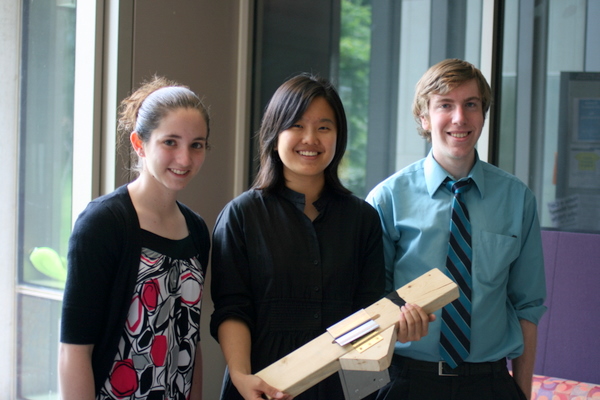
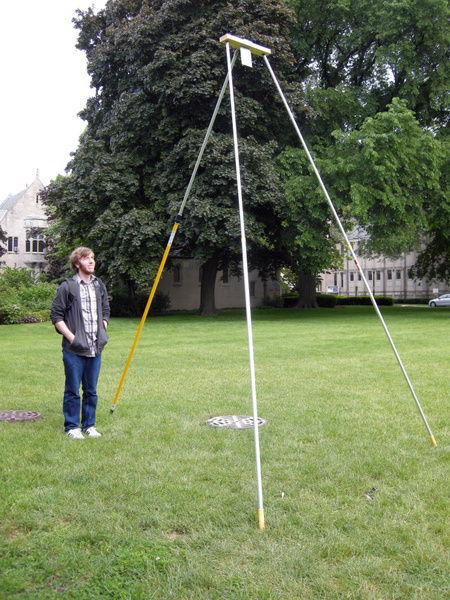
Three engineering students from Northwestern’s Engineering Design and Communication class built a specialized camera stand for the Echinacea project. Michelle Pineda, Christopher Moran, and HengJie Tan designed and built a giant tripod which we will use to improve our protocol for relocating Echinacea seedlings.

I told them about the paper maps we made by hand and how last summer Ben & Christine worked out a method to flag seedlings and make maps from digital images. To avoid issues with parallax they determined that photos had to be taken from fairly high up (at least 2.9 m from the ground).
Then the main problem was taking photos straight down from such a height. The hang-a-camera-from-a-pole method wasn’t stable enough (or safe). Michelle, Chris & Heng designed several scaled-down prototypes for their class project. Christine and I looked them over and then, based on our feedback and class feedback, they built this stand…

They presented the stand to their class and me on Saturday, along with a detailed report. I can’t wait to try it out! We will try it out this summer. We hope to avoid making paper maps altogether. We’ll see if it works!
I collected GPS coordinates of plants at the landfill on Saturday with our Trimble GeoXH. It froze as I was getting ready to go to the Riley site. I didn’t know what to do. I didn’t have a reference manual, just the Quick Start Guide. For future reference, here’s the link to manuals and perhaps other helpful resources…
http://www.trimble.com/terrasync_ts.asp?Nav=Collection-30232
Beware downloading PDF files from this site has crashed my browser many times.
I flagged 20 spots at the landfill site last Saturday. 18 are centered on Echinacea plants that flowered last year (blue flags). 2 are random locations (orange flags). Amy and Caroline are going there tomorrow to search for seedlings.
I noted other plants that were flowering on the east hill:
Zizia aurea
Lithospermum canescens
Sisyrinchium (1 pla)
Viola pedatifida
Astragalus sp.
Pediomelum esculentum – just about to start
Geum triflorum – done
Commandra umbellata – mostly done
On the west hill I noted these:
Senecio (1 pla)
Taraxacum officinale
Antennaria neglecta – done
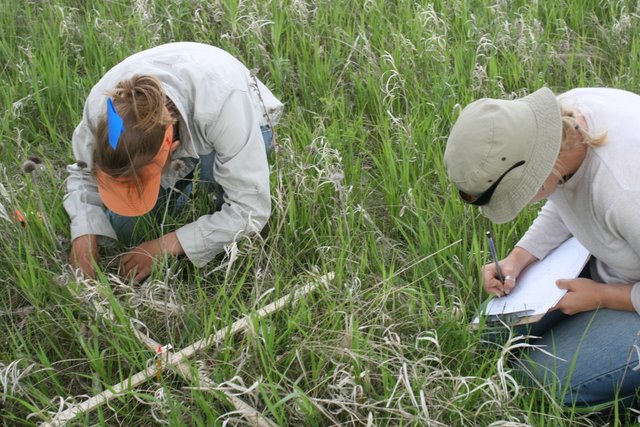
We searched for Echinacea seedlings in six prairie remnants last week. We found some! Over 2+ days eight of us found 57 seedlings.

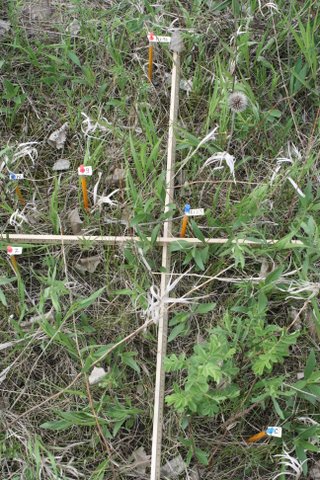
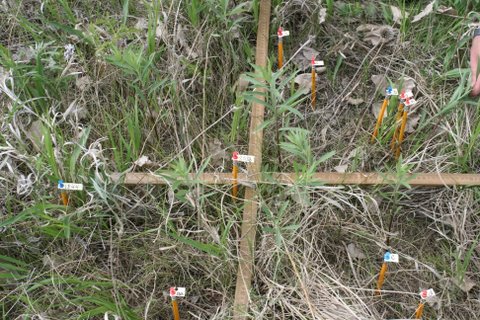
Ruth and Georgiana found 5 seedlings in this circle (41 cm radius) centered on plant 12034 at Steven’s approach.
We visited 87 circles. Ten of the circles were centered on random points in the remnants and the rest were centered on plants that flowered last year. The random points were all at least 1.5 m from every plants that flowered last year and within 4 m of one or more plants that flowered last year. The radii were 41 cm in 4 remnants and 50 cm in the other two. The total area searched was 51.3 square meters.
We also noted that there were about a gross other Echinacea plants in these circles. Some were tagged from previous year, others not.
We changed our protocol from last year and pairs differed in data they recorded and map notations. When we go back to the remaining nine sites in two weeks we should follow this protocol:
we must have at least two measurements to every seedling noted on the map
we must have at least one measurements to every basal plant noted on the map
make a map for every circle where any plant is found
note the style of every toothpick placed (round, square, colored, striped, etc)
note all plants that are determined to be just outside the circle on the map
We need consistent map notation for seedlings, basal plants, focal plants, flowering plants, tagged plants, nails
Also we need to get more pencils, thumbtacks, and cards with containers to hold it all.
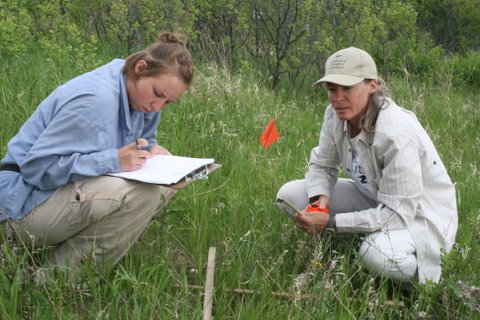
Here are some photos of us searching and photos of places where we found some seedlings…


There were eight of us searching, Amber Eule-Nashoba, Ruth Shaw, and Stuart Wagenius searched Thursday & Friday. Georgiana May searched on Thursday. Gina Quiram searched on Friday. Caroline Ridley, Amy Dykstra, and Kate B searched on Friday (after driving across South Dakota to search for seedlings there earlier in the week). [Note to SW: Kate B is KD on datasheets.]
On Thursday we found one circle at SGC that was overrun by poison ivy. Lacking protection, Amber and I decided not to venture in. On Saturday I went back to the circle with neoprene gloves. I removed some poison ivy and then searched the circle. Alas, I found none.
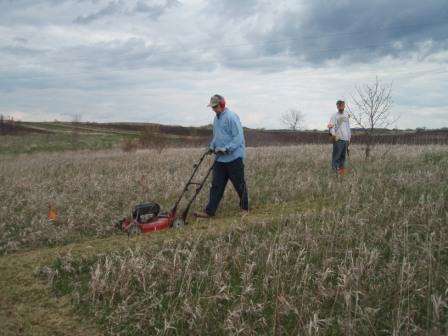
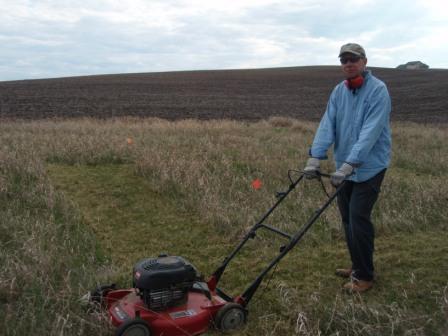
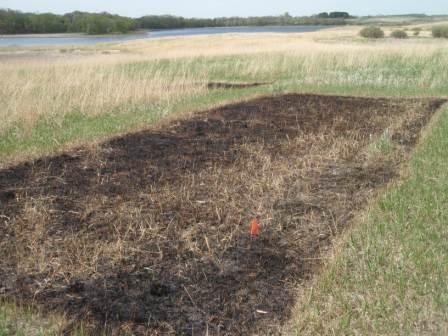
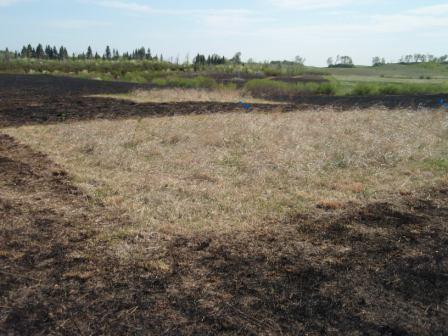
One of our long-term experiments evaluates the effects of burn treatments on seedling recruitment and survival (see abstract here:http://echinacea.umn.edu/bib/echinacea_abstracts.htm#wagenius_et_shaw_RE). Here are some photos documenting how we prepare plots for burning…

Figuring out which plots need to be burned.
Mowing burn breaks.
Nice job, Brad.
Successfully burned plots.
The east half of Hegg Lake WMA was burned by the DNR. For our recruitment plots located within the burned region, we mowed burn breaks around plots we did NOT want to have burned.
|
|