|
|
Here’s a list of ideas for independent or group projects that we discussed today.
1. Improve procedure for mapping seedlings in remnants.
2. Investigate new aphid biology: distribution, behavior, ant associates, et cetera.
3. Investigate biology and behavior of native bees:
flight distances in CG
find nests
pollination behavior Echinacea in CG
generalization/specialization
distribution with next boxes
bumblebee species
4. Do “Time lapse” photography of Echinacea heads to visualize floral development.
5. Pollen collection from plants to develop identification key (with pollen collection from bees to assess generalization/specialization.
6. Quantify plant species richness in remnants, experimental plots, local preserves.
7. Map distribution of Echinacea‘s co flowering species (Thistles, sweet clover, Coreopsis)
Kite or pole aerial photography
8. Collect seed of Stipa spartea or Dalea purpurea for common garden study.
9. There are many more possibilities…
Here’s an update on the main research activities this spring. The cool spring with a late snow (~15 inches -38 cm- at the end of April) delayed burning weather somewhat and we think seedling recruitment may be later than in the past few years.
Recruitment/Establishment Experiment
On May 9 I mowed burn breaks so the DNR burn crew could burn the plots. They burned the middle unit at Hegg Lake WMA on May 28. Two plots were in this unit. Here’s a photo of one plot just after the burn. Nice work! There are 3 plots to be burned at Hegg Lake WMA, two at Kensington Duck Refuge, and one a Eng Lake WMA. At the duck refuge I saw 2 Sandhill cranes and a Red-necked grebe (among the regular, awesome array of water birds).
Common Garden
Dwight, Jean, and I burned the common garden on May 22, starting just after noon. The weather was within prescription, but the wind was a bit strong and the fire jumped the gravel road and started some corn stubble. The fire worked its way to some reed canary grass and we managed to put it out there. If it had gone a little longer it would have torched the cattails and burned the whole slough west of the common garden. Whew!
The running fire was great in the 99S garden, but there were quite a few unburned spots in the main garden. We burn the CG every other year and we mow paths annually, so we don’t have quite enough fuel for really complete burns. Maybe in 2010 we should augment the fuel load with some prairie hay.
A big tree just east of the CG caught on fire. It was hollow, but quite strong. It finally broke and fell over around 7 pm. To put it out we scraped all the embers and coal from the trunk with an axe and shovel. We couldn’t reach a spot of punky wood 8 – 9 feet (2.5 m) off the ground. So I climbed up the trunk and used a 5 lb. pick mattock to scrape out the embers and punky wood. Then Dwight lifted the smith Indian backpack sprayer over his head and I sprayed and sprayed and sprayed. We put it out by around 10 pm. Exciting! We need to cut up the part of the tree that fell on the CG.
An adult bald eagle flew over the CG just as we started to burn and then again around 8 pm — great!
On 24 May, Gretel and I broadcast seed over the CG. We seeded Galium boreale, Bouteloua curtipendula, and Schizacharium scoparium. Gretel, Per, and I seeded the ditch with many species of seed, including Stipa spartea and Spartina pectinata. We forgot to seed the 99S garden.
Seedling Search
On 27 & 28 May Ruth, Amy, Julie, and I searched for Echinacea seedlings in five remnant prairies. We searched about 75 circles with 41 or 50 cm radius and found 17 seedlings. Several had only cotyledons and the tallest first leaf was 24 mm. We got rained out yesterday (29 May). It was also cold and windy.
Hjelm house
Last weekend Pete, Dwight, Gretel, and Stuart cleaned out all the sheetrock and insulation (yuck) in the house. That was a job. We got the house all ready to have the floors sanded. We have a lot left to do to get the house ready for the main field season. The highest priorities are bathroom and computer network.
I just found out that there is video footage of the house being moved on YouTube.
Here are the 3 links:
part 1
part 2
part 3
Enjoy!
Well, thought I’d just say that I am safely back in Washington after a nice long drive. We were slowed down by a flat from a nail and a screw stuck in my tire, at least one of which was probably picked up in Minnesota. Other than that, thanks for the great summer and good luck in school or whatever else you may be doing. Jennifer and I finally got to talk to one of the naked Finnish men on Lake Isaac and we obtained a few words of wisdom. The most important piece, which I think I ought to share, is that “taking a sauna with a swimsuit on is like kissing through a screen door.” That explains so much.
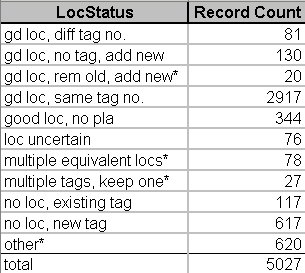
Here’s a quick tally of the demography data that we took in the natural remnants this summer. I think we did a lot! We took a total of 5027 records. Here they are broken down by loc status…

This is just the first rough pass through the dataset. There is a lot of clean-up to do and mysteries to figure out. For example, of the 81 “good loc, diff tag no” records, 12 have no loc and 1 has no tag (gulp).
Flowering rates seemed to be high this year. 1700 records list one or more normal flowering heads and another 223 records had only non-normal heads. There were some big plants too: two plants had 11 flowering heads and two had ten! The greatest number of rosettes was 47 (that’s good ol’ plant #1540 at NGC.) We counted 9276 total rosettes.
The summer field season is done for me. We drove back to Illinois on Saturday. I’ll try to post reviews of the datasets occasionally and maybe some photos too.
Jennifer is the only one still in the field. She is harvesting seedheads today & tomorrow, then returning to IL.
Per requests, here’s the recipe:
1/2 c butter
1 c sugar
1 egg
1/3 c molasses
2.25 c flour
2 t baking soda
1 t cinnamon
3/4 t cloves
3/4 t ginger
1/4 t salt
That’s it. Usual method – cream butter with sugar, add egg and molasses, then dry stuff. Recipe says bake at 375 for 10 min, but Thomas advises 350 for a little less time to keep them softer.
It was fun feasting on cookies – these, Julie’s and Jean’s – with you all on Thurs after our soaking morning!
Today was the last day of a great field season. We finished the the demography census of flowering plants. We surveyed all sites that needed it. We refound the last of the seedlings that we mapped this spring. And we organized our gear and put it away.
Here’s a photo of Ian, Rachel, and Amy sorting flags…

The heavy equipment in the photo was used to fill in the 2m deep trench that ran through the yard and driveway for the past few days. In the past few weeks, moving the new “storage shed”/office and the associated construction and landscaping has introduced additional chaos into our fun-filled field activities!
I’m heading back to IL tomorrow (oops, Saturday is already today). I’ll keep you posted with summaries of datasets as they come out and I hope to add some more photos to the flog. It’s been a great summer. Thanks to everyone for all your great work!
Georgiana May and I had a great day working with Amy M., Gretel, Ian, Jennifer, Julie, Rachel and Stuart. Though we had specially chosen Thursday as having the most promising weather, it was raining when we arrived at 9, but that didn’t stop us from piling into the truck for the trip out to the beautiful prairie remnant at Krusemark’s where we relocated previous flowering plants and collected demographic data on them. The water resistant paper kept the maps from thoroughly shredding, and we finished the job – but not before 1. Back at the farmhouse, water had been restored (after a break the night before) AND there were 3! batches of cookies – great reward!! After lunch, Gretel and Jennifer visited several remnants to relocate seedlings we marked in May. Amy, Rachel, Georgiana and I did the same at E. Riley – it was satisfying to see even just a few survivors! Stuart, Julie and Ian surveyed at Riley and E. Riley. All this, under beautiful, warm sunshine – what a difference a few hours makes! Georgiana and I enjoyed a look at Staffanson and Hegg Lake on our way out back to the TC’s. It was a great summer working with all of you!! My best wishes to all of you. Ruth
Hi Team,
I am safely installed back at home. The unpacking and laundry is done, and Costa Rica prep is in full swing. To those of you still in the field, I wish you steady hands on the surveying poles and expeditious dispatching of the demo maps. And to everybody, I wish happiness and good luck in life. It’s been fun.
Take care, Amy
Despite delays on the runway in Chicago due to rain and a well planned air show I did make it home. I apologize for the delay in posting, I’ve had a busy few days. Unpacking, doing laundry then immediately repacking takes it out of me. I hope that your final week(s) are as fun as the previous 9. I will continue to either blog or mass email about things that may or may not concern Echinacea.
A note: After looking at my mom’s purpurea I’m very glad that we study angustifolia. There are about six billion rosettes and heads on each plant.
|
|