|
|
Hello flog!
It’s been another busy day for Team Echinacea at the College of Wooster.
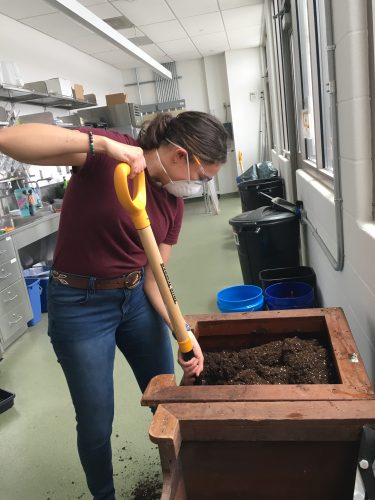
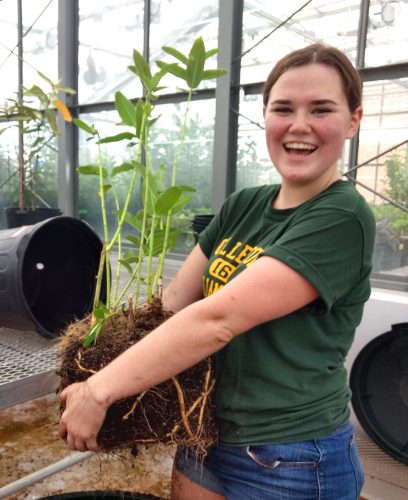
Seed Master Ren started the day off by making an excursion to the garden store to hunt down some soil that will be used to plant the seeds once they have germinated and formed a radical. Then, she showed off her muscles, mixing the soil with sand and some water. Additionally, the plant growth chamber for our first group of seeds was switched over into summer mode, so we will hopefully we will see some baby plants soon!
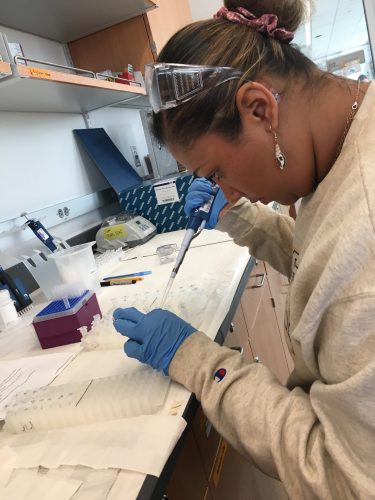
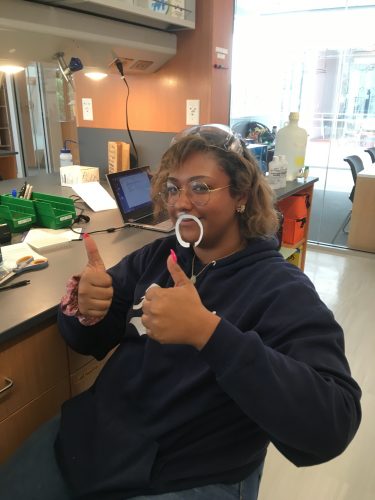
 Seedmaster Ren wrangles some dirt Extraction extraordinaire Miyauna cranked out another grueling set of DNA extractions from some of the parental plants. Luckily though, this should be our last set of extractions at least for several weeks while we wait for our seeds to germinate and grow big enough so we can take a leaf sample.
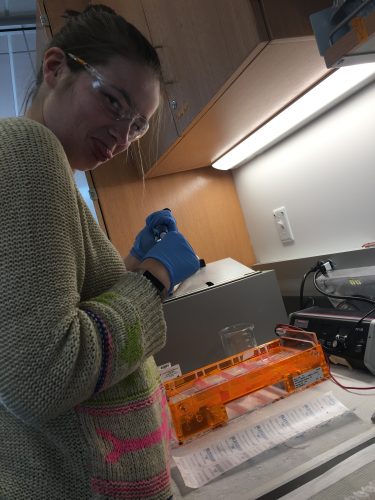
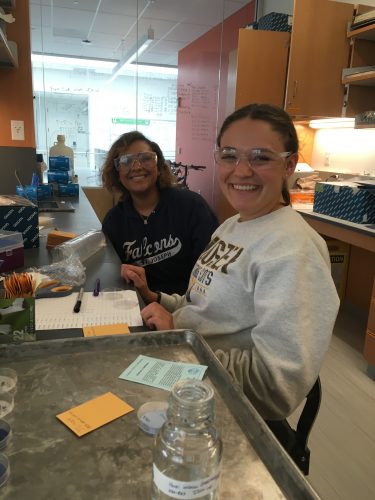
Miyauna, getting into the extraction zone. Our resident R expert/clumsy ninja Mia and I teamed up to begin PCR reactions with the DNA extracted on Tuesday and a batch that was extracted back in November. Each DNA sample needs to undergo 10 different PCR reactions (for the 10 different microsatellite markers being used), and after a bit of a slow start familiarizing ourselves with the methods, we ended up breezing through three PCR reactions. We also ran some gels and a nanodrop on the DNA samples to double check and make sure that DNA was successfully extracted for all of the samples.
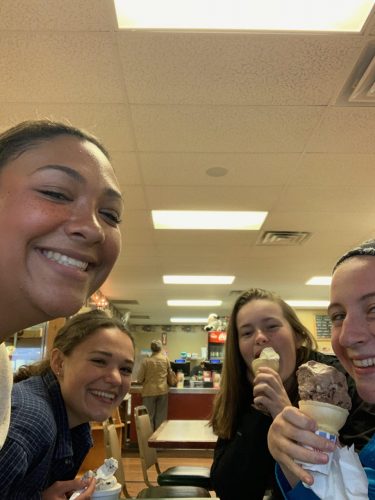
We love PCR and gel electrophoresis!!! After all this hard work, Team Echinacea Ohio called it a day in the lab. However, our team members still had one more important task – the noble quest for ice cream. Braving a torrential downpour, we set off for a local ice cream parlor/shop, where we enjoyed the sweet rewards of a hard day’s work.
Lab mates that eat ice cream together stay together So long for now!
Avery
Echinacea Project 2019
Biology, The College of Wooster 2021
Research Interests:
I am super fascinated with how life on this beautiful planet interacts and how truly interconnected everything is. I am particularly interested in how these interactions, and the lose of certain interactions, affect the reproductive and developmental biology of organisms. What affects fertility, stem cells, organogenesis, the effects of fragmentation, ART, and more! Genetics and the process of life happening is so awesome, that I hope to study it in graduate school !
Statement:
I was born and raised in Akron, Ohio. Along with being a biology major, I am also a Chinese minor and Education Licensure candidate at the College of Wooster. I love baking, hunting for great antique shops, trying fun food, and watching movies! I also enjoy hanging with my family, including my dogs, and exploring our urban parks. You can always find me singing, telling a story, or saying how cool science is.
Echinacea Project 2019
Majors in Biology & Environmental Science
The College of William & Mary, Class of 2019
Research Interests
Broadly I am interested in community ecology and population genetics for conservation. At my undergraduate institution I studied Asclepias syriaca, or common milkweed, another grassland plant. Through this work I learned about the genetic and phenotypic variation of plants within fine-scale habitats as well as the transmission of herbivory defense signals. This inspired my most recent interests in pollination ecology and nectar defense. I’m excited to investigate similar avenues within a new ecosystem and study species, as well as learn more about statistical analysis by working with the Echinacea Project’s long-term dataset!
Statement
I’m from Raleigh, NC and attended college in Williamsburg, VA, and am only a little terrified of the weather I’ll encounter in Minnesota and Chicago! As a birder I’ve spent my fair share of time chasing feathered things in blistering heat and freezing cold, and I’m eager to start learning new Midwestern birds. In addition to peering through binoculars and thumbing through field guides I love to draw, listen to podcasts and share trivia I learn while in the depths of a Wikipedia rabbit hole. I particularly enjoy observing the natural world while hiking and canoeing.

Asclepias is dead, long live Echinacea!
Hello flog long time no see!
Team Echinacea East working out of America’s premier college for mentored undergraduate research (lol) had a busy day! This summer we will be performing paternity tests on the seeds made during the big events from last summer. Today we did a set of DNA extractions on leaf tissue that was grown in the spring. This is a very long process and was a fairly novel process for all involved but everyone did a great job! Especially our Extraction Extraordinaire: Miyauna who led us fearlessly through the treacherous and tedious process.
The Extraction Extraordinaire hard at work. While the samples were in the water bath Dr. Ison/Jennifer gave a very interesting presentation giving background on previous work done by members of team echinacea. For lunch we stole some extra boxed lunches from a high school camp going on in the building (they were very good). These stolen lunches gave us the fuel necessary to finish the days work.
Miyauna and Ren working on seed germination Seed Master Ren finished putting all of the seeds in cold stratification. We have the seeds in the cold so they think its winter, then we take them out of the cold.
 The seeds chillin’ mid “winter” When all this was going on I (R clumsy ninja) was working in R analyzing genotyping data from a different project.
Tomorrow we will start running PCRs on the DNA samples we extracted today, under guidance of Avery the President of PCR.
Until next time,
Mia
Echinacea Project 2019
Biology and Environmental Studies, Tufts 2018
Starting a PhD in Ecology and Evolutionary Biology at UConn in August 2019
Research Interests
My research interests are, like most researchers at this stage, all over the place, but in general I love anything that has to do with plants, insects, and landscapes. I’m a big fan of studying communities: not just one plant or insects, but all the plants or insects that are in a certain space. I’d also be lying if I said I didn’t have research interests that also go into soil, leaf chemistry, birds, mammals, and hydrology. I guess I just like nature?
Statement
Hello again flog! I know I write here about 1-2 times a week, but I thought it necessary that I should write a new intro for a new summer field season. I’m wrapping up my year here as the Echinacea Project’s intern at the Botanic Garden with a return to the summer field crew. I’m very excited to get out and work with the plants again! In my spare time, I like to hike, run, read fantasy, and play video games (hey Riley, wanna Pokemon battle?)
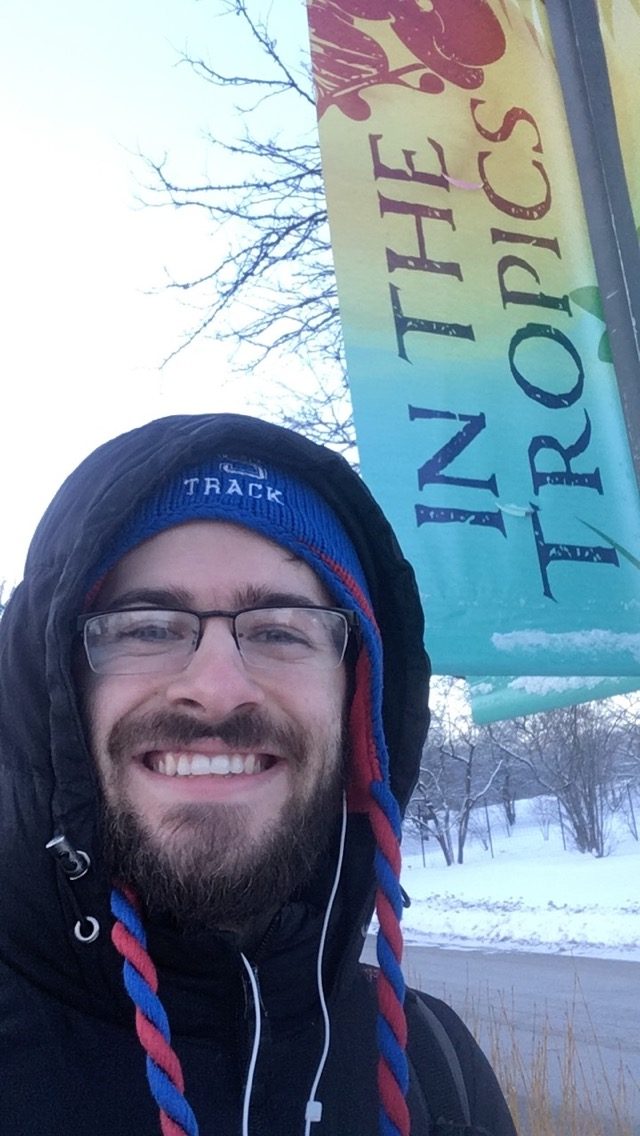
It’s -5 F in this picture
Echinacea Project 2019
Biology Major, Gustavus Adolphus College ’20
Research Interests
The the recent 2018 Nobel conference at Gustavus has gotten me interested in soil ecology. I want to know what goes on in post-agricultural and fractured prairie ecosystems and what the implications are for species richness and productivity underground.
Personal Interests
I am a Biology major minoring in Statistics and English from Waseca, MN. In my free time I like foraging for mushrooms, gardening, and anything that gets me outside. I also like making mixed media art, video games, and trying to learn Swedish.

Echinacea Project 2019
Biology Major, College of Wooster 2022
Research Interests
I hope to learn more about the interactions between echinacea and their pollinators, growth mechanisms that plants employ, and the environmental impact of fragmentation on flowering plant species as well as their pollinators. I aspire to obtain a PhD in botany and continue to research the environmental and molecular functions of plants.
Statement
I am from Medina, Ohio and enjoy gardening, running, biking, cooking, and reading. I also love to spend time in nature and am looking forward to working with echinacea and the rest of the research team!

Hey flog! I’m back!
Echinacea Project 2019
Biology, College of Wooster 2020
Research Interests:
In general I am interested in how plants interact with their surroundings, particularly the other plants in the system. I worked with Team Echinacea last year on a project attempting to determine how many pollen grains it takes to set a seed. Turns out it doesn’t matter and on the head a floret is that determines seed set! In the fall/this summer I will be starting my senior thesis/IS (independent study) with a plant called Coral Bean (Erythrina flabelliformis) in Arizona. I will be investigating how mating is affected by the amount of flowers on a plant and geographic/temporal distance between plants.
Personal Interests:
I am now a senior biology major with a minor in environmental studies at the College of Wooster. I am from Buffalo, NY. At school I am former president of knitting club, but recently I have really gotten into embroidery. I also enjoy spending time outside with my dog named Ellie.
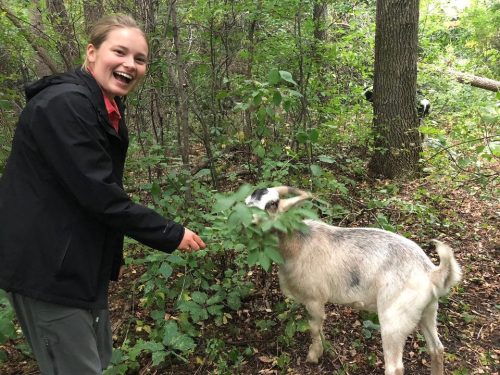
 Me last summer feeding one of the goats buckthorn MEEC 2019:
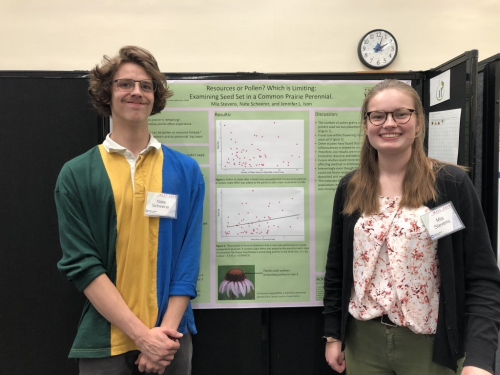
On a different note another student from Wooster (Nate) and I presented at MEEC. We presented a poster on my pollen to seed ratios from my research last summer. As it turns out, pollen is not the limiting resource to determine seed set but instead the location of a floret on the flower head.
Nate and I at MEEC with our poster. Link to poster:Pollen to Seed Poster
Title: Resources or pollen: examining seed set in a common prairie perennial.
Presented at: MEEC 2019 at Indiana State University in Terre Haute, IN
When: April 27, 2019
Echinacea Project 2019
Biology, The College of Wooster ‘20
Research Interests:
I am interested at investigating how different species of solitary bees impact male fitness in Echinacea. Additionally, I’m interested in the varying impacts climate change is having on different ecosystems and the interactions between organisms within these ecosystems.
Personal Statement:
I am a Biology major and Classical Studies minor from Cincinnati, OH. I will be part of the lab team in Wooster this summer, but will also join the field team in Minnesota for a few weeks during flowering season. In my free time, I love reading, baking, and exploring the outdoors. I also enjoy swimming and spending time with friends and family.

Jennifer L. Ison
Echinacea Project 2019
Assistant Professor of Biology, The College of Wooster (Wooster, Ohio), 2015 -present
Research interests
I’m a plant ecologist who is interested in how plants in human-altered landscapes mate. In particular, I’ve examined how spatial isolation and variation in flowering times limit mating opportunities between plants. Recently, we have examined how visits by different native bee species impact reproduction in insect-pollinated plants. We have found that the specialist-solitary bee, Andrena rudbeckia, is the most efficient Echinacea pollinator, both in terms of pollinating florets (individual flowers) and removing pollen (Page et al. submitted; Zelman 2019 thesis). However, we have also found that Andrena is typically only found in the largest Echinacea populations and is only active during early and peak flowering time (Ison et al. 2018 Oikos).
Last summer we conducted a large field experiment to understand how visits from different native bees contribute to a plant’s male fitness (siring success). For more information about this project please read Mia’s great flog post about the project. This summer Mia, Avery, Miyauna, and Ren are working genotyping the offspring from this study using previously developed genetic tools.
Statement
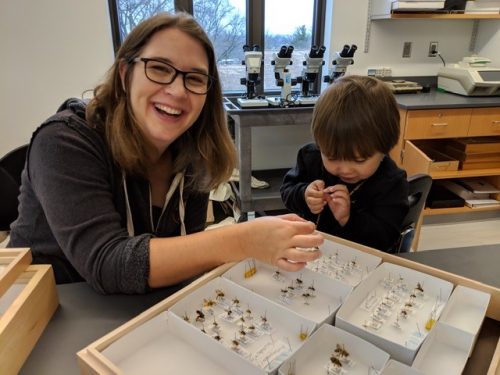
I’ve collaborated with the Echinacea Project for many years (before there was even a flog!). I started as a Team Member back in 2003 after graduating from St. Olaf College. After a few years, I started my dissertation research on Echinacea. After completing my dissertation, I took a few years off the Echinacea Project to work on a plant that takes 30 days (instead of 7 years) to flower. However, I couldn’t stay away from Echinacea and have been examining Echinacea‘s pollinators since 2013. When I am not watching bees on Echinacea, I enjoy hiking, especially with my very active nearly-four-year-old.
|
|