
From our experimental plots, we get information about Echinacea survival and reproductive fitness. Survival/health info comes from measurements of living plants, as does some information about reproductive success (# of flowering rosettes and # of heads). But achene (fruit) count, one of the most powerful measures of Echinacea reproductive success, requires the collection of heads. This is why, for the past few weeks, we have been harvesting flowering heads in experimental plots 1, 2, and 8.
Harvest requires careful timing. Harvest a head too early, and the achenes may not be fully developed. Harvest too late, and the head may have begun to lose achenes, throwing off our counts. To give ourselves the best chance of harvesting heads at the perfect moment, we check each head in our experimental plots every 6 days.
This is, as you might imagine, a complex operation. Even though there are few flowering plants in the experimental plots this year, relative to previous years, we still have 200+ heads to monitor and harvest across three experimental plots. Fortunately, there is a system in place. For a detailed description of this system, continue to the next paragraph. For a brief summary, feel free to skip to the final paragraph.
DETAILED DESCRIPTION: First, we create a list of all harvestable heads from our measure data. These are heads which were developing normally when measured, and might reasonably be expected to produce achenes this season. Heads in ExPt02 are identified by individual plant row and position, while heads in ExPt01 and ExPt08 are identified by both individual plant location and twist tie color (we added unique twist ties to each head while measuring).
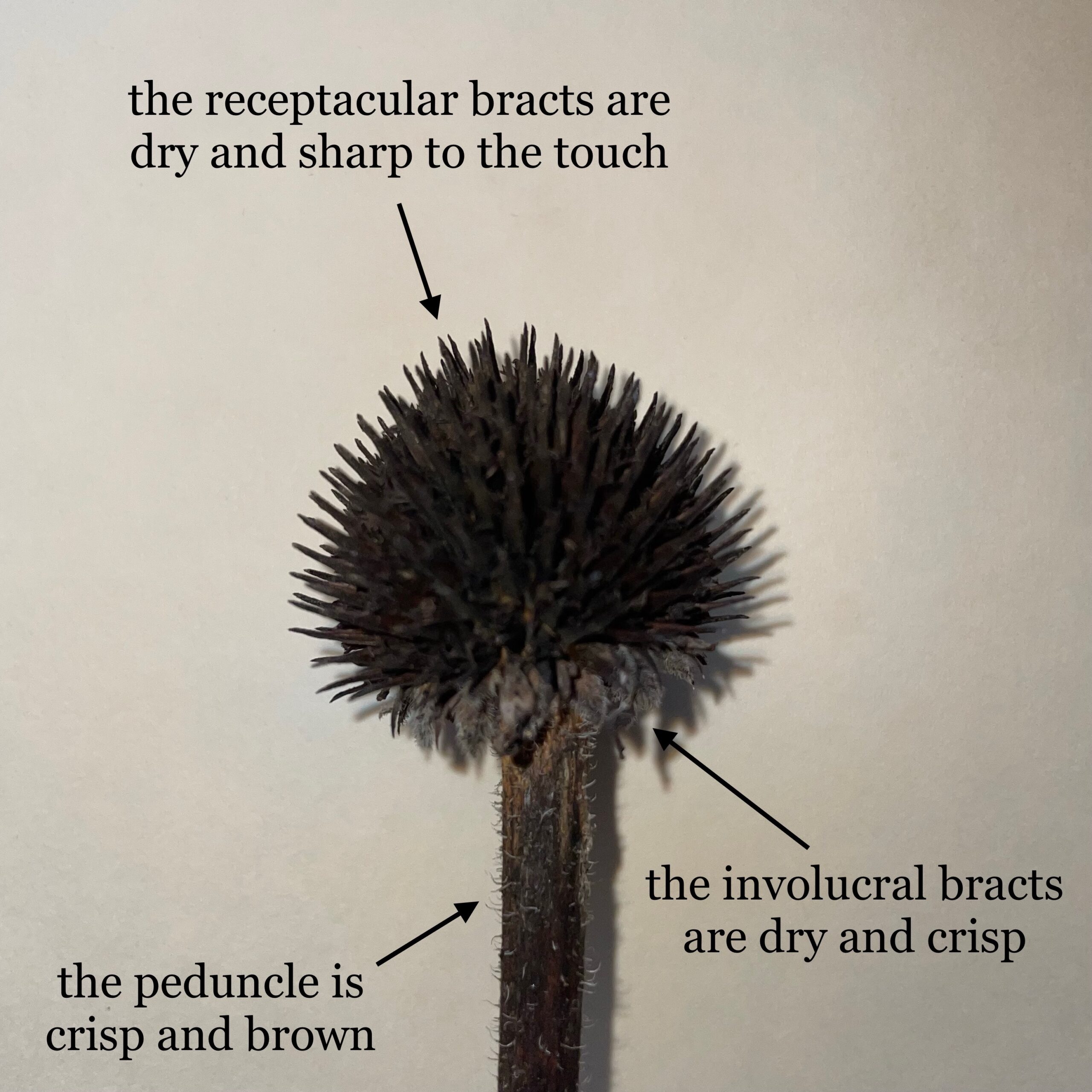
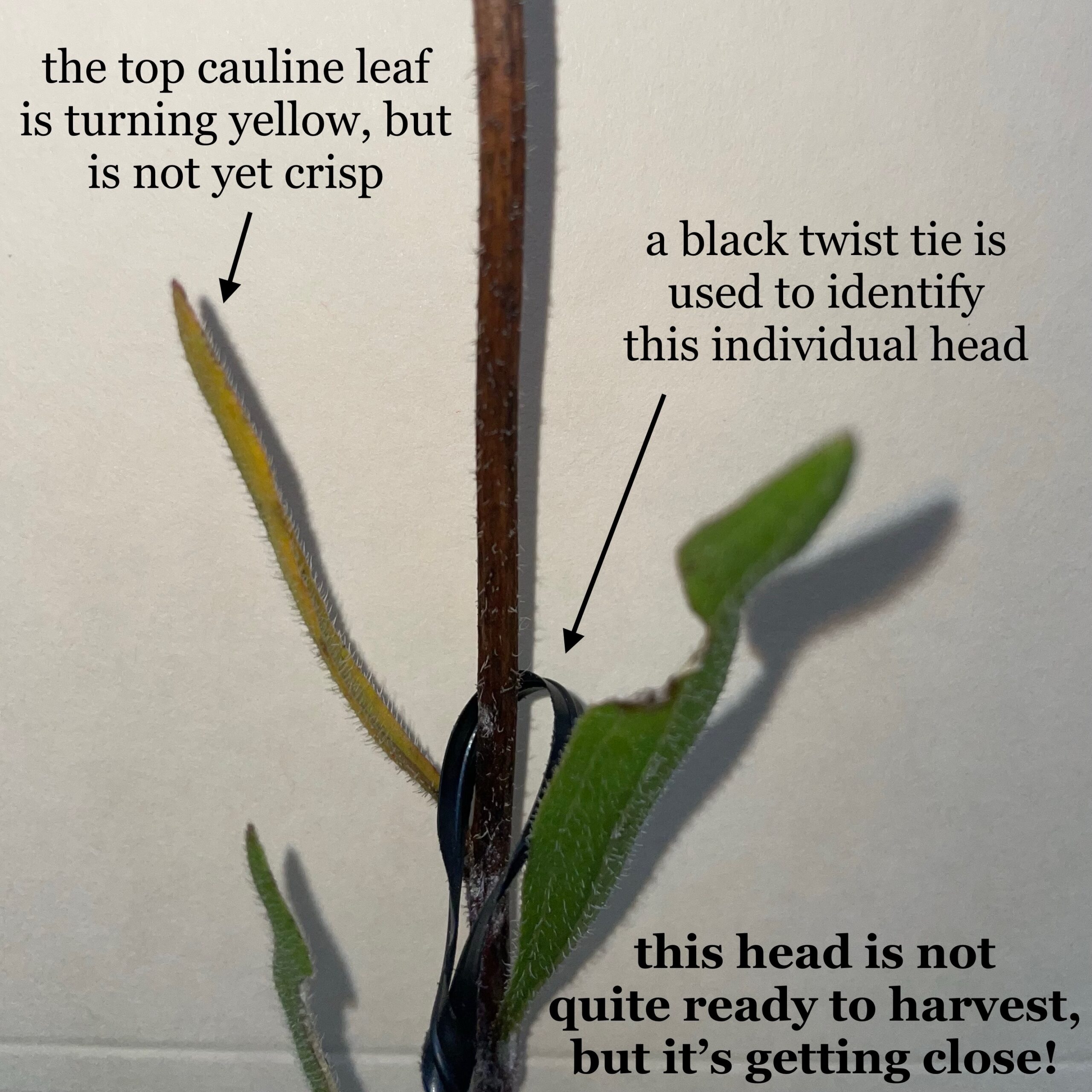
On harvest days, we visit every head that has not yet been harvested. Working in pairs, we independently assess whether each head is ready for harvest, then compare our assessments and discuss. For an Echinacea head to be ready for harvest, it must have 1) dry/sharp receptacular bracts, 2) crisp involucral bracts, 3) a dry/brown peduncle, and 4) a crisp top cauline leaf. If any achenes are missing or appear loose, the head is harvested no matter what, to minimize the loss of achenes.
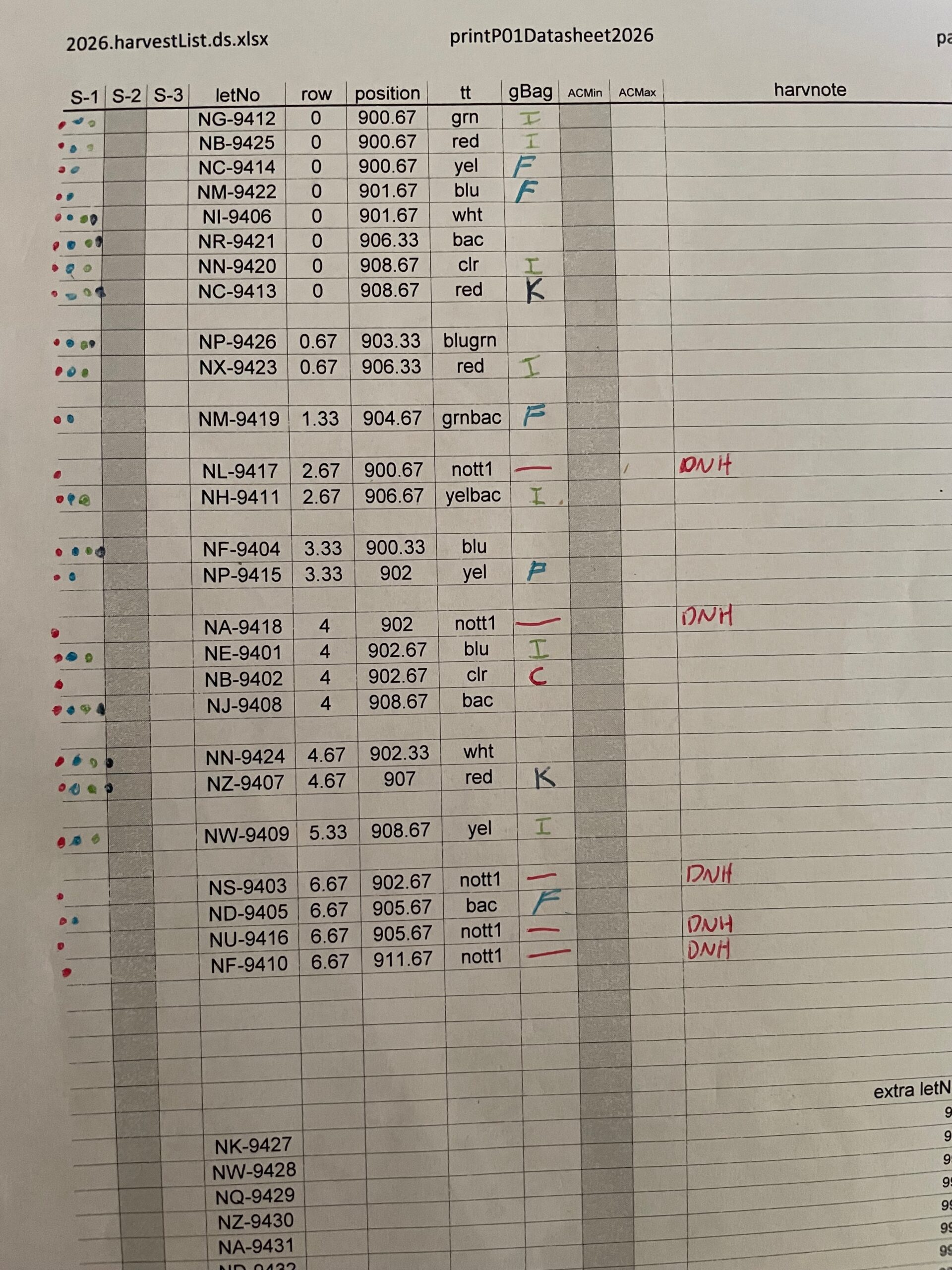
We use our harvest datasheets to keep track of this process. Each time we visit a head, we make a mark in a new color of pen to record our visit. If we deem the head ready to harvest, we carefully remove it with a hand pruner and place it in an “h-bag” (head bag). We label the h-bag with the LetNo (a unique 6-character identifier) assigned on the harvest datasheet. If harvesting all heads on one plant together (as is protocol in ExPt02), we may choose to use more than one h-bag, or an “l-bag” (lunch bag). The labeled bag(s) are then placed into a “g-bag” (grocery bag), which is given an identifying letter unique to that harvest session. The identity of the g-bag is also marked on the harvest datasheet. As you can see, a wide assortment of bags is crucial to a successful head harvesting operation.
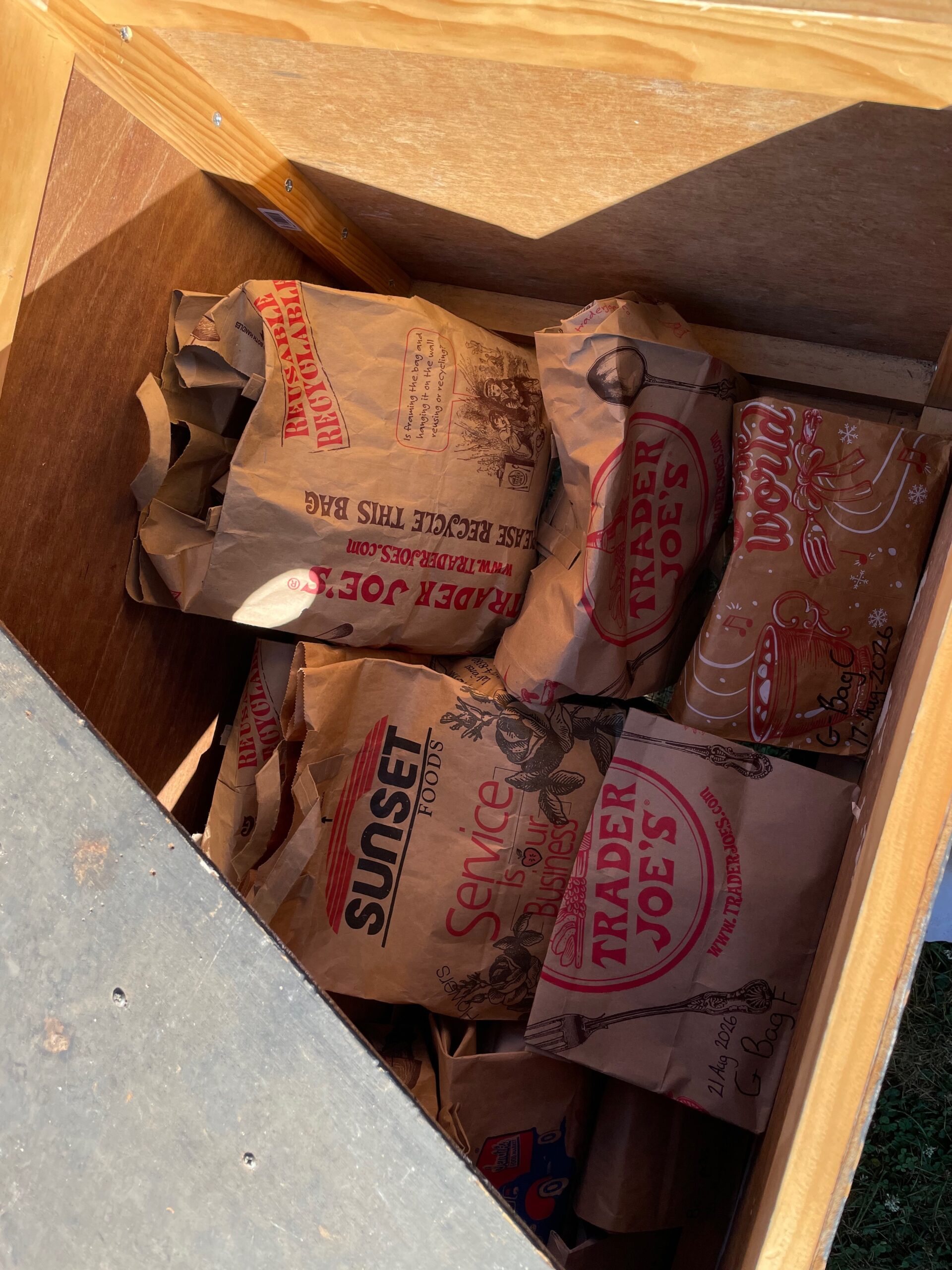
When we are finished with a harvest session, we close up our g-bag and add it to the seed dryer (a wooden box painted black which uses the power of the sun to dry Echinacea heads and other seeds). This way, when it’s time to process these heads and count achenes, they will be well-labeled and completely dry. As we continue to harvest this year’s crop of heads, we have also been working to process the heads and achenes harvested last year. Stay tuned for a flog post on head cleaning and scanning!
Our harvest is progressing well! Harvest at ExPt02 and ExPt08 is complete, and fewer than 10 heads remain to be harvested in ExPt01. Other than an unfortunate incident of seed predation in ExPt02, where 49 heads were eaten by some sort of monstrous creature or creatures (deer? ground squirrels? bears?), we have managed to harvest almost every head without losing achenes. If all goes well, next year’s team will have no problem sorting through and collecting data on the heads that we have harvested.
Many of the variables that affect harvest are out of our hands. We can’t control how quickly Echinacea heads mature, nor can we prevent animals from eating or achenes from loosening. This harvest system, developed by Team Echinacea over the years, allows us to obtain high-quality data from a highly unpredictable system. In the end, the natural unpredictability of our study system is what makes this research so exciting!
QUICK SUMMARY: A wide assortment of bags is crucial to a successful head harvesting operation.
Leave a Reply