|
|
Hi, my name is Ben Iberle and I’m going to be a junior Biology and Music major at Grinnell College in Grinnell, IA. I was born in Seattle, lived in the Willamette Valley of Oregon for nine years, then finished off the job in Vancouver, WA, right across the mighty Columbia from Portland. I love the Northwest, I love backpacking and hiking through it. I love the prairie, too, and I wish there were better places to backpack through big bluestem. I play ultimate frisbee, soccer, saxophone, and Scrabble. I think Kraken is my favorite word.
Hi, I’m Julie Stutzbach from Pitman, NJ- a small town near Philadelphia in the southern part of the state. Presently, I am a Bio major at Beloit College where I run cross-country. About a month ago, I returned from Ecuador and the Galapagos Islands where I studied Ecology, Evolution, Botany, Conservation, and assisted Luis Vinueza with a research project on algal distributions. Last summer, I worked at Gateway National Recreation Area in Sandy Hook, NJ on a Botany Invasive Species team trying to control some invasive plants in the park such as Mullein, Autumn Olive, and Tree of Heaven. I especially enjoyed the cut and stump method using chainsaws. You can see me sawing down a Tree of Heaven on YouTube: http://youtube.com/watch?v=cAzu5XQLF30. I am especially interested in Ecology, Botany, and Conservation science making the Echinacea team a solid match for me. After graduating, I want to see as much of the world as I can and then continue on to graduate school.
I was talking to my mom on the phone last night and mentioned how we squatted all day, but it was hard to do so comfortably without squashing the vegetation. My opinion is that the buckets don’t help much with this, especially on slopes. I thought my mom had a great suggestion: use milking stools. It would pack down less vegetation than the buckets and might be more comfortable (I say might because I’ve never actually used a milking stool). Just a thought.
I was born and raised in western Nebraska, graduated with a bachelor’s degree in biology from Nebraska Wesleyan University, spent a year working at the University of Washington herbarium, and will be attending the plant biology and conservation program at Northwestern in the fall. I grew up on the prairie, so it’s close to my heart, but I love everything plant-related, including eating them. I’ve been a vegan for seven years, but when I’m not reading the labels on food packaging, I like to read, sew, and BAKE.
I’m currently attending the University of Vermont (UVM) in Burlington, VT and will be a Junior next year. I am majoring in Environmental Science with a concentration in Water Resources. Burlington is a great little city. It is progressive and there is so much going on for such a little place…well, it is the biggest town in VT. There are so many great restaurants and shops and locally grown/made is a huge thing there!
I am from “Clover Valley” Minnesota. You won’t be able to find that on a map…but it is somewhere in between Duluth and Two Harbors a bit inland from the lake. Lake Superior is awesome and if you haven’t been to the North Shore and the Boundary Waters you definitely should at some point in your life.
Hello Echinacea fans!
I’m Christine… and I’m in the Plant Biology and Conservation master’s program at Northwestern University.
Here are some things I saw at the grocery store yesterday:
1. 40 jerky sticks vacuum-sealed together
2. A jerky gun (Fast on the draw, according to to the package)
3. Fireworks
I feel so un-American, not owning any of this.
Here’s an update on the main research activities this spring. The cool spring with a late snow (~15 inches -38 cm- at the end of April) delayed burning weather somewhat and we think seedling recruitment may be later than in the past few years.
Recruitment/Establishment Experiment
On May 9 I mowed burn breaks so the DNR burn crew could burn the plots. They burned the middle unit at Hegg Lake WMA on May 28. Two plots were in this unit. Here’s a photo of one plot just after the burn. Nice work! There are 3 plots to be burned at Hegg Lake WMA, two at Kensington Duck Refuge, and one a Eng Lake WMA. At the duck refuge I saw 2 Sandhill cranes and a Red-necked grebe (among the regular, awesome array of water birds).
Common Garden
Dwight, Jean, and I burned the common garden on May 22, starting just after noon. The weather was within prescription, but the wind was a bit strong and the fire jumped the gravel road and started some corn stubble. The fire worked its way to some reed canary grass and we managed to put it out there. If it had gone a little longer it would have torched the cattails and burned the whole slough west of the common garden. Whew!
The running fire was great in the 99S garden, but there were quite a few unburned spots in the main garden. We burn the CG every other year and we mow paths annually, so we don’t have quite enough fuel for really complete burns. Maybe in 2010 we should augment the fuel load with some prairie hay.
A big tree just east of the CG caught on fire. It was hollow, but quite strong. It finally broke and fell over around 7 pm. To put it out we scraped all the embers and coal from the trunk with an axe and shovel. We couldn’t reach a spot of punky wood 8 – 9 feet (2.5 m) off the ground. So I climbed up the trunk and used a 5 lb. pick mattock to scrape out the embers and punky wood. Then Dwight lifted the smith Indian backpack sprayer over his head and I sprayed and sprayed and sprayed. We put it out by around 10 pm. Exciting! We need to cut up the part of the tree that fell on the CG.
An adult bald eagle flew over the CG just as we started to burn and then again around 8 pm — great!
On 24 May, Gretel and I broadcast seed over the CG. We seeded Galium boreale, Bouteloua curtipendula, and Schizacharium scoparium. Gretel, Per, and I seeded the ditch with many species of seed, including Stipa spartea and Spartina pectinata. We forgot to seed the 99S garden.
Seedling Search
On 27 & 28 May Ruth, Amy, Julie, and I searched for Echinacea seedlings in five remnant prairies. We searched about 75 circles with 41 or 50 cm radius and found 17 seedlings. Several had only cotyledons and the tallest first leaf was 24 mm. We got rained out yesterday (29 May). It was also cold and windy.
Hjelm house
Last weekend Pete, Dwight, Gretel, and Stuart cleaned out all the sheetrock and insulation (yuck) in the house. That was a job. We got the house all ready to have the floors sanded. We have a lot left to do to get the house ready for the main field season. The highest priorities are bathroom and computer network.
I just found out that there is video footage of the house being moved on YouTube.
Here are the 3 links:
part 1
part 2
part 3
Enjoy!
Well, thought I’d just say that I am safely back in Washington after a nice long drive. We were slowed down by a flat from a nail and a screw stuck in my tire, at least one of which was probably picked up in Minnesota. Other than that, thanks for the great summer and good luck in school or whatever else you may be doing. Jennifer and I finally got to talk to one of the naked Finnish men on Lake Isaac and we obtained a few words of wisdom. The most important piece, which I think I ought to share, is that “taking a sauna with a swimsuit on is like kissing through a screen door.” That explains so much.
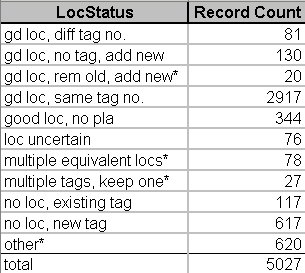
Here’s a quick tally of the demography data that we took in the natural remnants this summer. I think we did a lot! We took a total of 5027 records. Here they are broken down by loc status…

This is just the first rough pass through the dataset. There is a lot of clean-up to do and mysteries to figure out. For example, of the 81 “good loc, diff tag no” records, 12 have no loc and 1 has no tag (gulp).
Flowering rates seemed to be high this year. 1700 records list one or more normal flowering heads and another 223 records had only non-normal heads. There were some big plants too: two plants had 11 flowering heads and two had ten! The greatest number of rosettes was 47 (that’s good ol’ plant #1540 at NGC.) We counted 9276 total rosettes.
The summer field season is done for me. We drove back to Illinois on Saturday. I’ll try to post reviews of the datasets occasionally and maybe some photos too.
Jennifer is the only one still in the field. She is harvesting seedheads today & tomorrow, then returning to IL.
|
|