|
|
Today we began by presenting some of our independent projects to the group. Alex presented his proposal about studying the effects of neonicotinoid pesticides on native solitary bees. His study will analyze soil samples from several of our plots in addition to a behavioral study on the bees. Alex is very excited to be one of the first researchers to look at the effects of pesticides on solitary bees because so much research has been solely focused on honey bees. Alyson taught us about bogs and invasive species. There is approximately 10 acres of bog behind the farmhouse that Alyson is going to use to examine the impacts that non native buckthorn has on the bog ecosystem. She will remove buckthorn from half of her plots and compare them at the end of the season to the untouched plots. Assessing leaf litter, nitrogen levels, sunlight, and soil pH are some of the possible measures Alyson wants to use to compare the two. I presented my project which looks at how pollinator behavior towards Echinacea changes over the flowering season in a community context. I will be looking at the co-flowering densities throughout Echinacea‘s flowering period and comparing this to the pollen loads of several native bees. By collecting bees from several taxa, removing their pollen loads, and analyzing under a microscope I hope to determine what ratios of co-flowering pollen to Echinacea pollen is being carried and how this changes over time. I will also be conducting a behavioral study in which I observe what flower pollinators visit before and after visiting an Echinacea flower.
After our presentations we went out to Q3 to mark seedlings. It was a beautiful sunny day which a cool breeze, perfect for searching for Echinacea! We recorded seedling position in order to update our GPS coordinates, leaf height, and presence of cotyledons. The tallest seedlings we found were 9cm tall, one section had 8 seedlings present! We will return to Q3 tomorrow to continue our data collection and marking. This project will allow us to test Fischer’s Fundamental Theorem of Evolution in nature.
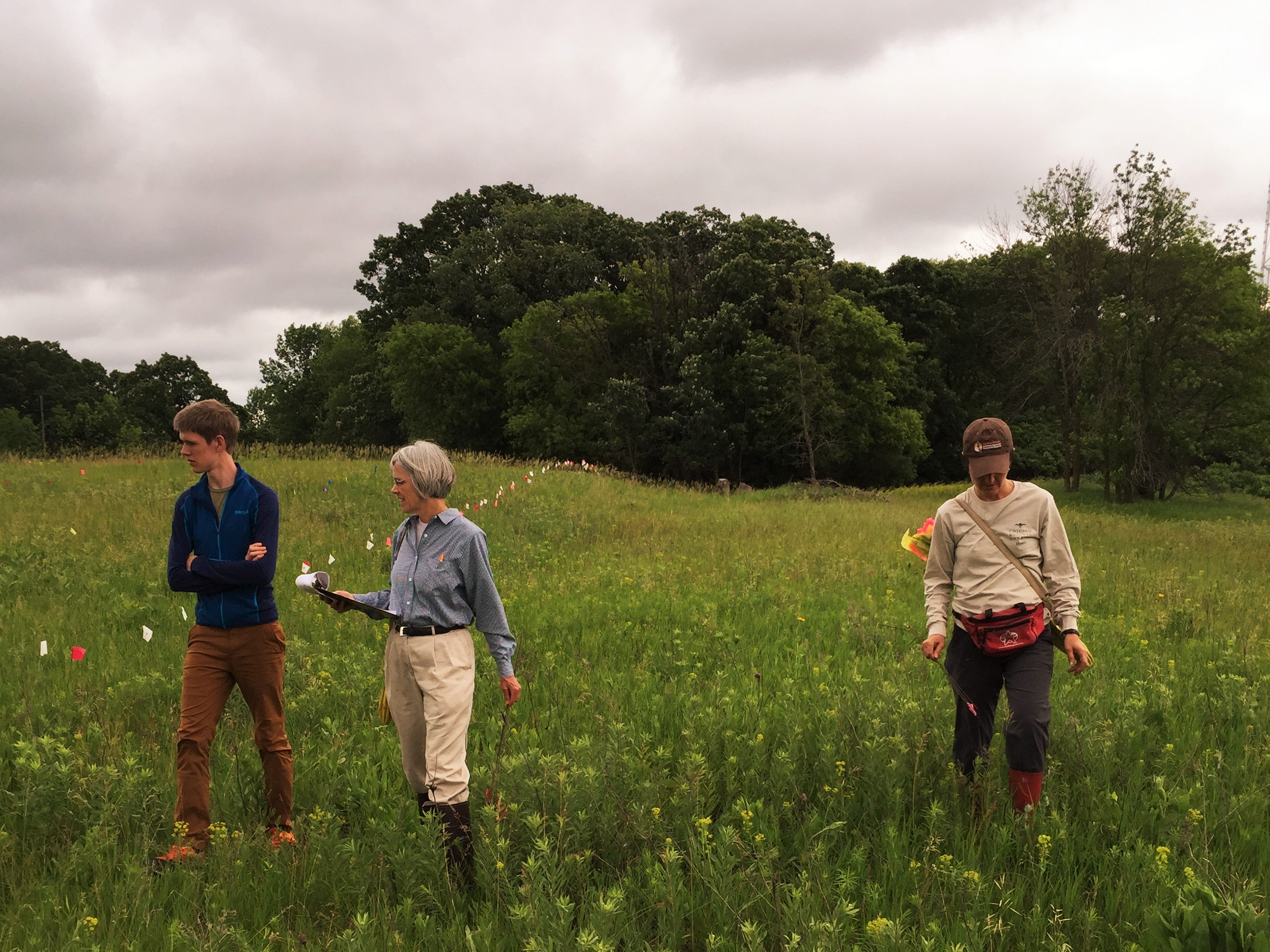
 Gretel and Alyson record Echinacea seedling data in Q3 Other notable events from June 16, 2016:
- We saw a bald eagle fly over us at Q3 and a vulture almost preyed on us. While there is a fine line between speed and accuracy in data collection, the vulture realized we were all alive and moving fast enough.
- I encountered my first tick and James taught me how to sex them, it was a female and I was not bitten.
- Jennifer left for the Evolution Conference in Texas and we all wish her the best of luck!
Today, we (Alex and Laura) visited the Landfill remnant prairie site and saw some pretty cool stuff. This site is unique because of its long and narrow shape along Sandy Hill road, and because of its shared border with a soy bean field and the local landfill! Luckily, the wind was not blowing toward us and all we could smell were the sweet prairie roses.
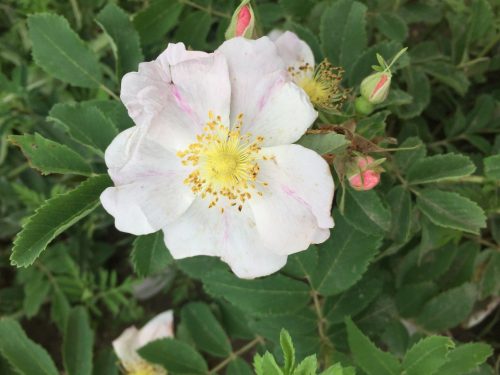
A prairie rose (and buds) spotted on the side of Sandy Hill Road. We believe that this site’s unique fragmentation makes it a good plot for The Echinacea Project. This area still has native prairie plants likely including Echinacea later in the season.
We observed three of the four main types of prairie plants. Most abundant was the non-native, cool season grass, brome. This was really the only grass we saw, and there were no warm season grasses visible. Along the road there was a profusion of prairie roses. We did not see this forb deeper into the fragment, which was interesting and puzzling because in other locations that we visited this week, prairie roses were found throughout the plots. Unlike the prairie rose, another forb, white sage was only found in the interior of the site past the ditch along the road, and was sprinkled with milkweed. Among the white sage, we found a lone false sunflower. It was likely disgruntled because, not only was it lonely, but the sun was nowhere to be found. We also spotted legumes, such as alfalfa and sweet clover, who were much less lonely and basking in the glory of their opulence.
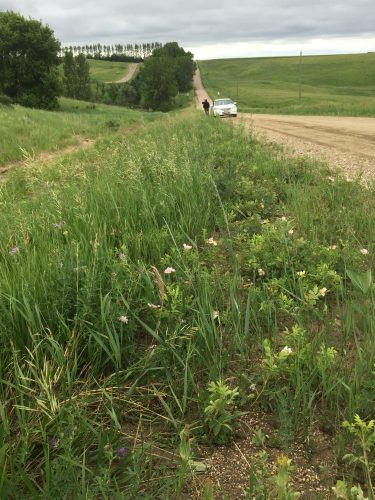
 A view of the landfill prairie fragment and its various plants along Sandy Hill Road. (landfill visible in top left corner) When we visit sites and identify plants, seasoned members of Team Echinacea can predict how this fragment got this way and why these specific plants are present. Today we tried our hand at this game. Considering that the most abundant grass was brome, we believe that this area (the soy bean field and landfill included) was used as land to feed livestock, as brome was initially imported to the New World as fodder for bovine and other grazing creatures. When the agricultural field and landfill were added to this area, the grass persisted in the undisturbed areas. Brome is a nonnative grass that could easily thrive in this area and bounce back from disturbances. Other nonnative plants include alfalfa and sweet clover, which could both thrive in this area for similar reasons. Native plants seem to be lacking at this site, which we attributed to the take over from the grass and legumes and the limited space with strange features. A few native plants, the prairie rose and white sage, were plentiful. They must have persisted through disturbances and been more capable of bouncing back and coexisting with nonnative species than other native prairie plants. We could not account for why all the prairie roses were lined up along the road, but we hypothesized that they were trying to hitch hike to Pasadena for a viewing of the Rose Bowl. Or perhaps, they are just trying to get a ride away form the landfill.
All together, a fun day of developing new skills and strengthening old ones.
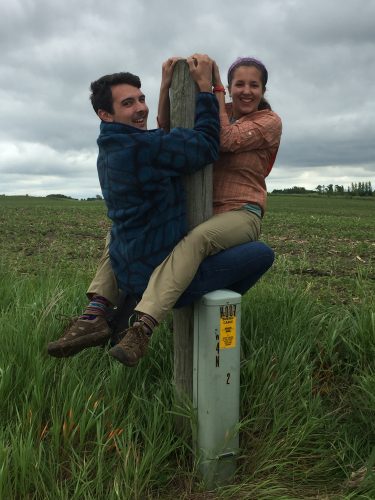
Alex and Laura refusing to leave our new favorite site (and also getting splinters).
Today we visited the rather small and flat NNWLF Site. This plot is just off the road and shows signs of disturbance from cars. The site is interesting because of the nearby pine trees which are not native to prairies. Pine trees could create a shadow over the remnant in the early morning because of their eastern position, this could impact the growth of plants. The outer edges of the plot contained non native sweet clover and alfalfa, which are legumes, and cool weather grass, brome. On the other hand, the core of the remnant contained mostly native milkweed and few non natives. There were no Echinacea buds yet as it is early in the season.
North of Northwest of Landfill Site
We started our second day of the field season with tour of Hegg Lake Wildlife Management Area. Stuart told us about the natural history of the area and we observed how management decisions and land use can impact plant communities. Some changes are obvious: Stuart pointed out that the landscape 200 years ago would have been mostly treeless, but now they are abundant between the agricultural fields that cover majority of the region. Other changes are more subtle: we saw a population of Echinacea at Hegg that were much further along in flowering than any others we had seen, but soon learned that these Echinacea were actually a different species–Echinacea pallida, which are not native to this area. Not all human-plant interactions are negative though! In certain areas we saw a large diversity of native plants, some of which were restored and others which persisted despite disturbance, and we finished up our tour of Hegg Lake WMA with a visit to p2, Jennifer’s experimental plot. This summer we will work in the p2 to answer questions about flowering phenology, pollination, and fitness.
 James, Ruth, and Gretel after setting up flags in p8 At lunch, we heard from Ruth about the quantitative genetics experiment (which we call qGen_1, 2, and 3), which aims to test Fischer’s Fundamental Theorem of Evolution in natural populations. After lunch, Lea, Will, Ruth, and I went to set up flags and get ready to measure the youngest cohorts of the qGen experiments. The rest of the group went out to visit other remnant populations and learn more about the lay of the land. Tomorrow we’ll collect the first data for the 2016 field season, when we search for seedlings from the qGen_3 experiment that was planted last fall. Fingers crossed for good weather and lots of seedlings!
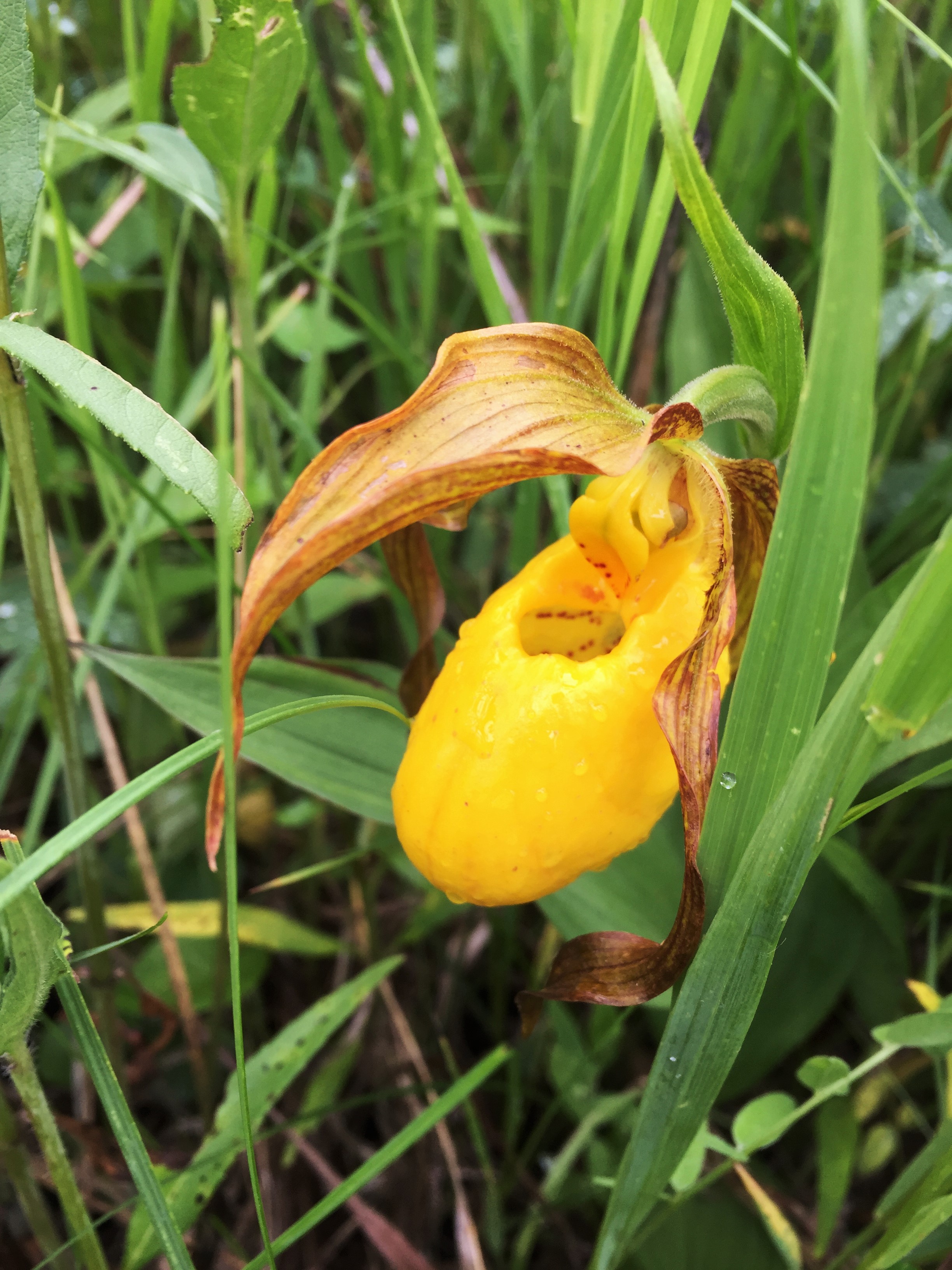
 Yellow Ladyslipper (Cypripedium parviflorum) at Hegg Lake Other notable events from 15 June 2016:
- “What is wind? I’m really flustered as to where it starts. Where does it start?” and “Does wind make noise?” were hot questions on the brains of all team members this morning.
- We saw a sandhill crane and some really neat yellow ladyslippers at Hegg Lake.
- I saw a little baby deer sleeping in p1 when we were putting up signs! It was very cute but unfortunately it ran away when Will walked over to take a picture.
Scott Nordstrom
Echinacea Project 2016
Biology, Math, William and Mary 2015. Operations Research, William and Mary, 2016.
Research Interests
I am interested in studying how complex systems assemble and function. I’m especially interested in pollination ecology (properties of plant-pollinator networks) and spatial processes in ecology. My ideal job is to spend the summer months on the side of a mountain catching butterflies, then spending the rest of the year playing around with data on the computer. I’m new to the prairie ecosystem, so I’m excited to learn it inside and out and contribute to exciting research projects.
Statement
I am from Burke, Virginia, in the suburbs of D.C. I’ve done field work in Oregon, Idaho, Vermont and Maine before this summer. In my spare time I like to hike, run, cook, drink coffee, and listen to my local public radio station.
Me with my vegetable of choice.
Echinacea Project 2016
Hi everyone! I’m a biology major and a political science minor. I attend the College of Wooster in Wooster, Ohio, and I will be graduating from there in 2017.
Research Interests
My primary research interests pertain to conservation biology and environmental science as it applies to biology. As a part of a Wooster education, students are required to complete an independent study project. For my project, I have chosen to study the exposure and effects of neonicotinoid pesticides on the native solitary pollinators of Echinacea. In future research and study, I really want to focus on how human activities have and currently are affecting fragile and scarce ecosystems like the prairies.
Statement
I am originally from Chagrin Falls (a small suburb southeast of Cleveland, Ohio). In my spare time I enjoy hiking, rock climbing, fly fishing, and backpacking, and in recent years these activities have taken me all over the United States. I truly love to travel, and I hope to do more in the future. I also love to draw and paint, and I look forward to doing some while I am in Minnesota.

Echinacea Project 2016
B.S. Biology 2009 California State University Los Angeles
Masters in Education 2012 University of California Los Angeles
Research Interests
As part of Team Echinacea I am certainly interested in understanding more about how Echinacea populations respond to their heavily fragmented environment. I’m also interested in learning more about species interactions from a community level, how species influence each other, and how learning more about those interactions might contribute to restoration and conservation efforts.
Statement
I am from Los Angeles, but have been living in Spokane, WA for the last year. In addition to science I love cooking, taking barre classes, spending time with my dogs, creating random art projects (which may not be worth looking at given the fact I have no expertise at all), and teaching. I was on Team Echinacea last year as a high school teacher and I’m excited to be back this summer as I make the transition back into graduate school!
Echinacea Project 2016
I am a Biology Major and Environmental Studies Minor at The College of Wooster and will be graduating in 2017.
Research Interests
I am very excited to join Team Echinacea this summer and learn more about The Echinacea Project. I will also be working on my Senior Independent Study this summer, looking at the effects of removing buckthorn, an invasive species, on a bog habitat.
Statement
I am originally from Manchester, Michigan, but I currently live in Flushing, Michigan. I play the flute in the Wooster Scot Marching Band and I am Vice-president of my sorority, Kappa Epsilon Zeta. In my free time I enjoy reading, hiking, and taking pictures of pretty flowers and cool fungi.

Today was the first day of the field season. We met at the Hjelm house at 8:30 but quickly left for a tour of the largest prairie remnant that we will be working in, Staffanson Prairie Preserve. We got a lesson in the history of the landscape from Stuart. We learned about geologic features in western Minnesota that were formed by glaciers almost 10,000 years ago! We also learned about the role European settlement had on the size and composition of prairie communities. We had a good look at many of the earliest plants to flower at Staffanson. We also got to see how big of a difference a burn makes in the prairie since the west unit was burned this spring. As we were leaving Staffanson it began to rain and we had to cut our tour of the remnant prairies in Solemn Township short.
After lunch Stuart gave a talk about some of the work that has been done on the project since it started. He talked about the Echinacea angustifolia mating scene and how the different dimensions of reproduction affect plant fitness. Distance, timing and compatibility can all play a role in the reproductive success of Echinacea! Jennifer also gave a talk on her work with pollinators and Echinacea, we learned about how varying taxa of pollinator affects the quality and quantity of pollen that a plant will receive. Her talk gave us a lot of good information to build a foundation for the work that will be done this summer with pollinators!
We called it a day a little early because of the rainy weather and so we could do some reading and think about what we want our independent projects to be for the summer. Tomorrow looks like it will be a little bit nicer or at least it won’t rain so hopefully we will be able to visit a few remnants and get started measuring seedlings that are apart of the Q3 experiment!
A dragonfly I spotted at Staffanson trying to warm up early in the morning, hopefully it didn’t get too beaten up by the rain! Stuart is giving his talk about the 3 dimensions of the Echinacea mating scene!
Echinacea Project 2016
Ecology, Evolution and Behavior & Plant Biology, University of Minnesota – Twin Cities 2018
Research Interests
This will be my third summer with the Echinacea Project, in past years I have investigated methods for increasing pollen longevity and the heritability of flowering time and duration in Echinacea angustifolia. I am very interested in using quantitative genetic methods to investigate traits in long-lived perennials and learning how local adaptation affects prairie species and overall prairie health. This summer I am looking forward to working with the demography and surveying aspects of the project.
Statement
I am from Alexandria, MN about 20 miles from the research site. In my spare time I enjoy doing things outdoors; fly-fishing, biking, hiking and kayaking are a few of my favorites! I also enjoy taking photo’s of the plants that we encounter during our field work. I am very excited to be back with the project this summer and I can’t wait to get started
|
|