|
|
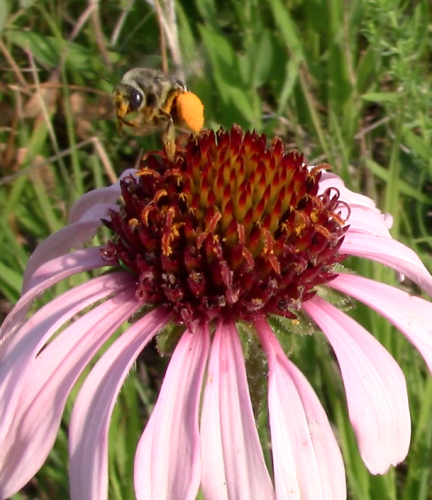
What an incredible three weeks! I wouldn’t have bee-lieved you if you told me three weeks ago everything I would learn! I would have said “quit pollen my leg”. On my first day working at the Chicago Botanic Garden I didn’t know a thing about native bees. Now, I have learned all about the bees that visit Echinacea, from their size to their nesting habits to fun facts about pollen regurgitation and flight velocity. I learned how to navigate DiscoverLife and how to examine a specimen under the microscope, looking for all the little distinguishing traits that make each species special, from the color on the tips of their mandibles to the distance from the rim the hair band on the T4 section of the abdomen rests. The collection of over 900 specimen is now all neatly organized and a reference collection is all packed and waiting to be used in the field this summer. The Echinacea Project youtube account is now set up and loaded with videos of all these little pollinators visiting Echinacea and working their hardest. And, finally, the database on the Echinacea webpage is complete, filled with links and beautiful pictures galore, ready to be poured over by future bee-lovers and scientists alike in the quest to explore the worlds of these bee-utiful pollinators! I want to thank the team here so much for your kindness and for all of your help along the way. Hive-five, everyone!
Happy Wednesday, readers! It’s hard to believe that this will be our last Wednesday here at the Garden, but it is—things are winding down. Well, sort of winding down. We still have a lot of work to do! For me and Jackie, we’ve finally gotten to start the data analysis (also known as the fun part).
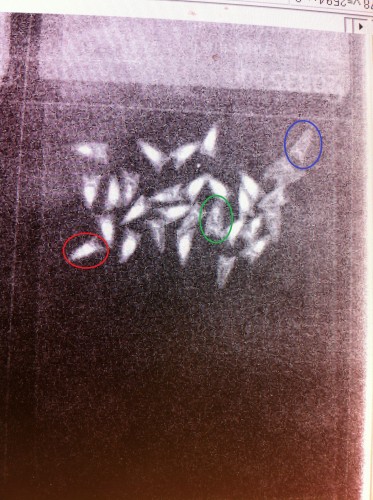
But first, we had to do all of the x-raying! We mentioned it briefly in some other posts, but here’s what the results actually ended up looking like:

We then had to look through the images and count which achenes were full, empty, or partially-full (shown in red, blue, and green, respectively). We use these x-rays to get a sense of seed-set, or how well the Echinacea heads were fertilized. All of the previous steps have been looking at achenes, which are actually the fruit of the flower. All the heads produce achenes, but only some of those achenes have seeds that will grow into more Echinacea. In this way, the x-raying can be considered the most important part; it’s measuring reproduction most directly. Also interesting to note: the x-raying protocol is very careful to minimize the x-ray exposure of achenes being studied. That way, any seeds produced are more likely to be viable, and still grow later!
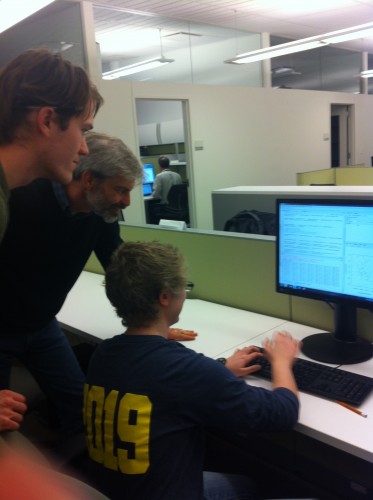
With that out of the way, we’re on to the fun of analysis, which doesn’t actually look that fun (unless you like computers):

Whoops, I accidentally got my finger in the shot.
We’ll be spending a lot of time manipulating our data in R (as shown) and feeding it into models. The idea is to test whether achene location on the head, plant isolation, and flowering timing relate to seed-set. Tune in on Friday for results!
If you have been obsessively checking the Echinacea Project website every few minutes today (as I often do), you will probably have noticed we have added an addition to our beautiful home! After many hours of crashing, banging, hammering, crying, and all those fun things that come with construction and home renovation, we now have a bee field guide. Take the time to explore it, but explore with great caution, as I am positive there are still bugs (hehe) to be fixed. Over the next few days I will right the wrongs and tie up all the loose ends.
What pun should I end with? Perhaps I will continue the metaphor- back to the buzzing of the drill!
We thought the worst was behind us- that all the heads had been cleaned. Today, we found out we were wrong. After digging up (literally) the remaining heads to be cleaned, cleaning, scanning, counting, and randomizing them, it seems like all that’s left is some x-raying and our data set will be complete.
That is, we would be done, if at the end of the day we hadn’t finally found the very last uncleaned head. It had been filed away a little precariously, but no matter. We look forward to tomorrow, when we will have hopefully finished most of the data collection, and can start into our analysis.
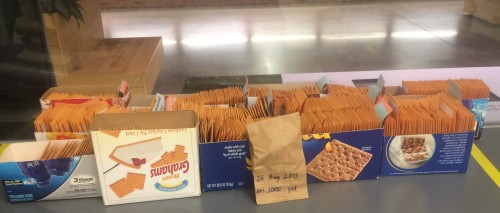
See Below- the impressive (to me, anyway) quantity of coin envelopes we’ve filled with seeds from different sections (top, middle, bottom) of each head, and (officially) the very last head to be cleaned.

Over the course of four Wednesdays spread throughout November and October, we in the Echinacea lab were fortunate enough to have two students from Lake Forest College’s plant biology course. These students, Daniel and Kyle, looked at this year’s (2015) flowering plants that were in the aphid addition and exclusion experiment. They dissected, scanned, counted, and x-rayed the seed heads to determine seed set in these plants then made a poster and did a presentation for their class. It was wonderful to have them here and their contribution to the Echinacea Project will be very useful as we move on with the aphid addition and exclusion experiment.
You can find their poster here.
With our second of three weeks coming to a close, the externs are working hard to get their projects finished. While Belle is still busy with the pollinator database, Audrey and Jackie have been desperately trying to finish processing all the randomly sampled heads from the remnant prairie populations. This processing isn’t quick–that’s why it’s taken up the majority of our externship. As mentioned previously, processing has five steps: cleaning or dissecting the head to get all the achenes out, scanning the achenes, counting the achenes, randomizing a sample of the achenes to x-ray, and finally x-raying the achenes for the presence of seeds. Now that we’re finally done with all of the cleaning, we’ve been focusing on scanning, counting, and randomizing so that we can get x-raying next week. Here’s a behind-the-scenes look at how we’ve been doing these steps:
The scanning is just how it sounds: we very carefully pour the achenes out onto a standard office scanner and get an image of them. This image is what we use for counting. It may seem superfluous to scan the achenes and count from the image when we could count the achenes themselves, but when heads often have more than 200 achenes, it’s tough to accurately count by hand. Computers are much better of keeping track of what number they’re on, so we let them do the work. Once the image is scanned, we just have to click on each achene we see in the image and it’s marked with a dot. The computer keeps track of the number of dots. That way, you know you haven’t missed any achenes and that your number is accurate. Here’s Jackie, in action counting:
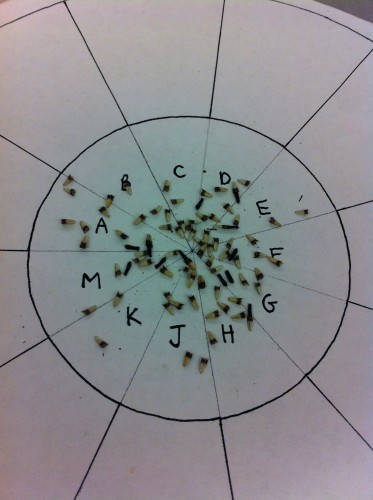
After scanning, I’ve been taking the achenes and randomizing them. In other words, I’ve been taking all the achenes from the middle of the head and taken a random sample of 1/6 of all the middle achenes. This is done pretty simply: you take the achenes and pour them out onto a circle divided into wedges and labeled with letters. Then, from a list random letters, you determine which wedges you’re taking achenes from. For the picture below, for example, the achenes chosen for x-raying were from wedges G and H:
If you think these steps sound a little tedious, you’re right. But, we’re hoping all this processing leads to some really interesting data to analyze next week!
Read Ben’s Lee’s report and look at his map about pollinator habitat in Echinacea land.
Busy as a bee this week! In my battle with native bee identification I was honorably defeated. I will prevail and try again, but in the meantime there is much to do. The bee specimen are now organized and looking beautiful. In total we have 43 different species visiting Echinacea, and a lot of my time this week was spent cooped up in our beautiful little library soaking in the natural light and learning endless fascinating facts about these many species. For example, the big and blustery Bombus fervidus is known to pursue potential threats for hundreds of yards. The Hylaeus bee carries pollen in a special, stomach-like organ in her abdomen rather than on her legs and then regurgitates it back when she reaches her nest. And this is the one that really got to me: The female Ceratina will guard the entrance of her brood chamber and die right there over the winter from the cold, but her body continues to block the entrance, thus keeping her brood safe. Also, this species can produce eggs without mating. Ceratina has got it all figured out.
Next week I hope to get all this information online for everyone to peruse! Bee prepared!
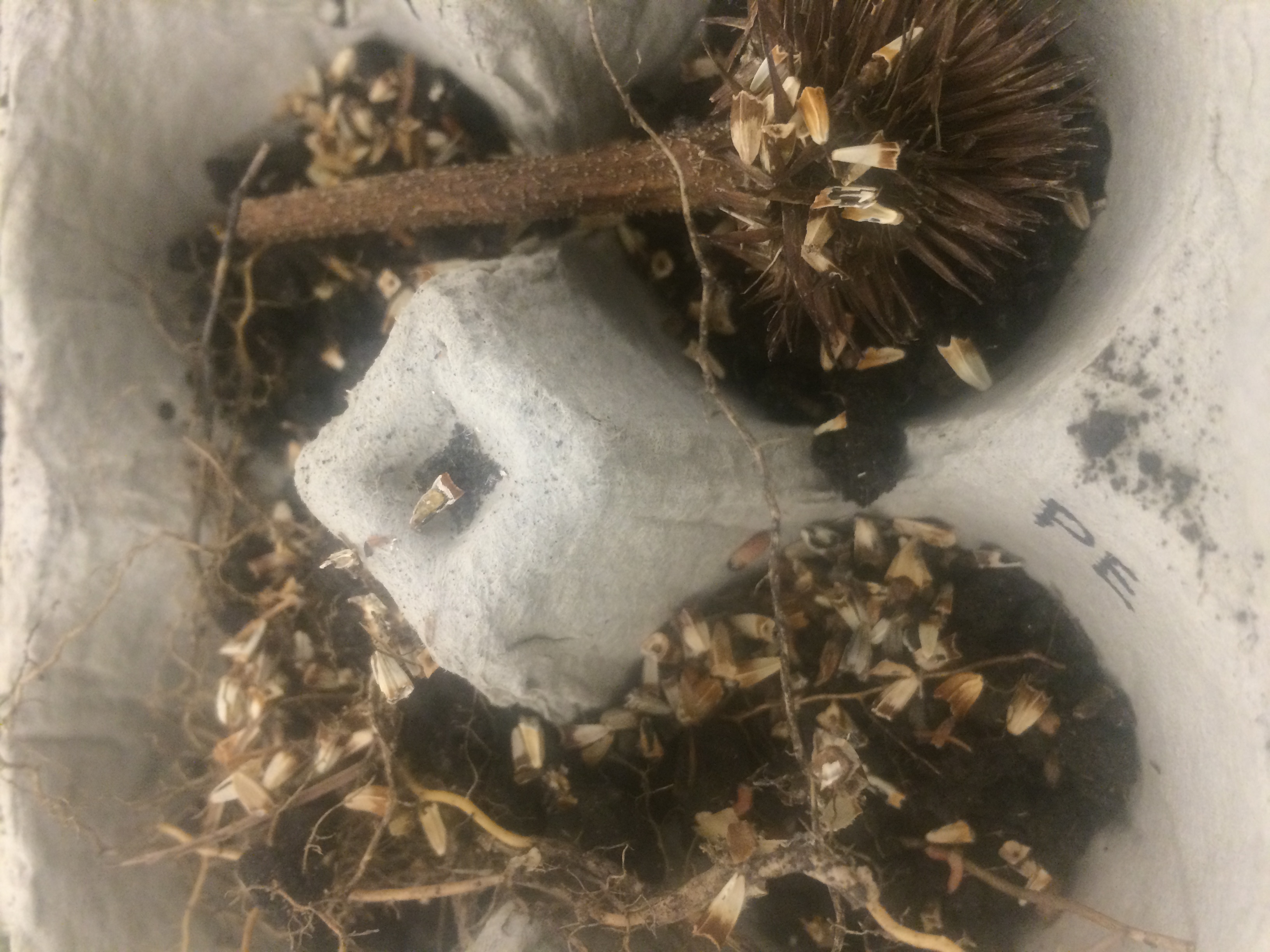
It’s been almost a week since I was extracted from my nice, cozy seed head: the only home I had ever known. Sometimes I still miss it- I had chewed through at least a third of the achenes there, and made nice holes in the base. I don’t know if I’ve ever been more comfortable than when I was firmly lodged within an achene. I also don’t know if I’ve ever been more uncomfortable than when I found myself squished in the grasp of a pair of tweezers. Suddenly, my home and everything I’ve known fell away, and I landed in a pit with lots of others like me. The floor was cluttered with achenes, but the structure was nothing like my old seed head. Moreover, the walls were clear. It looked as if escape would be quick- it is not, believe me, I tried. Something about plastic just doesn’t connect well with my prolegs. Speaking of prolegs, I, and all my kin, have four. It’s a trait characteristic of us caterpillars. Those silly humans probably thought we could have been flies or beetles before looking at our prolegs.
Today is significant, because our numbers have grown to the point where our measly petri dish jail was no longer doing us justice. After a rough and tumble fall into a new container, we’re all feeling a little better. Here we’ve been given a seed head and soil, just in case we decide either of those places are where we’d like to pupate. Things are starting to look up.
(Q: Wait, where did 84 come from? A: We have found about 14 caterpillars, each of whom has 6 pairs of eyes.)
(Q: So, what species are the larvae? A: We still don’t know. It’s possible they are codling moths, but those tend to prefer fruits like apples- more juicy than achenes. It’s also possible they’re banded sunflower moths, which appear just as pink in later larval stages as these larvae do),

Hello! The poster version of the webpage displaying parts of an Echinacea seedhead is now available online, in pdf form. The poster displays the parts of an Echinacea seed head and the types of chaff that might be found while cleaning a seedhead, with many pictures. The link can be found here: https://echinaceaproject.org/wp-content/uploads/2015/12/Echinacea-Seed-Head-poster-pdf.pdf.
|
|