Each year, we assess flowering phenology in experimental plots to determine mating potential for individual plants and see how a number of factors may affect flowering phenology. Some of the factors we have investigated in the past include heritability, burning, and climate.
2019 was truly a special year for Echinacea flowering phenology in experimental plots. There were flowering plants in four – yes FOUR – experimental plots. We had the usual flowering plants in exPt1 and exPt2 at Hegg Lake. We also had a flowering plant in exPt8 (qgen2 and qgen3) and exPt9 at Hegg Lake. Unfortunately, we did not see the flowering plant with an E. pallida dam at exPt9 until late in the season, so we did not take phenology in exPt9.
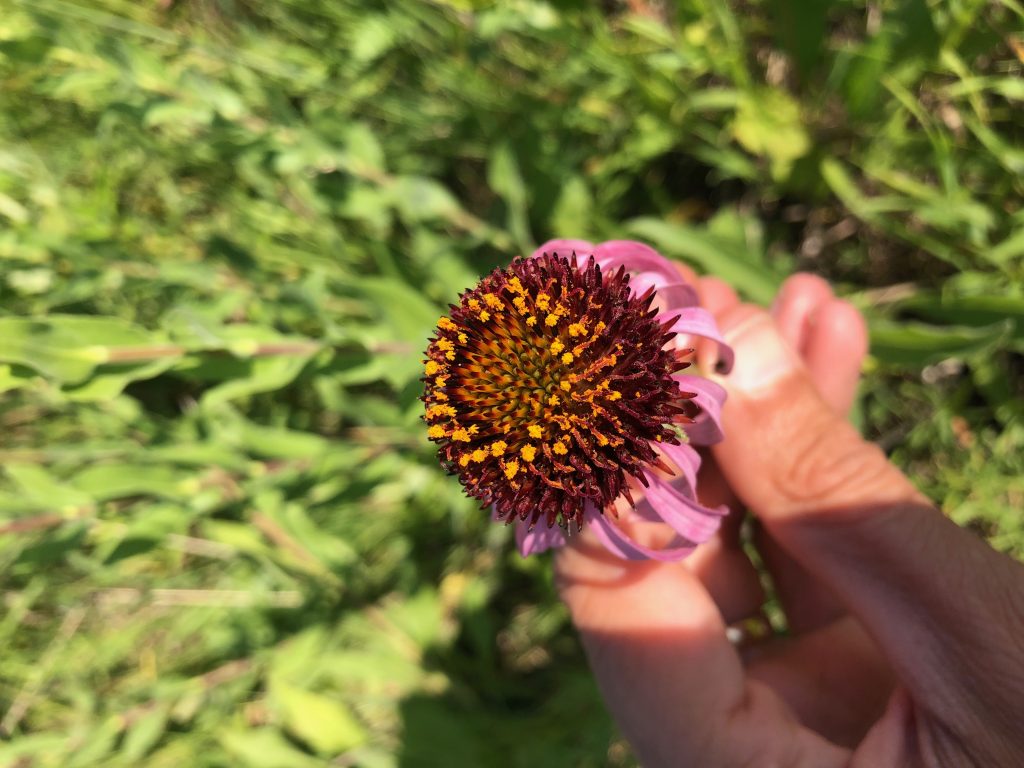
This Echinacea head is mid-flowering. It has more than 2 rows shedding pollen and more than 11 immature florets.
This year, we visited the three other plots and followed the usual Echinacea phenology protocol. We recorded first flowering day and subsequently recorded dates of “mid” and “late” flowering. Finally, we recorded the final flowering date of each plant.
In addition to the single flowering plants in exPt8 and exPt9, exPt1 had 63 flowering heads we tracked for phenology and exPt2 had a whopping 1207! The first flowering head in exPt1 started on July 3rd, while the first head in exPt2 started flowering on July 1st. The last day of flowering in exPt1 and exPt2 was August 21st. What a long summer of taking phenology data!
Data/
materials collected:phenology data (start date, mid flowering, end date,
etc…), harvested heads for the ACE protocol. All phenology data can be found in
the cgData repository in the subfolder p1p2Phenology.
Echinacea pallida is a species of Echinacea that is not native to
Minnesota. It was mistakenly introduced to our study area during a restoration
of Hegg Lake WMA. Since 2011, Team Echinacea has visited the pallida restoration and taken flowering
phenology and collected demography on the non-native. This year, we decapitated
all flowering Echinacea pallida to
avoid interspecific pollination with the local Echinacea angustifolia. We fear that Echinacea hybrids may be infertile, so we want to avoid the
establishment of as many hybrids as possible.
This year, a team slogged through the Hegg Lake restoration to find flowering Echinacea pallida. We recorded the number of heads on each plant, the number of rosettes (some plants were absolutely massive), shot gps points at all plants, and then chopped the flowering heads off! We visited the restoration and cut E. pallida heads off on July 8th, 9th and 10th of 2019. We revisited plants and shot gps points for them on July 11th, July 12th, and August 1st.
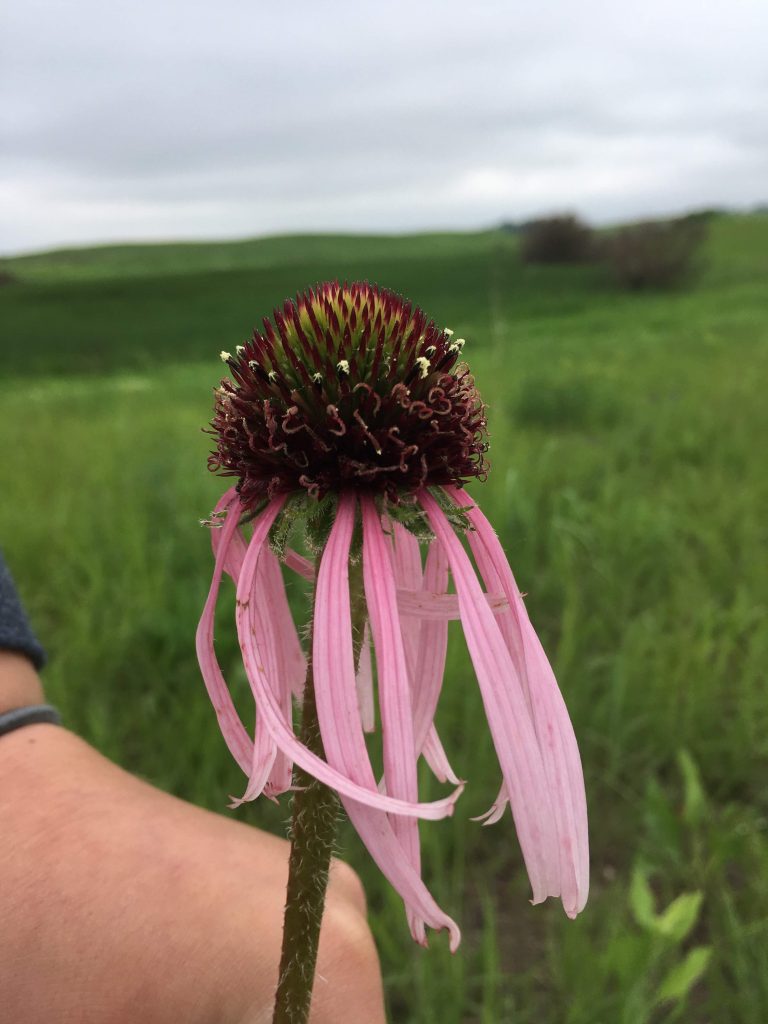
You can distinguish E. pallida and angustifolia heads by pollen color; E. angustifolia has yellow pollen, but E. pallida has white pollen (above).
Overall, we found and shot points
for 97 flowering E. pallida. On
average, each plant produced 2.5 flowering heads. That’s way more than an
average E.angustifolia!The average
rosette count was 5.4, another big number! The largest plant had 23 rosettes.
We collected tissue samples of E. angustifolia, E. pallida, and known hybrids so Elif can assess ploidy at the Chicago Botanic Garden using the flow cytometer.
Start year: 2011
Location: Hegg Lake
Wildlife Management Area Restoration
Data collected: Demography data, head counts, rosette counts, gps points shot for each E. pallida. Cut Echinacea pallida heads, tissue samples for ploidy analysis. Find demo and phenology visor records in the aiisummer2019 repository. Phenology visor records were taken when we cut heads and demography records were taken when we shot GPS points. GPS points can be found in Demap.
In summer 2019 Team Echinacea continued the aphid addition
and exclusion experiment begun in 2011 by Katherine Muller. The original
experiment included 100 plants selected from experimental plot one to have
aphids added and excluded through multiple years. The intention was to assess
the impact of specialist herbivore Aphis echinaceae on Echinacea fitness.
This year Erin and Shea managed the project. They located 15 living addition plants and 22 exclusion plants. The experiment was conducted from July 8th to August 16th. Erin and Shea performed addition and exclusion twice a week for a total of 10 events, with the final visit consisting only of observation. The number of aphids applied to each plant depended on how many could be obtained and varied between five and 10. They recorded the number of aphids present in classes of 0, 1, 2-10, 11-80 and 80<. They also recorded the precise number of aphids added. Erin and Shea found that natural hair paintbrushes were more effective than synthetic and trimmed the brushes down so fewer than half the hairs remained.
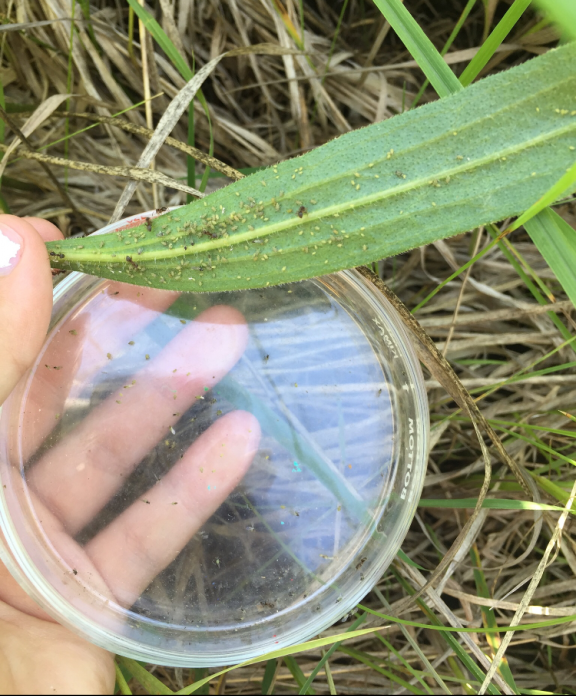
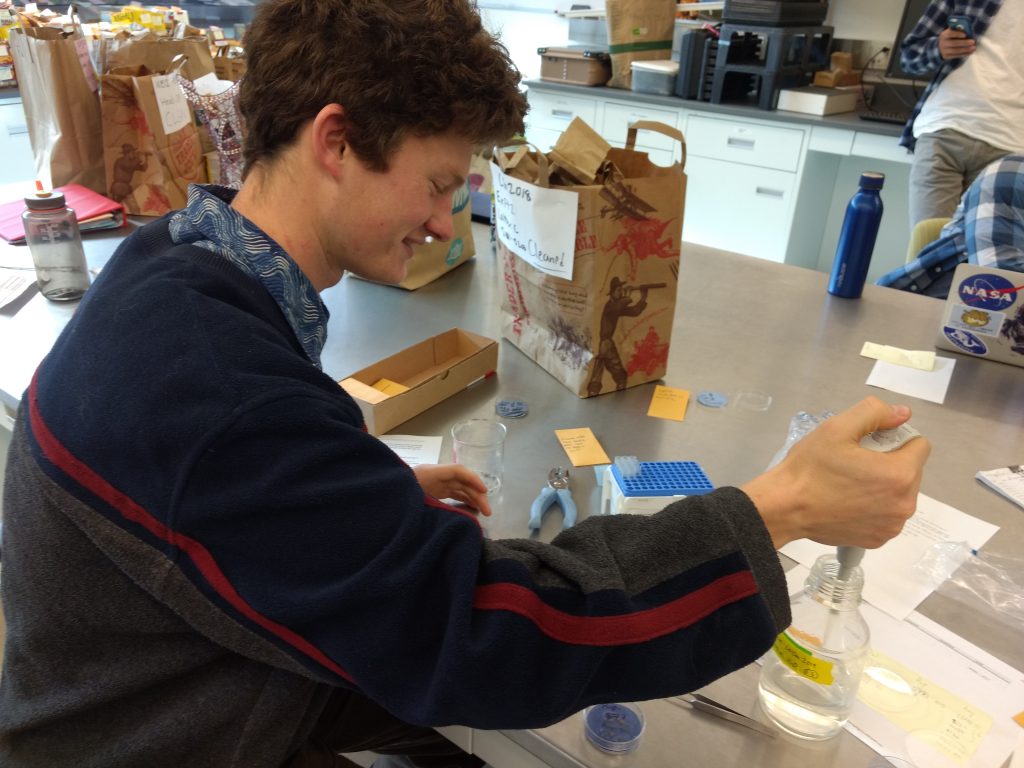
Aphids were gently pushed into petri dishes using paintbrushes
Data collected: Scanned
datasheets are located at ~Dropbox\teamEchinacea2019\aphidAddEx2019\aphidAdEx2019Datasheets.pdf.
The paper sheets are located in the CBG common area filing cabinets in a
manilia folder labeled “Aphid ad/ex 2019,” located next to the 2018 aphid
folder.
Products:
Andy Hoyt’s poster presented at the Fall 2018 Research Symposium at Carleton College.
2016 paper by Katherine Muller and Stuart on aphids and foliar herbivory damage on Echinacea
2015 paper by Ruth Shaw and Stuart on fitness and demographic consequences of aphid loads
You can read more about the aphid addition and exclusion experiment, as well as links to prior flog entries mentioning the experiment, on the background page for this experiment.
Three weeks have gone by fast! It’s pretty incredible how much we were able to fit into such a short time span.
Our first week was spent getting introduced to the center and the work happening here. We met lots of people as well as lots of lab equipment! We learned how data collection happens for the study of Echinacea, by completing a large set of Echinacea achene counting using new study protocols. This study will hopefully yield interesting insights into how Echinacea plants develop and utilize resources. We also learned how XRays are used and processed (RIP to the XRay machine, gone but not forgot), and spent some time helping organize Echiachea heads for later use.
Our second week, we continued the organization and processing of Echinacea data but also began to develop our own research inquires, based on our own personal interests and the data we had to work with. We all chose very different focuses, mine being a focus on long-term analysis of pollinator diversity and abundance measures, or “How are bee populations changing over time in the Echinacea fields?”
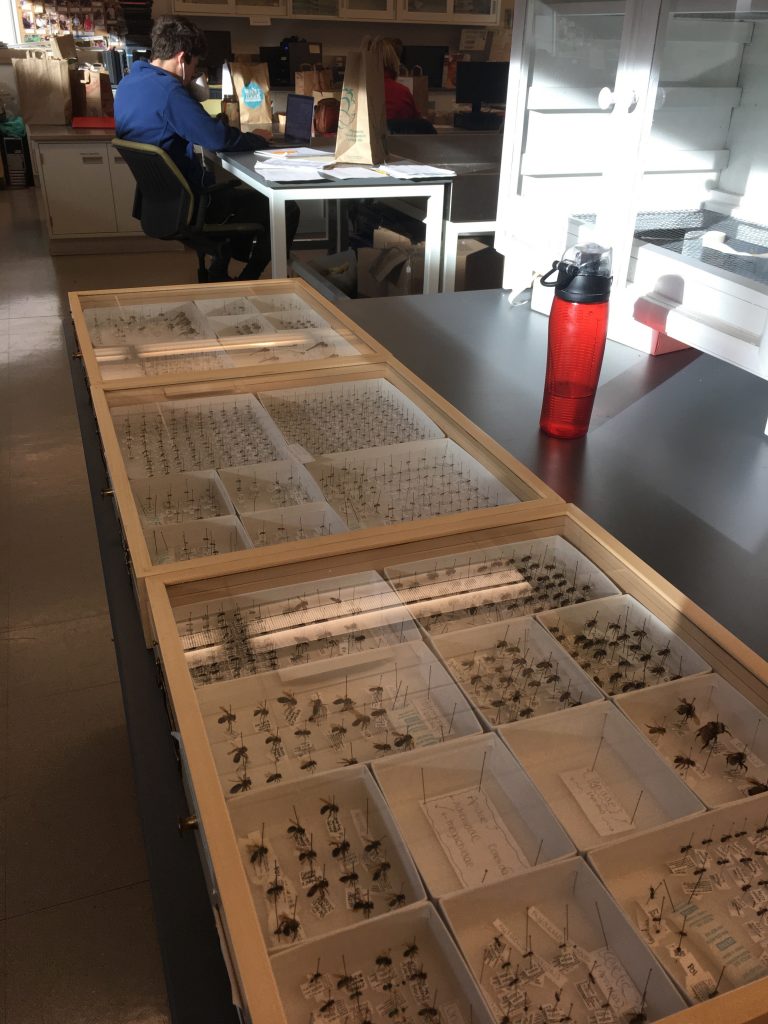
Bee samples that provided me with data for my work
Our third week, we focused in on our projects. Locating and processing my pollinator data took a good deal of time, so I spent a good chunk of the week processing this data as well as learning R, a widely applicable skill for someone interested in science. While I still have a lot of questions and things I’d like to explore further, I am very happy with what I was able to accomplish given the time constraints. Please see my attached presentation below for more detail and major takeaways!
I would like to give a huge thank you to Stuart, Erin, and Riley, who made this entire experience possible. They helped us pretty much every step of the way, whether it was practicing our ‘ABTs’s, scanning seeds, or learning R from the ground up. I am very happy to have had such a productive and fulfilling winter break and look forward to more breaks, and more work like it.
I have very much enjoyed my time here, and after 3 weeks of work am looking forward to the holidays with family, and sleeping in past 6am!
This last week at CBG has been busy and exciting! I’ve collected a lot of interesting data about optimal conditions for stimulating germination in rope dodder, checking my scarified seed treatments each day for radicle protrusion. It seems like rope dodder favors balmy incubation conditions, and scarification with acid and boiling water are both effective in ending the seeds’ primary dormancy. If you’d like to know more about my findings, check out my poster below!
Rejoining Team Echinacea again this winter has been wonderful. Carrying out this independent germination project has challenged me to apply my knowledge and skills in experimental design and analysis to a different kind of study than I had ever attempted. I am very grateful to Stuart and Drake for all of their help and guidance along the way. Even though I was only at CBG for two weeks, I have learned so much during that time, and I look forward to bringing everything I’ve learned here into my future endeavors as a scientist.
Today marks the end of an awesome three weeks! Today all four of us presented our individual projects at this morning’s lab meeting. All went quite well, and it was really fun to be able to present the interesting results to the questions I have been thinking about for the last couple weeks. Here’s my report about climate factors and flowering phenology!
This afternoon we had the opportunity to meet with Andrea Kramer, another scientist in the building, and talked about the struggle and importance of getting scientists and land managers seeing eye to eye to make real progress in conservation and restoration.
We also set up the seeds from three different Echinacea species – angustifolia, pallida, and purpurea – for germination for a new ploidy experiment!
All the best
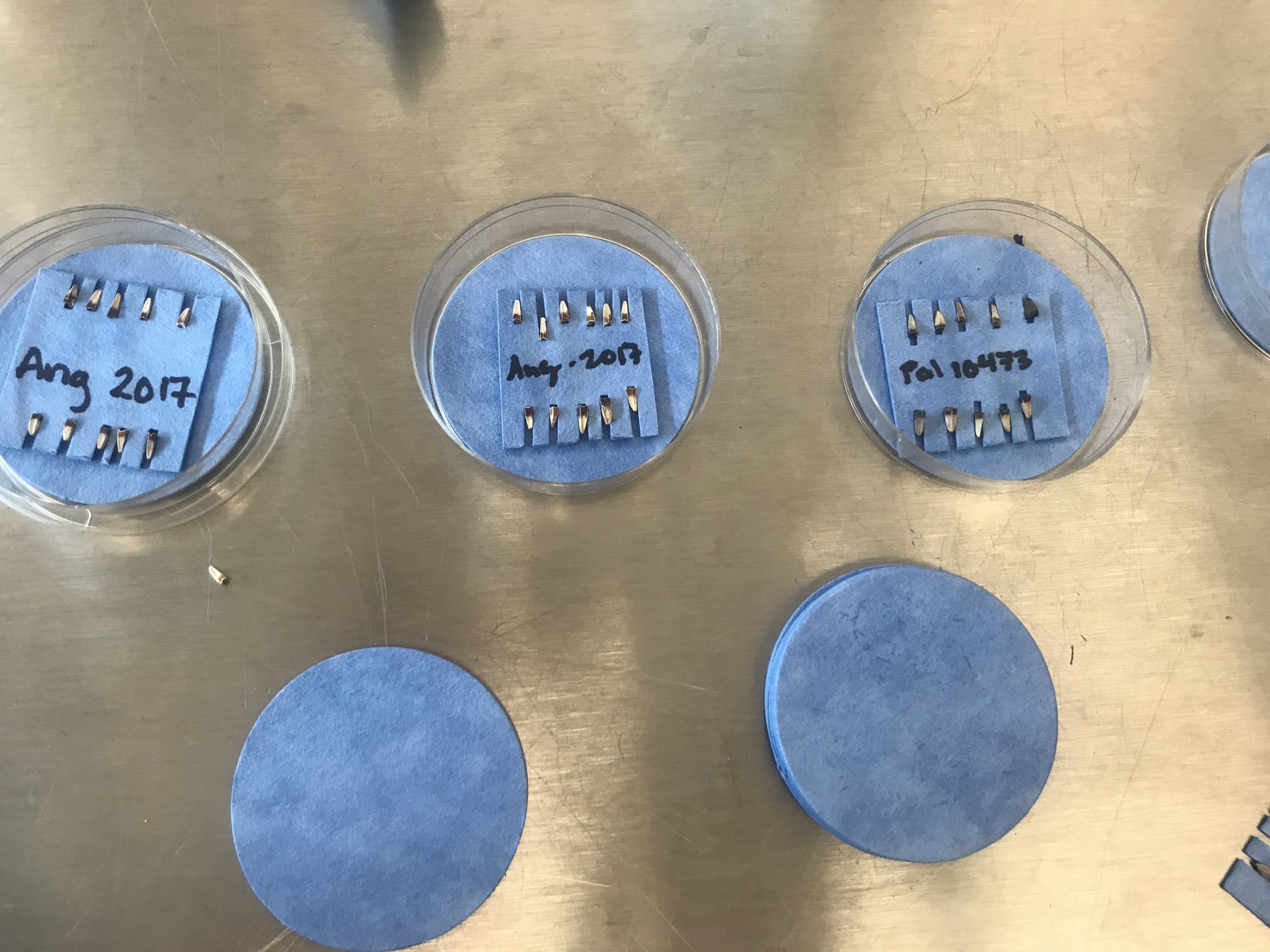
Adding florel solution to the germination blottersAchenes ready for germination!
It has been an awesome time here at the Echinacea project, attending lab meetings, experiencing the ins and outs of a long term ecology lab, and getting to work with an awesome team of people!
Today is the end of what has been a really cool externship! I’ve had a really nice time the last three weeks––Stuart, Riley, and Erin did a great job of helping us get a sense of what it’s like working in an ecology research lab and introducing us to what’s going on in the Chicago Botanic Garden’s Plant Science building. Some of the highlights for me were attending Echinacea Project lab meetings, getting a sense of what the building’s and lab’s culture is like through the office holiday party and an after-work get-together at Stuart and Gretel’s house, and doing a small independent research project. My project was on the impacts of inbreeding on survival and reproduction in Echinacea, and it was a great chance to get some practice using R, developing a project, and presenting it, and I learned a lot both about the study system and about doing research in general!
Working on the Echinacea Project also helped me further pinpoint what’s important to me in a career––doing something that makes a tangible positive impact on the environment and on the planet––and helped me better understand how a career in research might allow me to accomplish that. I’m really thankful to all the people I met here for making it a good experience, especially Erin, Riley, and Stuart, and I would be thrilled to work with them again in the future! Every time I do work on prairies I like them even more.
Now it’s time for everyone to take off for the holidays. I’m looking forward to my family coming to pick me up tomorrow on the way to celebrate Christmas with relatives in Indianapolis. Working for the Echinacea Project was a great way to spend my winter break and it’s given me a lot to think about going forward!
Tate Rosenhagen, an intern from Lake Forest College who spent four week days with the Echinacea Project doing seed research, finished a poster with findings about Echinacea reproductive output and achene weight. We really enjoyed having Tate around, he brought a lot of positive vibes and insightful questions to the lab. Tate is great!
Hi again, Flog! My name is Julie Bailard, and I’m a senior at Carleton College majoring in biology with a minor in cognitive science. I am excited to be starting my second winter at the Chicago Botanic Garden, after joining Team Echinacea last year as a winter extern and working this summer as an REU field intern. I am very interested in population and community ecology, particularly in the context of conservation and ecosystem health. Much of my previous work with the Echinacea Project has centered around one broad question: How effectively do our current methods of prairie maintenance and restoration protect and promote the health of small plant populations in fragmented habitat?
Staffanson Prairie on a gorgeous August day
This winter, I will be continuing to pursue this question in a new setting: my first germination study, using rope dodder (Cuscuta glomerata) seeds that Drake Mullett collected this summer for his dissertation research on the role of parasitic and hemiparasitic plants in prairie community health. Dodder seeds are “hard” seeds, with a tough outer coat that is impervious to water, leaving the seed dormant until that outer coat is damaged. Researchers aren’t sure how dodder breaks out of this physical dormancy in nature. While certain artificial laboratory methods for scarifying seeds have successfully broken the impervious outer coat in other dodder species, none of these methods have been applied to rope dodder, and very little is known about the optimal conditions for germinating rope dodder seeds. Interestingly, one earlier study of rope dodder distribution in Ohio prairies suggested that novel population recruitment may be positively associated with a recent history of burning. With my experiment this winter, I hope to compare the success of various scarification methods in promoting rope dodder germination, in order to identify the most effective treatment for laboratory germination. If possible, I also hope to consider the results in the context of rope dodder’s natural germinating conditions, including climate, sprouting phenology, and exposure to burning.
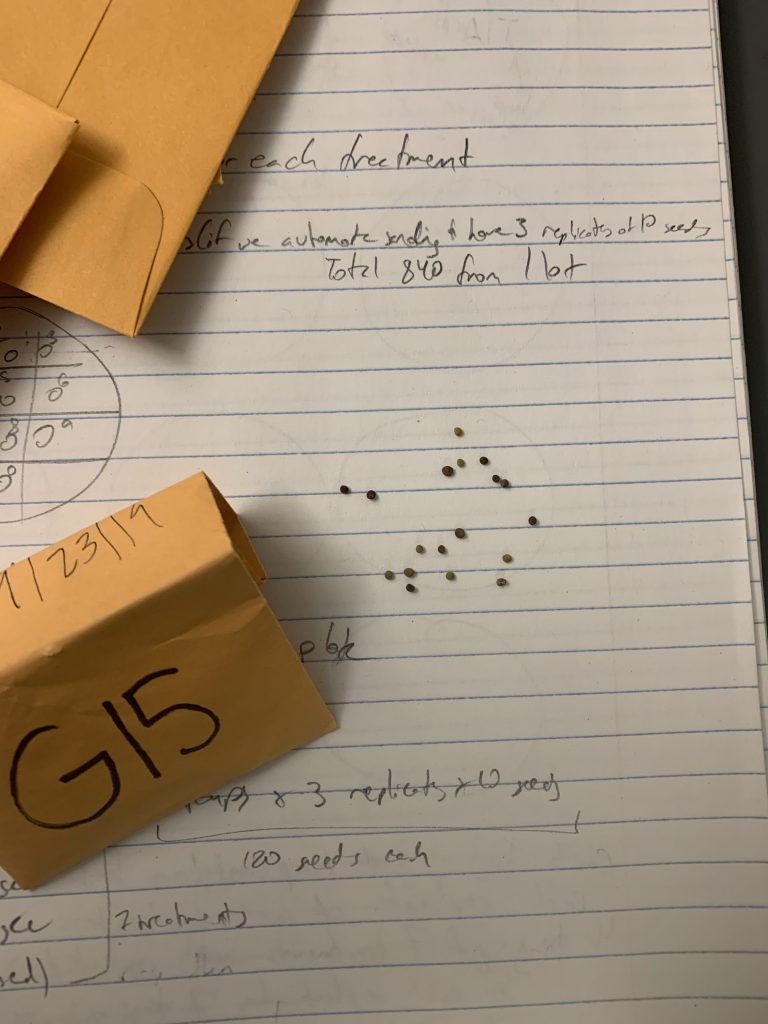
Cuscuta glomerata (rope dodder) seeds are about the same size as a poppy seed. And so far, no one knows how to make them sprout!…And sprout is exactly what I want to make them do! So this week, I’ve been designing and setting up a germination experiment to figure out what scarification methods and climate conditions are best for making these seeds grow.
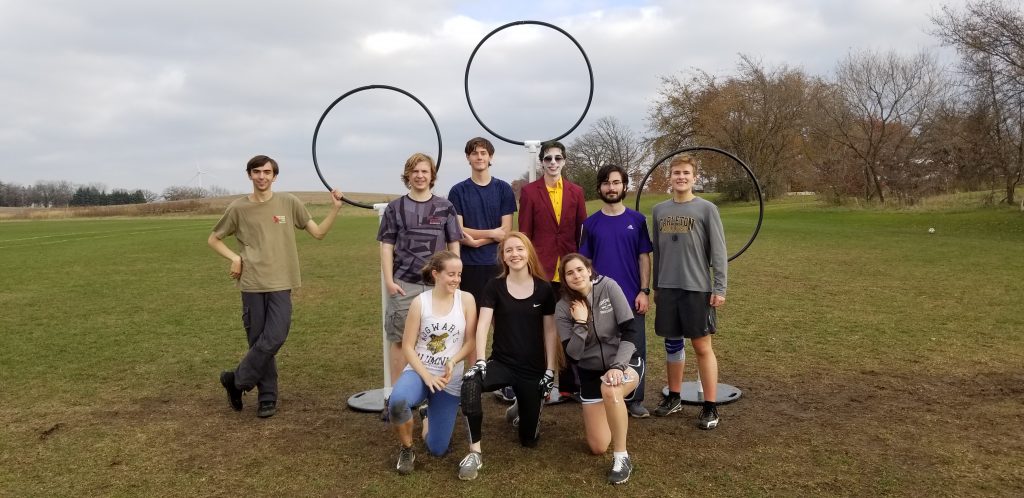
Outside of the lab, I am a clarinetist in the Carleton Orchestra and a consultant in our campus writing center. In my spare time, I also enjoy knitting, practicing T’ai Chi, and playing Muggle Quidditch.
Carleton Quidditch after a Halloween win against St. Olaf (in case you thought I was lying)
This week we’ve continued working towards generating achene data from the Pulse-Steady experiment. It takes time, and care is needed every step of the way to make sure the final product is something we can learn something from! Besides this, we’ve had time for research and thinking about our independent projects. I’m investigating whether there’s a difference in Echinacea offspring success when parent plants come from the same population or different populations, Jack’s working on whether climate factors like rainfall and temperature affect Echinacea flowering phenology, and Eli’s studying pollinator data from experimental plots to determine if any patterns in pollinator populations emerge.
Now we’re all reaching the “data analysis in R” step, which none of us are extremely familiar with, so we’ll be learning a lot about the kinds of questions we can ask and answer with this tool. Erin, Riley, and Stuart have been super helpful in leading us through the research process, and the last two weeks as a whole have been really informative for me on the ins and outs of scientific research and working in a plant ecology lab.
Finally, I can tell the Plant Sciences building at the CBG would be a good place to work based on the office holiday party we got to go to yesterday. From the potluck aspect to the trivia, everyone put in a lot of effort and it’s always a good time when there’s a game of White Elephant involved (I brought a box of Echinacea Plus tea and got a funky clock made out of shells in exchange! That will go great in my dorm room)!