In 2019 100 plants were selected for a flowering induction experiment using liquid smoke at site ALF. They were shot with GPS Darwin. Many of these plants lie beyond boundary fence and are not included in demo/surv. However, records containing a “loc” (numbered 1-100) and the number of heads per plant were taken on visors with the demo form and added to the 2019 demo data. The shot points were not added to surv. The experiment was not executed in 2019.
The demo records were added to aiisummer2019 in file ~aiisummer2019\demo\20190726demo.txt.
Job SMOKE_PLANTS_20190726_DARW contains 100 points shot of plants for the experiment. The job is backed up in three locations:
In 2019 Jennifer Ison tracked and sampled ground nesting bees in Exp. Plot 2 with Miyauna Incarnato, Avery Pearson and Ren Johnson from the College of Wooster. Bees were captured, refrigerated, fluorescent dyed, released and tracked to their nests. Several bee nests were located and shot with GPS Darwin. One was excavated and brought back to Wooster for study.
Job BEENESTS_20190730_DARW contains 13 points shot of nests and their surrounding plants. The job is backed up in three locations:
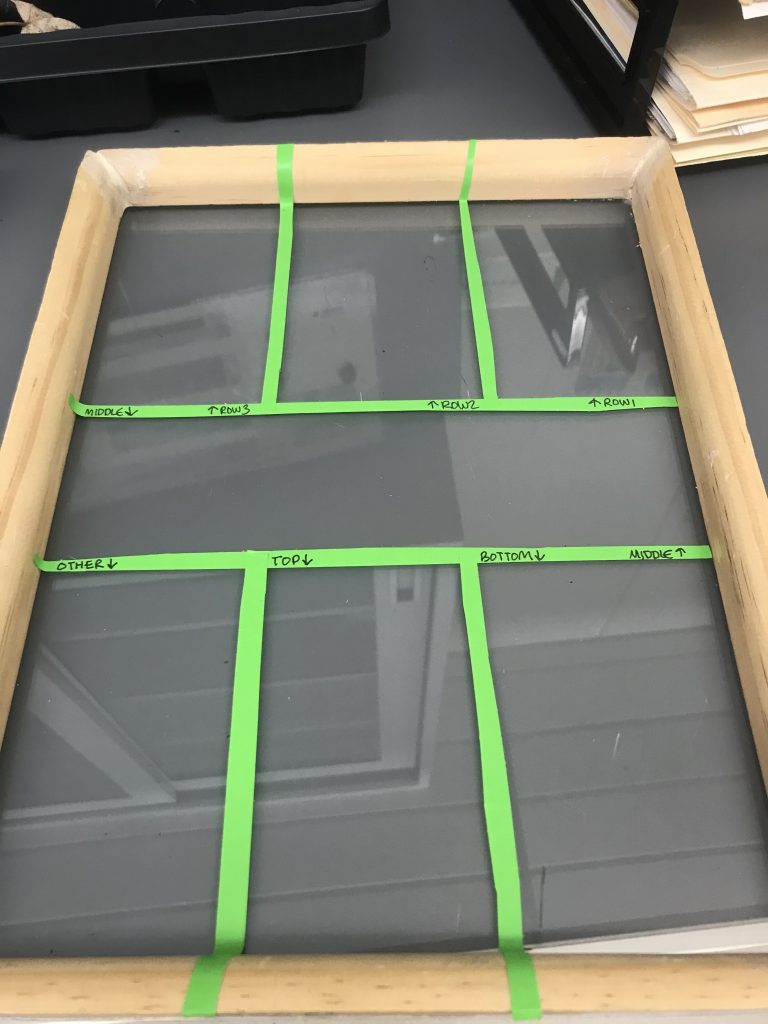
It has been a busy week! Over the course of Tuesday and Wednesday we finished scanning the achenes from the pulse-steady experiment using this fancy board to separate the achenes into their correct categories.
Erin made this to separate achenes when scanning
Yesterday Stuart gave us an introduction into using the X-Ray machine, which we hope to use in the near future on the pulse-steady achenes!
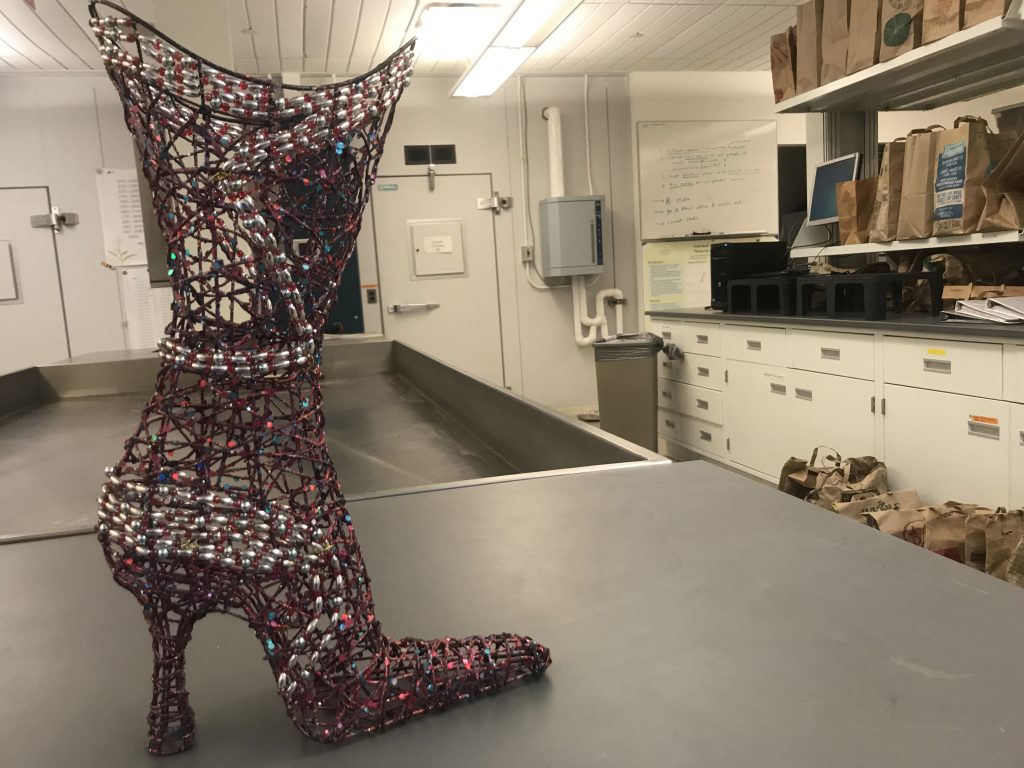
Yesterday was also the building-wide holiday potluck. We enjoyed lots of delicious food and had fun in the department-themed trivia. Our table ran away from the competition and decisively won the trivia trophy!
Our boot trophy from trivia!
We are busy working on our individual projects, beginning to look at data and doing lots of background research.
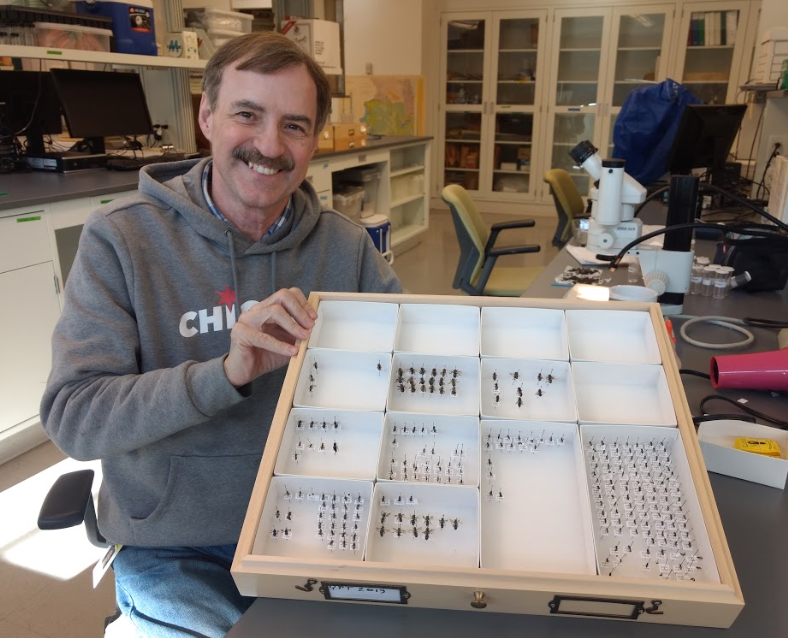
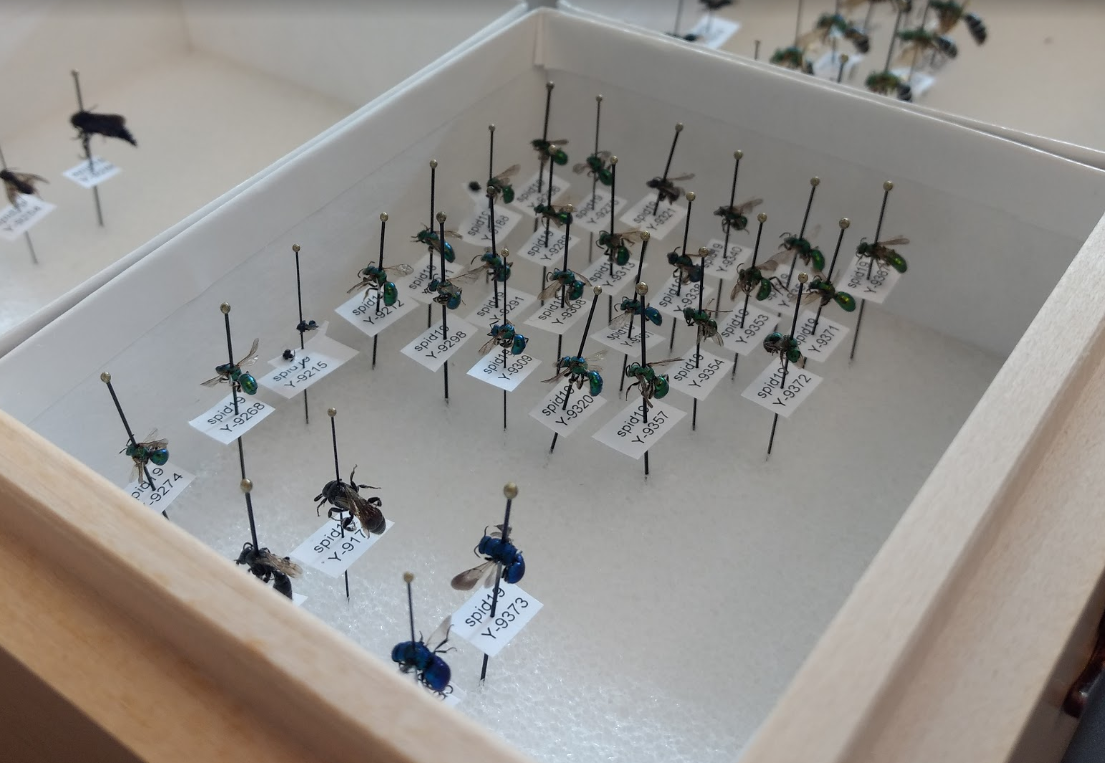
This summer Shea and John continued our yellow pan trap project to sample the pollinator community found along roads in our study area in Minnesota. Today volunteer Mike Humphrey pinned the last bee from this summer’s collection!
Mike with the collection; next he’ll be consolidating these with Shea’s pinning from this summer to be sent off for ID at the University of Minnesota!
Mike received a surprise on his last day of the year; volunteer Char found a desiccated bee in one of the Echinacea heads she was cleaning! Mike reports it’s different from anything else we have in the collection this year, so a seriously cool find.
A majority of the bees in our 2019 collection are unremarkable Lasioglossums that we call “small black bees,” but we also get remarkably shiny blue and green bees in our traps!
Thanks for all your hard work Mike, and we’ll see you next year!
Today was a very busy day at the Plant Science Center!
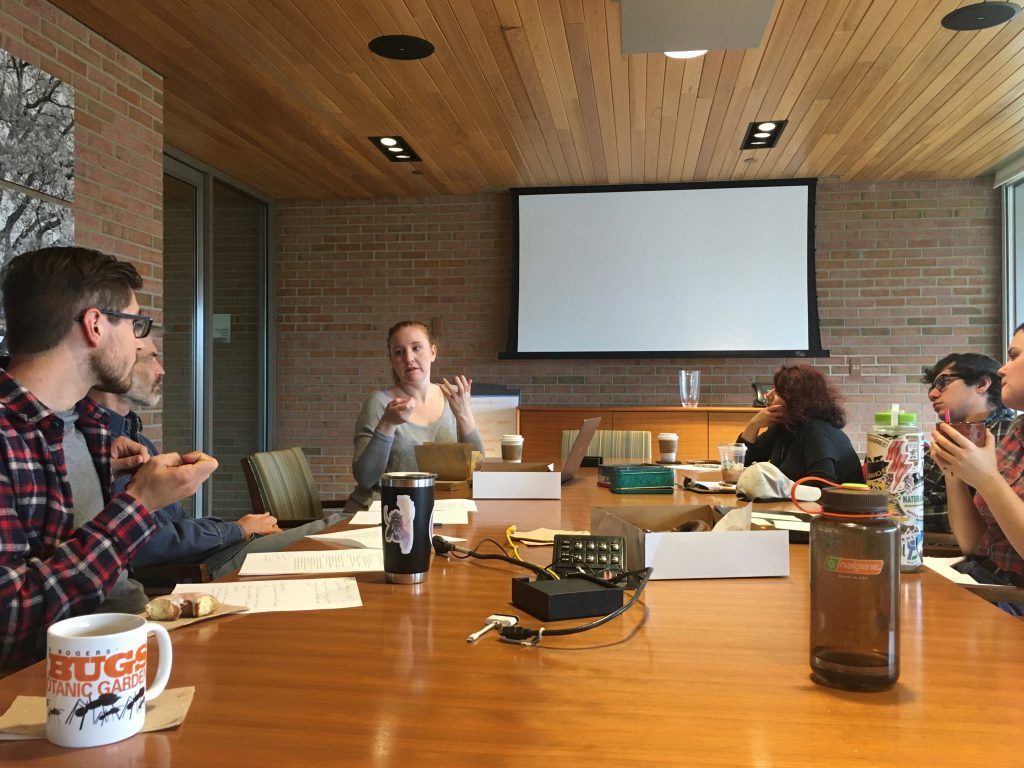
We started the day rechecking our echinacea heads, to make sure we had picked out and counted every achene. Soon after, we had a meeting with Leah, who presented her research paper outline on the comparative success of a number of prairie plants in relation to burnings. It was very interesting to think about the restorative nature that fire can play in these ecosystems, and we spent a lot of time discussing her methods of presenting data as well.
Leah discussing her paper outline
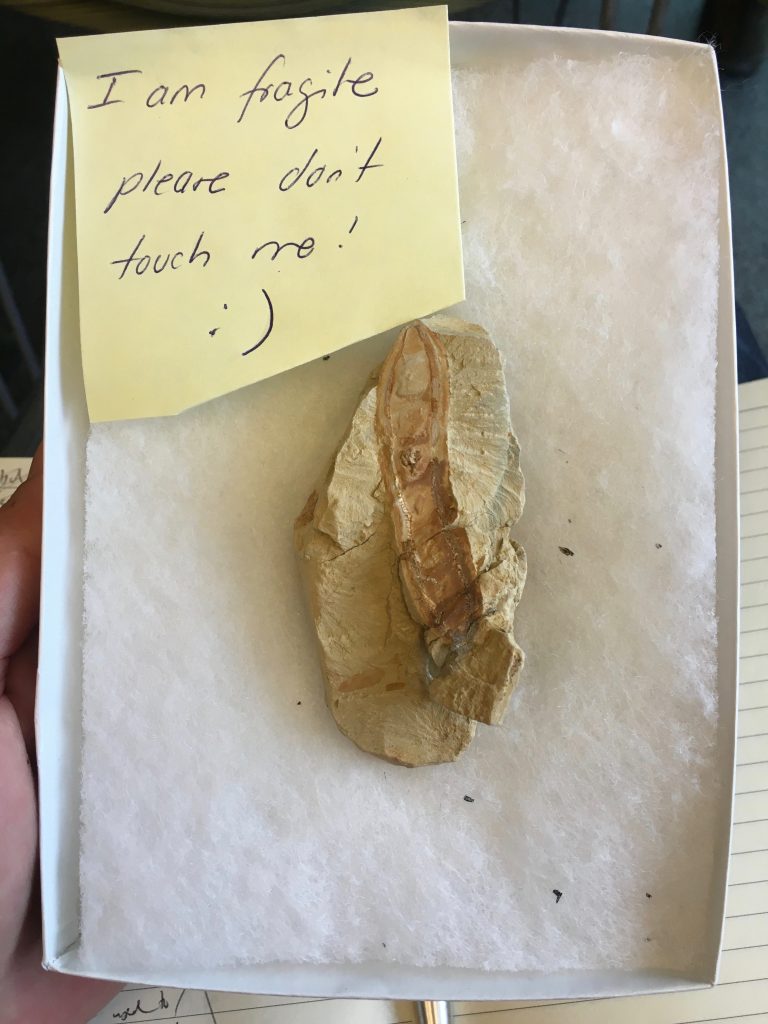
Next up, we heard from Fabiany about his work in conifer fossils, their evolutionary significance as well as how they connected to his home country of Columbia.
One of the plant fossils that Fabiany passed around to the audience
Before lunch, we went through training and began working on classifying achenes through X-ray scans. After lunch, we brainstormed ideas for our individual (or group) projects that we’ll be focusing on for the next two weeks. We all have a lot of different areas of interest, from the impact of inbreeding to limiting factors on plant growth to flowering based on climate change. In addition, we all plan to work on our data processing/analysis skills through learning “R” and more. We spent the rest of the day doing some background research on our project ideas and more discussion of the scope and general plan for our projects.
Overall, it’s been a productive day! We are excited to hit the ground running next week on our projects.
The sun’s going down at the CBG, and Jack, Eli, and I are wrapping up sorting the Echinacea heads for Pulse-Steady! We’ve been pretty focused on it the last few days, with some breaks for learning about the project and meeting people around the lab. Erin, Riley, and Stuart have been good about showing us the ropes and giving us chances to get exposed to what’s going on with Echinacea project and other researchers in the building. Earlier in the week we got to meet a volunteer who sets pollinators (mostly different types of bees) to send to the University of Minnesota for identification, which was really cool. We’re also working on ideas for small independent projects we get the chance to do, and we’re looking forward to tomorrow’s lab meeting where we’ll get to participate in a discussion of a CBG scientist’s research paper in progress, focusing on the effects of fire on the reproductive success of several different prairie plants. It’s been cool to see the lab side of prairie research so far, and to be exposed to so many people studying it! And now that cleaning heads is wrapping up, I’m excited to see what we do next in the process.
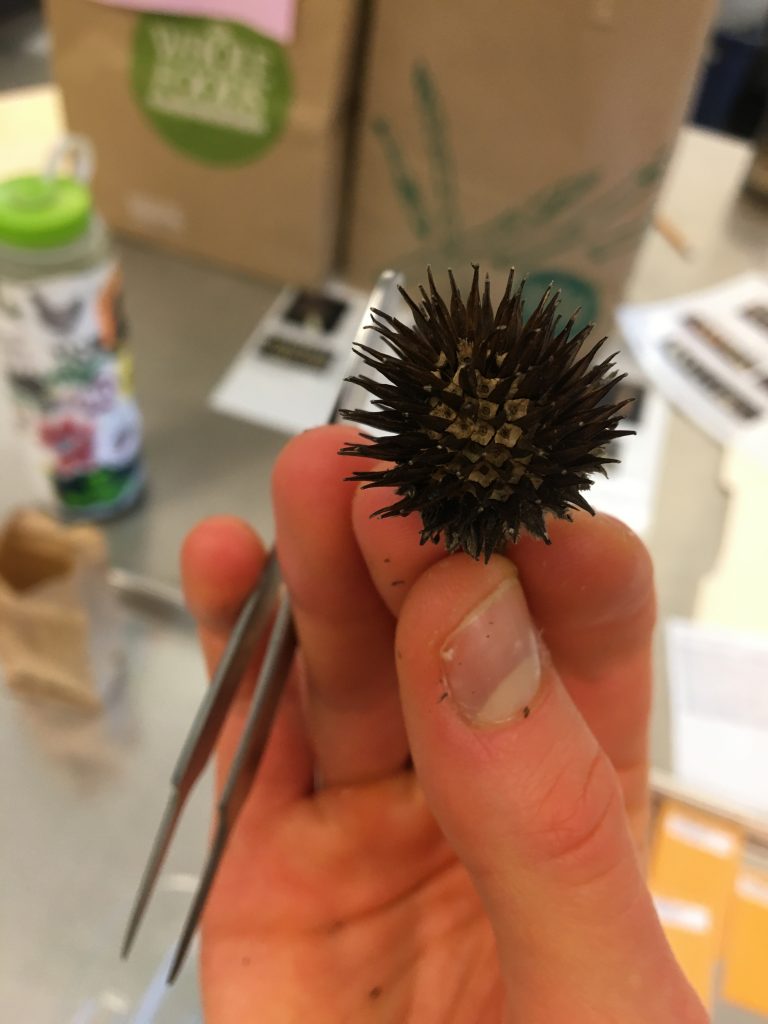
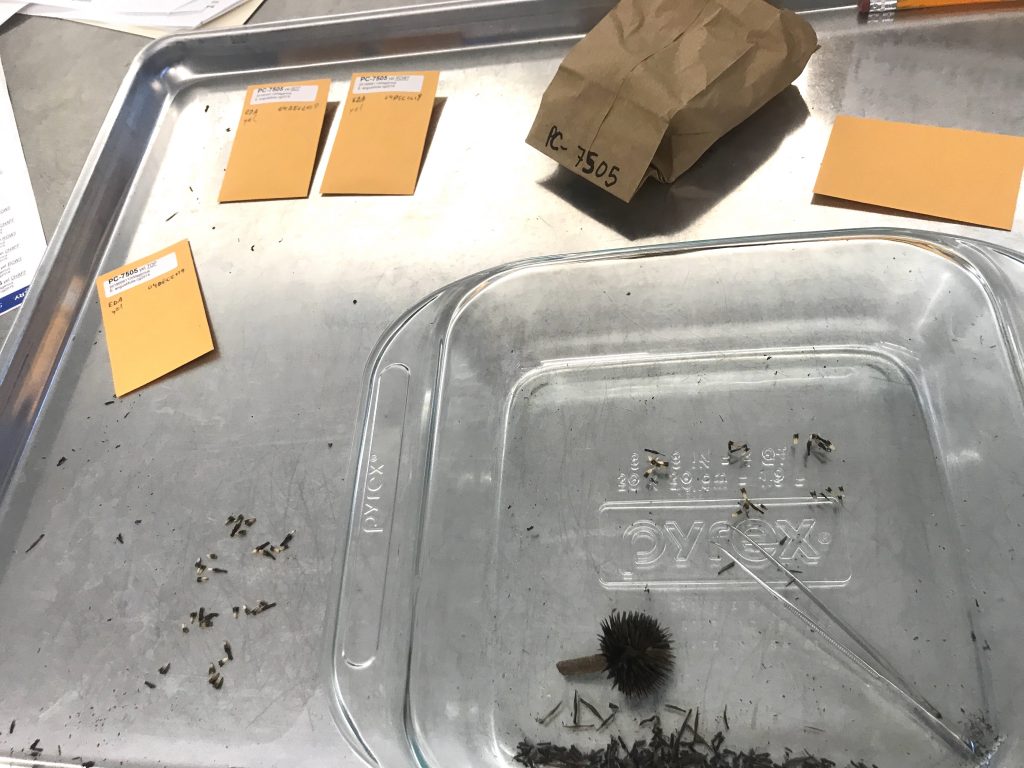
Above: an Echinacea head before being taken apart very carefully! We’ve all been able to get into some music/podcasts while cleaning seedheads, so here are some recs––Emma: I’ve been listening to some podcasts––mainly Nancy and a new season of Limetown; Jack: Drilled, a true-crime podcast; Eli: some Radiolab podcasts and Earl Sweatshirt.
The first three days of our time here have been great! We’ve been oriented with everything in the lab, and most of the building. On Monday we went out to lunch at the garden cafe with Riley, Erin, and Stuart. The walk over there let us see some awesome parts of the garden, and Stuart shared with us some cool history about the garden. The last two days have been filled with lots of Echinacea head cleaning by counting and sorting achenes for the Pulse Steady experiment. This process is a bit time consuming, but quite satisfying once finished!
Setup for cleaning Echinacea heads- sorting and counting achenes
This morning Erin and Riley showed us and talked about the many experiments occurring at experimental plots P1 and P2 all of which are quite interesting! These experiments may end up guiding some of our individual research in the coming weeks.
The rest of the week holds more head cleaning, maybe beginning to X-Ray the achenes, some discussion about research ideas, and attending a lab meeting and seminar on Friday!
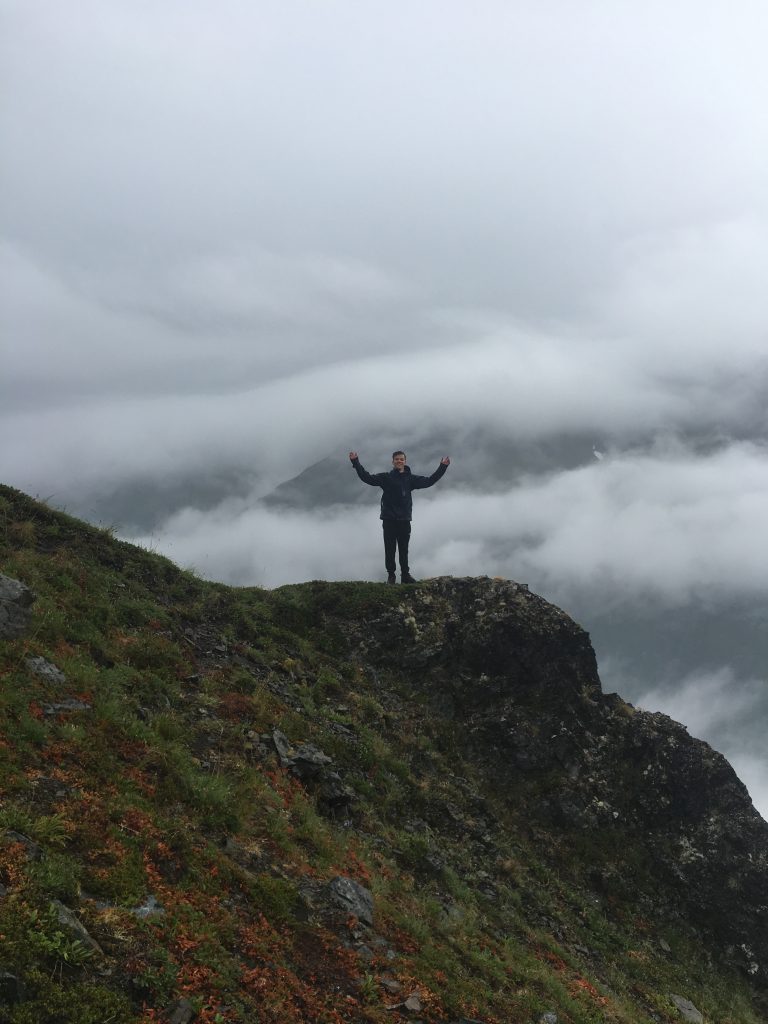
My name is Eli Arbogast and I am a sophomore at Carleton College. I am a potential (more and more likely) Bio major and am very excited to be joining the Echinacea Project. I want to study biology with a focus on ecology, environmental systems, and plant science, so this externship is the perfect opportunity for me. Past research/environmental-focused internships have included rebuilding trails in the Rockies, measuring agricultural impacts on water quality in rural Costa Rica and working on outreach/fundraising for wild salmon in Alaska. I have a foundation for my environmental interests as a result of being raised on an organic blueberry farm and being a beekeeper (albeit very much a beginner).
Outside of the lab, I am a big music person (playing and listening), love hiking, climbing, and most outdoor activities. I am big into exercise, like to read confusing books, mess around with computers, and play video games when I can find the time.
I’m very excited and grateful to be working on this project this winter, and I look forward to learning a lot!
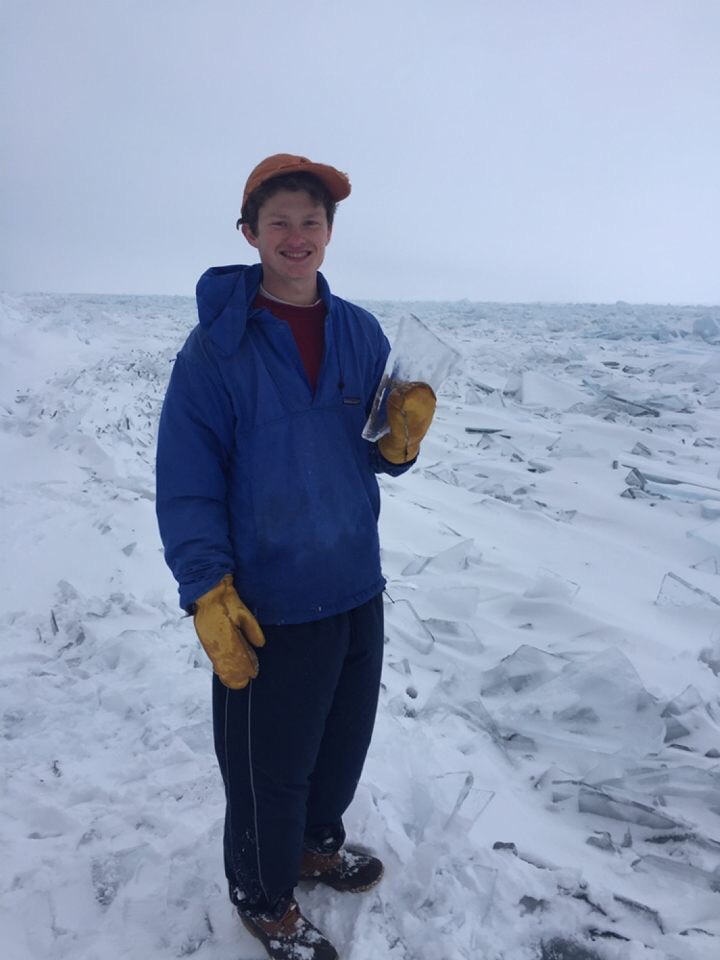
Hello! My name is Jack Schill and I’m a junior at Carleton College. I’m excited to be part of Team Echinacea for the next three weeks as a research extern. I am an Environmental Studies major at Carleton, and I am very interested in many aspects of environmental science so I don’t really know exactly what I want to explore going forward in my education. However, I have really enjoyed and learned a lot from the ecology courses I have taken so far, so I’m hoping this will build on those interests! Furthermore, by growing up and going to school in the upper midwest (I grew up in Milwaukee, WI) I have a special interest in prairies and prairie restoration. I also hope my time here will allow me to meet a lot of interesting people doing cool work, and understand how people got to this position to maybe try to help me figure out what areas of environmental science I want to explore!
In my free time at Carleton, I’m on the varsity soccer team, I’m a member on climbing staff at the rock wall, I’m an active member of the ski club, and I enjoy doing crosswords. Away from Carleton, I enjoy spending time with family, and skiing as much as possible. I’m really excited for the next few weeks to work with Team Echinacea!