At the Echinacea Project Evanston Outpost Riley and I have been chugging along with our work for the past two and a half months. We’ve had countless remote meetings, surrendered precious square feet of floorspace to binders of datasheets, migrated the infallible sticky-note kanban to our walls (me) and online (Riley,) and begun coordinating with our summer team to prepare for the field season. Expect to see some new faces on the flog in the coming week!
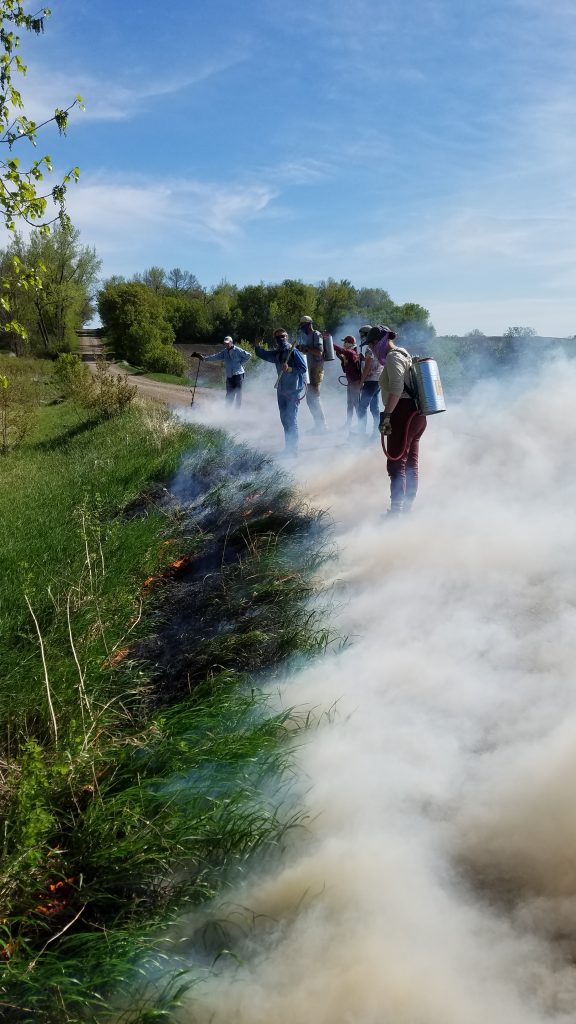
We started on the northwest corner of P1 and split into two groups to work around the plot. The burn was long and slow!
As we approach the field season, we’ve gotten the chance to stretch our legs outside our apartment. In late May a team dashed up to the field site to capitalize on a narrow window of perfect burn conditions. Changeable winds made our burn of the 99-south plot a little more exciting than we had hoped, but we took the burn low and slow and very safely across experimental plot 1.
Drake headed up to our field site several weeks ago, where he’s been germinating seeds for a parasite competition experiment he’ll conduct this summer. When we return to the field in a couple weeks we’re looking forward to seeing the hoop houses he’ll have set up to house his plants!
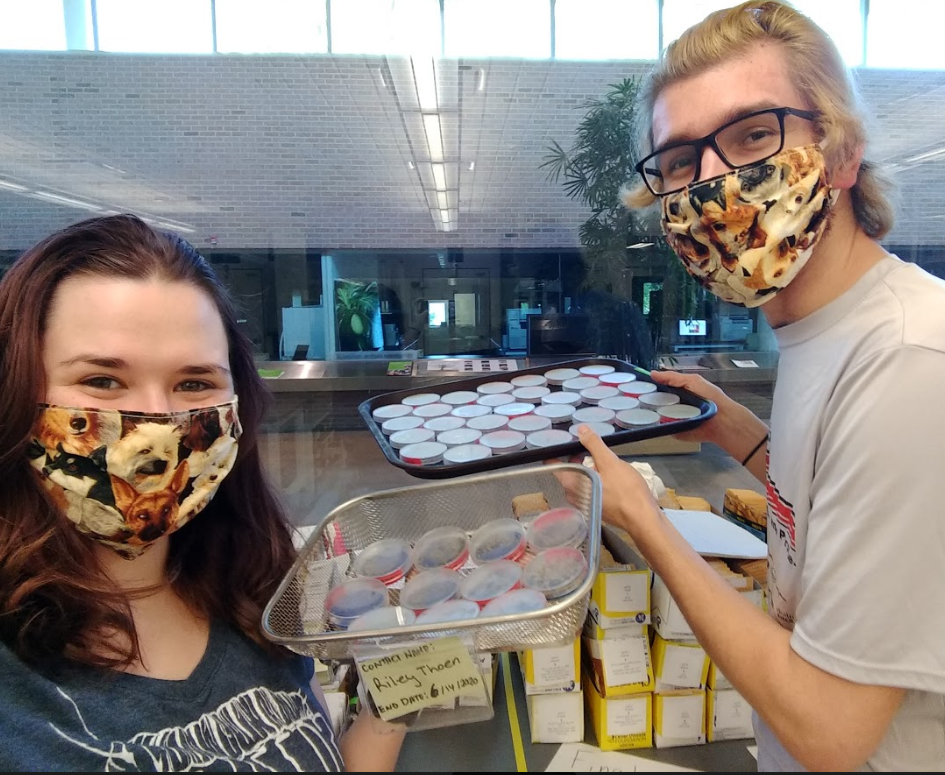
Drake is planning to germinate some 40 plant species this summer, but he forgot our favorite species in Illinois– Echinacea angustifolia! Riley and I have gotten special permission to return to the Chicago Botanic Garden to start a pre-germination treatment of Echinacea achenes in the lab. I’ll bring Drake the achenes when I drive out to the field site in the next couple weeks– what are the odds that radicles start emerging in my car?
It’s been exciting to get back to the garden, though we may look a little different from the last time we were here!
The garden will start a limited reopening next week, when visitors will be allowed to walk the perimeter of the grounds. We took a peek outside when we were preparing the pre-germinants, and it looks like the grounds crew have been doing a beautiful job maintaining the garden. We’re excited to see more before we head back to Minnesota!
Sadly, Riley and I have also made use of our visits to the garden to clean out our desks. Access to the plant science building is limited and we will not be working full-time there again, as we are headed off to graduate school following the field season. This will be the first time Riley and I have lived apart since meeting last June! However, we’ll only be a few states apart– Riley is headed to the University of Georgia in Athens, GA and I’ll be at North Carolina State University in Raleigh, NC.
Once a team member, always a team member
As the field season gears up, we will return to our daily summer flogging schedule. We’re all very excited to get out to the field and to meet the new team members!
Anthropogenic habitat fragmentation has contributed to severe biodiversity loss worldwide and is expected to have lasting negative impacts on remnant communities in the coming years. One great consequence of fragmentation is the loss of genetic diversity and adaptive potential within individual remnant populations. Many studies have demonstrated the loss of neutral genetic diversity within remnant plant populations and linked this phenomenon to reduced population fitness. However, few studies have been designed to understand how remnant plant populations with varying sizes and degrees of isolation are differentially affected by climate change and how neutral and quantitative genetic variation may predict population persistence in a changing environment. Thus, it is my goal to understand the additive effects of habitat fragmentation and climate change for the persistence of remnant plant populations.
Statement
I grew up in Bloomington, MN, and went to college in Saint Peter, MN, where I learned to appreciate the biodiversity of the Midwest. I really enjoy being outdoors with no people around, and I am really looking forward to getting out of the big city (Chicago) and into the field in West Central MN again. Some of my other hobbies include: playing board games, playing video games, engaging in scientific discussions, participating in sports, reading (when I feel like it), and watching shows produced by the Bachelor franchise. My summer with Team Echinacea will be slightly truncated because I am starting a Ph.D. at the University of Georgia in August, but I am really looking forward to participating in field work and meeting folks this summer!
In the past, team members have observed Echinacea heads while sitting on buckets. I hope to revolutionize fieldwork this summer by teaching folks to observe buckets while sitting on Echinacea heads.
Hello
Echination! It sure has been a long time since I last flogged, and I really
have missed giving fun updates to folks both in the lab and online. Over the
past few months, members of Team Echinacea have been stuck at home due to the
ongoing global pandemic. We have spent a lot of time working on existing
projects, preparing for data collection in the field, and meeting with colleagues
over Zoom. However, due to the current situation, there is one project that has
taken precedence over all others: our Covid-19 preparedness plan.
Although
we have been shut out of the Chicago Botanic Garden for some time, we are
fortunate to have been granted permission to conduct field work in Minnesota. Each
field season is incredibly important for Team Echinacea, as this is when we
collect a large amount of data and harvest specimens to be processed in the lab.
Because Echinacea angustifolia is a
long-lived plant, it is imperative we conduct field work in MN as much as possible,
so we can gather accurate estimates of lifetime fitness in our
self-incompatible perennial forb and assess whether remnant populations will
persist in West Central MN. That said, there is something even more important
than conducting long-term ecological research: the health and safety of humans.
Over
the last few weeks, the Echinacea lab core members have assembled a dream team
of past, present, and future team members to construct a plan to prioritize
safety during the field season while still allowing for the efficient collection
of high-quality demographic and fitness data on Echinacea angustifolia. The Covid-preparedness team consists of: Stuart,
Ruth, Erin, Riley, Amy D., Amy W., Drake, Lea, Mia Stevens, Jared Beck, and John
“Texas” VanKempen. What a team! The first thing we did to prepare for a socially-distant
field season was to read interesting articles about Covid transmission, best
business practices for Covid, and government recommendations; we then shared
these articles with the group. Next, we discussed what we learned from these
articles and then broke into small groups to discuss minimizing transmission
probability during every-day tasks. For example, I was on teams that discussed
how to reduce potential Covid transmission while eating lunch, syncing visors, and
engaging in team building activities. From there, we reconvened as a group and
shared our optimal plans for each activity. To solidify our ideas, we put all
of our ideas into a “Covid-19 Preparedness Plan” – a template created by the State
of Minnesota for reopening businesses. We hope to share a draft with all summer
2020 team members soon, and we will certainly document our plan on the flog in
the coming weeks!
We learned a lot during this process, and we are looking forward to getting back out into the field with our ever-friendly study species. Many feelings are invoked by the thought of field season, including excitement, stress, adventure, nostalgia, and most importantly, the feeling of community. Obviously, being a part of a community is personally gratifying, but this summer, it is imperative that we come together as a community to keep each other healthy and safe. I can personally say I am incredibly excited to spend part of my summer with Team Echinacea, but I can also say I am nervous about being on a field team in light of the ongoing global situation. However, I know that if I look out for others and if they look out for me, Team Echinacea will be healthy, efficient, and as fun as ever.
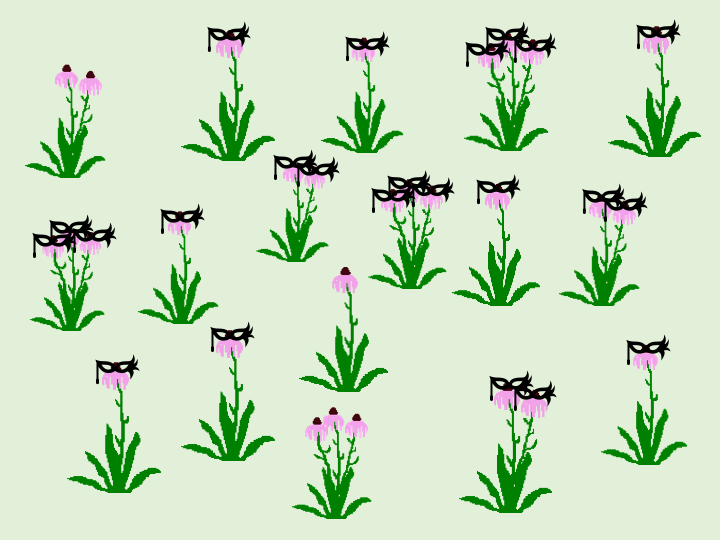
Due to the global pandemic, we warned Echinacea that they may actually benefit from isolation in summer 2020. Many responded by purchasing masks from their local party supply store.