|
|
Lydia mapped many Echinacea plants in two remnants: eelr and alf. Here is a list of distances in meters between all pairs of plants.
distancesForLydia.RData
This version of Lydia’s R script will read her dataset and edit it and then read the distances and merge them to her compatibility dataset.
mergeScriptForLydia.R
We delayed our fieldwork for a few minutes this morning because of scattered showers. Who knew we should have delayed for a few more minutes because of Solar X-Ray Flux?
The National Weather Service’s weather radar indicated that the rain (aka atmospheric H2O flux) was mostly south of us, so we knew it would be a short delay. However, we should have checked NOAA’s space weather forecast…
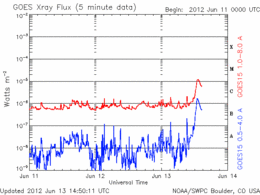
When we arrived at the site, the atmospheric weather was OK, but the space weather was poor and our gps machine, Sulu (a Topcon GRS1), had a difficult time getting oriented. It may have been groggy because of the burst of solar X-Ray Flux. Here is the graph of Solar x-ray Flux from NOAA:

Just our luck! Next time we’ll check our local weather forecast and the space weather forecast!
Here is Sebastian Di Clemente’s final report on the main project of his internship:
If you are heading to ESA, visit Callin Switzer’s poster “Inspiring future ESA members in elementary or middle school, using place-based inquiry.”
It has been scheduled for:
Contributed Poster Session: Education: Pedagogy
Date: Tuesday, August 7, 2012
Time Slot: 4:30 PM – 6:30 PM
Location: Exhibit Hall DE at the 2012 ESA Annual Meeting, to be held in Portland, Oregon, August 5-10, 2012.
Visit his poster, #35507!
What’s this in plug 156? A young seedling with fused cotyledons and a true leaf just peeping up. in the nearby corner is a more typical seedling. Both plants come from florets of Echinacea angustifolia that were pollinated with pollen from Echinacea pallida.
Click image to embiggen!
In a paper just published in Restoration Ecology, Echinacea Project researchers report that establishing Echinacea angustifolia in existing prairie restorations and abandoned agricultural fields requires more than 20 seeds for each plant that germinates and survives to flowering. Plants start flowering about 10 years after sowing. Also, burning the prairie before broadcasting seeds helps emergence and survival.
Wagenius, S., A. B. Dykstra, C. E. Ridley, and R. G. Shaw. 2012. Seedling recruitment in the long-lived perennial, Echinacea angustifolia: a 10-year experiment. Restoration Ecology 20: 352-359. Available here: https://echinaceaproject.org/pub/wageniusEtAl2012.pdf
The Echinacea Project posted a job description for a postdoctoral position and details about how to apply. Applications will be reviewed starting 19 March 2012 and will be accepted until positions are filled. Learn more.
The Echinacea Project posted job descriptions for field research internships for summer 2012 along with details about how to apply. Applications will be reviewed starting 29 February 29, 2012 and will be accepted until positions are filled.
The text of an ad to be distributed is copied here…
Are you interested in gaining field research experience and learning about the ecology and evolution of plants and plant-animal interactions in fragmented prairie? We are looking for 3-5 summer field researchers for an NSF-funded project on habitat fragmentation of the tallgrass prairie. We are investigating how small plant population size influences inbreeding, demography, pollination, and herbivory in the purple coneflower, Echinacea angustifolia. This is a great summer internship, REU, or co-op for those interested in field biology or conservation research.
No experience is necessary, but you must be enthusiastic and hard-working. You will survey natural plant populations, measure plant traits in experimental plots, hand-pollinate plants, observe & collect insects, and assist in all aspects of research. Housing is provided and there is a stipend. Undergraduate students have the opportunity to do an independent project as an REU participant.
2:00 pm winds WSW
1 ew left/row [?]
Tape ends at 18.8m on the N side and 18.85 on the S side.
Plant at 0, 0.33, 0.67 m.
Flags at even meters (ending at 18.04).
Two Oenothera 1-yr olds at N edge 10.45m and 11.00 m.
Weeded Poa, Brome, Carduus, Cirsium, Euphorbia (before planting).
Zer[o] at westernmost grass.
[entered from notes in 2012; see plantOenotheraNov2011.pdf]
In a paper just published in PLoS ONE, Echinacea Project researchers show how habitat fragmentation may make plants more susceptible to aphid attacks. Aphid abundance early in the season is higher on inbred and outcrossed Echinacea angustifolia plants compared to regular plants. Elemental stoichiometry plays a role in this plant-herbivore interaction, but other genetically-based plant traits must also attract or encourage aphids.
Ridley CE, Hangelbroek HH, Wagenius S, Stanton-Geddes J, Shaw RG, 2011 The effect of plant inbreeding and stoichiometry on interactions with herbivores in nature: Echinacea angustifolia and its specialist aphid. PLoS ONE 6(9): e24762. Available online at http://dx.plos.org/10.1371/journal.pone.0024762.
|
|