|
|
Join the summer fun in West Central Minnesota!
Kensington Runestone Days
13 – 15 June 2014
Old Settlers’ Reunion, Barrett
18 – 22 June 2014
Heritage Days, Starbuck
3 – 6 July 2014
Ashby Appreciation Days
18 – 20 July 2014
Grant County Fair, Herman
17 – 20 July 2014
Waterama, Glenwood
22 – 27 July 2014
Flekkefest, Elbow Lake
1 – 3 August 2014
Show White & The Seven Dwarfs Prairie Fire Children’s Theatre, Barrett
8 – 10 August 2014
Hoffman Harvest Festival
8 – 10 August 2014
Douglas County Fair, Alexandria
14 – 17 August 2014
Don’t forget the Minnesota State Fair!
21 Aug. – 1 Sept. 2014
Our host, UThink, is retiring at the end of December 2014. This June will be the last month we post flogs here. We’ll let you know where we are moving when we find a new host!
You can always learn what we are up to on our website and on twitter.
Gia gave a presentation at the NU research expo. Here are the details…
Hallaman, G. “Ant Diversity for Six Western Minnesota Tallgrass Prairie Remnants: The Connection between Ants and Echinacea angustifolia.” Northwestern Undergraduate Research and Arts Exposition, June 2, Evanston, IL USA, 2014 (Oral Presentation).
Sarah Baker presented “Flowering phenology of Echinacea angustifolia in Minnesota tallgrass prairie remnants over three years,” the results of her summer 2013 REU project, at the National Conference on Undergraduate Research, University of Kentucky, on 4 April 2014.
Here’s the presentation…
Sarah_Baker_NCUR_Presentation_FINAL.pdf
Check out this episode of Prairie Yard & Garden. Stuart was interviewed this summer for this half-hour long public TV show about the Echinacea Project. The episode is called “Prairie Flora: History and Future” and it aired yesterday in western MN and the Dakotas.
Please help spread the word about prairies! Here’s the link: http://goo.gl/qU4bcN
The whole interview and much of the footage is from the main common garden experimental plot.
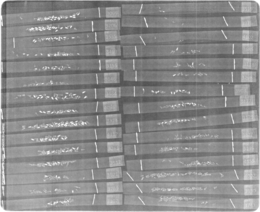
We took some high-quality images of Echinacea achenes for our q2 experiment this fall; an example is below. Notice how easy it is to distinguish empty achenes from those with embryos. By darkening the room and removing the opaque film, we were able to use lower levels of xrays for a shorter duration than we have previously. This plate was exposed to 12kV x-rays for 4s. We used long, thin glassine envelopes to facilitate counting. Notice also that the laser-printed labels reveal the packet IDs.

X-ray image of 30 packets of achenes from
Echinacea angustifolia. Click on thumbnail to enlarge.
We are preparing to plant a new experiment this fall. We are cutting down ash trees (Fraxinus pennsylvanicus) in an abandoned agricultural field that was planted with Brome in the 1980s. We will plant Echinacea angustifolia seeds from our experimental crosses this summer. We will hand broadcast two native warm-season grasses: Bouteloua curtipendula (sideoats grama) and Schizachyrium scoparium (little bluestem). Keep up-to-date on progress on this experiment via twitter.

Dwight, Lydia, & Ilse with tools of the day: chainsaw, loppers, brushcutter. Not shown: paintbrush.
What is a typical radiation dose experienced by an Echinacea seed when we x-ray Echinacea fruits to assess seed set?
We usually put the seeds on the bottom tray and the setting 10 s @ 18 kV. According to the documentation on dosage for our x-ray machine 18 kV outputs 292.6 R/h when the dosimeter probe is 57.2 cm away (that's the shelf with 1:1 magnification). The dose unit quote here R is Roetngen.
A little arithmetic can tell us total Roentgens for a ten second exposure:
( 10 s frac{1 h}{60 min} frac{1 min}{60 s} 292.6 frac{R}{h} )
In R code, that's
10 * 1/60 * 1/60 * 292.6
## [1] 0.8128
0.8128 R (Roentgen)
We may put the seeds on a higher shelf for more magnification, maybe 1:1.5 or the 1:2. We can enter dosages from each shelf from the documenation on exposure levels by shelf to estimate how much higher the dose is.
lvl <- c(1, 1.5, 2, 3, 4, 5)
RPM <- c(7.815, 20.55, 42.55, 115.45, 232, 397)
data.frame(shelf = lvl, dose = RPM)
##   shelf    dose
## 1   1.0   7.815
## 2   1.5  20.550
## 3   2.0  42.550
## 4   3.0 115.450
## 5   4.0 232.000
## 6   5.0 397.000
The dose on the 2x magnification shelf is RPM[3]/RPM[1] = 5.4447 times greater than the dose on the 1:1 shelf. Doubling the magnification generally should increase the dose by a factor of 5.4. Let's check: the dose on the 4x shelf is RPM[5]/RPM[3] = 5.4524 times greater than the dose on the 2x shelf. Also, the dose on the 3x shelf is RPM[4]/RPM[2] = 5.618 times greater than the dose on the 1.5x shelf. Close.
The expected dose at the stadard settings is 0.82 R on the bottom shelf and 0.8128 * 5.5 = 4.4704, or about 4.5 R on the 2x shelf.
We had a great party on Tuesday night–Dayvis & Marie’s last day. We enjoyed excellent food, played croquet, and ate s’mores around two bonfires. Very enjoyable. The garden is late this year–no tomatoes or cucumbers yet. I regret I didn’t take any photos, but here’s the menu…
corn on the cob
pesto pasta
Pam’s pasta salad
quinoa salad
fresh sourdough bread
black bean dip
corn chips
deviled eggs
kohlrabi slices
brownies
iced tea
s’mores makings
|
|