In 2023, Team Echinacea did not conduct any fieldwork for this experiment.
Pollinator populations are declining worldwide, and pollinator habitat in western Minnesota has diminished over the years, but it is unclear whether the native bee community is changing as well. The Pollinators on Roadsides project, also known as the Yellow Pan Trap (YPT) study, is investigating how native bee diversity and abundance have changed from 2004-2022 and learning about whether the amount of agricultural land and grassland correspond to the nearby bee community.
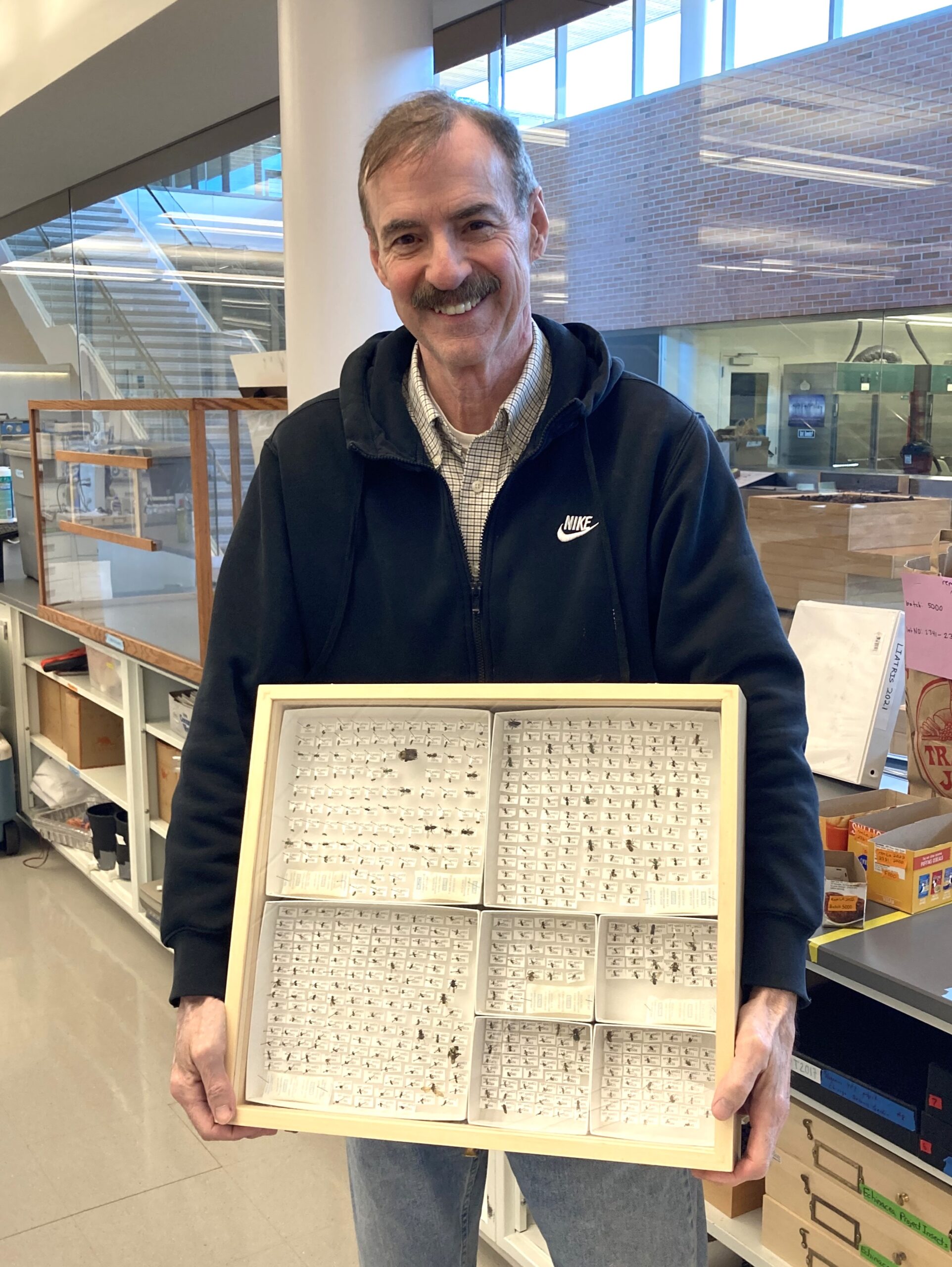
In the lab, rock star pinner and volunteer Mike Humphrey finished pinning all 789 bees from 2022 on 6 April, 2023. Intern Alex Carroll brought the bees to Zach Portman, the bee taxonomist at the University of Minnesota, for identification on 6 June, 2023. Zach recently reported that he’s all done with our 2022 bees, and we will be picking them up from UMN next chance we get!
Mike shows off a finished bee case
Alex worked to put datasets together (view in Dropbox/ypt2004in2017/yptDatasets/) for this experiment to prepare us for when Zach finishes his identifications. Alex also created this to-do list of next steps:
When Zach finishes identifying the 2022 specimens, fill in zachGenus, zachSpecies, and zachSex for 2022 spids.
Remove 2022 spids that are nonbees.
Update 2017 collectDate. In 2017, traps were put out one day and then collected the next day. Some of the 2017 dates are the day the trap was put out and some are the collection day. These should be standardized. MAS figured out most of the timeline here: ypt2004in2017/yptDataAnalysis2022/collectionDatesAndMowedTraps/2017listOfCollectionDatesAndMowedTraps-11-May-2022.csv These dates are based on the 2017 summer datasheets: ypt2004in2017\YPT2017\YPTsummer2017\ypt2017FieldDatasheets.pdf
Locate missing trap numbers for 35 bees, all collected on 07/26/2004. There is a memo for half of the traps collected on 07/26/2004, but half (the outerloop) are missing. See ypt2004in2017/YPT2004/yptMemos2004/ypt04-js.doc
Determine what to do about missing specimens. Some specimens were identified by Sam Drogee in the past, but we couldn’t find the bee. SW remembers that Sam took some specimens, so he may still have them. A few specimens have gone missing. See the notes column.
Summary
Start year: 2004, rebooted in 2017
Location: Roadsides and ditches around Solem Township, Minnesota. GPS coordinates for each trap are located here: ~Dropbox\teamEchinacea2022\YPTsummer2022\yptTrapLocations2022.csv
Zach Portman identified all specimens from 2004-2019, and the specimens are stored in eight cases at the CBG lab.
Mike finished pinning specimens from 2022 on April 6th, 2023. Alex delivered 2 cases of specimen to Zach on June 6th 2023. A little over a month ago, Zach said he had a backlog and wouldn’t get to them for a month. So, hopefully he’ll be working on them soon!
Team members involved with this project: Geena Zebrasky (2022), Mia Stevens (2020-2023), Alex Carroll (2021-2023), Erin Eichenberger (2019-2020), Anna Stehlik (2020), Shea Issendorf (2019), Mike Humphrey (2018-2021), John Van Kampen (2018-2019), Kristen Manion (2017-2018), Evan Jackson (2018), Alex Hajek (2017), and Steph Pimm Lyon (2004)
Funding for this project was provided by the Minnesota Environment and Natural Resources Trust Fund as recommended by the Legislative-Citizen Commission on Minnesota Resources (LCCMR). The Trust Fund is a permanent fund constitutionally established by the citizens of Minnesota to assist in the protection, conservation, preservation, and enhancement of the state’s air, water, land, fish, wildlife, and other natural resources. Currently 40% of net Minnesota State Lottery proceeds are dedicated to growing the Trust Fund and ensuring future benefits for Minnesota’s environment and natural resources.
You can read more information about the pollinators on roadsides project here.
On this sweltering day, Lindsey and I worked on developing a system for keeping track of demopup, the process of mopping up any mistakes, mishaps, and general instances of misses. We collected a list of every site and made a poster to keep a close eye on the process, and have some fun. Chupy the chupacabra/badger/puppy has made a reappearance.
Lindsey deep in the creative process
We will revisit every site to search, demo, and survey flowering echinacea one more time. Team members will keep track of how many plants they find that aren’t all the way through the process, and once they get back to Hjelm they get to put a corresponding number of their own special sticker next to the site in question. Sticker options to come!
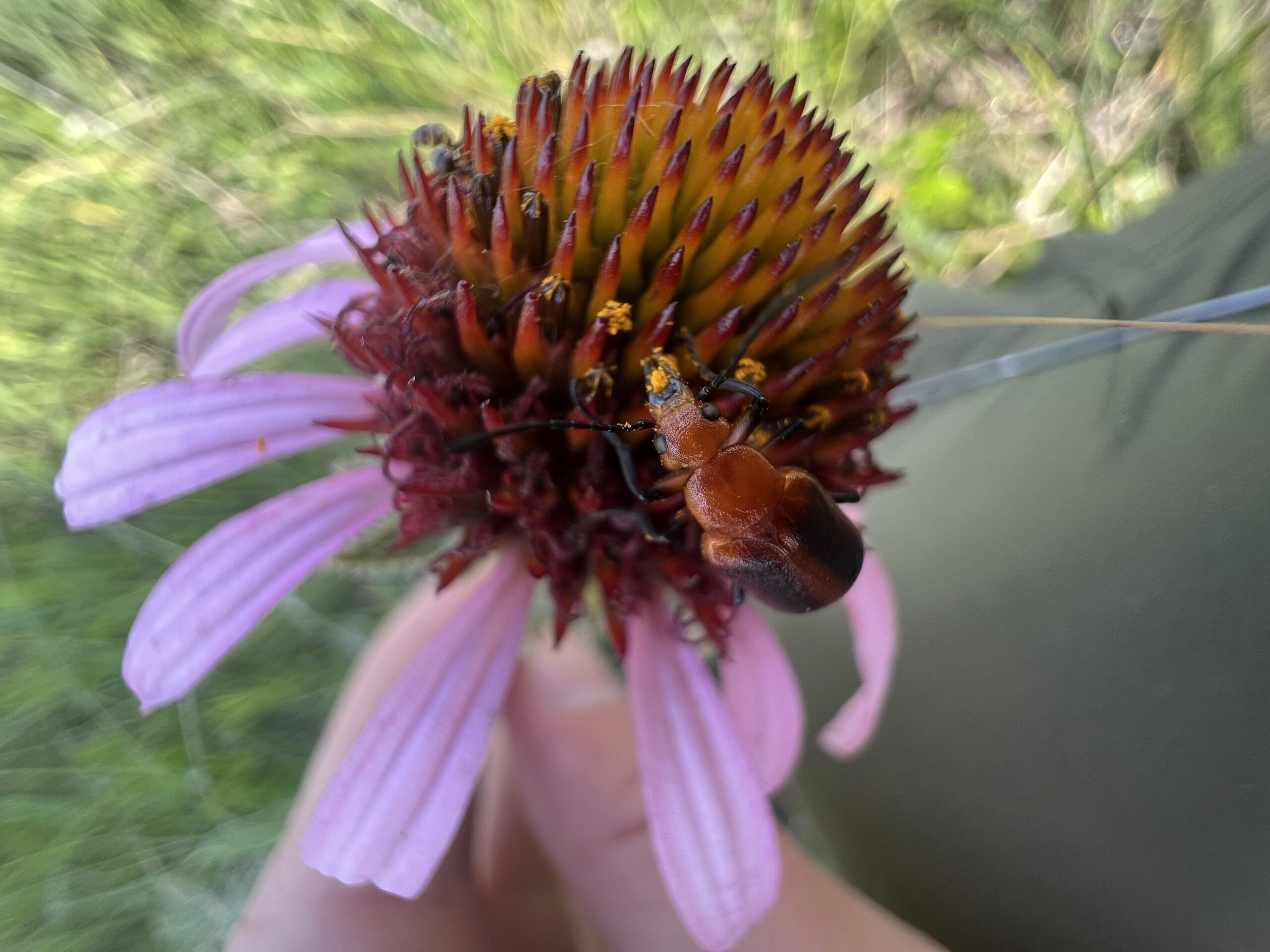
A beetle was seen allegedly stealing pollen from Echinacea Angustifolia this morning at Staffanson Prairie preserve. The insect’s motives are currently unknown and the suspect is still on the loose.
The crime in progress
Witnesses say the crime occurred around 9:40, when the critter began apparently attacking Angustifolia’s anthers unprovoked.
“It was like nothing I’d ever seen,” said Amorpha Canascens, Angustifolia’s neighbor. “My forby friend was just going about their business trying to reproduce when this cranky creature started pocketing all their pollen for itself.”
Officials have reported that 2023 is a relatively low flowering year for our favorite prairie flower in the area, so Angustifolia may not have had many mates anyway. Still, they would have liked to have had a chance to reproduce.
“A whole day of pollen production wasted! This is going to throw off my synchrony stats for sure,” Angustifolia said.
Despite the hardship, Angustifolia remains committed to their goal.
“I still have some more flowering days in me yet,” they said. “And for every selfish beetle, there’s a benevolent bee to help me out. Because in the prairie, we look out for each other.”
Yesterday, we spent the early afternoon at the picnic tables outside of the Hjelm house. It was a lovely day save for the smoke in the air (see Jen’s poem). After we all ate lunch, Jared gave a talk, bringing the team up to speed on the work we do in the remnants. We learned all about the work that started in Staffanson and is now in 35 different prairie remnants in our area. And, though Echinacea will always be our darling study species, we’re starting to look more into other fun species, like different grasses and more forbs (shoutout to Liatris).
Jared giving an impassioned talk
Afterward, we did our annual team norms activity, where we discuss 4 questions pertaining to how we learn and conduct science and come together to agree on how we can best support each other this summer. With everyone contributing, we were able to come up with norms that we all liked. Hurray for discussion and repetition and communication and repetition!
Me with our responses to question 2 (I forgot to change the number on the board)
Northwestern University, MS in Plant Biology in Conservation, expected spring 2024
Pronouns: she/her
Research Interests
When we talk about plants benefitting from prescribed burns, we often think of increased flowering rates following a fire. Often, this effect is attributed to advantageous post-burn growing conditions, like more light, increased nutrient availability, and reduced competition. However, in our prairies, while many species do exhibit fire-stimulated flowering, some don’t, which doesn’t make sense using this physiological explanation! Why would some species take advantage of these better growing conditions while others decide not to?
My research takes a closer look at the reasons for fire-stimulated flowering and considers whether it could be a heritable trait, a built in behavior passed down through the generations. I’ll be primarily working in the experimental plots where we can compare the flowering rates of different families across years. I’m very excited to get out in the field and work toward learning more about this big question!
Statement
I’m from Chanhassen, Minnesota, and love living and working in this neck o’ the woods (or prairie). In my free time I like to fish (catch and eat, yumm), explore, camp, play board/card games, and cook with friends.
This Saturday was a glorious day: Independent Bookstore Day! Every year on the last Saturday in April, the nation celebrates indie bookstores in all sorts of ways. In Chicago (and the Twin Cities and maybe other places), local bookstores participate in a passport event – visit as many bookstores as you can, get a stamp at each one, and win a prize based on how many you visit!
With 40 participating stores this year, visiting 10 would get you 10% off at all the bookstores for a year, and 15 would get you 15% off. Individual stores also often had their own special goodies for the day, including snacks, pencils, tote bags, and other exclusive (and often free!) merchandise. Alex and I were up for the challenge. In fact, we even took on a non-book related side quest, more on that later.
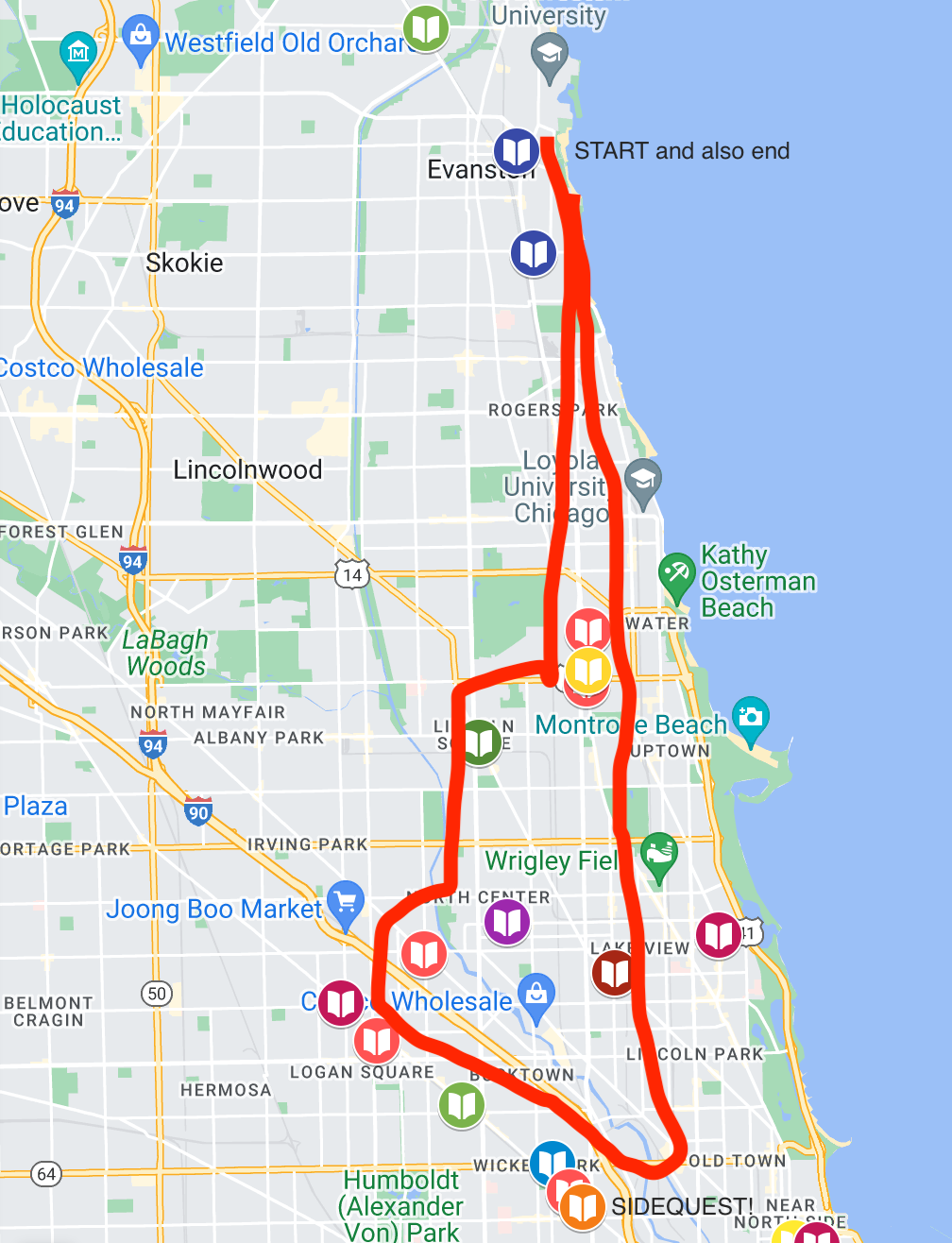
An approximate map of our odyssey
We started out strong with Bookends & Beginnings in Evanston, where we got free totes, some books, and our passports with our first stamp. We made our way south, visiting stores both familiar and novel.
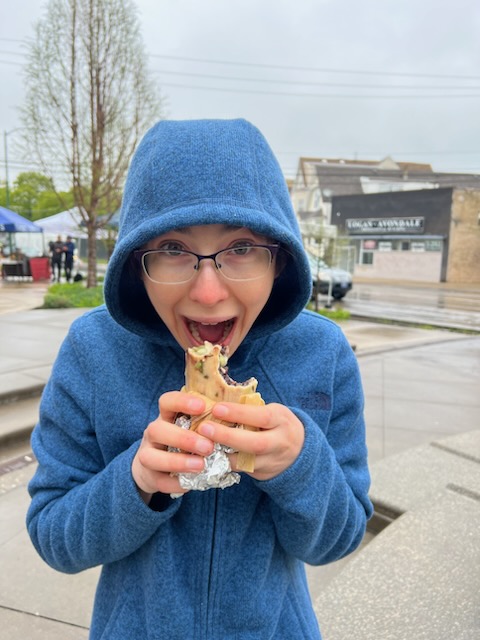
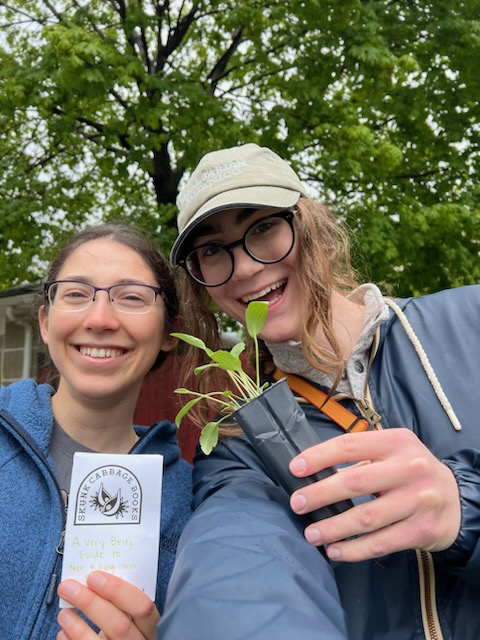
A much needed tamale stopSkunk Cabbage Books gave us a Ratibida seedling with our purchase!
Upon reaching our tenth bookstore, we were both awarded pins that will give us a 10% discount at all 40 stores for the rest of the year. We rejoiced! But at our 11th bookstore, tragedy struck. I couldn’t find my passport anywhere, and I fear it was left at our tenth stop. We mourned! The show didn’t stop though, because Alex still had her passport, we had four more bookstores to go, and one very important side quest.
Stores 12-14 were located within walking distance of each other in Wicker Park, so we visited them all in one stop and got falafel sandwiches and waffle fries to boot. With full stomaches and a clear bath forward, we took of to Goose Island, home of the holy Restaurant Depot.
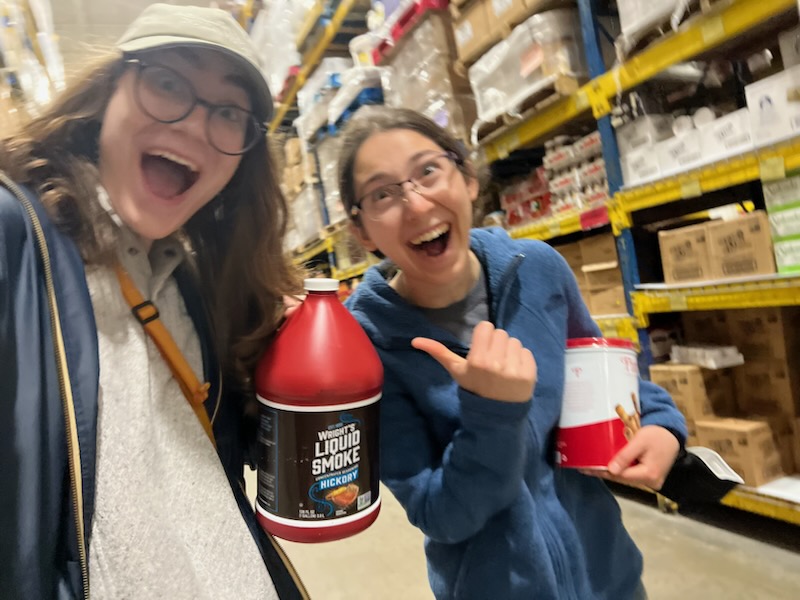
Our secret mission was to locate and extract one gallon of Wright’s Smoked Hickory for Alex and Lindsey’s smoke experiment. The job was difficult; mammoth quantities of random everyday ingredients tantalized us at every turn. However, I am happy to report the mission was a complete success. We escaped with our sanity intact and only one extra item (who can say no to a big ol’ container of chocolate hazelnut wafer rolls?).
Mission success!!!!
We hit our 15th bookstore on our way back north, where Alex was celebrated as a grand winner of the day (though they had run out of 15 store pins). Victorious, we made our way back to Evanston. Until next time, bookstores!
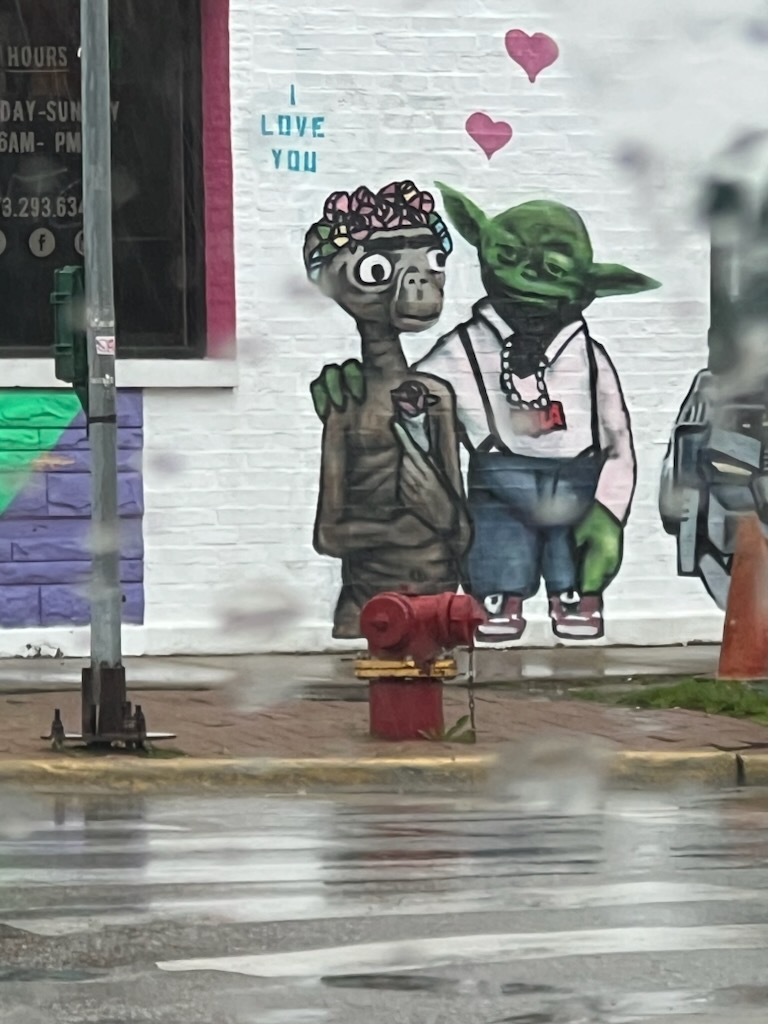
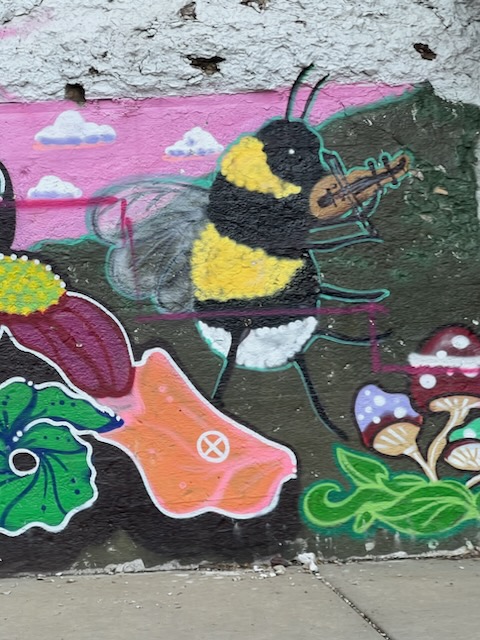
(we also saw some lovely street art)
LoversPlaying some Rimsky-Korsakov on the world’s smallest violin