|
|
Hello Flog!
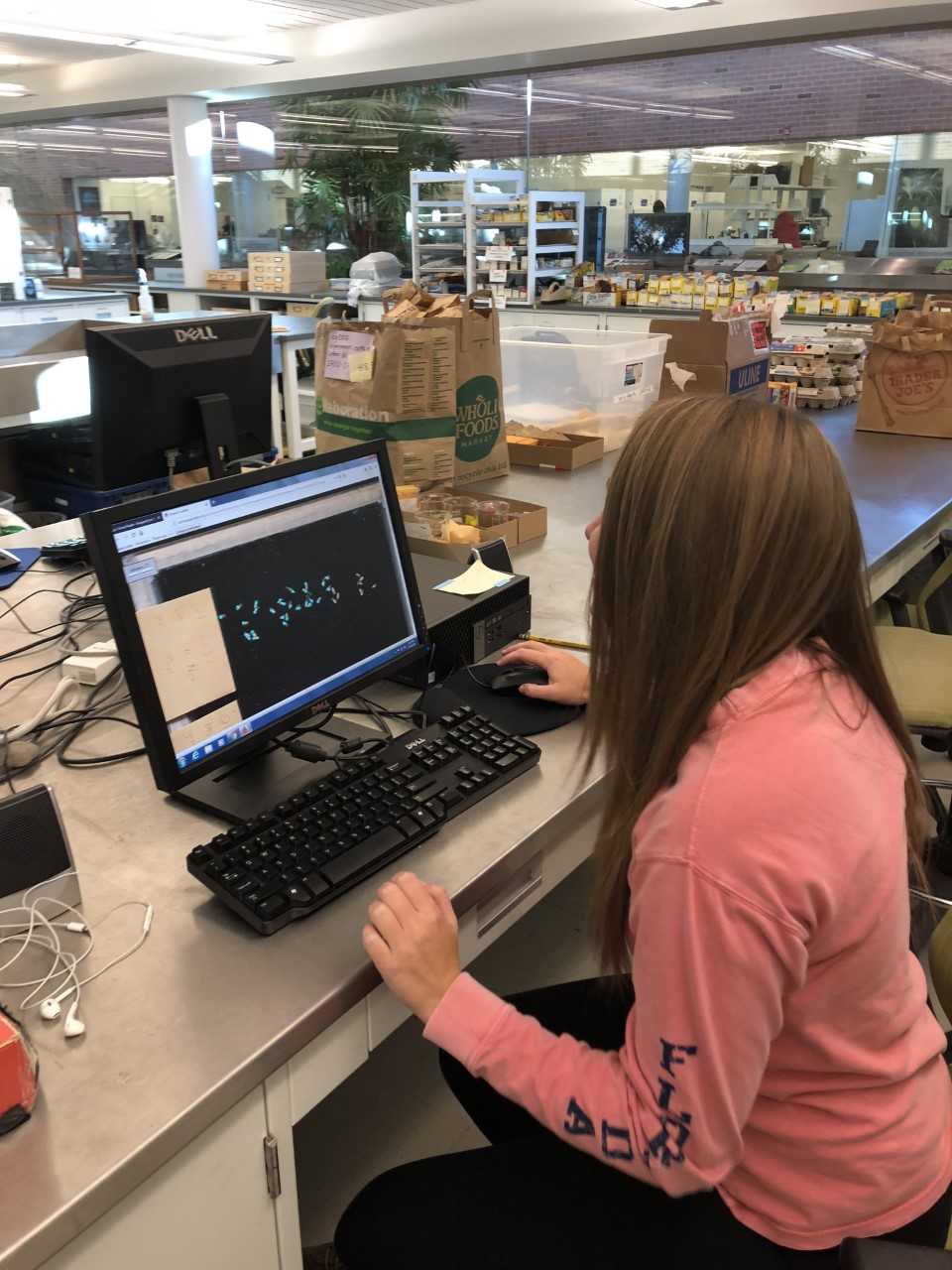
My name is Julie Bailard, and I am a junior biology major and cognitive science minor from Carleton College. I am working with Stuart Wagenius and Michael LaScaleia on their project examining the effects of pollen limitation on Echinacea angustifolia‘s survival and reproductive success. I have also been collecting data for Lea Richardson’s research determining whether the Echinacea Project’s findings apply to other flowering prairie plants with similar methods of seed formation. Over the course of my first week in the lab, I have been cleaning, counting, and randomizing samples of achenes from Echinacea and Liatris aspera. As an aspiring population ecologist, I am thoroughly enjoying this opportunity to work with specimens up close and to follow these achenes from the flower head to the data sheet. I can’t wait to start analyzing the data soon!
Outside of the lab, I enjoy reading, knitting, playing quidditch, and practicing clarinet.

Hello! My name is Sarah Allaben, and I’m a sophomore from Carleton College. I’m excited to be working with Team Echinacea for three weeks as part of Carleton’s winter break externship program. Along with Tris and Julie, I have been cleaning and processing many, many Echinacea angustifolia and Liatris aspera heads in support of projects examining the extent of pollen limitation of Echinacea and the effects of spatial and temporal factors on Liatris and Solidago fitness. However repetitive it may be, I find this process is strangely satisfying (though I do look forward to switching it up a little bit next week and hopefully analyzing some data).
Especially because I’m not quite sure what I’d like to pursue after graduating, this experience is hugely valuable for developing a better understanding of careers in biological research (and receiving advice from accomplished scientists and grad students!). I have yet to delve into too many biology classes, but I’ve found myself most interested so far in paleontology, especially in that it allows for extrapolation of past evolutionary and climatic changes to predict future outcomes of anthropogenic climate change. Yet, after learning more about Carleton’s restored tallgrass prairies, working in the campus greenhouse, and now spending time with Team Echinacea, I’ve developed a strong interest in ecology and plant biology as well! The plan is to gain as much experience in these different fields as I can over the next few years, and see where it takes me. In the meantime, I enjoy rock climbing, art, hiking, and dogs; I’m also a cross country and track runner and love trail running. I’m grateful and excited for the opportunity to work with Team Echinacea, and look forward to my next two weeks here!

Dear flog,
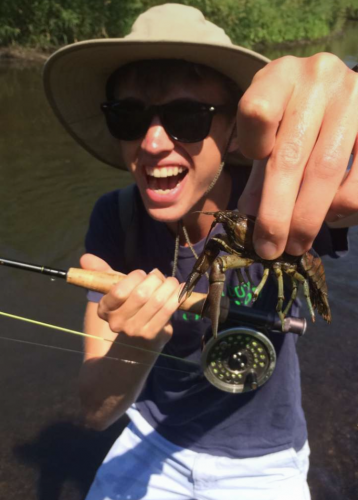
My name is Tris Dodge and I am a winter research extern for the Echinacea Project. I am a senior biology major at Carleton College, interested in understanding how human-driven environmental change is affecting species interactions and causing rapid evolution. I spent the summer of 2017 in Carleton’s restored tallgrass prairies, researching how herbivore exclusion affects soil nutrients and community composition. Last summer, I was a research assistant for two projects at the Rocky Mountain Biological Laboratory (RMBL). I helped gather data on how changing phenology alters the competitive landscape and fitness of perennial wildflowers, and I monitored functional traits, fitness, and glucosinolate chemistry of Boechera stricta in a common garden, as part of a larger genome-wide association study. After graduating from Carleton, I hope to pursue a PhD in ecology or evolution. I enjoy spending my time outdoors and am a member of the cross country and track teams. In my free time, I hike, fly-fish, and knit.
This winter, I am a research extern assisting with projects testing pollen limitation in Echinacea angustifolia and how isolation in space and time affect fitness of Liatris aspera and Solidago speciosa. In practice, each day involves hours of cleaning and counting seeds while thinking about biology. So far, seed counting has allowed me to closely observe the beauty of flower physiology, and has also made me crave sunflower seeds (another Asteraceae). I am very excited to contribute to team Echinacea for these next few weeks!

Hello Flog,
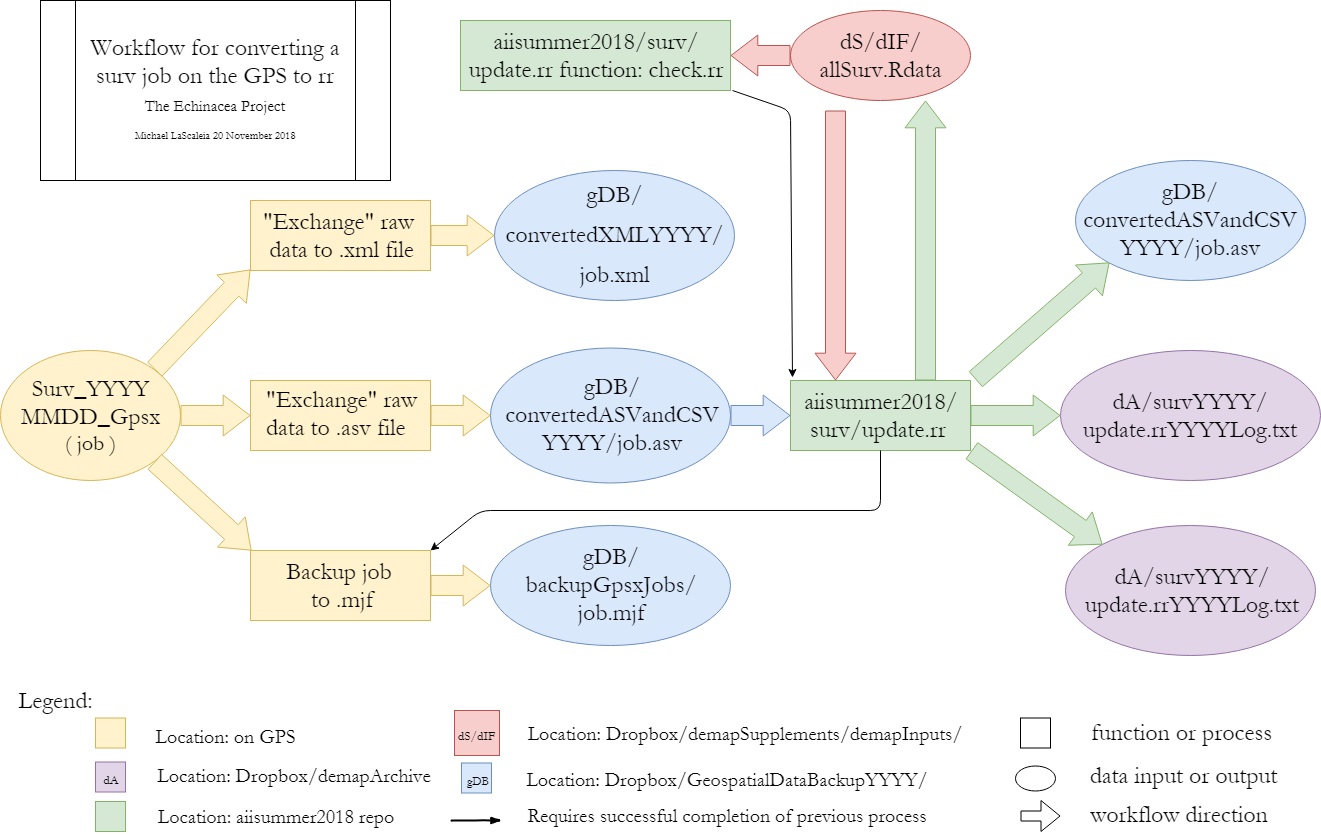
As we wrap up these short few days before Thanksgiving in the lab I would like to share with you some of the very behind the scenes data management we do here at the Echinacea Project. For the last few weeks, we have been working on revamping our workflow for how we add GPS points into our 24-year dataset. Ultimately, this was our result:
 How we take the data on the GPS (the bubble on the left) and get it into all the different formats we need Well maybe this isn’t exactly “light” reading, but it does offer an insight to just how many steps there are to managing this data.
Hope you all have a wonderful Thanksgiving!
Michael
Hello! My name is Emma Carlson, and I am one of the Lake Forest College student interns working at the CBG! I am currently working with Tracie Hayes and Stuart Wagenius on the aphid exclusion and addition project. Over the past few weeks, I have been working on cleaning Echinacea heads, as well as randomizing and counting achenes! I have thoroughly enjoyed being a part of this project and being able to actually DO science! As a future science teacher, I always want to emphasize to my students that science is not just something you learn or read about, but something that you do and engage in! Science is about exploration, discovery, research, and hands-on problem solving. I am LOVING this opportunity to get out of the classroom and actually do science with this internship!
I am so thankful for this opportunity to see and experience how all of the different parts of the project, such as counting thousands of achenes, contributes to the overall importance of the study. This mini-internship has been an extremely valuable experience for me, and something that I am honored to be a part of!
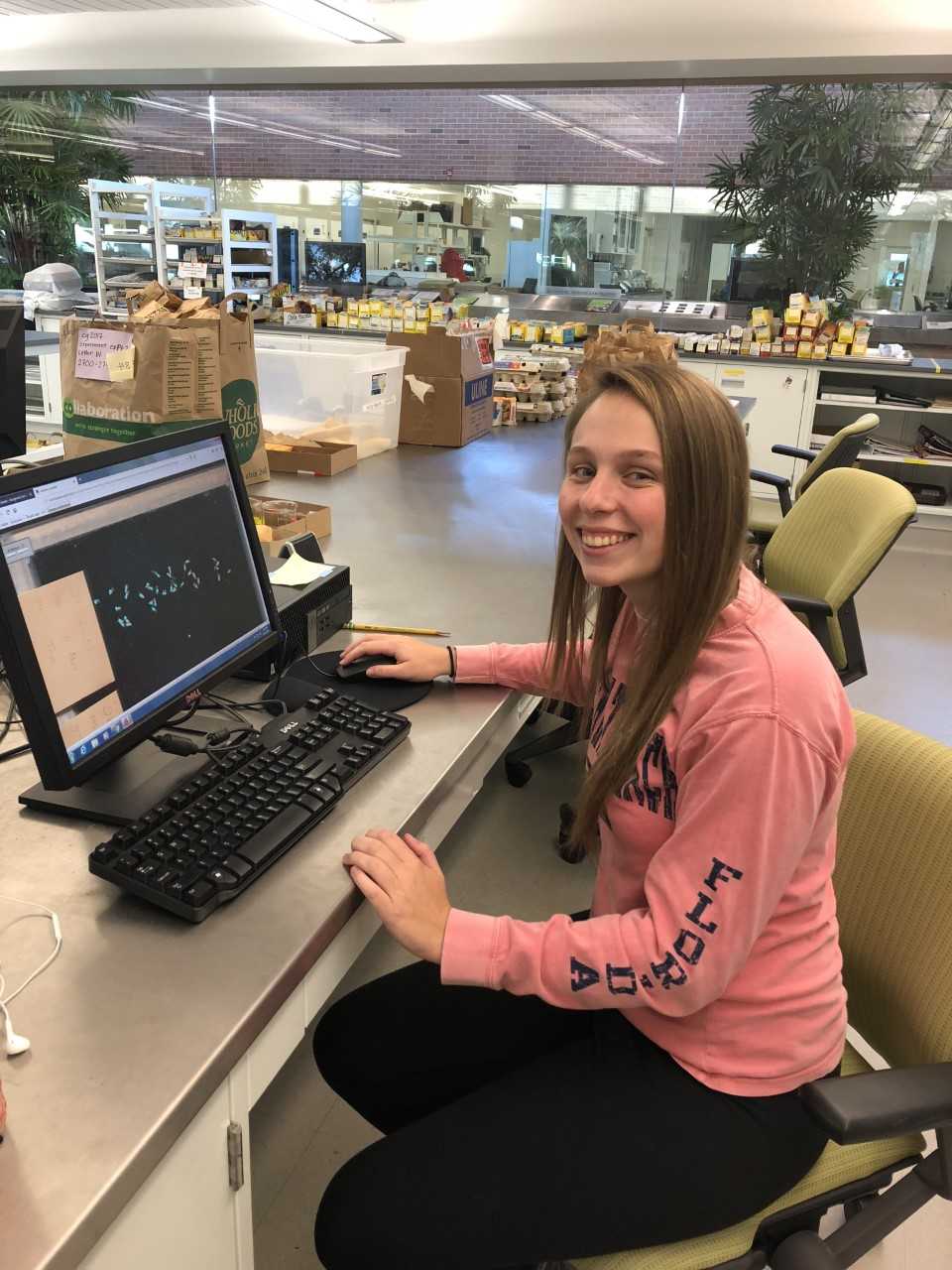
Here is a few photos of me, working super diligently to beat Leah’s overall achene count for the day!

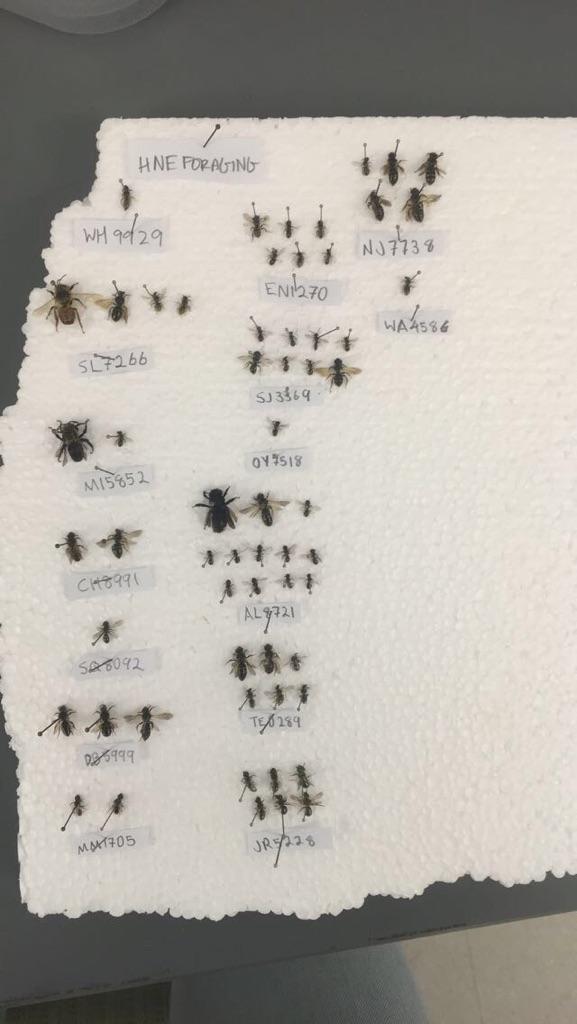
Hello! I am Emily Staufer, one of the Lake Forest College students taking part in the ‘mini-internships’ with CBG! I’m working with Kristen Manion on pinning foraging bees from the Hegg NE site.
I really enjoy working on this project; I spent the past summer in a research lab point-mounting ants, and so working with critters a little larger and involving much less glue is a much-welcomed change of pace. I’ve also always had an interest in conservation ecology, so this project is a perfect fit, and Kristen is helping me figure out how to ask questions of my own about my little section I’m working on in order to have a great presentation for the end of the semester.
When asked about my specific role, I like to think of my corner of the table in the CBG lab as my bee beauty (bee-uty!) salon – it’s my role to make the specimen look as good as possible, and this all boils down to fluffy bees.
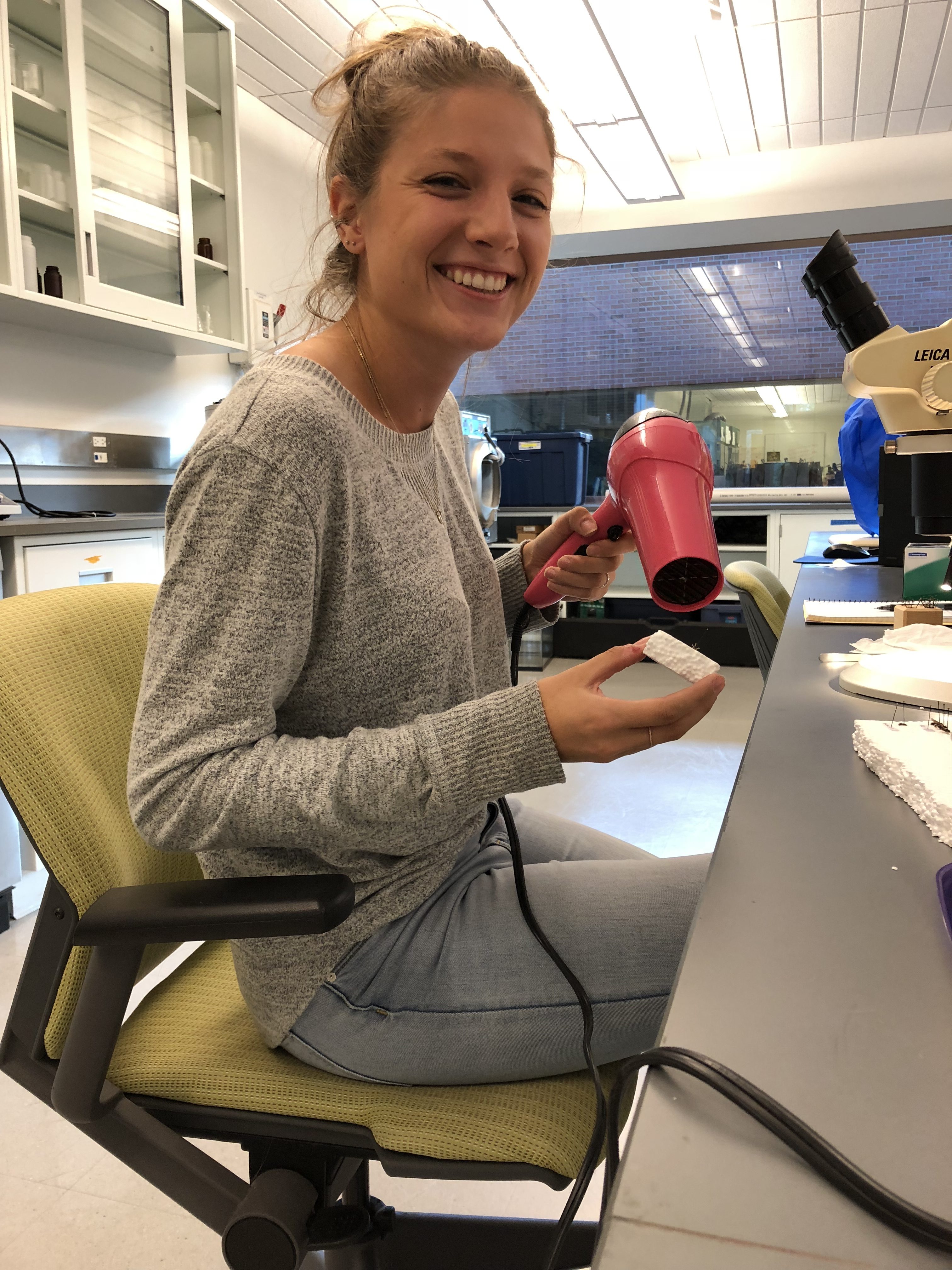
At my salon, the wash always comes first, since the bees are all in their ethanol tubes from each collection location. A quick towel dry follows to begin the fluffing process. Under the dissecting scope, they undergo a slightly invasive process when the pin is put in place through the center of their abdomen, but it is followed quickly by a relaxing massage with a pair of forceps as I position their legs and wings. What comes next is the real treat – a nice, warm blowdry using my very professional Pink Hairdryer. No bee is left defluffed, as this is key to the process! After their treatment, each happy customer is added to the larger board next to their foraging friends from the same site. Come visit my salon in the CBG lab, 100% satisfaction rating on Yelp (or it would have one, if bees had access to iPhones).
 Some of the bees Emily has been working with these past few weeks.
This week the Echinacea Project welcomes our three Lake Forest College interns: Emma, Leah, and Emily! We’re excited to have them for the next four weeks helping out in the lab. Emily is pinning bees from Hegg NE for Kristen, Emma is looking at our 2015-2017 heads in the aphid addition and exclusion experiment, and Leah is looking at our 2015-2017 heads in the pollen limitation experiment. Look forward to more updates from Emma, Leah, and Emily themselves!
 Emma and Leah cleaning heads Emily blow drying a bee
Stuart, Michael and I were back in Minnesota this week Monday-Thursday to finish up a few fieldwork tasks. We staked to 268 points across our sites to complete demo rechecks. Most of our Echinacea have fully senesced, but there were a few out there with some greenish leaves. There are not a lot of species flowering, except your occasional Solidago still holding on.
We also started work herbiciding Ash trees in p8. We didn’t apply herbicide to any trees close to Echinacea, because we wanted to test out our methods. It will be interesting to see how well the herbicide works. Finally, no chances for a burn these last few days, with wind and humidity levels not right. There might be a chance for a burn this fall, but more likely spring 2019.
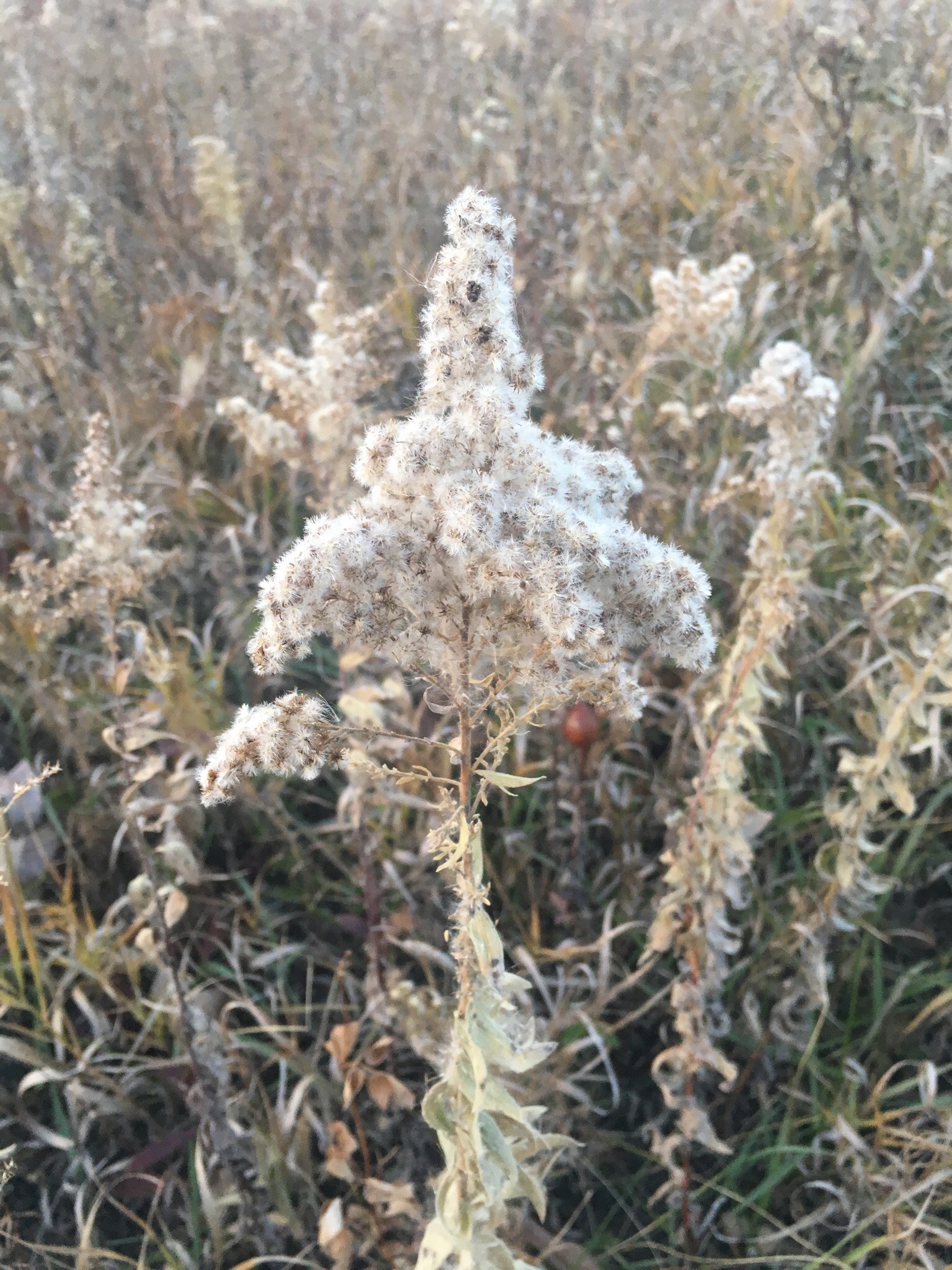
Solidago fluff at Hegg.
“When life deals us cards
Make everything taste like it is salt
Then you come through like the sweetener you are
To bring the bitter taste to a halt”
Ariana Grande, in the song “Sweetener” off of her latest album Sweetener (2018).
Greetings from the College of Wooster, or Team Echinacea East
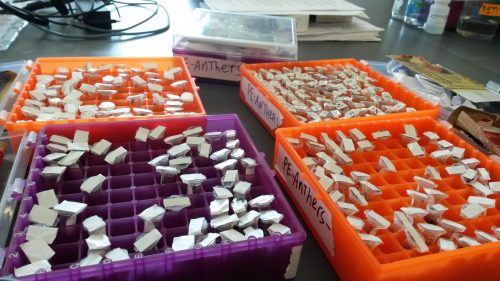
This summer I helped conduct research about the differences in pollen removal and deposition (a measure of pollinator efficiency) across different taxa of solitary bees that visited Echinacea flowers, out at P2 (with Evan, Mia, and Jennifer Ison). In order to quantify pollen removal we collected anthers (the male part of the flower that presents pollen) before a bee visited and again after the visit; we suspended the anthers in water. In order to quantify the number of pollen grains in each sample. But what to do with these samples?
 Here are all the sweet anther samples! In order to quantify the number of pollen grains present in each sample I first break apart and shake up the anthers, to try to get the pollen evenly distributed in the solution; then I count a small amount of this pollen solution on a hemocytometer under a microscope (a hemocytometer is a sort of microscope slide with a grid that is used to count red blood cells in blood; I use it to count pollen particles in water).
Here’s the hemocytometer all loaded up with sweet pollen to count! Now that the summer field season is over I’ve been able to spend quite a bit of time counting pollen. While I’ve been counting pollen I’ve been listening to music on my roommate’s portable speaker. Mostly I’ve been listening to Ariana Grande’s new album Sweetener. The title track which opens this flog post speaks directly to the relationship that I have developed with the act of counting pollen. It is the sweetener to my life. I struggle to leave the lab each night; wanting to get just a little more of that sweet taste of pollen counting. It brings the bitter taste of college life to a halt. I don’t know what it is about pollen counting that I like so much. Is it the repetitiveness of it? The simplicity? The repetition? It’s impossible to say. All that I know for sure is that I really hope that everyone can experience the sweetness that counting pollen brings to my life.
P.S. I really hope I find something to fill the void that will be left in my existence once I run out of pollen to count (I only have 340 samples or so, and I’m more than half way through them).
Thanks
Hello from Team Echinacea East!
A long long time ago on the flog many clicks away, Lara Leventhal performed an experiment to determine the amount of interspecific pollen diversity on different taxa of solitary ground nesting bees. The field aspect of this experiment occurred during the summer of 2016 this involved catching bees and wiping them on styles of Echinacea. By genotyping seedlings that were produced by wiping bees on receptive styles, we are able to determine how many different plants that the bee taxa are carrying pollen from. This requires performing plant paternity tests really means a lot of PCR work. This work has been going on for over a year, we are starting to reach the end and almost to a point of doing only reruns on samples that failed. I have not been doing this work alone, there have been many people that have worked on this project right now Michelle Chang and I have been on the molecular team, (there has been at least two people besides Laura that worked on this project).
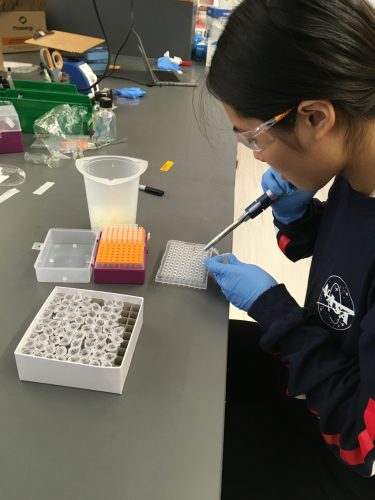
Meet Michele! She is working on loading a PCR plate in this photo
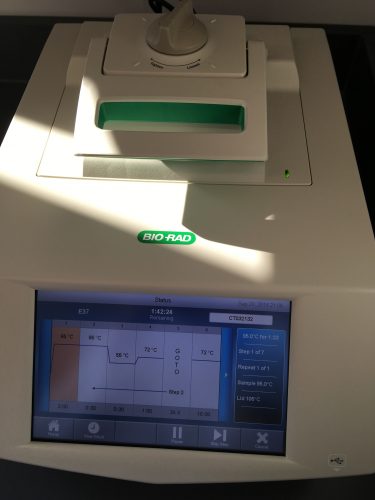
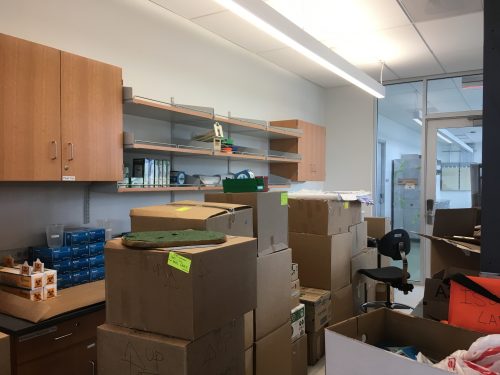
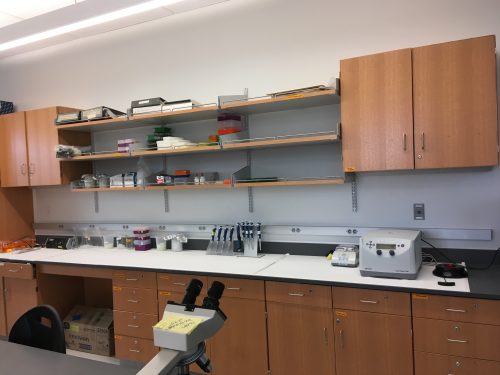
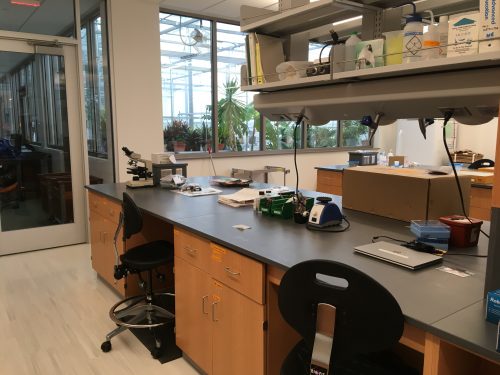
Look its a new PCR! We called it boxville for a reason! Doing lab work requires well a set up lab. The College of Wooster just opened our new life sciences building that means that when I got back to school the lab was full of boxes. We had to unpack before we could do anything. This was very exciting but also was a daunting task, we have recently have finished setting up the lab and the greenhouse(oh have I not mentioned it yet there is a greenhouse attached to the lab!)
One side of the lab(post boxes) The other half of the lab Until next time flog!
Mia
|
|