|
|
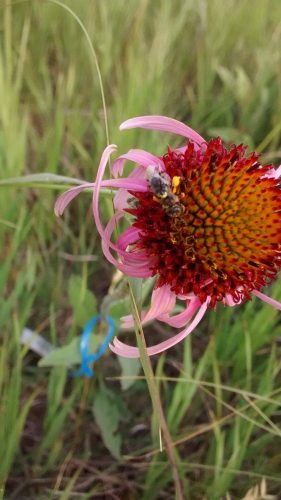
Today was the first day of Team Echinacea’s pollinator observations! A number of genera were tentatively identified, including a number of small black bees and Agapostemon. As I sat in the field today, I encountered a pair of mating bees (picture below) on an Echinacea head.
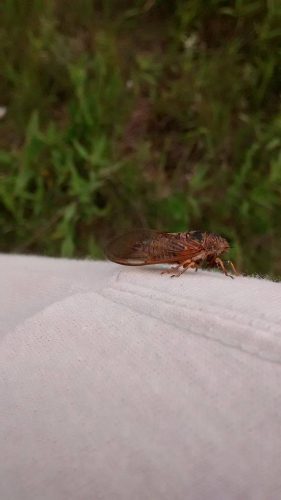
 Pair of unknown bees mating on an Echinacea head while the female forages. The female’s scopae were chock full of pollen, and it was a great way to start this season’s pollinator observations! I also saw a few bumblebees today, buzzing around but not visiting Echinacea heads. All around, it was a great day of observations. On my last few observations, I came across a pretty big bug. It decided to chill out on my arm for a while until I finally finished my last observation and returned to the Hjelm house for lunch.
A Big ‘ol bug (of unknown species) who decided to take up residence on my arm for a while this morning. It was interesting to note that many observers noticed that as the day wore on, more and more pollen was (presumably) collected by pollinators until there was a time when little to no pollen was able to be observed on Echinacea, and after this time pollinator observations were few and far between. This seemed to happen even at Landfill (where I was located), even though there were a relatively greater number of flowering pollinators than at some smaller sites. It was also interesting that though there were relatively more flowering plants, there were fewer pollinator observations at Landfill than at some of the smaller fragments.
I can’t wait to continue pollinator observations in the near future, and to observe the changes in pollinator diversity as the Echinacea flowering season continues!
After a nice, relaxing weekend, we were ready for our breezy and busy Monday. We split up into teams this morning to accomplish things like phenology, Stipa harvesting, using the GPS and finding more q2 seedlings. Lea and I took one of the routes to some of the prairie remnant sites to assess phenology of Echinacea. Lea helped me become so much more confident identifying the flowering day and style persistence of each plant, so she gets a special shout-out for answering (and re-answering) all of my questions.
 An “Instagram-worthy” view taken during our drive to remnant sites We all convened for lunch to hear Kevin Kotts speak about his job as Wildlife Manager with the Minnesota DNR. The team learned that he has many different jobs, including work in wetland, grassland, and wildlife management. It was really interesting to learn about all of the ongoing conservation and restoration projects in the five-county area.
After lunch, it was back to work to finish what we had started before lunch. However, we mixed up groups, so I was able to go out to Landfill with Amy, Will, and Alex to learn how to use the GPS and jam out to a bit of Taylor Swift.
Finally, at the end of the day, we all met back up to chat about our progress and get a little insight into tomorrow’s adventure. Jennifer and Stuart taught us how to identify the pollinators we should expect to see during pollinator observations. Also, I got my mustard in the mail today, so hopefully I will be able to go to the bog soon to take the rest of my initial measurements for my I.S.
Today we recorded first flowering dates for the early-flowering Echinacea plants in our remnant populations. For short, we call this activity “phenology.” Now we want to estimate how many total plants will flower this year at each site.
At four remnants (eri, sap, yohe, and lfw), we also recorded as many plants as we could find in bud. The ratio of currently flowering plants (flPla), to all plants in bud (allPla) at these sites ranged from 9 – 27%.
The below table shows the estimates (guesses) of how many plants will flower at each site this summer based on the assumption that 10% (guessHigh) and 25% (guessLow) of plants at each site are already flowering.
> aa[order(aa$guessLow), ]
    site proFl allPla flPla guessLow guessHigh
12  nwlf  0.00      2     0        0         0
16 rrxdc  0.00      2     0        0         0
20 tower  0.00      1     0        0         0
23 woody  0.00      1     0        0         0
5     gc  0.50      2     1        4        10
17   sgc  1.00      1     1        4        10
10   lcw  1.00      2     2        8        20
11  nrrx  1.00      2     2        8        20
22 tplot  0.50      4     2        8        20
25  yohw  0.67      3     2        8        20
3    eri  0.09     33     3       12        30
6     kj  1.00      3     3       12        30
15   rrx  0.43      7     3       12        30
21    th  0.75      4     3       12        30
24  yohe  0.22     18     4       16        40
1     aa  0.56      9     5       20        50
19   sap  0.19     26     5       20        50
4   eelr  0.54     13     7       28        70
18  sppe  0.57     14     8       32        80
2    alf  0.50     20    10       40       100
13  on27  0.60     25    15       60       150
8    lfw  0.27     74    20       80       200
7    lfe  0.39     62    24       96       240
14    ri  0.44     54    24       96       240
9    lce  0.74     34    25      100       250
>
These estimates will help us decide which populations to choose for our planned systematic observations of bees this summer.
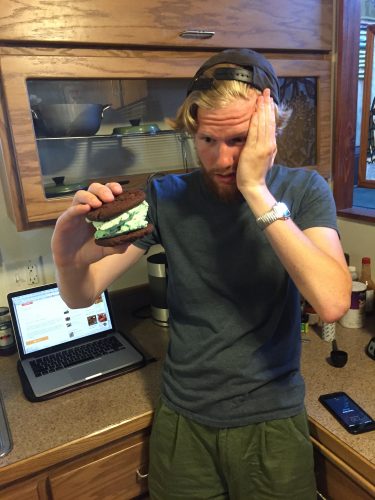
Today, June 26th, little Scott’s mind was blown (see below).
 Scott trying to fathom how an ice cream sandwich could be so perfect. Yes, the most perfect and tastiest of ice cream sandwiches was created in Kensington today. Kensington is no longer the just the birth place of America but now the birth place of the most divine and exquisite ice cream sandwich. A stunning combination of chocolate brownie-cookie and mint chocolate chip ice cream in the perfect ratios created a treat that not only holds rank among ice cream sandwiches, but ALL sandwiches. Additionally, the “mouth-feel” was exceptional.
Energized by the ice cream, a spontaneous and rambunctious frisbee session began and superlatives were awarded.
Alyson: Best Mind Games and Most Intimidating Eye Contact
Amy: Best Dinosaur Noises
James: Longest Reach and Best Fake-outs
And then the game got serious when we asked the REAL questions: “How many ice cream sandwiches is too many ice cream sandwiches?” and “Should we wash out feet before we get in bed or should we just put socks on?”
Stay tuned.
So far our weekend has been busy but fun! We started the morning off with a family breakfast of eggs, vegetables & hash browns that other Lea and I cooked. Scott then helped his professor Harmony Dalgleish from the College of William & Mary sample milkweed populations on route 37. The Town Hall group then went to Elbow Lake for swimming, diving, and sunbathing for a few hours. We decided Amy has the best dive and James has the best cannonball. James was also able to touch the bottom of the lake with his feet (granted he is the tallest in the group).
After grabbing lunch back at town hall we headed to Alexandria for a shopping trip at GoodWill and Cub for groceries. Alyson was able to pick up mason jars to collect insects from her bog and Alex found more shirts for field work. Alyson & I also picked up a pitcher from Walmart to make some sun tea this weekend. Half the team (the carnivores) headed to Will’s house to try his ribs while the vegetarians returned to town hall to rest after the long day.
 Will’s infamous backyard!
 Alex and Leah with one of the first flowering plants of the season! Happy Stir-Friday, everybody! We had a very productive day here in Kensington. More and more plants are flowering in the remnants, and we started out the morning by assessing phenology at the Riley and East Riley sites. From there we split into groups to check on flowering plants in the other remnants. The team convened for lunch, then split into smaller groups again. Leah, Alex, and I went to the Landfill sites to flag and do phenology. After that, we came back and found more q2 seedlings.
Gretel, Will, Lea, and James went to p2 to tackle flagging and doing phenology there. Word on the street is that it will be another big year for flowering at p2, but fewer than last year. We’ll see! Meanwhile, Scott, Stuart, Alyson, and Laura collected Stipa in p1. While doing so, they discovered that something or someone has been eating the Stipa! Why?! How?! It is so pokey! Current hypotheses propose that deer have been browsing, but the motivation they would have for eating a grass with such bad mouthfeel is unclear.
We finished the day with rootbeer floats. Yum! And because it was stir Fry-day at Town Hall, Alex made us all a tasty stir-fry for dinner. We’re looking forward to a fun weekend and the busy weeks ahead with increased flowering, pollinator observations, and more!
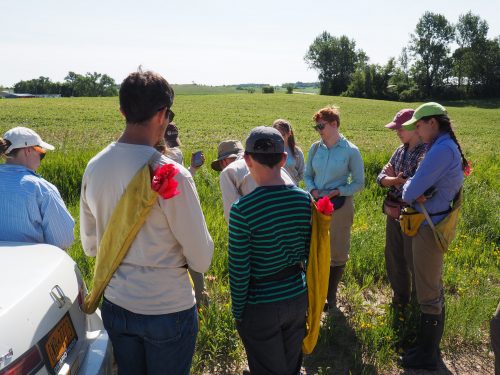
Today we went out looking for pollen producing Echinacea heads, after finding one at East Elk Lake Road and in experimental plot 1. We started looking for flowers at Steven’s Approach and we found one that had started producing pollen today! After searching at Steven’s Approach some of us went out to scout other remnants for plants that had already begun flowering. We found 18 flowering plants! One at East Riley started flowering about 5 days ago! After visiting all of the remnants we took a break for lunch and heard about Lea and James’ independent projects.
The team learns about recording data on flowering phenology and finding flowering plants! First flowering plant at Steven’s Approach! Amy and James tagging flowering Echinacea Echinacea on day 5 of flowering at East Riley After lunch we headed down to experimental plot 1 to continue searching for stipa, we searched all the rows and found about 130 flowering plants. One of the plants had over 200 fruits! We ended our day measuring seedlings in q2.
Finding flowers this morning means we have to get on top of thoroughly searching the remnants for plants that will flower this summer so we can get flowering phenology and demography data from them. We have our work cut out for us!
This week the crew pushed on cleaning and re-checking seeds and counting achenes. I spent a good amount of time prepping seeds to be frozen for long term storage. These seeds are from several different experiments in 2013 and 2014 and have not been X-rayed. They must be placed in the dryer for two weeks, which removes enough internal moisture to avoid the seed rupturing when frozen at -20 degrees Celsius. These E. angustifolia seeds join the Dixon National Tallgrass Prairie Seed Bank here at the Chicago Botanic Garden. This collection has aimed to bank at least one representative sample of every species found in the tallgrass prairie ecosystem. Multiple populations have also been sampled for more than 500 species that are deemed critical to prairie restoration, so our seeds are in good company!
Seeds from multiple experiments in 2013 going in the dryer.
Today was another great day on Team Echinacea. This morning we continued our work on Q2, and we continued to make significant progress. We measured many plants and found at least five new plants in the experimental site. After a hearty lunch and a short time marveling at ice formations in a water bottle, Amy Dykstra gave a presentation on her research, which included her study of local adaptation of Echinacea. The afternoon was filled with preparations for IS projects (for the Wooster folks) and independent projects for the rest of us. Leah and Laura quickly became adept at catching pollinators, but were not so successful at transferring the collected pollen to fuchsin jelly. The rest of us hunkered down on our computers, read some literature, prepared project proposals and thought about how hard it would be to use NMR and IR to analyze pollen.
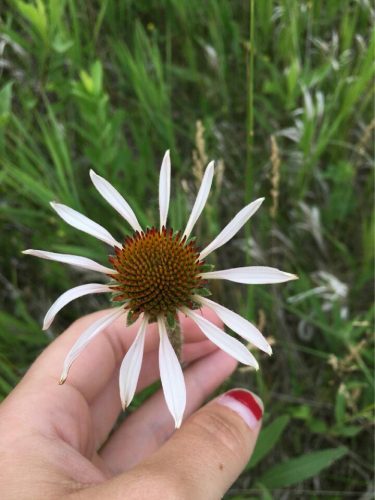
Leah regales us with stories of captured pollinators and attempts at melting fuchsin jelly on a car dashboard. The exciting news of the day is that we found our first flowering Echinacea in P1 and at Elk Lake Road East! Tomorrow we will find out how many more Echinacea are flowering.
 The second flowering Echinacea (found at Elk Lake Road East)!
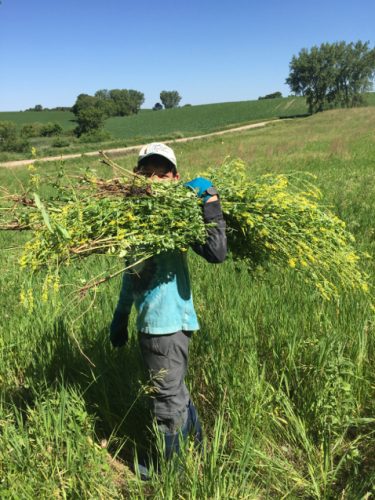
The gang had a busy day today, almost all of it in the warm June sun. Alyson continued setting up her experimental plots in the Staffanson bog, and spent the afternoon measuring canopy cover and soil pH for her IS project. Meanwhile, the rest of the team (minus Gretel, who was setting up work for q2 juvenile counts) picked up our fleg begs and counted Hesperostipa spartea and weeded in p1. Amy and James found one H. spartea specimen with 137 seeds! We are now up to 17 out of 59 rows surveyed. Meanwhile, Will, Alex and Per led the crew in weeding out the non-native yellow sweet clover (Melilotus) from the periphery of the plot area. Hopefully we eliminated a lot of potential seeds form the seed bank, meaning that in future years the rows will be devoid of this weedy legume and the study Echinacea will have less competition. Stuart also showed me what poison ivy looks like for the third time, and I still don’t think I could pick it out of a lineup.
Per with a bundle of sweet clover picked from around p1. This is probably less than 10% of what was removed today. After some brief (or for Alex, who was cleaning the bathroom, not so brief) chores at the Hjelm House, the team returned to exPt8 (experimental plot 8) to search for juvenile Echinacea crosses planted in 2013. This meant more time bent over, although now instead of looking for seedlings we were looking for melted bits of toothpick (which were placed to mark seedlings). Some seedlings were in great shape — Alex and I found a couple with basal leaves over 10 cm tall. Others were not in great shape, either dead or missing like Jimmy Hoffa. We got about a third of the work for qGen2 this afternoon. It may rain tomorrow, so we’re bracing for indoors-work and hiding our bicycles inside.
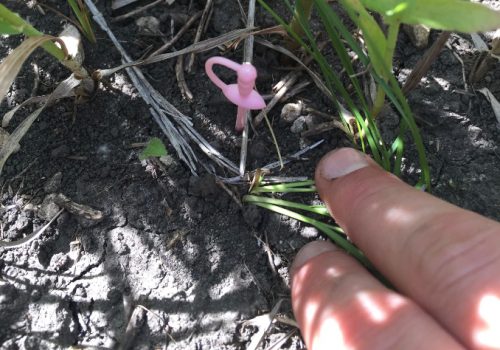
 Using a pink sword to claim the new seedling (left) for Team Echinacea. We used cocktail swords to denote seedlings germinating this year from achenes sown in 2013.
|
|