|
|
As dawn broke on yet another day in Kensingtonville, Team Echinacea arose to a dark sky producing ominous rumbles of thunder. An occasional pitter-patter turned into a steady fall of condensed water vapor. The team members wearily turned to each other and half-heartedly debated whether to arrive at base per normal routine. Some, namely Katherine, Jill, and Greg, decided that it would be best to separate from the rest of the crew for a while and work under the grey skies above. Those who remained in the heart of Kensingtonville hurriedly tried to edit abstracts whilst waiting for the skies to be more favorable. After a few dreary hours, sunrays started to peek through the clouds, and then suddenly burst out with blinding brilliance, stunning those indoors. After the initial shock of seeing sunshine, select members of the crew finished their abstracts and drifted off into the land of unicorns and chocolate chip cookies.
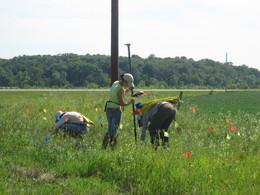
After lunch, the two parts of the crew decided that it would be in our best interest to come back together and work as a brave platoon to conquer the plot that is Caroline’s, over yonder at Hegg Lake. After a few encounters with fierce toothpicks and cardinal directions, Team Echinacea prevailed!! (And finished early. Woohoo!!)

Team Echinacea has taken on another difficult task: the task of mastering the Dread Pirate R. And his crew of R.O.U.S.’s (R-scripts Of Unusual Size). R comes to you at night and steals your sanity. But only part of it. There’s a big difference. The crew has differing opinions about R:
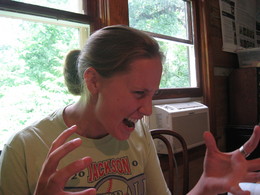
Those who don’t mind it too much:
And those who mind it quite a bit:
On the brighter side of the spectrum, the crew finished the day early, and therefore had more time to lounge around/nap/work on projects. A few decided to go for a swim in the great Elk Lake before dinner (which was quite nice, if I might say so myself).
Tuesday morning marked the end of measuring in the common garden!!!! It was slightly anticlimactic with only one and a half rows left to finish but it is still rewarding to be finished.
It was a rainy morning so we didn’t get out to the common garden until about 10:30, but we had time to pull all of the thistles between measuring and lunch. Now there will be one less prickly plant to avoid when we return to recheck missing plants and contradictory records in the next few weeks.
While the rest of us were working inside or in the common garden Katherine and Jill spent a long morning at work in the remnants performing their aphid and any survey. They made significant progress, leaving only two small sites to finish on wednesday, and found Kelly’s sunglasses that she had lost at Staffanson.
We had been planning to spend the afternoon measuring in the common garden, but since we finished earlier than expected we had the rest of the day to work on individual projects. Many of us took the opportunity to prepare abstracts for submission to the University of Minnesota for the poster session we will be presenting at on August 9th. It turns out that abstracts become more challenging to write when you are still floundering through R endeavoring to analyse your results, but as Stuart reminded us, all (or most) of the other presenters are likely to be facing the same challenges.
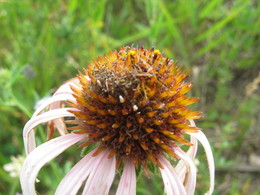
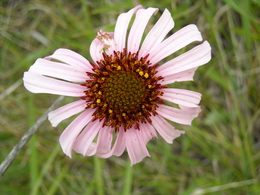
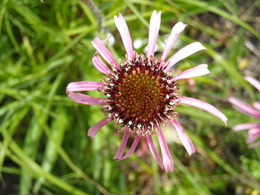
I haven’t been very good about taking photos recently, but while I’m on the topic of individual projects here are two photos that relate to my work. The first one is E. angustifolia and the second is E. pallida. You can see how they have a slightly different appearance.
This week started off strong with a morning of dedicated work on independent projects; Jill and Katherine visited a couple of remnants to work on the ant and aphid surveys, Maria continued her observations at Hegg lake, and the rest of us enjoyed the cool of the Hjelm house as we put or noses to the grindstone, analyzing our data and beginning to work on our posters. To help us prepare for writing our abstracts, before lunch Stuart gave a quick tutorial on putting hypotheses into words, a task that some of us found surprisingly challenging. After lunch Jennifer Ison gave a presentation which she had prepared for the recent evolution meeting, and we finished off the day by measuring the last major set of rows in the big batch garden. Now only 1 and 1/2 rows left.. Woohoo!
Jill is busy looking for those ants and aphids.
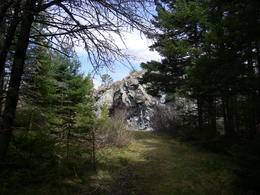
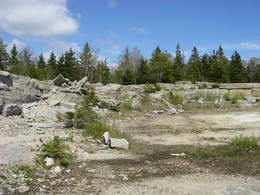
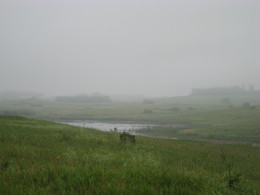
Sunday was a much-anticipated day off for all of us in K-town. Kelly’s grandparents were in town, Lydia was off working at Mount Carmel, and Andrew spent time with his girlfriend, Kelsey, showing her around the research sites. Meanwhile, I slept in and made “bark stuff” (an addicting chocolaty dessert) to satisfy my weeklong chocolate craving. I also GRE-ed, made a concerted effort to learn more Italian verbs, and worked on some things for my research back in Maine. Although I don’t have any pictures from the day, I do have some pictures of my research sites in Maine for those who haven’t seen a heaping hunk of serpentine before. The top picture is Pine Hill, a serpentine outcrop, and the picture below it is Settlement Quarry, a granite outcrop.
Friday morning started out with a quick round of phenology in the common garden. Split between four or five of us it only took about 20 minutes each and it seems like flowering is just about done! From what every one who has been here in previous years, this year appears to be earlier than usual.
After phenology we all had a few hours to work on our individual projects. Although a few people are still doing fieldwork, most of us are done or beginning to wrap up, and moving on to data analysis. I transferred my first data set to R and started attempting to figure out how to organize it with some help from Stuart.
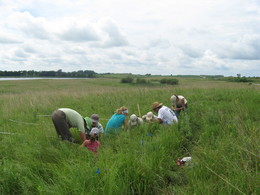
We had an early lunch to allow for a longer stretch of work in the afternoon and managed to finish measuring at Jennifer’s plot at Hegg Lake a few minutes after 5pm. We took a short and very welcome break halfway through for watermelon that Jennifer brought. And managed not to loose any surveying pins, despite me forgetting to pick up the pile I made and Maria’s attempts to hide one in her flag bag.
Here is a link to a csv of my data sheet!
angustifoliacrossdata_2012_all_locations.csv
And also, here’s the script that I used in R.
Compatibility script.r.txt
Imagine walking into a foggy wonderland where all you can hear is the sound of birds, frogs, and the occasional drip of water. Well, you should be jealous because that’s where we spent our morning: Hegg Lake!
We spent the entire morning measuring Jennifer’s plot, and we are nearly halfway done (I think). Take that, echinacea!
This afternoon after lunch, Jennifer gave us her presentation on her work with assortative mating based on phenology. Stuart then briefed us on doing demography in the remnants, where we find all of this year’s flowering plants and record data on them and then GPS their coordinates.
And now most of us are sitting around as we eagerly await an all-Amerrrrrican dinner of mashed potatoes, corn-on-the-cob, veggies, and apple crisp lovingly prepared by Kelly and Andrew! Nom nom nom….
Tuesday’s weather compared to Monday was “not as bad” to speak Minnesotan. While individual projects were tackled and we measured in the afternoon, it still isn’t done. The glimmer of hope is that one good day of measurement will finish the task for the year.
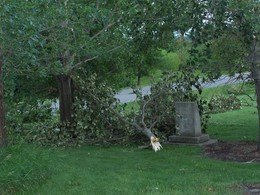
In more MN terms, the storm Wed morning was also not so bad as the late July storm last year that uprooted trees and took out power. The picture is from the Runestone Park devastation that Maria and I witnessed last year.
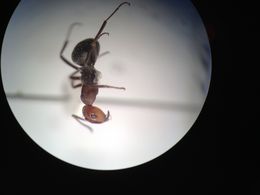
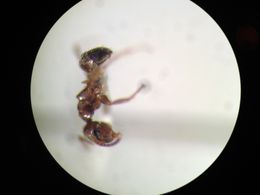
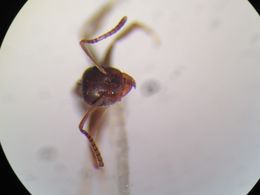
With the goal to be done with work by noon, I biked up to the Hjelm house at 6:30 this morning to survey flowering plants in the common garden, and by 7:30 was hunkered down in the Hjelm house basement with the dissecting scope and an army of ants. Since Thursday, I’ve been identifying the ants I collected from Echinacea plants. Ant ID can be incredibly frustrating, given their small size and minute characteristics. For instance, one of the major differences between genera is the number of teeth on the mandibles! Exasperated after two hours of looking through the scope, I decided to pin my ants and return to ID-ing on Monday.
Later this coming week, I’ll also attack the ants I collected from my pitfall traps, some of which have over 100 specimens! I also need to decide how many weeks I’m going to collect from my traps, and how much of the data I can realistically get through before the two poster sessions in August.
Other than my ant party, here’s what else was going on today:
–Kelly flew Felix, our adopted kitten, to his new family this morning!
–Shona, Lydia, Maria, and Andrew surveyed flowering plants in the common garden and then headed to Kelly’s remnants to work on her phenology while she’s out of town
–Katherine worked on her aphid experiment in the common garden
Today most of us started out doing phenology in the Common Garden. Phenology is starting to go much quicker. Hooray! The rest of the morning was spent working on individual projects. Most projects are drawing to a close already. Time sure flies! Jill spent the morning identifying the species she collected from her pitfall traps in the remnants. Maria was found over at Hegg Lake collecting seeds and anthers. She also looked at some dicanthelium at other sites and discovered that they were all mostly done flowering. Kelly and I spent the morning out at our remnants doing phenology and finishing up my experiment. I assessed my last cross for the summer! Some of my crosses were flops due to the caterpillars that ate my anthers and styles. Meanies. How to tell they are there? They leave a TON of frass everywhere.
In the afternoon, we continued to measure plants in the Common Garden. Maybe we’re halfway there? We’ve nonetheless become pros at measuring echinacea. Bring it on!!
|
|


-thumb-260x195-128753.jpg)