|
|
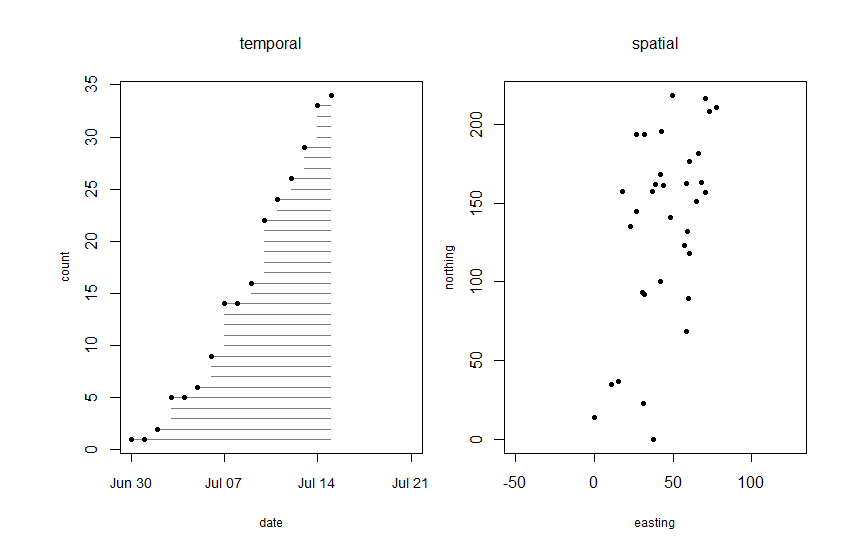
Echinacea pallida, a non-native Echinacea species that is compatible with E. angustifolia, was planted at a restoration at Hegg Lake WMA. One aspect of the potential that E. pallida has to interact with E. angustifolia individuals is the synchrony of their flowering timing, or phenology. To study this, we have kept track of the start and end dates of flowering for Echinacea pallida individuals in the Hegg restoration plot since 2011. In 2015, we identified 48 flowering plants with 139 heads. Flowering began on June 30th. Then, on July 15th, we chopped off all the Echinacea pallida heads. Before this date, 34 individuals flowered.
 Flowering schedule and map of Echinacea pallida at Hegg WMA. Note the abrupt end of flowering on July 15th. Click to enlarge! Read more about this experiment.
Start year: 2011
Site: Hegg Lake WMA restoration
Products: In Fall 2013, Aaron and Grace, externs from Carleton College, investigated hybridization potential by analyzing the phenology and seed set of Echinacea pallida and neighboring Echinacea angustifolia that Dayvis collected in summer 2013. They wrote a report of their study.
Overlaps with: Echinacea hybrids (exPt6, exPt7, exPt9), flowering phenology in remnants
Previous team members who have worked on this project include: Nicholas Goldsmith (2011), Shona Sanford-Long (2012), Dayvis Blasini (2013), and Cam Shorb (2014)
We spent the morning working on our personal projects. Elizabeth assessed style shriveling on her crossed flowers at Yellow Orchid Hill, where, she reports, flowering has recently passed its peak. Meanwhile, Claire and Jared performed crosses on the focal plants on the west unit of Staffanson. In P1, Will worked on his pollen preservation experiment and the Pollinator Posse (Keaton, Maureen, and Jennifer) surveyed P1 phenology. Further afield, Alli continued her flowering community analysis.
But the real action was at Hegg Lake, where I finished my first round of aphid additions to Echinacea angustifolia, E. pallida, and their hybrids in P7. I have almost doubled my efficiency since starting the additions, performing 20 additions in a little over an hour. I also surveyed the phenology of the 18 E. pallida flowering in the restoration nearby. Aphid survival and flowering phenology may seem pretty disparate topics–and they are–but they both inform our understanding of the consequences of introducing a non-native but closely related Echinacea species. Do they support the same aphids? How about their hybrids? How likely are they to hybridize? How much does their flowering phenology overlap? It’s hard to stick to just one question.
Doubtless inspired by my example, the rest of the team came to Hegg in the afternoon, where we measured plants in P2. Many of us we were able to increase our efficiency by working alone instead of in pairs, and row by row we progressed eastward. Less than an afternoon’s work remains.
Here is the latest draft of my proposal to investigate the survival rates of Aphis echinaceae on Echinacea hybrids and the impact they have on host fitness:
CMS_proposal_8Jul2014.pdf
I’m excited to get started. In addition to my main project, I will be conducting and coordinating a variety of side projects related to aphids and Echinacea hybrids:
1. Katherine Muller and Lydia English’s aphid addition/exclusion experiment in P1.
2. Assessing fitness of the two Echinacea species and their hybrids in P6 (Josh’s Garden) and P7 (at Hegg Lake).
3. Recording flowering phenology of Echinacea pallida at Hegg Lake, where they were planted in a prairie restoration.
|
|