|
|
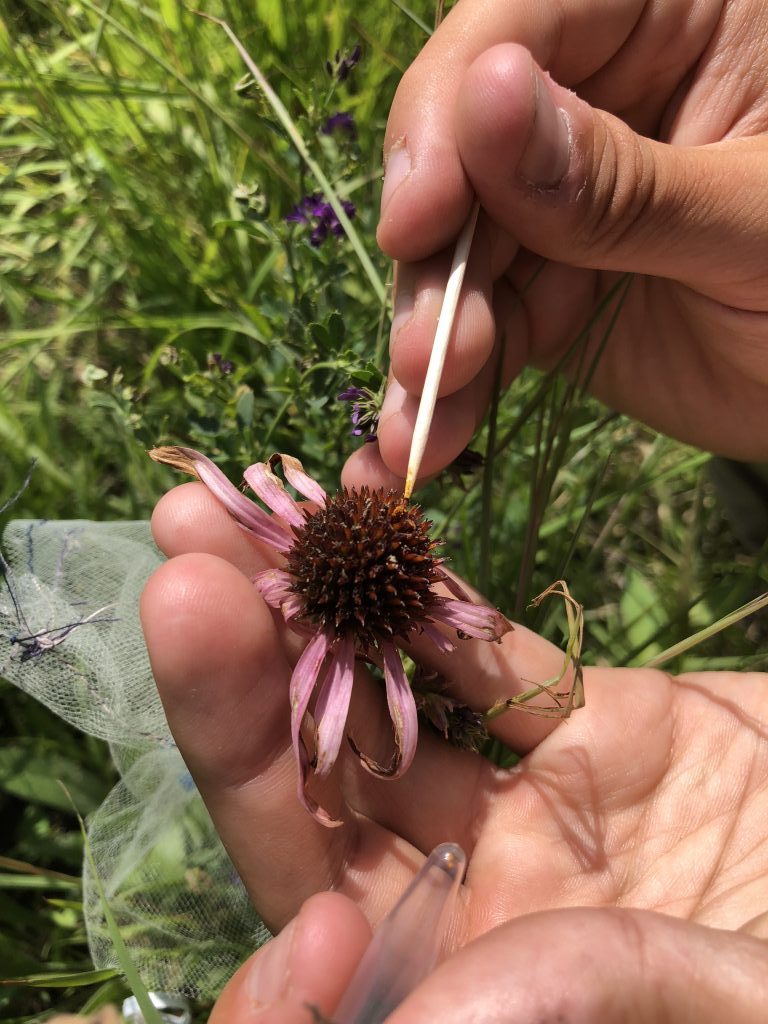
 Michael adds pollen to one of the “addition” plants using a toothpick and a vial of collected pollen. Does receiving the maximum amount of pollination vs. no pollen at all affect a plant’s longevity or likelihood of flowering in subsequent years? Since 2012, we have been either adding or excluding pollen from the same plants’ heads to test what role pollen plays in ongoing survival and flowering. Unlike the previous two years, many plants in this experiment flowered this year, and analyzing them will likely reveal interesting results.
This summer, 14 of the 26 plants remaining in the pollen addition and exclusion experiment flowered, for a total of 25 heads. This is the most heads the pollen addition and exclusion project has had since 2013. We continued experimental treatments on these flowering plants and recorded the survival and flowering status of all plants in the experiment. Of the original 38 plants in this experiment, 12 of the exclusion plants and 14 of the pollen addition plants are still alive.
In this experiment, we assess the long-term effects of pollen addition and exclusion on plant fitness. In 2012 and 2013 we identified flowering E. angustifolia plants in experimental plot 1 and randomly assigned one of two treatments to each: pollen addition or pollen exclusion. When plants flower in subsequent years they receive the same treatment they were originally assigned. The increase in flowering rates this year will allow us to move forward with analyzing this data set, to potentially answer this 7-year question.
Start year: 2012
Location: Experimental plot 1
Physical specimens: We harvested 25 flowering heads from this experiment that will be pulled from the normal ACE processing and pushed through faster. This is so we can more quickly determine achene count and proportion of full achenes.
Data collected: Plants survival and flowering data was recorded as part of our annual surveys in P1 and can be found with the rest of the P1 data. Data on when heads had pollen added can be found in CGData/115_pollenLimitation, particularly dailyPollenAddition for the year 2018.
You can find more information about the pollen addition and exclusion experiment and links to previous flog posts regarding this experiment at the background page for the experiment.
This summer Team Echinacea continued adding and excluding aphids to plants in the experiment that Katherine Muller started in 2011. Katherine Muller randomly designated a sample of 100 Echinacea plants in experimental plot 1 for either aphid addition or removal.
Andy managed the project for the team in 2018, making sure that aphids were removed from the exclusion plants, and added to the addition plants. Twice a week, Andy (and occasionally Morgan) visited every plant in the study, recording the number of aphids, ants, and leaves infested. There remain 54 plants in the aphid study, 26 from the aphid addition plants and 28 from the exclusion plants. The data for this year will be added to the ongoing dataset.
Aphis echinaceae is a specialist aphid that is found only on Echinacea angustifolia. Read more about this experiment.
That’s a lot of aphids! Start year: 2011
Location: Experimental Plot 1
Overlaps with: Phenology and fitness in P1
Data collected: All sheets describing the addition and removal of aphids from echinacea are stored in two places. All physical sheets are in Stuart’s manila folder titled “Aphid Add/Ex 2018.” Additionally, all data from the sheets are present in the aphidAdd2018Master and aphidEx2018Master. The exact path of this file may change but is currently ~\Dropbox\teamEchinacea2018\andyHoyt\aphidAddEx2018\aphidDataAllYears
Physical specimens: We harvested 25 flowering heads from this experiment that will be pulled from the normal ACE processing and pushed through faster. This is so we can more quickly determine achene counts and proportions of full achenes.
Products:
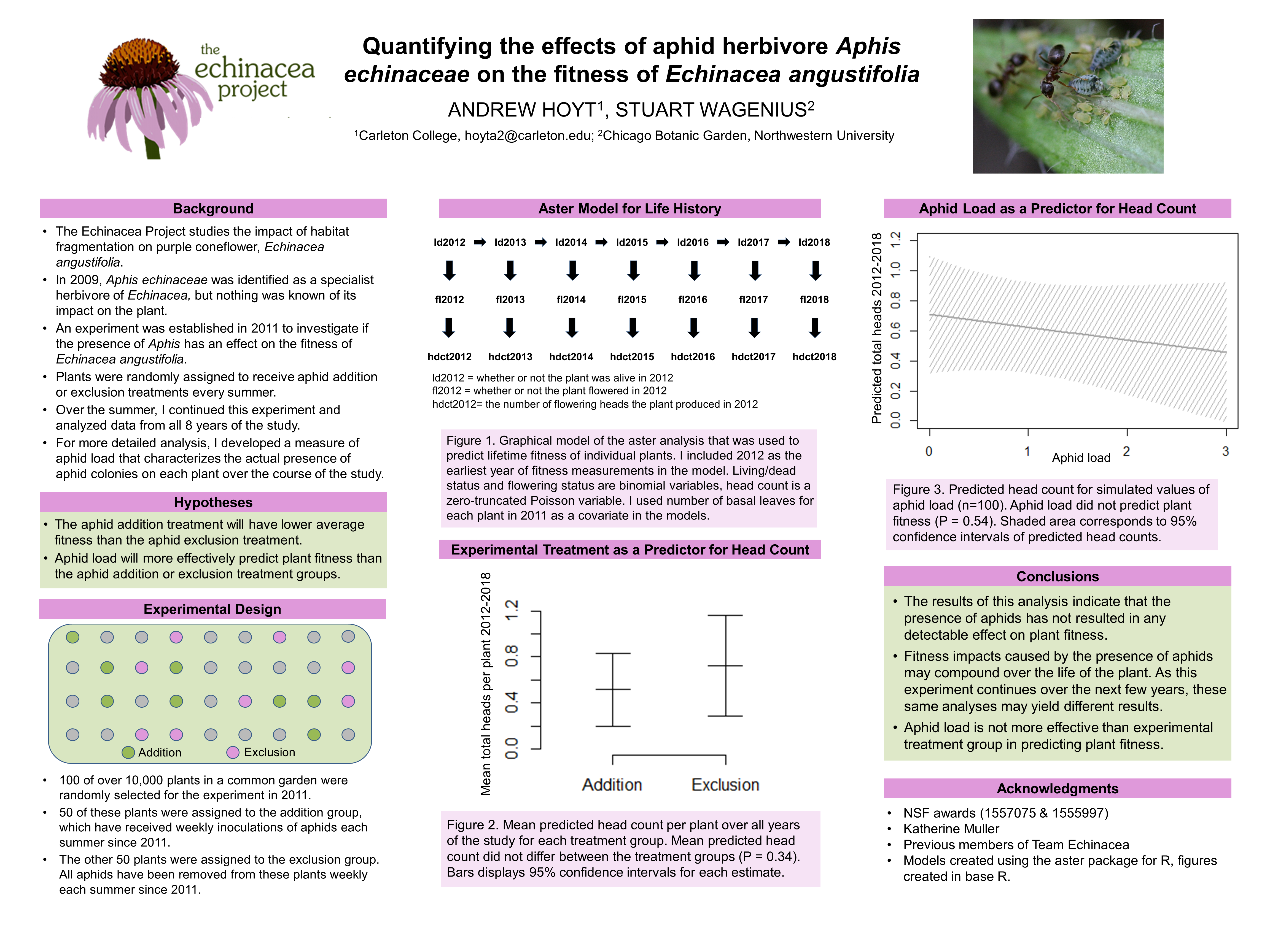
- Andy Hoyt’s poster presented at the Fall 2018 Research Symposium at Carleton College.
- 2016 paper by Katherine Muller and Stuart on aphids and foliar herbivory damage on Echinacea
- 2015 paper by Ruth Shaw and Stuart on fitness and demographic consequences of aphid loads
You can read more about the aphid addition and exclusion experiment, as well as links to previous flog entries mentioning the experiment, on the background page for this experiment.
In summer 2018, I harvested 80 seedheads from 12 remnant Echinacea populations (ALF, EELR, KJ, NWLF, GC, NGC, SGC, NNWLF, LC, RRX, NRRX, YOH) to study patterns of reproductive fitness. I sampled heads in two ways – (1) I randomly selected 20% of the individuals at each site (43 individuals) and (2) I randomly sampled up to 5 individuals from full factorial combinations of high, medium, and low spatial isolation and early, peak, and late flowering time (i.e., high spatial isolation/early flowering, high spatial isolation/peak flowering, etc.) across all sites (37 individuals).
In January 2019, I dissected seedheads that I collected from the NW sites (ALF, EELR, KJ, NWLF, GC, SGC, NGC, KJ, NNWLF). I extracted the achenes by row to observe temporal variation in seed set within heads. I x-rayed the achenes and assessed seed set in January.
 Xray images that show whether achenes contain embryos or not Start year: 1996
Location: Remnant prairies in central Minnesota
Overlaps with: Phenology in the Remnants, Gene Flow in Remnants
Products: Check back with the flog for preliminary results and annual reports.
You can read more about reproductive fitness in remnants, as well as links to prior flog entries mentioning the experiment, on the background page for this experiment.
In summer 2018, I began a project to look at pollen movement within and among the remnant populations. To do this, I chose two focal areas, the NW sites in the study area (populations: ALF, EELR, KJ, NWLF, GC, SGC, NGC, KJ, NNWLF) and the SW sites (populations: LC, NRRX, RRX, YOH, and two large populations in between these sites). I mapped and collected leaf tissue from all individuals in the study areas and harvested seedheads from a subset of these individuals (see Reproductive Fitness in Remnants). I am currently extracting the DNA from the leaf tissue samples and a subset of the seeds I collected, and will use the microsatellite markers that Jennifer Ison developed in her dissertation to match up the genotypes of the offspring (i.e., the seeds) with their most likely father (i.e., the pollen source).
 An Echinacea that has had today’s load of pollen fully removed by pollinators Start year: 2018
Location: Remnant prairies in central Minnesota
Overlaps with: Reproductive Fitness in Remnants, Phenology in the Remnants
Products: Check back with the flog for preliminary results and annual reports.
Team members who worked on this project include: Amy Waananen
In 2018, we checked 80* focal plants at 12 remnants for nearby seedlings found in previous years. We found 97 out of the original 955 seedlings (26 fewer than the 123 found last summer). Although challenging to obtain, information about the early stages of E. angustifolia in remnants is critical to understanding the demography of these remnant populations. With still no flowering plants, it is plain to see how long it takes for Echinacea to begin flowering.
Between the summers of 2007 and 2013, team Echinacea observed the recruitment of Echinacea angustifolia seedlings around focal plants at 13 different prairie remnants. The locations of these seedlings were mapped relative to each focal plant and the seedlings (now former seedlings) are revisited each year. For each of these former seedlings, we make a record each year updating its status (e.g., basal, not found), rosette count, and leaf lengths. We also try to update the maps, which are kept on paper and passed down through the years, each person using a different color ink. As you can imagine, they are quite colorful & marked up by now.
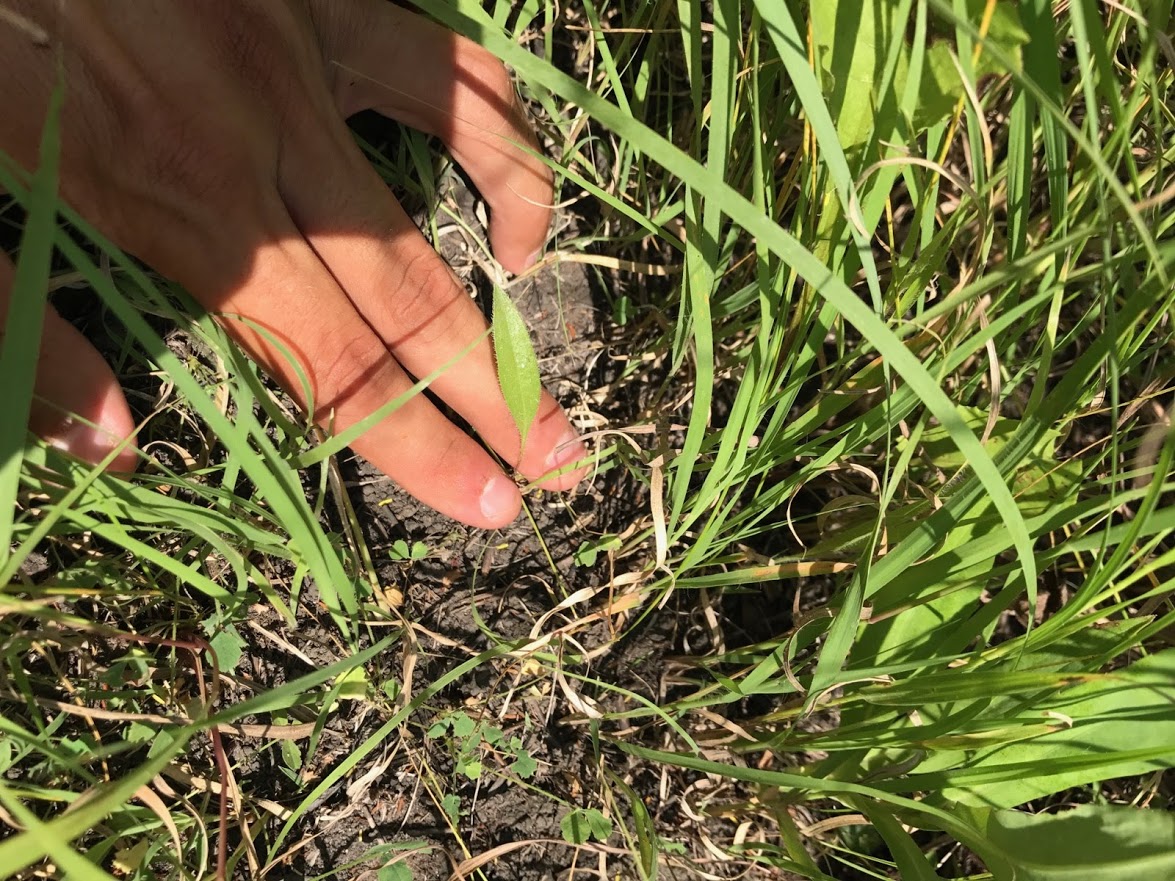
 It can be tough to find small plants like this one! Year started: 2007
Location: East Elk Lake Road, East Riley, East of Town Hall, KJ’s, Loeffler’s Corner, Landfill, Nessman, Riley, Steven’s Approach, South of Golf Course remnants and Staffanson Prairie Preserve.
Overlaps with: Demographic census in remnants
Data collected:
- Electronic records of status, leaf measurements, rosette count, and 12-cm neighbors for each seedling. Currently in Pendragon database
- Updated paper maps with status of searched-for plants and helpful landmarks
Products: Amy Dykstra used seedling survival data from 2010 and 2011 to model population growth rates as a part of her dissertation.
You can read more about the seedling establishment experiment and links to previous flog entries about the experiment on the background page for this experiment.
* This number originally read 119, which is incorrect according to the sling master datasheet from 2018. EE edited this on 8 Jan 2020 while writing the PSR for 2019. I encourage someone to correct this number if it is now incorrect but to the best of my knowledge 80 is the number of maternal plants/circles visited.
In summer 2018, we searched experimental plot 7 for Echinacea plants that are crosses between and within E. angustifolia and E. pallida. Of the 294 plants originally planted, we found 169. However, for the first time in the history of experimental plot 7, we found a flowering plant (an E. pallida x pallida cross)! The table below shows the counts of Echinacea plant in the summer of 2018. In addition to the lowest survivorship, the native E. angustifolia also has been the smallest (above-ground) over the five experimental years. Uh oh!
Riley with the first ever flowering head in exPt7!
| Status 2018 |
ang x ang |
ang x pal |
pal x ang |
pal x pal |
| not found |
52 |
12 |
26 |
35 |
| found |
22 |
16 |
59 |
72 |
Start year: Crossing in 2012, Planting in 2013
Location: Hegg Lake Wildlife Management Area – Experimental Plot 7
Overlaps with: Echinacea hybrids: exPt6; Echinacea hybrids: exPt9
Data collected: Rosette number, leaf number, length of longest leaf, herbivory for each plant collected electronically and exported to CGData. Recheck information for plants not found was also collected electronically and stored in CGData. In 2018, Riley also used a Li-Cor 6400 to analyze ecophysiological traits of Echinacea in expt7. This included photosynthetic rate and water use efficiency. Riley has this data and we’ll make it available after he’s done with his thesis.
Products: Riley’s 2018-19 Biology Honors Project at Gustavus. Riley found that within-species Echinacea angustifolia crosses have lower survivorship, above-ground biomass, and ecophysiological traits than other cross types. Riley made a poster, is writing his thesis, and will defend it in May.
You can read more about rexPt7, as well as links to prior flog entries mentioning the experiment, on the background page for this experiment.
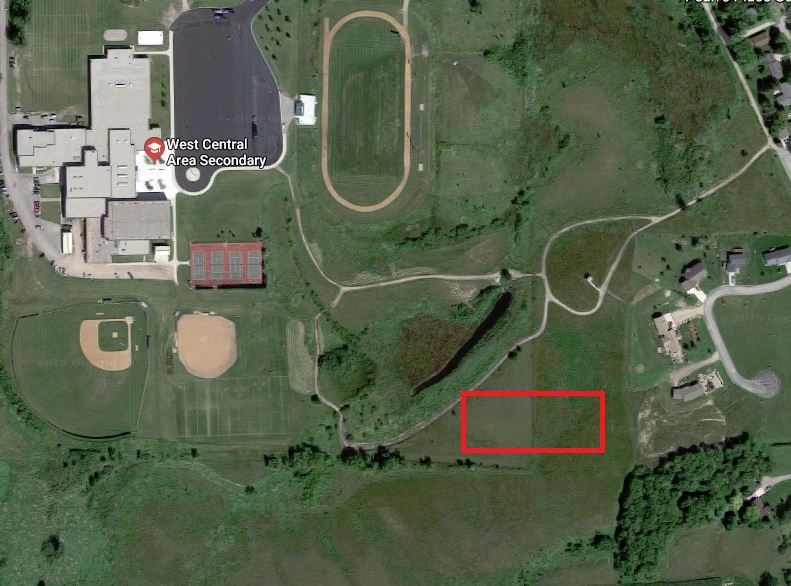
West Central Area School District and grounds are located in west central Minnesota. The high school is located in Barrett, MN which encompasses five small communities (Barrett, Hoffman, Kensington, Elbow Lake, and Wendell) that have united to make one high school. The school was built in 1994 and we are still in the process of restoring our 35 acres of land (Environmental Learning Center – ELC) into native prairie plant species. The ELC has several trails, an observation deck, and a pier that reaches into a small pond. The area has recently begun to be more and more incorporated into several classroom activities. One of the science classes used the ELC in 2018 to sample types of Bombus (bumblebee) species and populations, the agricultural instructor has been using the ELC for soil sampling and classification along with looking at soil profiles. Even the art teacher has had drawing sessions from the observation deck and the English teacher used it for writing exercises. The plan is to utilize the ELC more and more in upcoming years and we have received outstanding support from the school administration, school board, and local businesses in promoting this part of our school. Plans for 2019 are to have 12 plots that 8m x 12m in which four are burned in the spring, 4 are burned in the fall and 4 are not burned at all. As years progress, we plan to have classes engaged in monitoring the progression and health of some native species in these plots, especially Echinacea angustifolia, which will be hand planted in the plots in May of 2019.
Start year: 2019
Location: West Central Area High School
Overlaps with: Nothing… yet!
GPS points shot: 96 points delineating the future plot locations
 The location of the field site, near the high school
Hello flog, one last time!
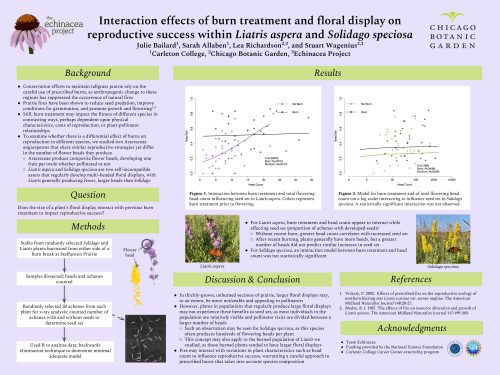
Today marks the end of my three weeks here on Team Echinacea, and I’m certainly sad to say goodbye! Nevertheless, it was exciting and rewarding to culminate this externship with a week of data analysis, poster creation, and presentation of findings to the team. While Tris chose to analyze data from Michael’s Echinacea pollen limitation experiment, Julie and I decided to delve into the worlds of Liatris aspera and Solidago speciosa, two other Asteraceae common to prairie ecosystems. Lea has been working with these species for her PhD project over the past few years, studying how timing and location of flowering influences reproductive success, so she was a great help as we commenced our analysis!
After having meticulously cleaned, counted, and classified innumerable Solidago and Liatris flowering heads, Julie and I wondered how the vast differences in head count between these two species may impact each plant’s fecundity (when Liatris plants generally have 10-20 heads, and many Solidago plants have hundreds or even thousands) . Further, knowing that human populations have largely suppressed the occurrence of natural fires in today’s prairies, we were also interested in analyzing the effects of prescribed burns on these common prairie species. We put these two questions together in our data analysis by forming a statistical interaction model–one in which the effect of fire would interact with the effect of flowering head count to influence reproductive success–and fitting it to our Liatris and Solidago data. Interestingly, we did not uncover the same results for these two closely-related plants! For Liatris, the interaction model was highly supported by our data: the head count of plants seemed to have more effect on seed set (a measure of fecundity) in plants that had not been recently burned than in plants that had been recently burned. Yet, for Solidago, this pattern was not present. Our findings suggest that prairie management strategies, of which prescribed burns are an integral part, should carefully consider the species composition of a prairie before burning, because different species may react to burn treatment in different ways. Check out our poster, attached here, for a more detailed analysis, as well as plots of our models!
Before I sign off, I want to send a huge ‘thank you’ to every member of Team Echinacea! This opportunity was incredibly influential for me–this was my first real research experience, and I learned so much about ecology, networking, career paths, data collection, statistics, and more. I had an amazing time, and I hope to see some team members again someday!
Thank you again,
Sarah

PDF version below:
Soliatris2018 Poster
Hi flog,
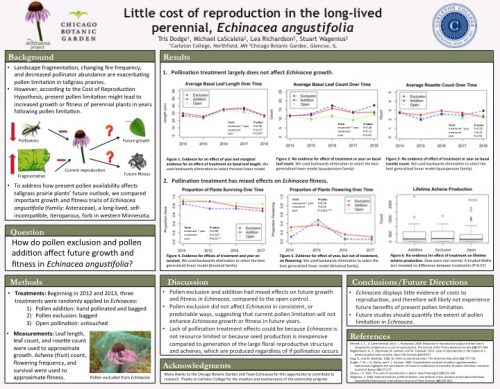
Wow! These last three weeks passed by super quickly! While the first two weeks were focused on seed cleaning, seed counting, and x-raying, we spent this past week on our independent projects. But that’s not to say this week was easy! In the past 5 days, I wrote exactly 900 lines of code in R to generate the figures and perform the analyses.
To get at how current pollen limitation affects Echinacea growth and future fitness, I performed analyses testing differences in plant traits between pollen exclusion, pollen addition, and open pollination treatments. I did not find evidence that pollination treatment affected either growth or fitness, which indicates that current pollen limitation will not benefit Echinacea in the future. This could be because Echinacea is not resource limited or because the cost of seed production is negligible.
Many thanks to the members of Team Echinacea who helped guide me through this process and made working in the lab such a pleasure!

Tris
Link to Poster
The aphids were a hit at Carleton’s Summer Research Symposium. At the Carleton College Summer Research Symposium on October 26th, I presented a poster on my work on the aphid addition/exclusion experiment. Over the summer, I administered the aphid addition and exclusion treatments for the experiment and collected data on leaf senescence and herbivory on plants in the study. Since August, I have been developing an aster model in R to analyze differences in fitness between these two experimental groups. Preparing the aster model for my project was quite a bit of work, but I learned more about R, statistical analysis, and plant-herbivore interactions in the process. Interestingly, Aphis echinaceae has not had an impact on plant fitness over the 8 years of the study.
I am excited to see how the experiment progresses in the coming years, and how the addition of data on seed set affects the results of future fitness models. Quite a few visitors to the symposium were also interested in the results of my analysis and my experience working with the aphids. It was a pleasure to represent the Echinacea Project at Carleton and to have a chance to share the fantastic work the team did over the summer.
|
|