|
|
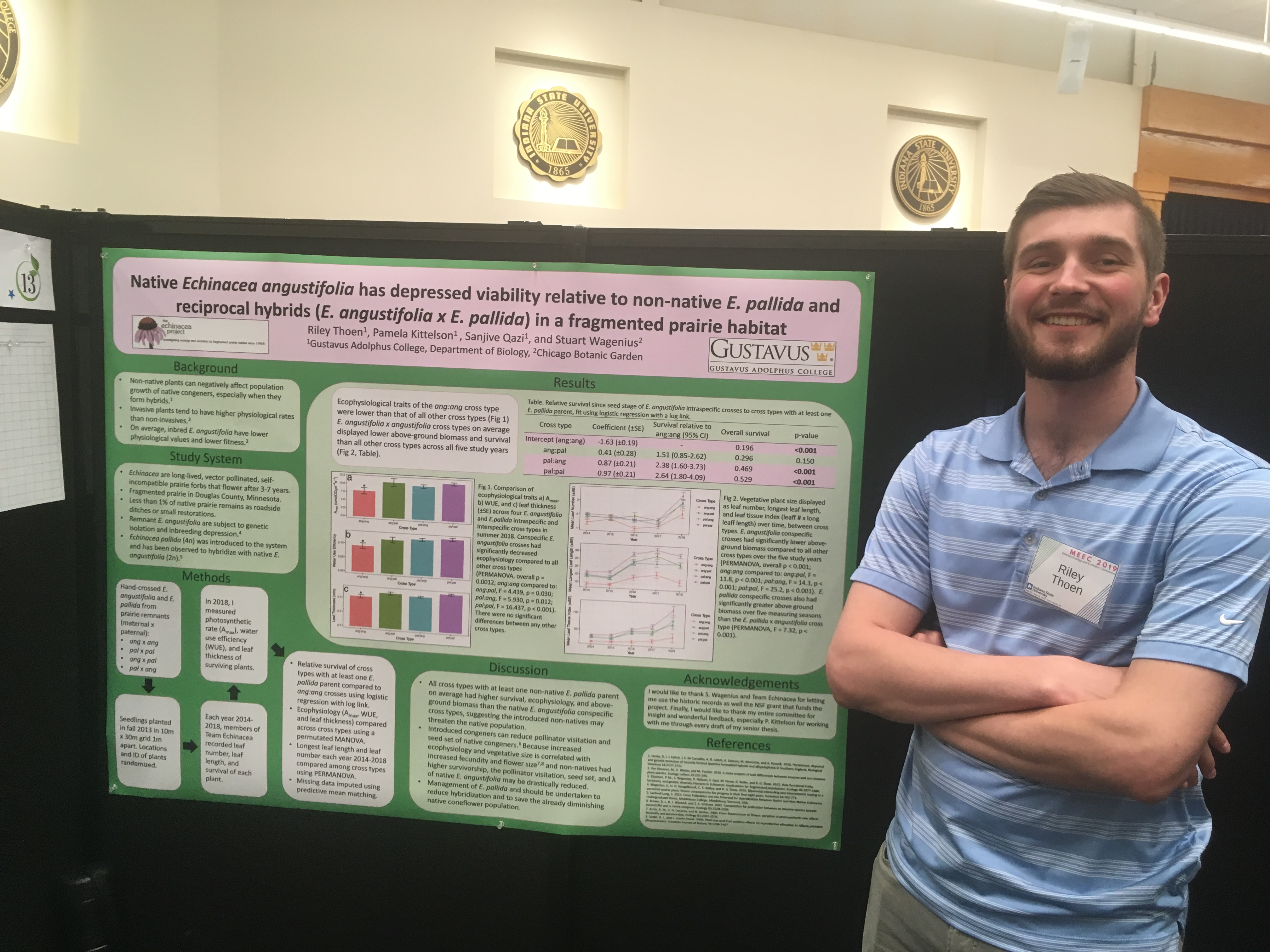
Next up from MEEC we have Riley’s poster about the photosynthetic rates of Hybrid plants in exPt7. Riley collected the data for this project in the summer of 2018, and has been working on aggregating and analyzing since then. The central question behind the research: do Echinacea hybrids between E. angustifolia and E pallida have higher photosynthetic rates than conspecifics?
 Riley with his poster Overall (as the title says), Riley found that E. angustifolia may be in trouble if it has to compete with E. pallida. Both the hybrids and conspecific E. pallida plants were more photosynthetically active than E. angustifolia. Additionally, they had higher survival rates. And to put the final nail in the coffin, the only plant that has flowered in exPt7 is an E. pallida plant. All things considered, Riley’s work is crucial to finding out how to protect E. angustifolia from this invasive species!
Click the link bel0w for a full .pdf of Riley’s Poster
echinaceaPoster2_Thoen
Title: Native Echinacea angustifolia has depressed viability relative to non-native E. pallida and reciprocal hybrids (E. angustifolia x E. pallida) in a fragmented prairie habitat
Presented at: MEEC 2019 at Indiana State University in Terre Haute, IN
When: April 27th, 2019
Hello again!
I’m back with more updates from our team trip to Terre Haute for MEEC 2019. Today, I want to show off the incredible pollen limitation study poster presented by Tris Dodge. Tris joined Team echinacea this last November when he was a Carleton Extern at the Chicago Botanic Garden for three weeks before winter break. As an intern, Tris did a lot of work gathering and analyzing data on our pollen limitation study. If you want to learn more about that study, check out our background page. If you want to see the work that Tris did specifically, check out the flog posts that he has written. Tris’s flog posts include a direct link to his poster
In his analysis, Tris found out that creating seeds is basically free for echinacea plants. If they produce a lot of seeds one year, they can produce a lot of seeds the next year as well. This was not what we had predicted! Tris used the data from 7 years of the pollen limitation study to show that plants that had zero reproduction did not turn into big-leafed, multi-head super plants, but instead look exactly the same as those heads that produced many achenes.
Tris presenting his poster to Nate Title: Little cost of reproduction in the long lived perennial, Echinacea angustifolia
Presented at: MEEC 2019 at Indiana State University in Terre Haute, IN
When: April 27th, 2019
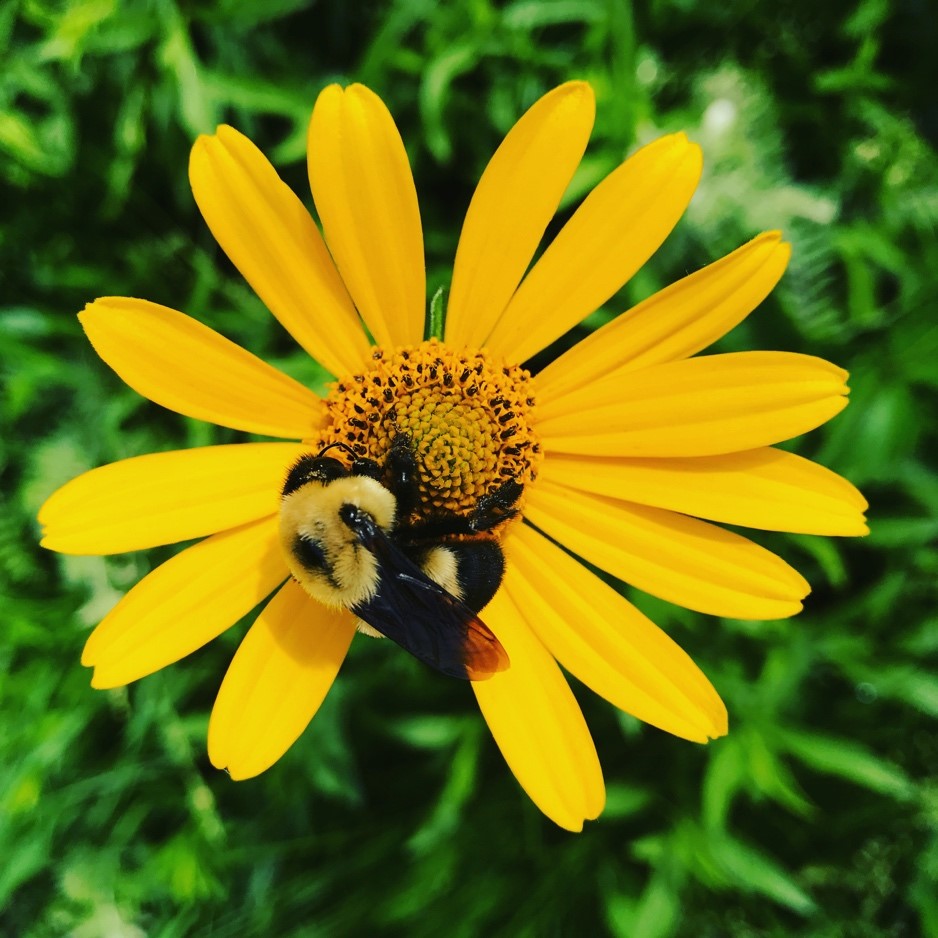
 A bumblebee on a yellow flower. We use yellow pan traps to mimic these Asteraceae Pollinator diversity and abundance are declining due in part to land use change such as habitat destruction and fragmentation, pesticide contamination, among other numerous anthropogenic disturbances. The extent to which pollinator and native bee diversity and abundance is changing is not well understood, especially within tallgrass prairie ecosystems. Pollinators are important in the prairie and they provide valuable ecosystem services to native plants and to economically important plants used in agriculture.
In summer 2018, we collected bee specimens from 37 roadside sites using yellow pan traps. These sites are located within a gradient of various surrounding landscapes, some surrounded by natural areas, semi-natural areas, agricultural fields, development, or a mixture of the above. IN summer ’17 we sampled over 600+ bee specimens across 8 sampling weeks. IN summer ’18, we captured similar abundances of bees (~450 specimens) collected across 6 weeks. Once specimens are collected, they are stored in ethanol until we are able to pin them. Once specimens are processed, we catalog specimens and keep a record for later specimen identification. Identifying specimens to species requires specific, expert knowledge of the families and genera of native bees and pollinators in this ecosystem.
The goal of this experiment was to repeat a similar study done in 2004 by Wagenius and Lyon, in which they collected information on pollinator abundance and diversity. The aim of the project was to understand how landscape characteristics may influence bee community composition. The information from this project allows us to make comparisons between the pollinator communities collected in 2017, and a similar project from 2004. This information can inform diversity and abundance changes across the 13-14 years and provide valuable insight into native bee declines in this system.
Year started: 2004, rebooted in 2017
Location: Roadsides in and around Solem Township, Minnesota.
Overlaps with: Ground nesting bees (link to come)
Samples collected: Over 450 bee specimens, currently being pinned at CBG
GPS points shot: Locations for each of the pan trap sites
Team Members who have worked on this project include: Steph Pimm Lyon (2004), Alex Hajek (2017), Kristen Manion (2017 & 2018), and John VanKempen (2018). Also, a big thank you to Mike Humphrey who has worked in the lab pinning, processing, and cataloging native bee specimens from the 2017 and 2018 field seasons.
You can find out more about the pollinators on roadsides project and links to previous posts regarding it on the background page for this experiment.
In 2018, we searched for 30 of the original 66 Echinacea hybrid plants. We found 29 Echinacea hybrids… which shows incredibly low mortality! This means that 40% of the original cohort is still alive, with the survival rate this winter of more than 96%! Of the surviving plants, the average leaf count was 2.2 leaves, the longest basal leaf was 14.75cm. These plants are considerably smaller than their exPt9 counterparts, despite being several years older.
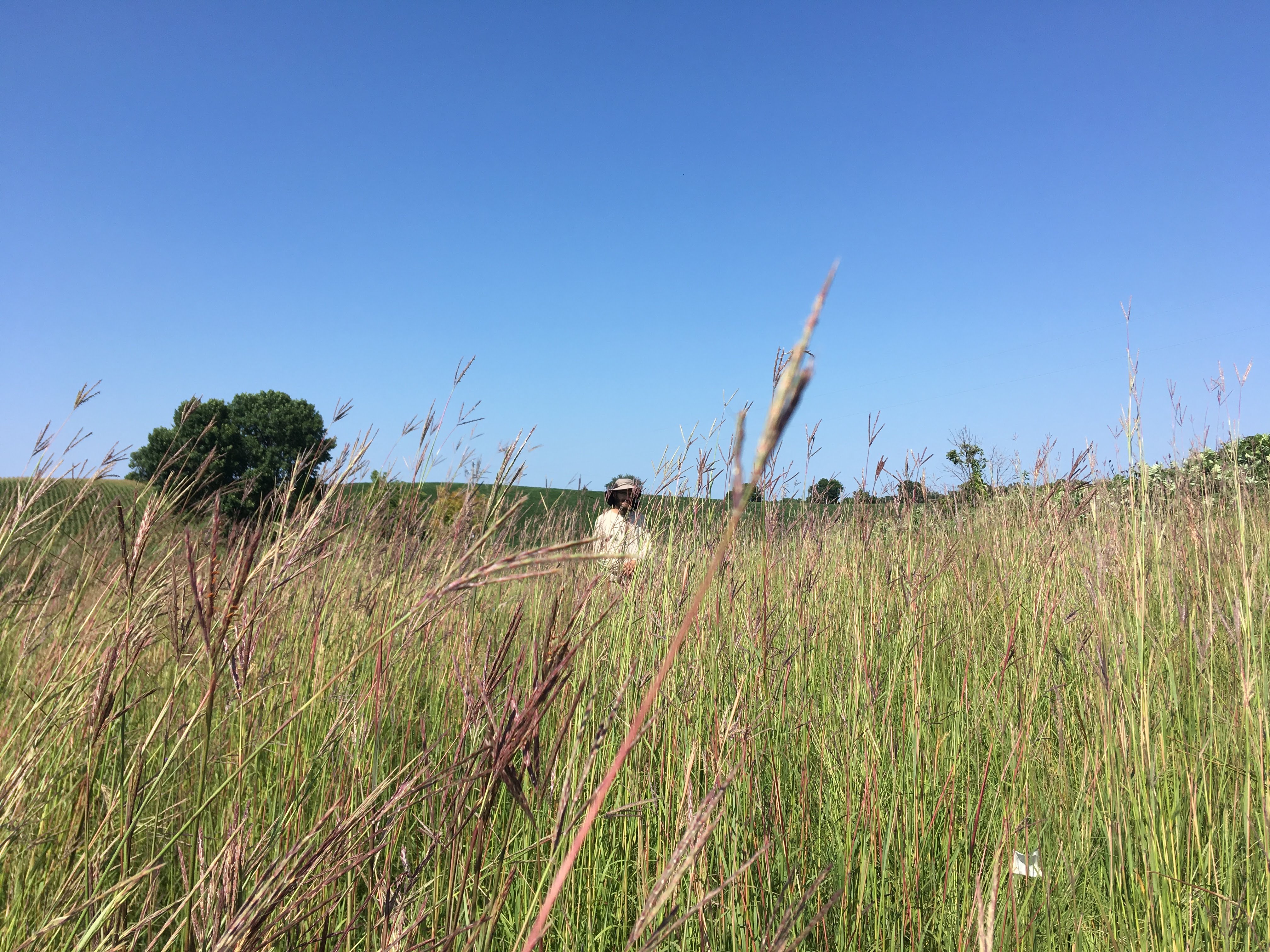
 This big bluestem made finding these tiny plants pretty hard! This plot was originally developed for Josh Drizin’s experiment with exotic grasses, but 66 hybrids of Echinacea angustifolia and Echinacea pallida were also planted in 2012. In 2011, Gretel and Nicholas Goldsmith performed reciprocal crosses between 5 non-native pallida plants found at Hegg Lake and 31 angustifolia plants in P1. These plants have been revisited each summer since then.
Year started: Crossing in 2011, planting in 2012
Location: Experimental Plot 6, on Tower Road
Overlaps with: Echinacea hybrids — ex Pt 7, Echinacea hybrids — ex Pt 9
Data collected: Status, rosette count, longest leaf measurement, and number of leaves for each plant. Exported to CGData.
Products: Nicholas Goldsmith wrote a summary of the crosses he conducted in 2011. A chapter of his dissertation, which he defended in December, reports on the fitness of hybrids compared to plants of either species.
You can find more information about experimental plot 6 and previous flog posts about it on the background page for the experiment.
In summer 2018, we again measured Echinacea plants in experimental plot 9 at Hegg Lake. These plants are from open-pollinated E. angustifolia plants near the restoration plot with flowering E. pallida plants. ExPt9 includes some hybrid plants, as determined by DNA fingerprinting techniques. The table below shows the number of plants found alive during each search since the experiment started in 2014. Much like last year, the average surviving plant had about 3 leaves. The average longest leaf was 21 cm, 4 cm shorter than in 2017. We suspect that leaves are shorter this year than last year (25cm in 2017 on average) because of a burn in the Hegg Lake WMA. This year we searched for plants once then rechecked every position where we didn’t find a plant during our first search. No plants flowered this year (no flowering plants yet!).
| Year / Event |
Number Alive |
% Original remaining |
% Of previous year |
| Planting (2014) |
746 |
100 |
N/A |
| 2014 |
638 |
85.5 |
85.5 |
| 2015 |
521 |
69.8 |
81.7 |
| 2016 |
493 |
66.1 |
94.6 |
| 2017 |
401 |
53.8 |
81.3 |
| 2018 |
329 |
44.1 |
82.0 |
This experiment comparing the fitness of Echinacea hybrids with pure-bred E. angustifolia and E. pallida will give insight into the possible consequences of non-native E. pallida being planted in restorations in Minnesota, where E. angustifolia is the only native Echinacea to this area of MN.
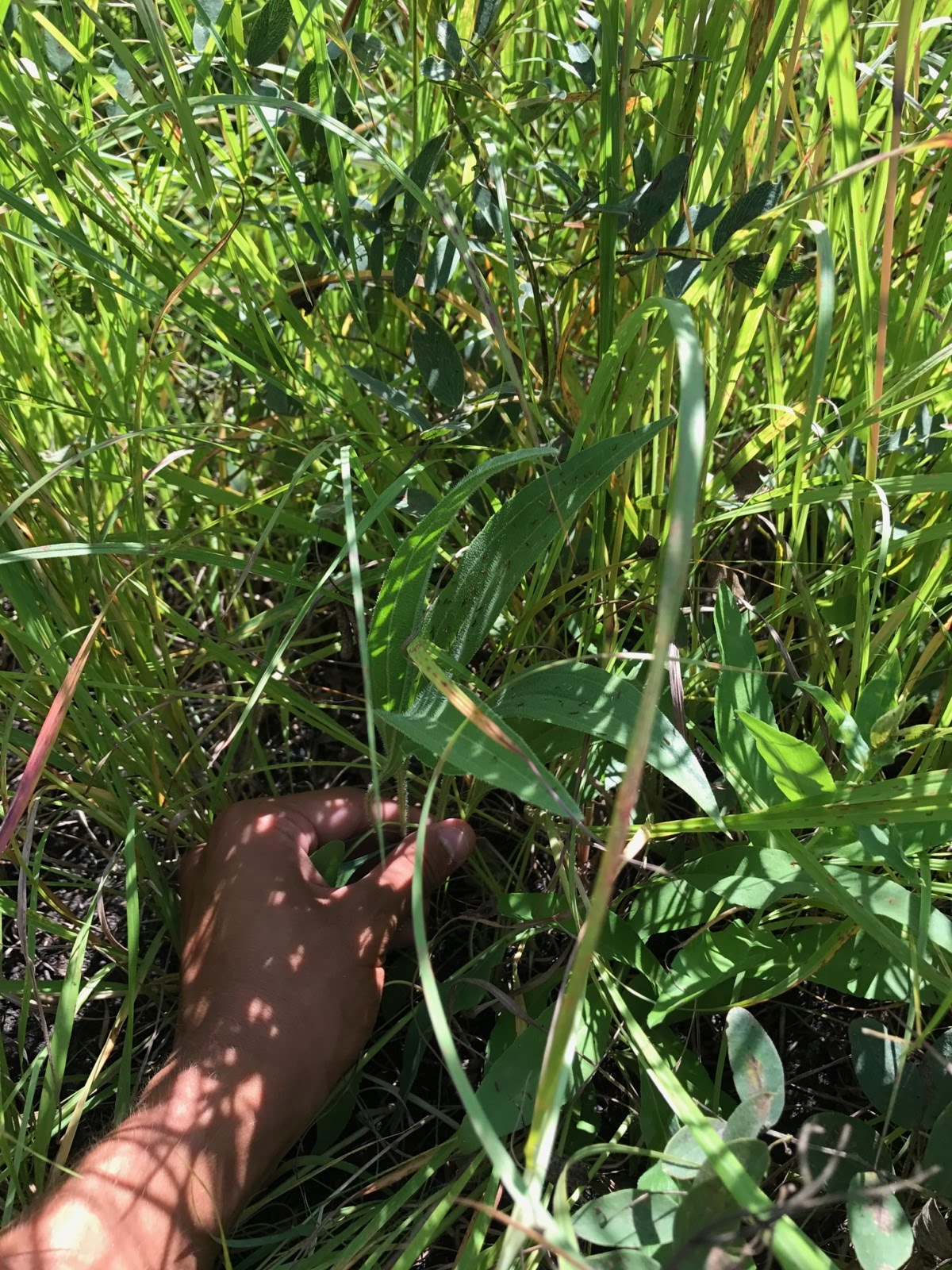
 Most exPt9 plants look like this! Start year: 2014
Location: Hegg Lake Wildlife Management Area — experimental plot 9
Overlapping experiments: Echinacea hybrids — experimental plot 6, Echinacea hybrids — experimental plot 7
Data collected: Rosette number, length of all leaves, herbivory for each plant collected electronically and exported to CGData. Recheck information for plants not found was also collected electronically and stored in CGData.
You can find out more information about experimental plot 9 and flog posts mentioning the experiment on the background page for the experiment.
As always, demo was a huge job this year. This season we added 3868 demo records and about 1539 survey records to our database. After over 20 years of this method, we are starting to get a very good idea of the demography of Echinacea in Solem Township.
So how do we do demo? When we find a new flowering Echinacea plant, we give it a tag and get its location with a survey-grade GPS (better than 6 cm precision). Then, we can revisit this plant for years to come and monitor its survival and reproduction. We’re monitoring over 10,000 plants as of 2018. With this many records, organizing demap in the future is going to be a big task!
We made some small adjustments to how we do total demo and flowering demo (we do flowering demo in every remnant now). Now, in our big plots, we only do a sample of the plants instead of total demo. Check out the updated table below (remember we did flowering demo everywhere). We still managed to shoot thousands of points, take even more demography records, and, as always, follow the colored flags!
| Total Demo |
BTG, Common Garden, DOG, East of Town Hall, KJs, Krusemark, Landfill West, Loeffler Corner East, Near Town Hall, Nessman, NNWLF, NRRX, recruit he, recruit hp, recruit hs, recruit el, recruit hw, recruit ke, recruit kw, RRX, RRXDC, South of Golf Course, Steven’s Approach, transplant plot, Tower, Town Hall, West of Aanenson, Woody’s |
| Sample Demo |
Aanenson, Around LF, East Riley, Hegg Lake, Elk Lake Road East, Golf Course, Landfill, Loeffler Corner, North of Golf Course, NWLF, On 27, Riley, Staffanson, Yellow Orchid Hill |
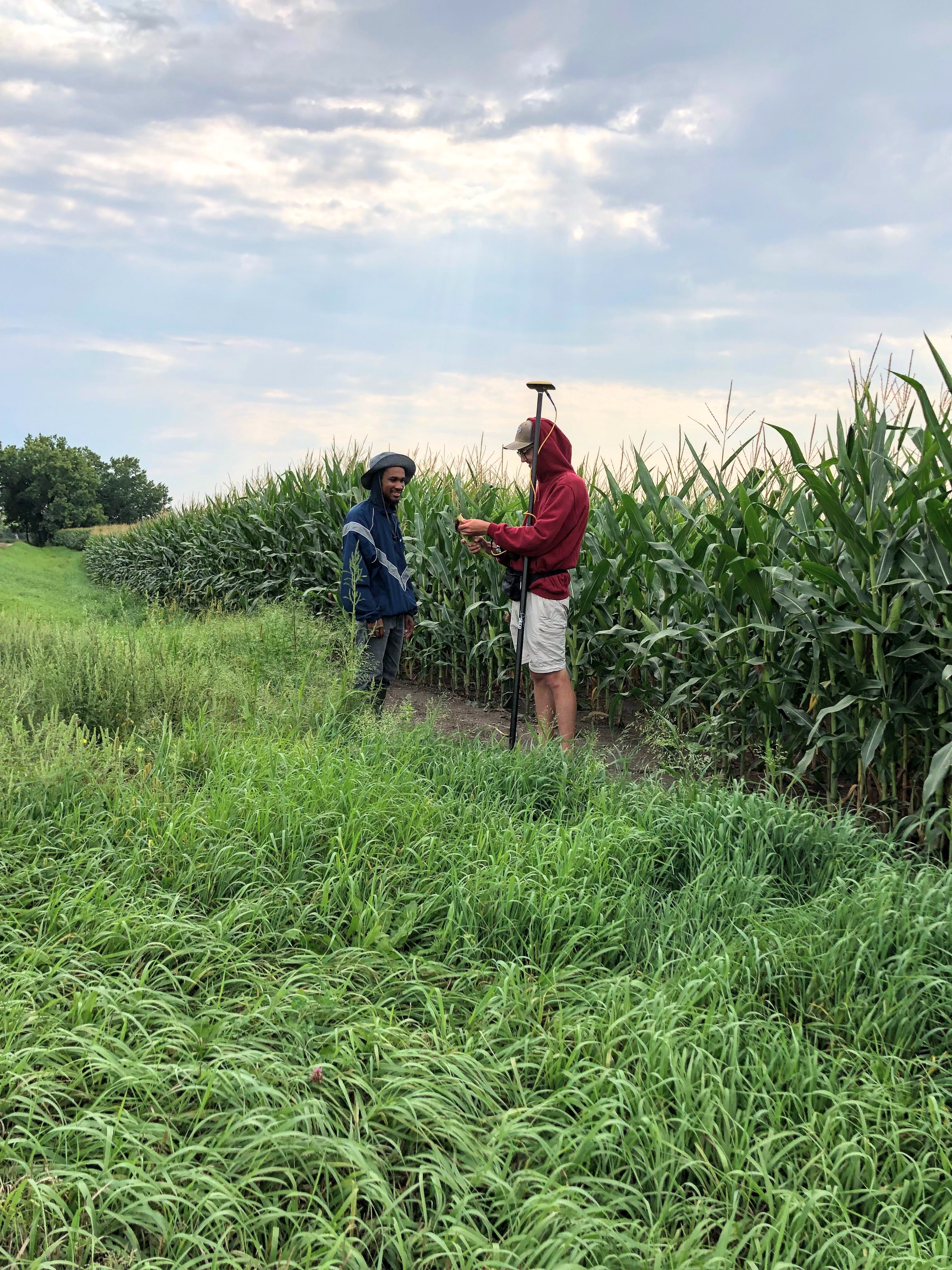
Evan and Will doing demo by the corn. While you might not be able to see the echinacea, we promise, it’s under there! Year started: 1996
Location: Roadsides, railroad rights of way, and nature preserves in and near Solem Township, Minnesota.
Overlaps with: Flowering phenology in remnants, fire and flowering at SPP
Data collected: demo records include Flowering status, number of rosettes, number of heads, neighbors within a 12 cm radius of plants found. These are all taken with PDAs that sync with an MS Access database. They are all transferred to the demap R repository in bitbucket with git version control.
GPS points shot: Points for each flowering plant this year shot mostly in SURV records, stored in surv.csv. Each location should be either associated with a loc from prior years or a point shot this year.
Products:
- Amy Dykstra’s dissertation included matrix projection modeling using demographic data
- Project “demap” merges phenological, spatial and demographic data for remnant plants
You can find out more about the demographic census in the remnants and links to previous posts regarding it on the background page for this experiment.
For her REU project, Brigid gathered data to study the relationship between flowering density and seed set. She worked at Staffanson Prairie Preserve, which appears to have higher flowering density in burn years than non-burn years. This year, 2018, was a burn year on the east side of the preserve. Brigid and Team Echinacea kept track of the style persistence of about ~150 individuals many of which we have phenology and style persistence information from prior years. These individuals were harvested and their achene count and seed set will be assessed by volunteers and interns at the CBG.
Brigid also observed nearest neighbors for many of the plants that she tracked. It might be the cases that echinacea flowers are more successful if they have other flowering plants nearby. Synchrony is a large part of why fire is so important, and, since SPP is our largest remnant prairie, it’s the best place to test the relationship between fire and synchrony. Number of heads, phenology, and head size may also \ interact with fire — we’ll know once we look at the data!

Site: Staffanson Prairie Preserve
Start year: 1996
Overlaps with: Phenology in Remnants, Reproductive Fitness in Remnants
Data and Samples: We shot 90 GPS points for nearest neighbors, many of which were plants that flowered for the first time this year. We also harvested 22 heads that are awaiting cleaning at CBG
Products: None so far
 In 2018 only 19% of the plants flowered, despite it being a burn year. Is the 1996 finally showing its age? In 2018, 51 plants flowered of the surviving 269 plants in the 1996 cohort. That means that 41% of the original plants are surviving and 19% of the living individuals flowered. That’s up huge since last year, where only 2% flowered, and the year before where five percent of living individuals flowered. In contrast, however, 45% of living plants flowered in 2015, and 37%, 34%, and 40% flowered in 2014, 2013, and 2012 respectively. We found that of the original 646 individuals, 269 were alive in 2018, only 15 fewer than last year. We are not sure why so many more plants flowered this year. It’s probable that the fire in the plot in fall 2017 influenced flowering rates.
The 1996 cohort has the oldest Echinacea plants in experimental plot 1; they are 22 years old. They are part of a common garden experiment designed to study differences in fitness and life history characteristics among remnant populations. Every year, members of Team Echinacea assess survival and measure plant growth and fitness traits including plant status (i.e. if it is flowering or basal), plant height, leaf count, and number of flowering heads. We harvest all flowering heads in the fall, count all achenes, and estimate seed set for each head in the lab. As yet, these heads are still waiting to be cleaned April 2019.
Start year: 1996
Location: Experimental plot 1
Overlaps with: phenology in experimental plots, qGen3, pollen addition/exclusion
Physical specimens:
- We harvested 59 heads. At present, they await processing in the lab to find their achene count and seed set.
Data collected:
- We used Visors to collect plant growth and fitness traits—plant status, height, leaf count, number of flowering heads, presence of insects—these data have been added to the database
- We used Visors to collect flowering phenology data—start and end date of flowering for all individual heads—which is ready to be added to the exPt1 phenology dataset
- Eventually, we will have achene count and seed set data for all flowering plants (stay tuned)
Products:
- See the exPt1 core dataset where yrPlanted == ‘1996’ for 1996 cohort fitness measurements
- Amy Waananen’s paper, Mating opportunity increases with synchrony of flowering among years more than synchrony within years in a nonmasting perennial, published last year in The American Naturalist, was based on plants in this cohort.
You can find more information about the 1996 cohort and links to previous flog posts regarding this experiment at the background page for the experiment.
In the summer or 2018, Lea collected data for the third year of her observational study quantifying
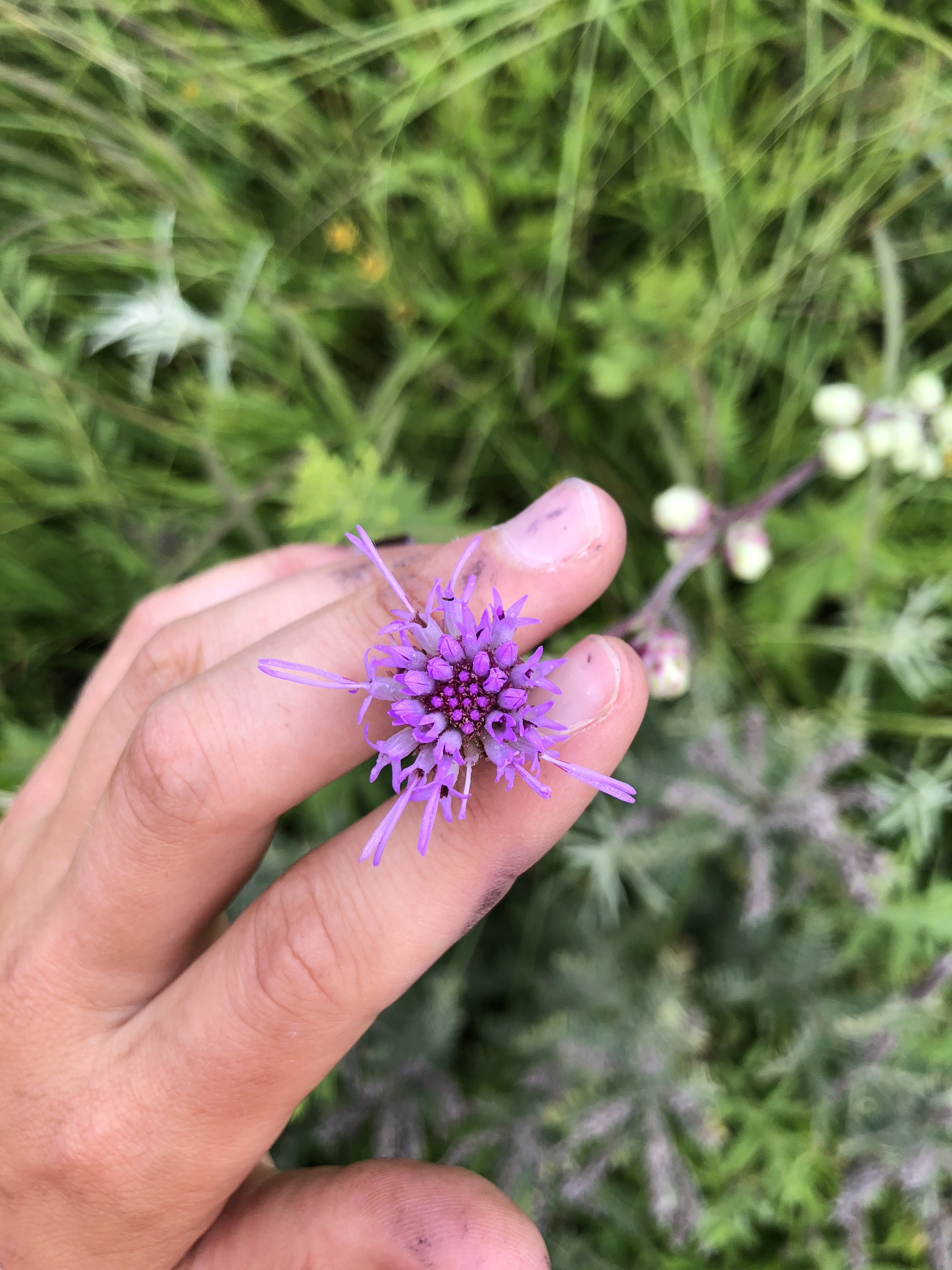
 Flowering Liatris flowering phenology and reproductive success (seed set) for Liatris aspera and Solidago speciosa plants located along a transect at Staffanson Prairie Preserve. Staffanson is divided into east and west units. The west unit of Staffanson was burned Spring 2016. In 2016, Lea looked for differences in phenology and reproduction of east vs. west Liatris and Solidago plants. In 2017, neither unit was burned. In 2018, the east unit burned. Data collected this year combined with data collected in 2016 and 2017 will enable us to to see if burns influence phenology or reproduction. To assess phenology, Lea visited plants three times a week and recorded if they were flowering. She took GPS data for each plant included in the study. She also mapped the seven nearest neighbors of all flowering plants within her transect in 2018. Additionally, Lea visited all plants in the 2016 and 2017 datasets to see if they were still present and if they were flowering. To assess reproduction (seed set), plants were harvested and brought back to the Chicago Botanic Garden so that seeds could be removed from the plant and x-rayed. This study helps us understand how fire, phenology, and reproduction are linked in species that are related to Echinacea angustifolia.
Start year: 2016
Location: Staffanson Prairie Preserve
Overlaps with: Fire and fitness of EA, Flowering phenology in remnants
Physical specimens:
- ~80 harvested Liatris aspera specimens from summer 2018, located at the CBG
- ~80 harvested Solidago speciosa specimens from summer 2018, located at the CBG
Data collected: Phenology data was taken on the visors every Monday, Wednesday, and Friday through the growing season. Paper harvest data sheets were used and brought back to CBG.
GPS points shot: ~543 GPS points were visited or shot, one point was visited for each plant monitored in summer 2016 and 2017, and points were shot for each plant in the 2018 dataset along with its seven nearest neighbors.
Spring is here! The birds have returned and some plants are finally starting to poke up after a (seemingly) very long winter. Of course, you know what that means! It’s time to get planting!
While many people will take this opportunity to begin growing their garden, here at the Echinacea Project we’re taking the opportunity to… well, grow more echinacea!
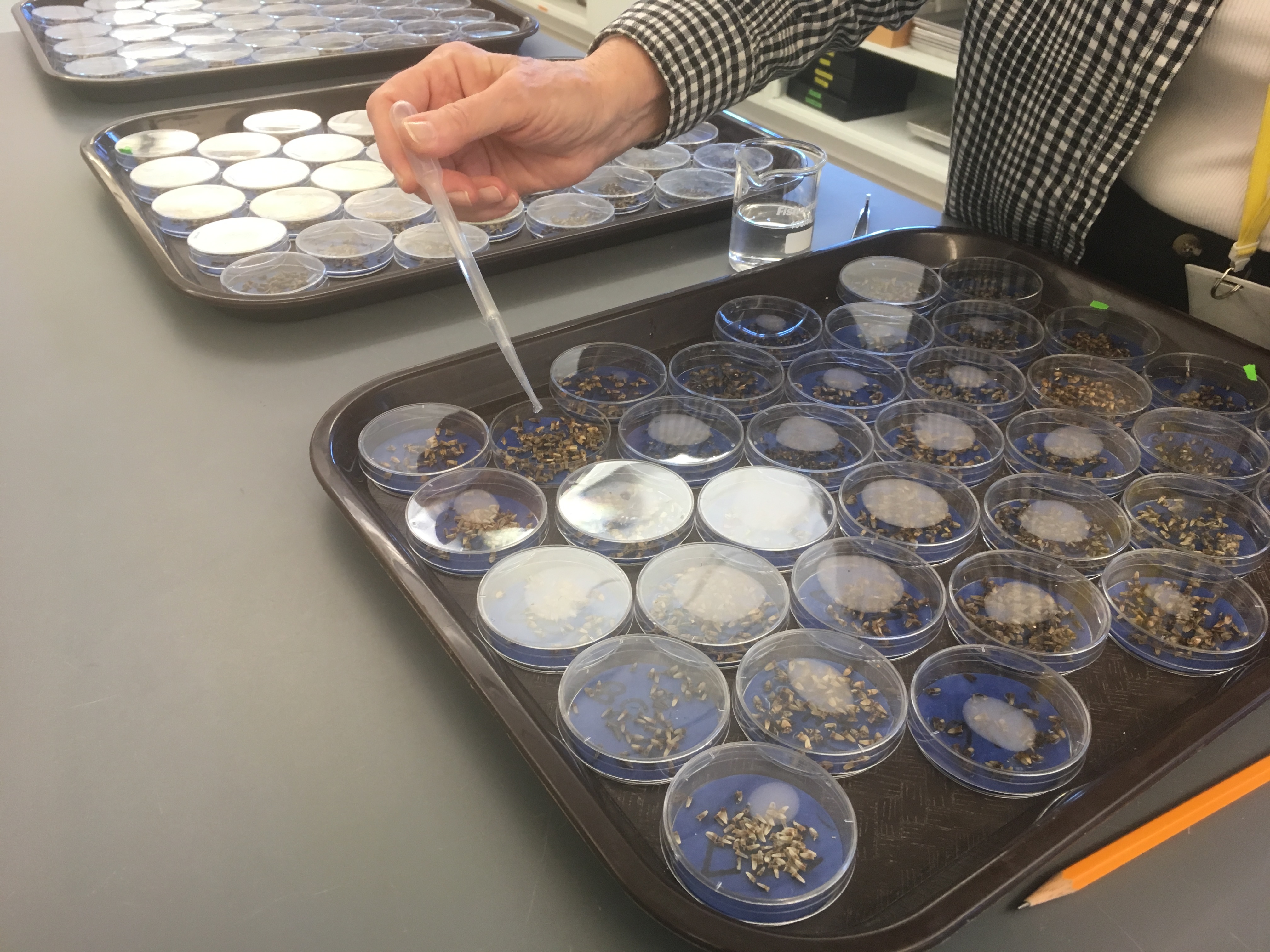
We’ve taken this opportunity to do a small experiment on the shelf life of echinacea achenes. We’re germinating 54 heads total, exactly half of which are from 2016, and half from 2017. If their germination rates differ, we’ll being to get an understanding of how long these seeds are viable for. If they don’t differ, well then I guess echinacea achenes last a pretty long time.
For right now, the achenes are going to spend two weeks in the refrigerator in low light to simulate their “winter.” I’m sure many people would also enjoy a 2-week, 40 degree winter.
Expect updates on the growth of these seeds in about two weeks when we pull them out of the fridge and they begin to sprout! It will very exciting!
Suzanne giving some water (and a bit plant hormones) to the seeds Stayed tuned in to the flog this week for some exciting plugs for this weeks Unearth Festival!
Michael
|
|