|
|
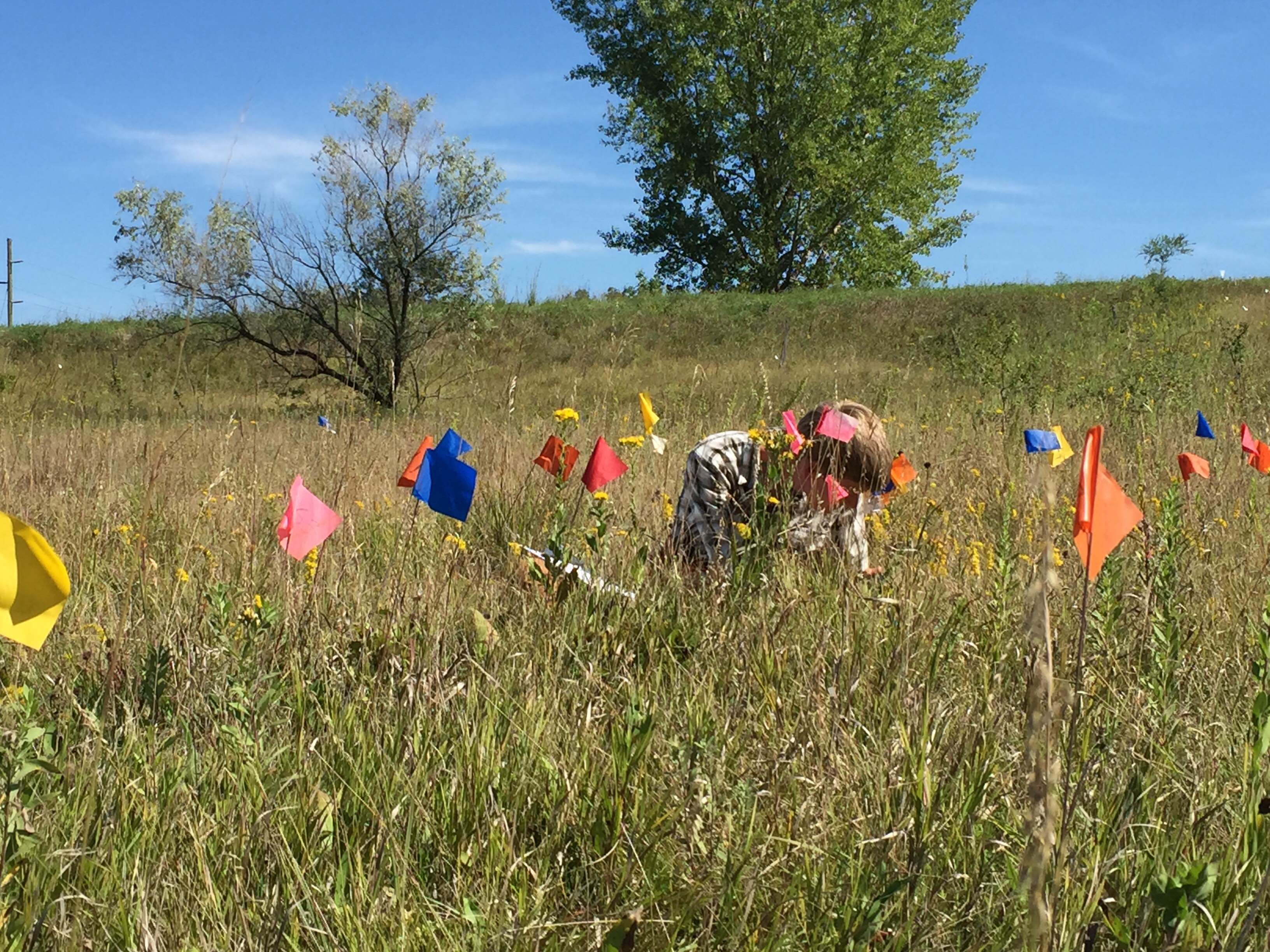
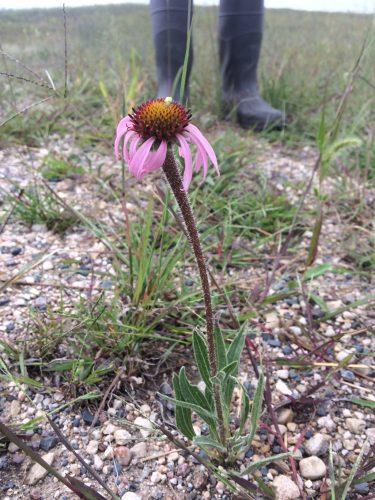
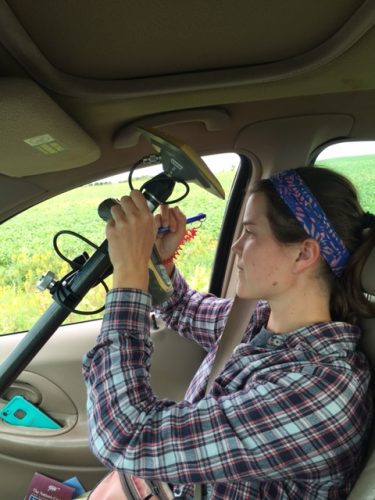
 We revisited locations in remnants where flowering plants were observed in previous years. We tag each Echinacea plant we see flowering in our prairie remnants, and record its location using the GPS. This is useful because it allows us to revisit the same plant in future years, checking to see if it is still alive, and if so how large it is and whether or not it is flowering. This has provided us with a very rich longitudinal dataset of life histories, dating back two decades and including thousands of plants. This year, we did total demo, visiting each plant in our database, at several sites including Staffanson, Loeffler’s Corner East, Northwest of Landfill, and East Elk Lake Road. In the interest of time, we only did flowering demo (only visiting plants that flowered this year) at several sites, including Landfill, Around Landfill, and Railroad Crossing. For each plant visited, we recorded its status (e.g., basal, flowering), its number of rosettes, and any neighboring Echinacea within a 12 cm radius. This data can be used to study inter-annual variation in flowering, population dynamics, and response to fire.
Year: 1996
Location: Roadsides, railroad rights of way, and nature preserves in and near Solem Township, Minnesota.
Overlaps with: Flowering phenology in remnants, fire and flowering at SPP
Data collected: Flowering status, number of rosettes, number of heads, neighbors within a 12 cm radius of plants found, stored in demo2016
GPS points shot: Points for each flowering plant this year shot mostly in PHEN records, stored in surv.csv. Some points of flowering plants stored in SURV records, also in surv.csv. Each location should be either associated with a loc from prior years or a point shot this year.
Products:
- Amy Dykstra’s dissertation included matrix projection modeling using demographic data
- Project “demap” merges phenological, spatial and demographic data for remnant plants
You can find out more about the demographic census in the remnants and links to previous posts regarding it on the background page for this experiment.
Hi Flog! It’s me, Amy!
This winter we’ve been working on ‘demap’, a project to coordinate 20+ years of demography and spatial data from remnant populations of Echinacea in Solem Township. When we are done we will have a great long-term dataset of over 3000 individuals in 27 remnant populations. We can use that information to answer all kinds of questions about flowering dynamics in natural populations, population growth, and the consequences of disturbances such as habitat fragmentation and fire! In particular, this January we focused our efforts on answering questions about the demographic consequences of fire. Does fire’s stimulation of flowering contribute to increased population growth over the long term? Do reproductive benefits of fire outweigh potential survival costs? We’re not sure, but we hope to find out by analyzing four populations– a large population that had one fire event, a large population that has not been burned in the past 20 years, a small population that burned once, and a small population that has not burned in the past 20 years. We’ll combine our demography data about flowering and survival with other information, such as the seedling recruitment and remnant seed set data, to project population growth.
Will was here to help out with the project in the first two weeks of January. We got a lot done with demap and made meaningful progress on other big questions such as “Is kale overrated?” and “What does overrated mean statistically?”. We also made big strides in terms of professional development by studying business mogul DJ Khaled’s keys to success. Stay tuned for updates!
Sincerely,
Amy
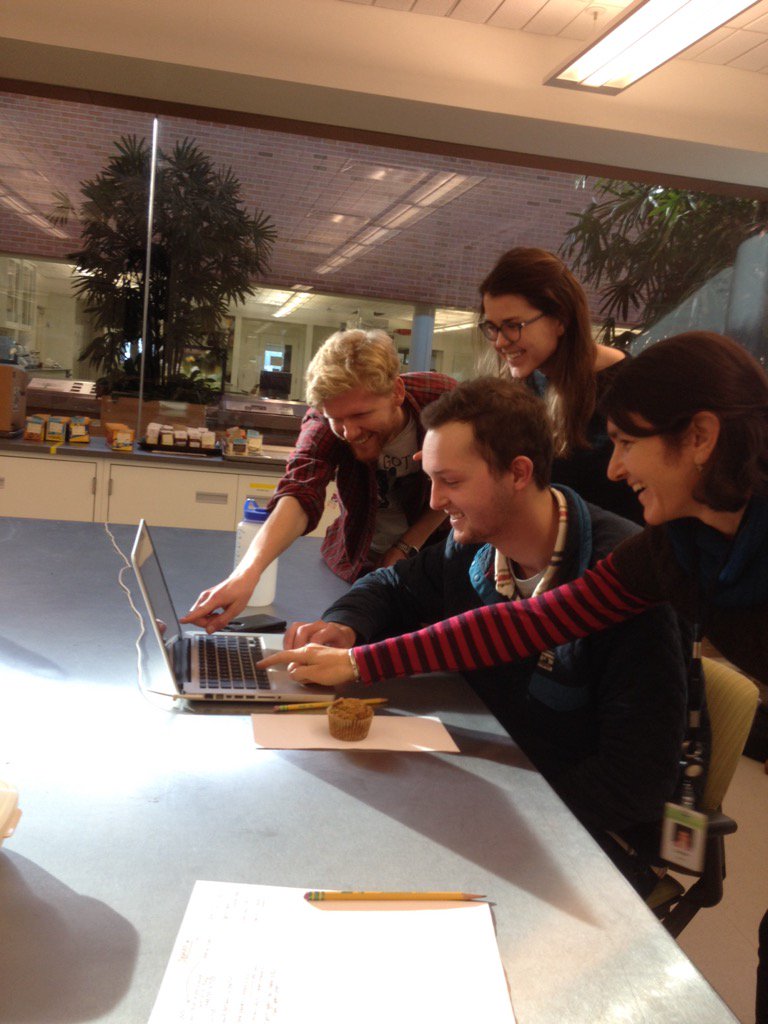
 Demap is a team effort! In this shot, we are helping Will find a plant on the computer.
So it begins! Two new externs have joined Team Echinacea from Carleton College. We (Mikaela and Emma) will be here every day for the next three weeks, and are excited to discover new revelations for the Asynchrony, Isolation and Incompatibility experiment.
So far, most of what we’ve discovered is that cleaning Echinacea seed heads is tedious. Two days in, we have cleaned 36 seed heads; scanning them was a nice relief from the monotony. We think we could get through all 110 by the end of this week.
Although yesterday was quiet, there was a little bit of commotion: Mikaela’s second seed head had a rare deformity. Many of the achenes were uninformative. This means they were aborted part of the way through formation, so it cannot be determined whether they were fertilized. After minutes of puzzled deliberation, Stuart, Amy and Scott decided to keep them in the sample.
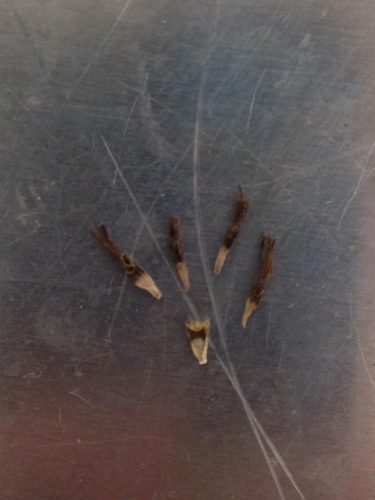
 Four uninformative achenes compared to one normal, small-to-mid-size achene. Because of their immaturity, the florets are still firmly attached. In contrast to yesterday, today there were quite a few volunteers and a couple of students who we got to meet. It was nice to talk to other people who were involved in and excited about this project. We also got to hear about other experiments going on in the lab besides our own.
Today’s seed cleaning also presented an exciting moment: just moments after Amy told us about last year’s larval discoveries, we each found a live larva residing in the heads we were cleaning. We’re thinking about raising these mystery larva so we can finally learn just what they are. Hopefully we’ll have more success than last year’s effort!
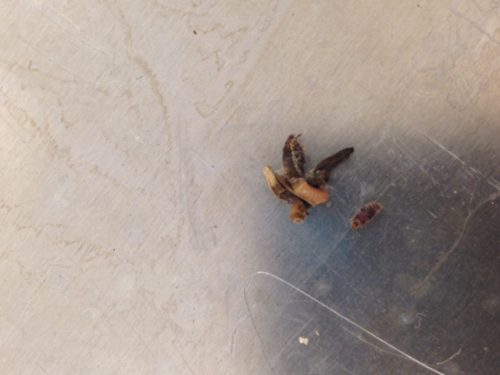
 Our two larva. Emma’s is the tiny brown one on the right, and Mikaela’s is the pink one hanging out on a makeshift habitat of chaff. We are grateful for this opportunity to contribute to and learn from the project, and are looking forward to the next three weeks!
Thanks for the warm welcome,
Mikaela and Emma
Dear Flog,
Last time I mentioned in passing that Stuart, Amy, Scott, and I had been discussing papers about fire and its potential impact on the reproductive fitness on Echinacea plants. This week I will go into greater detail about what I’ve learned about fire and what our data can teach us about how it impacts prairie health.
Some of our studies taken from previous years have shown us that, even when there are enough bees to carry pollen from plant to plant, Echinacea plants can have difficulties receiving pollen from potential mates. There are a few reasons for this. In our fragmented prairie remnants, Echinacea plants are often far enough apart that pollen collected by a bee will often fall off before it can reach another Echinacea flower. Echinacea plants may also flower in different years, or at different times in the season. This can prevent mating even between close flowers. This mate availability problem is compounded by the fact that Echinacea is self-incompatible, meaning a plant cannot pollinate itself or its close relatives. This means that if a plant flowers and fails to find mates, all the energy it expends to flower and fruit results in no offspring. This is an extraordinary energy cost for no payoff.
Data we have collected seems to suggest that fires may help perennial prairie plants like Echinacea find other mates. Explosive flowering after a large burn is typical for prairie plants. There is some evidence that increased availability of nutrients from burned organic matter and the increased availability of sunlight provide resources for a plant to invest in a costly reproductive structure like a flower. This is probably no different for Echinacea. However, as an added bonus, some of our data seems to show that this explosive flowering may reduce the reproductive isolation of Echinacea plants by increasing the number of synchronous flowering plants. Thus, fire helps Echinacea successfully seed by increasing the number of available mates. Really cool!
The tendency of Echinacea to flower synchronously after a fire could be the result of natural selection, or simply a byproduct of the excellent growing conditions created by fire. In either case, this knowledge affirms how important fires are to prairie ecosystems. The Echinacea Project, through projects like SppBonus, hopes to further elucidate these mechanisms through which fire improves prairie health.
Until next time!
Sam
Citations:
Wagenius, S. and Lyon, S. P. (2010), Reproduction of Echinacea angustifolia in fragmented prairie is pollen-limited but not pollinator-limited. Ecology, 91: 733–742. doi:10.1890/08-1375.1
https://echinaceaproject.org/pub/wageniusAndLyon2010.pdf
Ison, J.L., S. Wagenius, D. Reitz., M.V. Ashley. 2014. Mating between Echinacea angustifolia (Asteraceae) individuals increases with their flowering synchrony and spatial proximity. American Journal of Botany 101: 180-189.
https://echinaceaproject.org/pub/isonEtAl2014.pdf
Part 1. I couldn’t stay away from the Echinacea Project too long. As I’m positive you want to hear both about my poster that I will be presenting at MCMS tomorrow at the University of Chicago and my adventures in Chicago, I will share both. As I arrived at the airport to fly to Chicago, I realized I had forgotten my cell phone. I thought to myself, I lived most of my life without a cell phone, I can do it another day. After arriving in Chicago, I had thankfully packed a dollar in quarters, so I was able to use a pay phone (yes, those still exist) to call a cab. While I did struggle to understand the technology, I was finally able, after spending my only dollar in quarters, to procure transportation to the Chicago Botanic Gardens. I was left penniless, phoneless, and with only a laptop and my knowledge of Chicago (this, by the way, was absolutely nil). After making a successful rendezvous with the team, I enjoyed a lunch and tour of the lab. It was great to see everyone again.
Part 2. After figuring out the best way to get to my destination at the University of Chicago, I jumped on the purple line, confident that, after a quick jaunt on the green line, all I’d have to do was walk a block or two to the hotel, where dinner awaited me. I hopped off the train, and quickly realized that the area had been highly developed since the last google street image had been taken, unless my memory of the picture failed me. Ah well, I thought, I wrote down the street that will get me to my hotel, it’s just east of here. The street just east was not the correct street. Maybe the map I saw was just wrong. By the next street, I knew I was in the wrong place. Thankfully a friendly man suggested a bus that would take me five miles to the east, where I thought I was getting off. Yes, I had taken the wrong train. All was well and good until I hopped on the bus and realized that I was penniless, with no money for a fare. Again, the bus driver was a greatly friendly man, and I rode the bus without a fare. Sailing was smooth from there on out.
Tomorrow I will present my findings on how edge effects play a role in the style persistence and pollen limitation of Echinacea at the Midstates Consortium for Math and Science. Style persistence decreased as plants were farther from habitat edges, demonstrating a spatial pattern in pollination. Attached is my poster. stylepersistenceedgeposter
Off to share a room with someone I haven’t met yet. Day in the life.
No explanation needed. Great to see y’all again.
Hey Flog!
My name is Sam Hamilton, and I am a Northwestern senior doing research in the Echinacea Project lab this quarter. My project specifically seeks to understand the relationship between prairie fires and reproductive success of flowering plants using our model organism A. Echinacea. This is an important relationship to understand because, while historically fires were an integral part of the prairie life cycle, today’s isolated prairie remnants are often never burned. This could have a large impact on the success of shorter plants that rely on the extra sunlight and nutrients that a burn year supplies to flower and germinate. This quarter, I will be collecting the data from seed heads collected this year and analyzing it along with data collected in previous years to draw my conclusions.
I am also looking at the reproductive success of Echinacea flowers collected from the bottom, middle, and top of each head. In Echinacea, flowers mature first at the bottom and slowly develop towards the top over time. This allows us us to deduce when a plant was pollinated best during the season. I’ve been hard at work the past month cleaning seed heads and separating their achenes into top, middle, and bottom sections for later analysis. It’s been a lot of work, but the great company has kept it fun!
Until next time!
-Sam
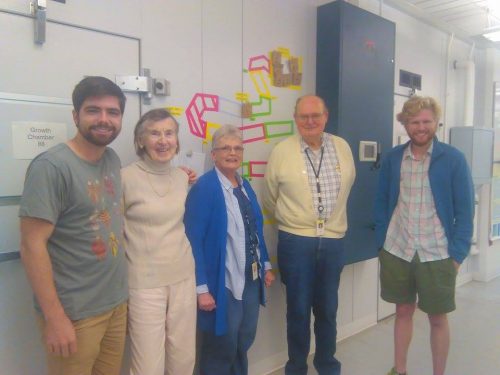
Myself with Susie, Char, Aldo, and Scott. (Left to Right)
One month of cleaned and organized achenes.
After a slow start, Amy and I did demography at some of the recruitment plots near Hegg Lake and p2. The flowers in plots HE and HS, near P2, were doing especially well; we counted a total of 34 flowering plants combined in those two plots, with several having multiple heads, and were able to find nearly all of the plants there. We also returned to a stand of Cirsium hillii near p2 that we measure each year, and found that at least three of our study plants flowered recently. Whether they flowered this year or last year is not yet clear — the leaves definitely looked gray and crispy. Stuart made the long trek back from Chicago today and harvested some Astragalus canadensis for broadcasting and corralled an escaped goat.
The highlight of today was finding a flowering (second day!) Echinacea near the Cirsium study area. We finished phenology in all of the remnants and plots several weeks ago, and have even harvested a good number of heads that are ready to drop their achenes. How this one is flowering so late in the season is a mystery — it may have to do with some recent mowing. We look forward to revisiting this plant to see if, by some miracles, it gets lucky and some of its styles shrivel.
Flowering (second day!) Echinacea found today near P2. Outrageous! Amy and Chek look for Echinacea from the car.
Today was probably the coldest day of fieldwork we have had all summer, a cold front passed through on Wednesday and left us with a cloudy 60 degree day. For those team members who are more accustomed to hotter summers today was a little bit of a shock.
We went out to do total demography at Staffanson Praire Preserve, our goal while doing total demo is to census all of the plants that have flowered sometime in the last 20 years. It’s a big project, at Staffanson alone there are just over one thousand locations to visit. While not all of these locations still have a plant it is awesome to see a tag around a plant that was put there in 1996 or 1997.
Even the flowers are cold! We made a huge dent in the number of locations at Staffanson, of the 1054 locations we visited 435, nearly half done!
Scott stakes locations while Amy does demography on the plants at each location
I am excited to present to you my summer 2016 research proposal. While previous research has shown that isolated Echinacea plants and populations experience reduced reproductive fitness, we have not looked at what influence edge effects may have on Echinacea populations. Findings presented in Ison and Wagenius 2014 showed that plants in P1 experienced slight edge effects on seed set. My research this summer will use style persistence data collected from all remnant sites and quantify the relationship between distance of an Echinacea plant from a habitat edge and average style persistence. This will help us understand if fragmented populations are being harmed by yet another factor. Hopefully you find this topic as interesting as I do.
JamesEckhardtProposal2016
Here is a proposal for a fun project. It involves using demography data from this (and prior) years to estimate the growth rates of each of the remnants individually. Actually, that’s basically the whole project. Action items for the next month include: reading technical manuals with specifics on implementing aster models (see the list of project publications if you want to read them for me on your own).
scott_proposal_1
In other Scott-research related news, I will also try modeling fitness of various Hesperostipa spartea crosses in experimental plot 1. Just today I got a list of positions of plants found alive in 2016 — my plan in the near future is to search positions in the plot where plants were found alive in 2011 but weren’t found in 2016 to assess mortality. Keep your eyes open for another action-packed research proposal for this porcupine grass-ey project.
|
|