|
|
We met a half hour early today so we could do pollinator observations during what we thought would be their peak time. We were wrong. Hardly any bees were out and about on this very windy morning. Everyone finished around 10:30 and we met down in P1 to weed the birdsfoot trefoil.
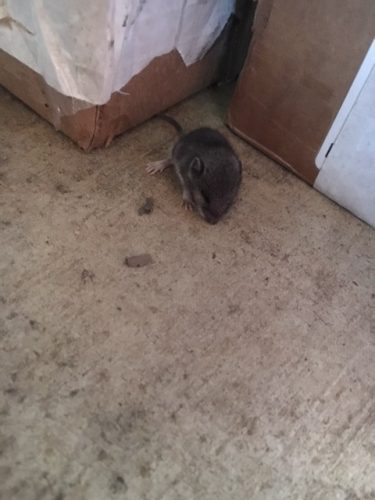
 This little mouse greeted us in G3 this morning. The lunch table was very crowded today as we had a number of special visitors. Ruth Shaw, Dan (a grad student from U of M), and Amy and Brad Dykstra all came to help out. They also brought yummy chocolates and muffins for a lunch treat.
After lunch, everyone set out different ways. Some people went GPSing and some went to catch pollinators. I got to stay back to teach Lea, Scott, Alyson, and James my special talent, aphid exclusion and addition. Last summer, I worked a lot on the aphid project so it was a lot of fun to do again! Alyson even sang to the aphids to sooth them into their new homes. Roxy saw how much fun we were having and decided to join us for awhile in P1. We found 70/100 original addition/exclusion plants, including 33/50 addition and 37/50 exclusion ones.
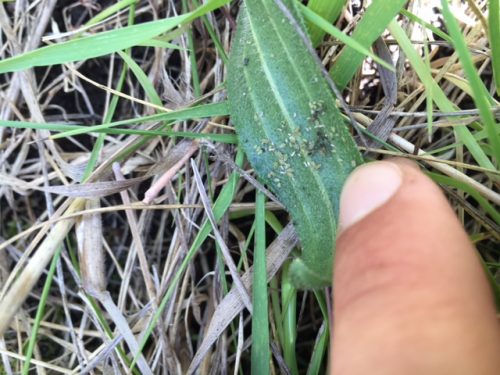
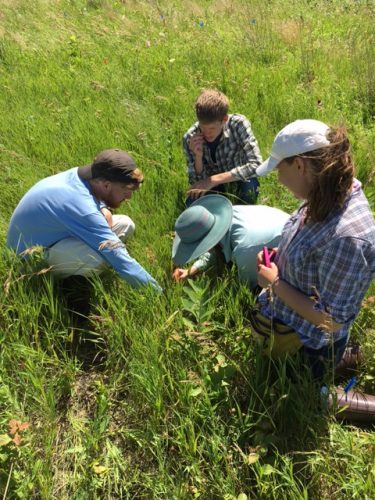
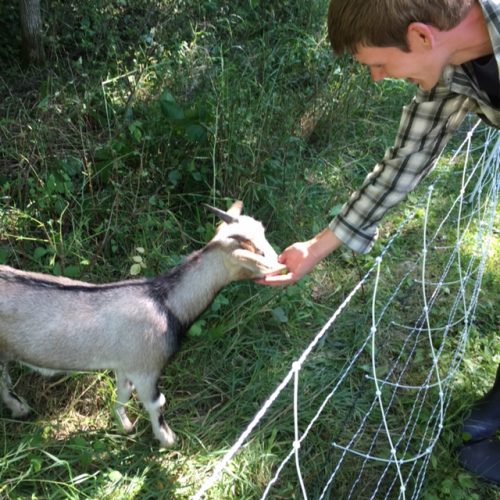
 Here’s some aphids I found on a collection plant in P1.  Team members learning the ways of aphids. Today I also took my first trip to the infamous bog with Alyson and James! Roxy, the bog dog, took me on a wonderful tour of the place. On our way up, we stopped to pet the goats.
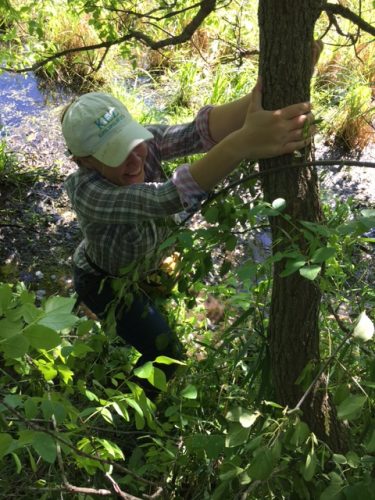
 Alyson trying to escape the treacherous bog waters.  Scape Goat eats out of James’s hand.
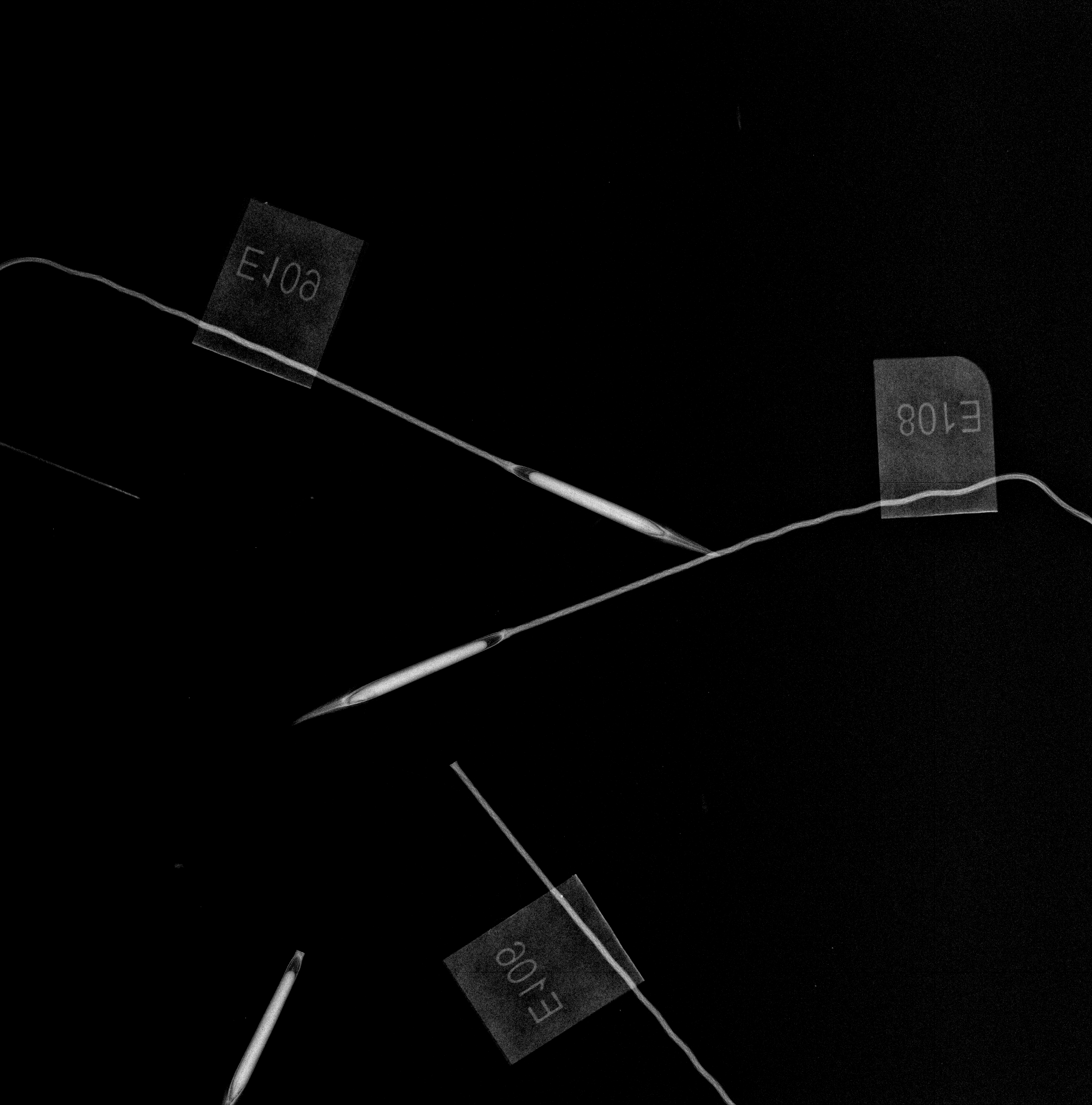
While looking for some information about the establishment of the Stipa experiment, I encountered an x-ray image of a few Stipa propagules (Hesperostipa spartea). Check it out…
 An x-ray image of a Stipa propagule (Hesperostipa spartea)
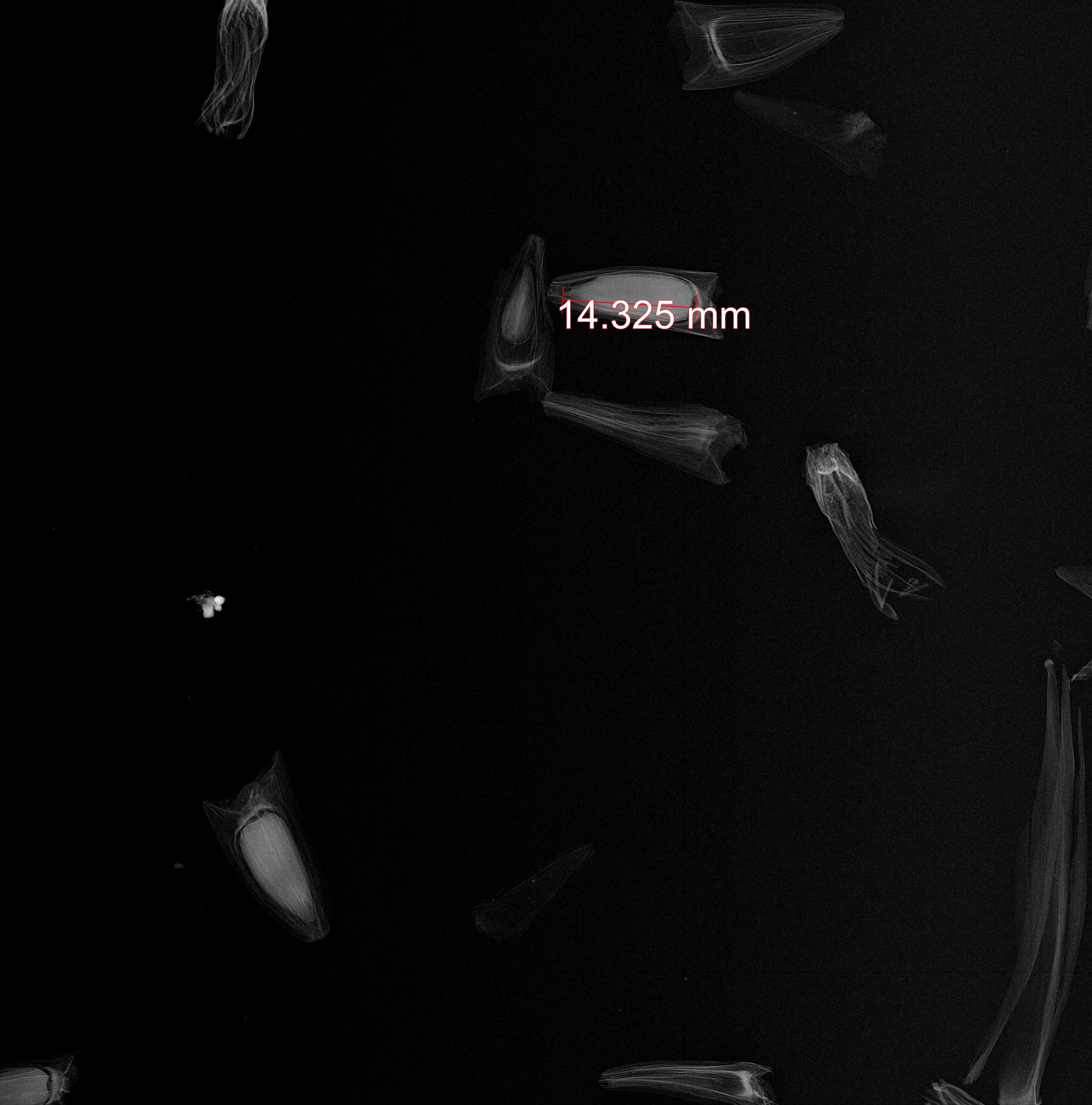
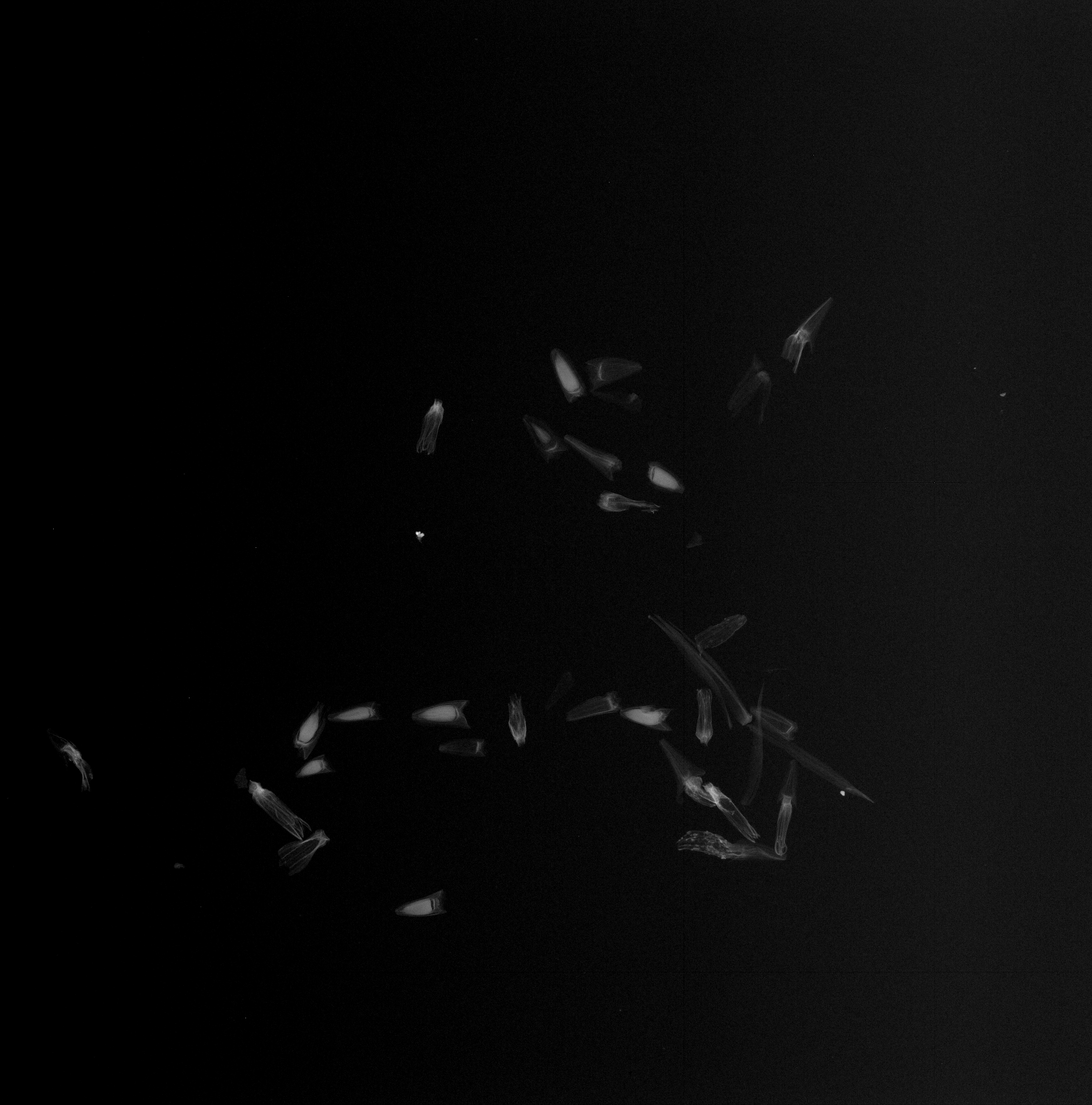
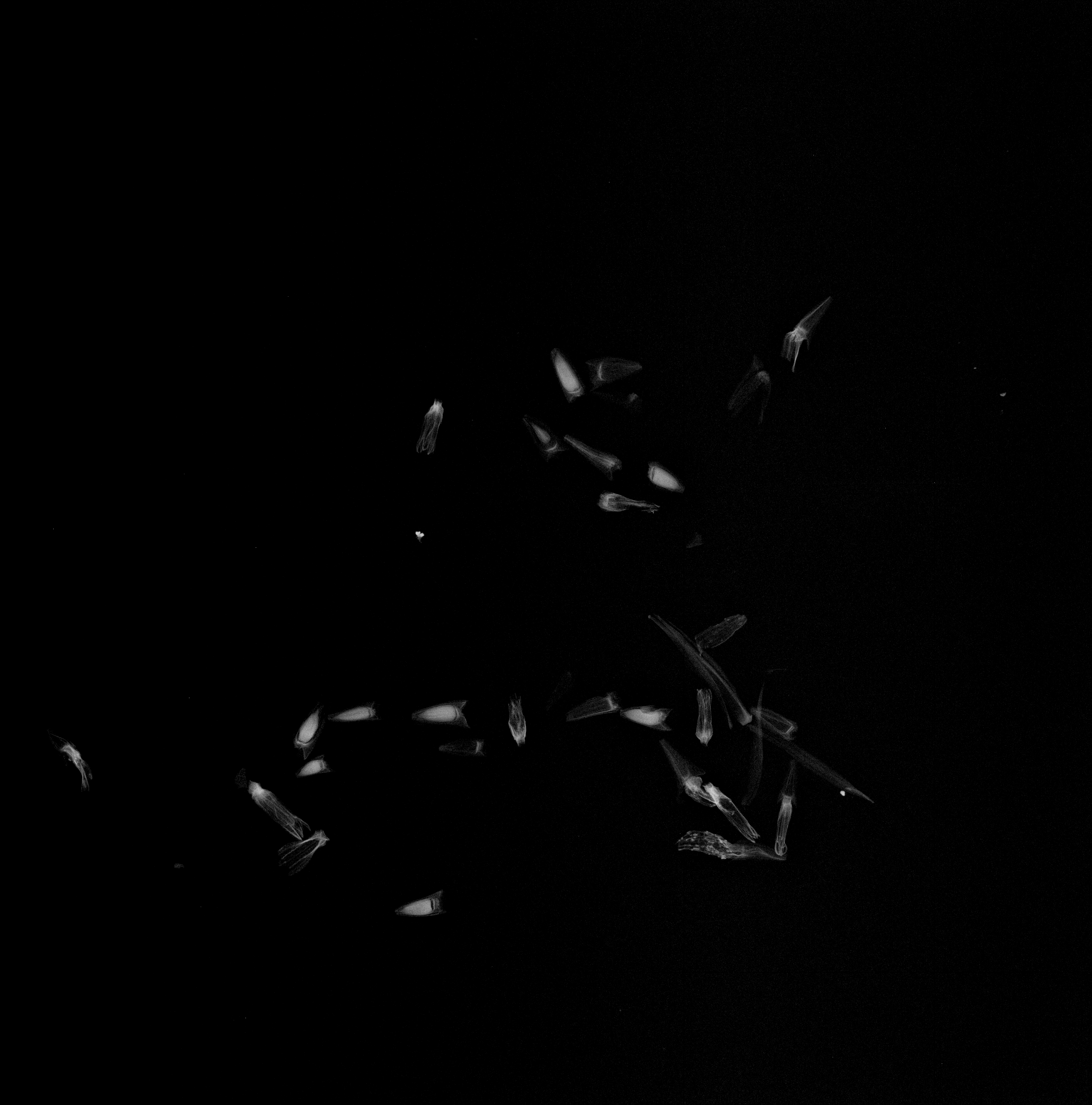
I also found some x-ray images of Echinacea angustifolia achenes. There are higher resolution images than the ones we now take for data analysis.
An x-ray image of achenes & other stuff from an Echinacea angustifolia head with higher magnification
An x-ray image of achenes & other stuff from an Echinacea angustifolia head An x-ray image of achenes & other stuff from an Echinacea angustifolia head
Today was another great day on Team Echinacea. This morning we continued our work on Q2, and we continued to make significant progress. We measured many plants and found at least five new plants in the experimental site. After a hearty lunch and a short time marveling at ice formations in a water bottle, Amy Dykstra gave a presentation on her research, which included her study of local adaptation of Echinacea. The afternoon was filled with preparations for IS projects (for the Wooster folks) and independent projects for the rest of us. Leah and Laura quickly became adept at catching pollinators, but were not so successful at transferring the collected pollen to fuchsin jelly. The rest of us hunkered down on our computers, read some literature, prepared project proposals and thought about how hard it would be to use NMR and IR to analyze pollen.
 Leah regales us with stories of captured pollinators and attempts at melting fuchsin jelly on a car dashboard. The exciting news of the day is that we found our first flowering Echinacea in P1 and at Elk Lake Road East! Tomorrow we will find out how many more Echinacea are flowering.
 The second flowering Echinacea (found at Elk Lake Road East)!
The gang had a busy day today, almost all of it in the warm June sun. Alyson continued setting up her experimental plots in the Staffanson bog, and spent the afternoon measuring canopy cover and soil pH for her IS project. Meanwhile, the rest of the team (minus Gretel, who was setting up work for q2 juvenile counts) picked up our fleg begs and counted Hesperostipa spartea and weeded in p1. Amy and James found one H. spartea specimen with 137 seeds! We are now up to 17 out of 59 rows surveyed. Meanwhile, Will, Alex and Per led the crew in weeding out the non-native yellow sweet clover (Melilotus) from the periphery of the plot area. Hopefully we eliminated a lot of potential seeds form the seed bank, meaning that in future years the rows will be devoid of this weedy legume and the study Echinacea will have less competition. Stuart also showed me what poison ivy looks like for the third time, and I still don’t think I could pick it out of a lineup.
 Per with a bundle of sweet clover picked from around p1. This is probably less than 10% of what was removed today. After some brief (or for Alex, who was cleaning the bathroom, not so brief) chores at the Hjelm House, the team returned to exPt8 (experimental plot 8) to search for juvenile Echinacea crosses planted in 2013. This meant more time bent over, although now instead of looking for seedlings we were looking for melted bits of toothpick (which were placed to mark seedlings). Some seedlings were in great shape — Alex and I found a couple with basal leaves over 10 cm tall. Others were not in great shape, either dead or missing like Jimmy Hoffa. We got about a third of the work for qGen2 this afternoon. It may rain tomorrow, so we’re bracing for indoors-work and hiding our bicycles inside.
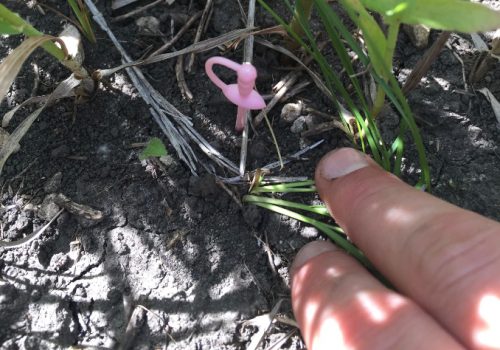
 Using a pink sword to claim the new seedling (left) for Team Echinacea. We used cocktail swords to denote seedlings germinating this year from achenes sown in 2013.
We were curious about the average sizes of our various remnant populations so I did some quick calculations and created this csv. As you can see, landfill is quite large with a median of 315 individuals found per year, whereas sites like dog and mapp are tiny, with only 3 plants found per year. At dog, to the best of our knowledge, there are only 3 Echinacea to be found, so we have regularly gathered demographic info on all of them. It’s important to note that these numbers are preliminary, rough estimates. Sometimes we have to redo a site during the summer so there will be twice as many records (hence the right skewed means), most of the time we focus on only finding flowering plants, but in some years at certain sites (e.g. landfill in 2005 and 2007) we’ve attempted to find every single individual whether or not it was flowering. All that said, here are some histograms showing numbers of demography records at each site per year:
demoSizeGraphs
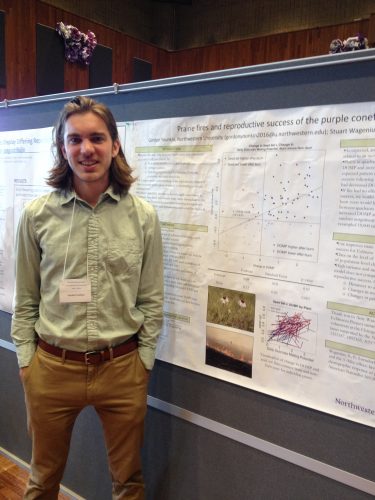
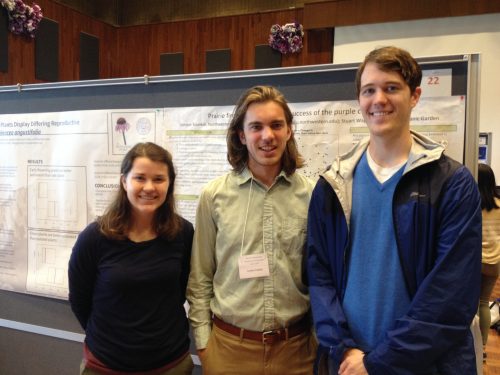
Gordon presented his poster, “Prairie fires and reproductive success of the purple coneflower” at the Northwestern Undergraduate Research and Arts Exposition. Here are some pictures from the event and his poster, which you can find here.
The Stipa Project — studying the effects of habitat fragmentation on the ecology and evolution of Stipa, a cool-season grass. In 2009 & 2010 we planted over 4,000 Stipa seeds in exPt 1. We’ve been put to the test trying to find our Stipa plants in a matrix of other grasses, but once they flower they are easy to spot. While we collected seed from Stipa in our common garden in 2014, our 2015 search for flowering Stipa plants was fruitless!
Read more about the Stipa experiment.
Read more about the natural history of Stipa.
Start year: 2009
Location: exPt1
 2015 measuring qGen1: finding EA in a sea of flowering big bluestem! The qGen1 (quantitative genetics) experiment investigates the heritability of traits in Echinacea angustifolia. During the summer of 2002 we crossed plants from the 1996 & 1997 cohorts of exPt1. We harvested heads, dissected achenes, and germinated seeds over the winter. In the Spring of 2003 we planted the resulting 4468 seedlings (this great number gave rise to this experiment’s nickname “big batch”). In 2015 we assessed survival and fitness measures of the qGen1 plants. Here’s a summary of what we found:
| living |
flowering |
headCount |
| 2319 |
409 |
793 |
Read more about the qGen1 experiment.
Start year: 2003
Location: exPt1
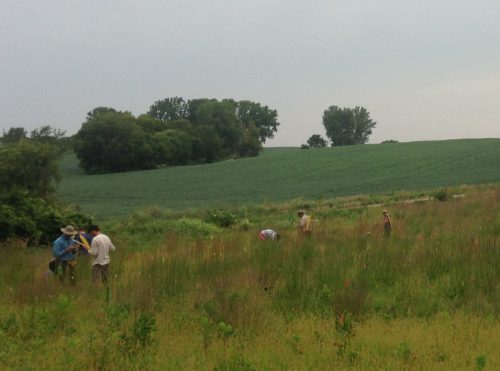
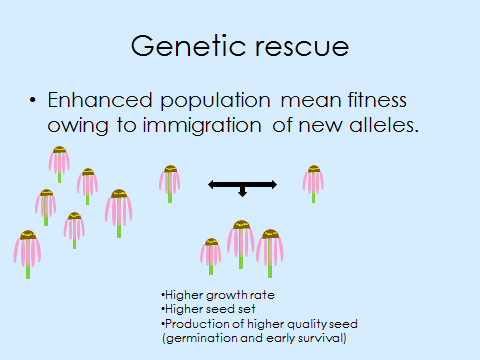
 Caroline Ridley established this experiment to compare fitness (recruitment and survival) of seeds originating from individuals with parents from three different backgrounds: 1. both from a large remnant population, 2. both from a small remnant population (not rescued), and 3. one from a large population and one from a small population (genetically rescued). Caroline sowed achenes in an experimental plot at Hegg Lake WMA and marked seedlings with colored toothpicks in May 2009. Caroline Ridley established this experiment to compare fitness (recruitment and survival) of seeds originating from individuals with parents from three different backgrounds: 1. both from a large remnant population, 2. both from a small remnant population (not rescued), and 3. one from a large population and one from a small population (genetically rescued). Caroline sowed achenes in an experimental plot at Hegg Lake WMA and marked seedlings with colored toothpicks in May 2009.
We annually assess survival and fitness of these plants. In 2015 we relocated and measured 42 individuals of the 381 seedlings originally found. These plants had 1-3 leaves; the longest leaf was 21 cm. The dense non-native brome grass dominating this plot may be shading out these small plants. It should be interesting to see which individuals are hanging on!
Read more about this experiment.
Start year: 2008
Site: exPt 4 at Hegg Lake WMA
Overlaps with: crossing experiments qGen1, qGen2, qGen3 & recruitment experiment; INB1
 Pollen vials from sire 403 used in qGen3 The goal of the qGen2 and qGen3 experiments is to compare the evolutionary potential of two remnant prairie populations of Echinacea angustifolia by estimating the additive genetic variance of fitness under two mating scenarios: crosses performed within the core sites (core x core) and crosses performed between the core site and nearby sites (core x periphery). Additionally, we will test for differentiation among families; do progeny from sires differ after accounting for maternal (dam) effects?
In June 2015 we assessed survival and measured 1-year-old plants from qGen2. During the summer and fall of 2015 we replicated the qGen2 experiment through a second crossing experiment. We sowed the resulting achenes in exPt 8 as our qGen3 cohort.
Read more about the qgen2 and qgen3 experiments.
Dam to be crossed with pollen from 2 sires Start year qGen2: 2013
Start year qGen3: 2015
Location: exPt 1 (dams), remnants Landfill and Staffanson (sires), remnants Landfill (core) & around Landfill (peripheral) and remnants Staffanson (core) & railroad crossing sites (peripheral) (grand-dams), exPt 8 (progeny)
Overlaps with: Heritability of fitness–qGen1
|
|


 Caroline Ridley established this experiment to compare fitness (recruitment and survival) of seeds originating from individuals with parents from three different backgrounds: 1. both from a large remnant population, 2. both from a small remnant population (not rescued), and 3. one from a large population and one from a small population (genetically rescued). Caroline sowed achenes in an experimental plot at Hegg Lake WMA and marked seedlings with colored toothpicks in May 2009.
