|
|
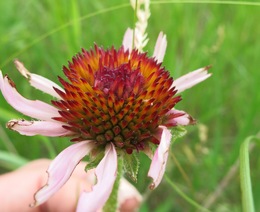
Today was a big day for remnant phenology surveys–possibly our biggest of the season. We made the process more efficient by not recording style persistence on flowers on their 3rd, 6th, 7th, and 8th days of flowering.
But we didn’t stop there. We also collected pollen, painted bracts, and performed the first crosses with the 10 focal plants at Riley. Each focal plant was crossed with its nearest neighbor, its farthest neighbor within the remnant, the earliest flowering plant, and the latest flowering plant. This is to help us understand how compatibility varies across space and flowering time.
In other news, Will and I saw an immature bald eagle amongst the gulls and turkey vultures at the landfill.
Here is the latest draft of my proposal to investigate the survival rates of Aphis echinaceae on Echinacea hybrids and the impact they have on host fitness:
CMS_proposal_8Jul2014.pdf
I’m excited to get started. In addition to my main project, I will be conducting and coordinating a variety of side projects related to aphids and Echinacea hybrids:
1. Katherine Muller and Lydia English’s aphid addition/exclusion experiment in P1.
2. Assessing fitness of the two Echinacea species and their hybrids in P6 (Josh’s Garden) and P7 (at Hegg Lake).
3. Recording flowering phenology of Echinacea pallida at Hegg Lake, where they were planted in a prairie restoration.
Today Jared, Will and I spent the afternoon at Staffanson Prairie Preserve wrangling the blooming Echincea with flags and twist ties while also updating our flowering map of 2014. We’re working to find plants that were used in phenology studies in previous years so we can look at how a single plant’s flowering pattern changes over time. Here’s a map of the plants we’ve found so far this year, overlaid on multiple years of previously mapped plants.
staffmap.pdf
While out and about in Staffanson it’s easy to get drawn into the morphing landscape as new species begin to bloom. Here’s a picture of one of our favorites, Delphinium carolinianum.

Today the whole team was busy mapping and monitoring the phenology of Echinacea at numerous remnants. Although mosquitoes, gopher holes, and construction crews conspired against us, we were able to complete all monitoring before a bout of afternoon rain.
Here is a quick and dirty map of flowering Echinacea plants at Staffanson prairie that were mapped between 2011 and 2013. Please note that west, rather than north, is “up” on this map (the unusual orientation of this map is just for my convenience)…
sppmap
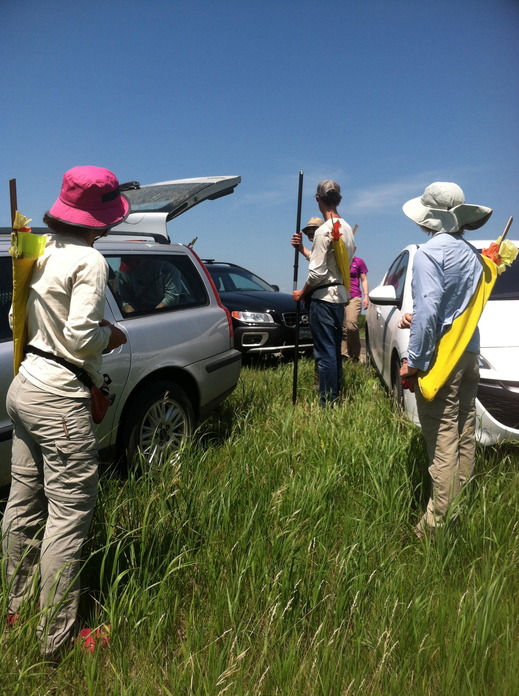
Having mutually pledged to the Echinacea Project our Lives, our Fortunes and our sacred Honor, we set out this fine Saturday morning to survey the flowering phenology of Echinacea in the prairie remnants. We are interested in phenology (the study of recurring phenomena) because just as distance can genetically isolate fragmented populations, so can time. Since Echinacea cannot reproduce with itself, it needs to be flowering at the same time as a compatible mate if it wants a chance to reproduce.
To quantify flowering phenology, we have to check on the flowers every few days. Echinacea is just beginning to flower now, and we don’t want to miss anything. Today we split up into two-person teams, went to different remnants, and recorded the progress of every flowering Echinacea. All our work locating and flagging plants earlier this week allowed us to move efficiently through the sites, finishing our survey by mid-day. Here we are converging at the final site:

A formidable crew undertaking a daunting task in pursuit of a noble goal: what a glorious Saturday!
This morning started with Jared and I doing an inventory of the Hesperostipa spartea (porcupine grass) in experimental plot 1. We are interested in determining the fitness of each H. spartea. We went to each plant found during a systematic search. We determined how many seeds were present on each culm of each plant. We counted the number of full (having a viable seed), inviable (having a seed that would not reproduce), or unknown (a glume that was empty, or peduncle that had no glume) seeds for each plant and harvested ripe seeds for later plantings. We found one studly plant that had 14 culms and 58 seeds that were ready to harvest! After experimenting with several methods of tying the immature awns together (to make sure we could find the seeds once they are mature and drop), we determined the most effective way to retain the seeds is to tie the awns together with twist ties. We hope the twist tie method allows us to harvest seeds before they disperse. We tried several other methods for tying the awns together (tying the awns to the stem, tying the awns to a red flag, and tying the awns together) but twist ties appear to work the best. In the afternoon I tagged my first Echinacea (plant 1980)!
It’s been a day full of giddy excitement for Team Echinacea. Not only was it a team member’s birthday, but on our first trip to the remnants we found the first flowering head of the season.
If you look carefully at the picture below you can see the first style on the bottom right.

This plant is number 1414, first tagged in 1997 in the KJ remnant. The upper florets on 1414 are not typical in form, and appear to be diseased. Bets are still on for the first flowering head in the experimental plots.
-Claire
This afternoon Claire and I struck out for Staffanson Prairie to check on the flowering status of Echinacea. Over the course of the summer, we will be monitoring the phenology of mapped plants at Staffanson to examine how fire influences mating opportunities and reproductive success in Echinacea populations. We found several plants getting ready to flower (including Echinacea #7553 photographed by Claire) but we are still a week away from floret emergence. Although Echinacea bracts were closed tight, we did find numerous other species in bloom such as Wood Lily (Lilium philadelphicum), Yellow Sundrops (Calylophus serrulatus), Prairie phlox (Phlox pilosa), Prairie Alumroot (Heuchera richardsonii), Silverleaf Scurfpea (Pediomelum argophyllum but always Psoralea to me), and the aptly named Mountain Death Camas (Zigadenus elegans).
I graduated from Jefferson High School in June, and I will be attending the University of Minnesota – Twin Cities next fall. This is my first real research experience but last summer I spent some time with the Minnesota Department of Natural Resources and the University of St. Thomas doing some work with stable isotope ecology.
This summer I plan to study pollen longevity and determine a method for long term storage of the pollen. I am also very excited to work with other team members and help with their projects.
I am incredibly excited to be a member of Team Echinacea 2014, I think it is going to be an amazing experience and I am going to be working with some very awesome people! you can learn more about me at my page on the Echinacea Project website.
|
|